

TL;DR:
- Continuing education in forklift safety maintains operator competence and compliance with OSHA standards. It includes formal instruction, practical training, and performance evaluations that must be documented and regularly updated. Regular refresher training reduces risks, ensures OSHA compliance, and addresses changing workplace conditions effectively.
Continuing education is the primary driver of forklift safety, reducing accidents and keeping operators compliant with OSHA 29 CFR 1910.178(l), the federal standard governing forklift operator training and evaluation. The role of continuing education in forklift safety goes far beyond initial certification. Skills erode, workplaces change, and equipment gets updated. Without structured refresher training and periodic evaluations, even experienced operators develop dangerous habits. Safety managers who treat certification as a one-time event put their facilities at serious legal and physical risk. This guide covers what ongoing forklift education requires, what it prevents, and how to build a program that actually holds up under OSHA scrutiny.
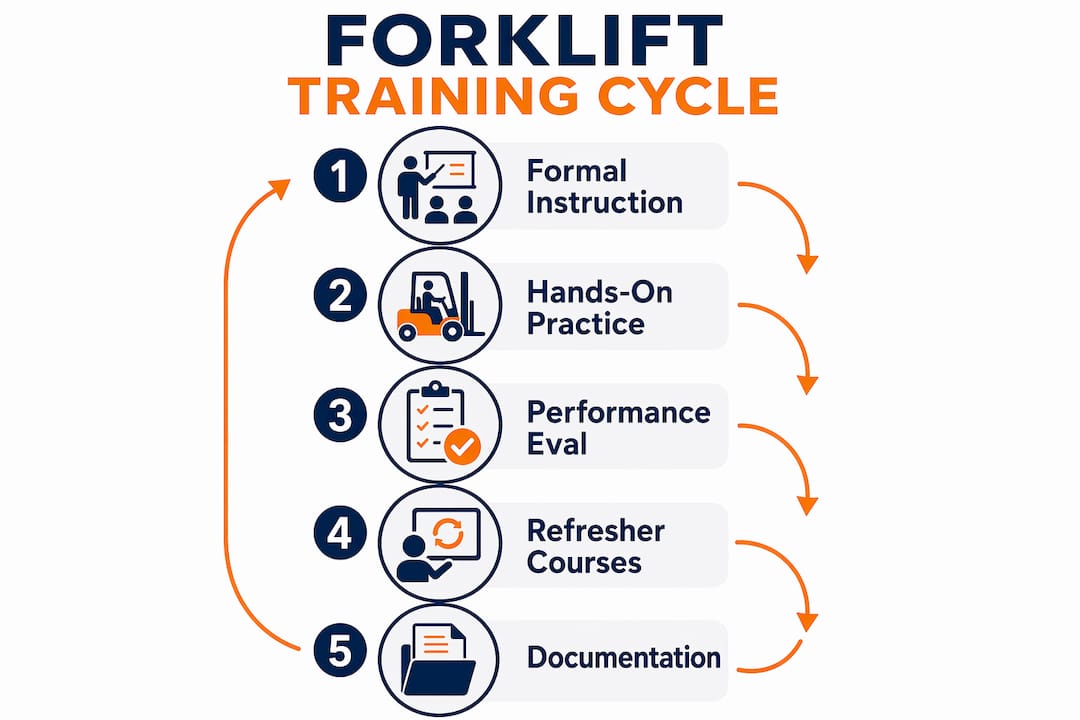
Continuing education in forklift safety is the ongoing cycle of instruction, hands-on practice, and performance evaluation that keeps operators competent and compliant throughout their careers. The industry term for this cycle is “recurrent training,” and OSHA makes it legally mandatory, not optional.
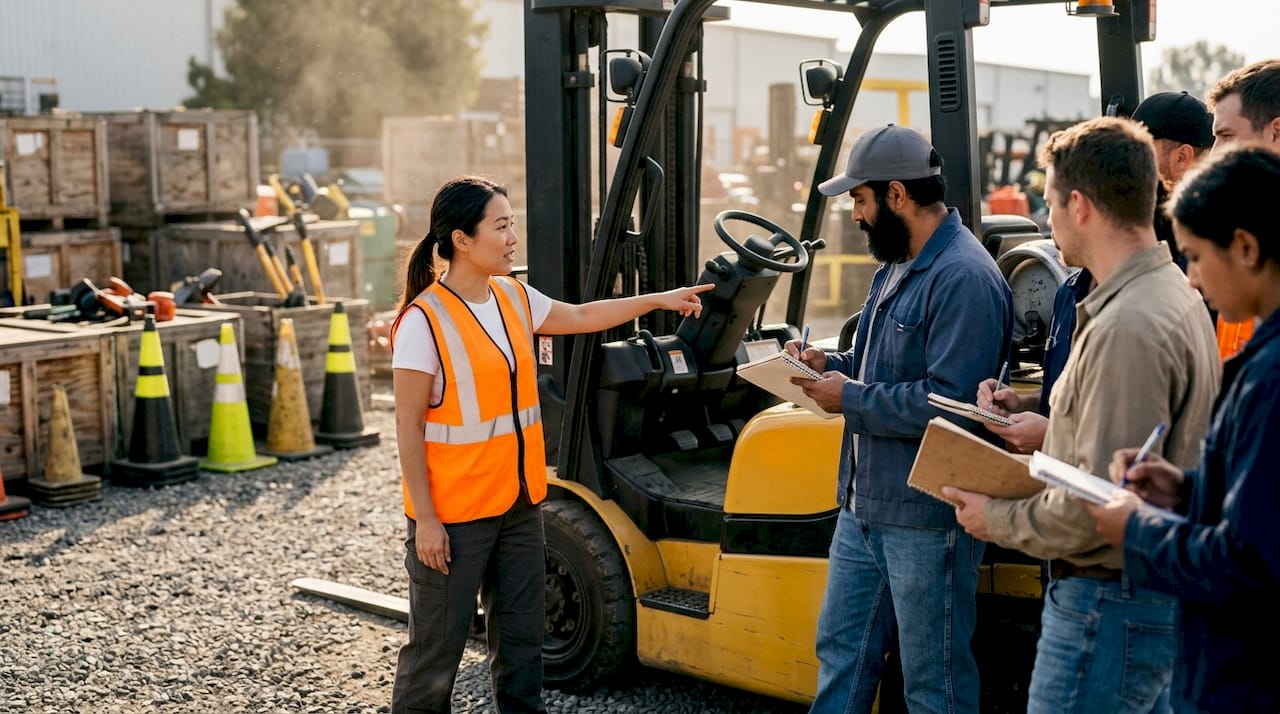
OSHA mandates three components for forklift operator certification: formal instruction, practical hands-on training, and a workplace performance evaluation before any operator drives unsupervised. Each component serves a distinct purpose. Classroom training teaches the fundamental “why” behind forklift safety rules. Hands-on training teaches the “how” specific to the actual equipment and facility. The workplace evaluation confirms the operator can perform both safely together.
Treating initial certification as permanent is one of the most common and costly compliance mistakes a facility can make. Without ongoing maintenance, even excellent initial training degrades into a liability. OSHA auditors check for documented refresher records, not just original certificates.
A compliant continuing education program mirrors the same three-part structure OSHA requires for initial certification. Each component must be present for the program to satisfy regulatory standards.
Formal instruction covers the knowledge base operators need to make safe decisions. Delivery formats include:
Hands-on practical training puts operators on actual equipment in their specific work environment. No online course substitutes for this step. OSHA explicitly requires the employer to conduct practical evaluation before an operator drives unsupervised. This is where operators practice load handling, turning in tight spaces, and responding to real floor conditions.
Workplace performance evaluation is the final checkpoint. A qualified trainer observes the operator performing actual job tasks and documents the result. This evaluation must happen at least every three years, and more frequently when specific triggers occur.
Pro Tip: Document every component separately. OSHA inspectors look for records of all three parts. A completed online course alone does not constitute full certification.
Refresher training is the mechanism that closes the gap between what operators learned at certification and what they face on the floor today. Skills fade, habits drift, and facilities change. Refresher training corrects all three.
OSHA requires refresher training whenever any of the following triggers occur, regardless of where an operator falls in the three-year evaluation cycle:
These triggers reset the retraining clock entirely. A warehouse that adds new racking, changes traffic flow, or brings in a reach truck must retrain affected operators before they operate in the new conditions.
The three-year evaluation cycle is the minimum. Most safety managers run annual refresher cycles to stay ahead of compliance gaps and reduce the risk of an unplanned retraining event after an incident. Annual cycles also keep forklift safety training current with any regulatory updates OSHA publishes.
The compliance benefit is direct. Facilities with documented refresher programs face far fewer citations during OSHA surprise audits. Inspectors look for training records that show dates, trainer names, equipment types, and evaluation outcomes. A gap in those records is a citation waiting to happen.
Pro Tip: Schedule refresher training during safety awareness weeks or just before your busiest operational season. Rolling schedules let you train operators in small groups without halting warehouse operations.
Technology has changed how facilities deliver the formal instruction component of forklift continuing education, but it has not replaced the hands-on requirement. The most effective programs blend digital tools with in-person evaluation.
VR simulation is the most significant recent development in forklift safety training. VR reduces risk and downtime during hands-on training by preparing operators on controls and inspection sequences before they ever sit in a real cab. Operators who complete VR modules enter practical training with higher baseline competence, which shortens the hands-on session and reduces the chance of equipment damage during practice.
Blended learning programs combine online formal instruction with scheduled hands-on sessions. The benefits include:
The limitation of technology is clear. Online certifications mislead operators when presented as full qualification. Only an employer-conducted practical evaluation grants full OSHA certification status. No app, VR headset, or online platform replaces that step.
Pro Tip: Use safety technology in training to handle the knowledge transfer, then protect your hands-on time for skill assessment and site-specific hazard practice. That split makes both components stronger.
The most expensive compliance mistakes in forklift safety come from misunderstanding what certification actually means and who is responsible for maintaining it.
Misconception 1: Certification transfers between employers. Forklift certification is employer-specific and not portable. An operator certified at one facility must complete a new site-specific evaluation before driving unsupervised at a new employer. Prior certificates do not exempt anyone from this requirement. OSHA auditors catch this regularly during surprise inspections.
Misconception 2: An online certificate equals full certification. Online courses satisfy only the formal instruction portion of the three-part requirement. Without a documented hands-on session and workplace evaluation, the operator is not legally certified to drive unsupervised. Facilities that skip these steps face citations and potential shutdown orders.
Misconception 3: The three-year cycle is all you need. The three-year evaluation is a floor, not a ceiling. Any of the five refresher triggers described above requires immediate retraining. Waiting for the three-year mark after an accident is a compliance failure.
Misconception 4: External certifications cover internal training needs. A one-time external course does not keep your internal trainers current on facility-specific hazards or updated OSHA guidance.
“Operator certification must be site- and employer-specific. Ignoring this leads to OSHA citations during surprise audits due to the non-portability of certificates.” — OSHA 29 CFR 1910.178(l) compliance guidance
The train-the-trainer model addresses this gap directly. Internal trainers who are regularly updated on current standards and facility-specific hazards deliver more relevant training than any external provider can. They know the floor, the equipment, and the operators personally.
A sustainable forklift continuing education program requires four operational elements working together: tracking, site-specific content, internal training capacity, and a delivery method that fits your operation.
Build a tracking system first. Every operator needs a training file that records the date, trainer, equipment type, and outcome of each formal instruction session, hands-on session, and evaluation. The OSHA compliance checklist for 2026 specifies exactly what documentation an inspector expects to find. A spreadsheet works for small operations. Larger facilities benefit from a dedicated training management system that sends automatic alerts when evaluations are due.
Build site-specific content into every training cycle. Generic forklift safety content covers the fundamentals. Your facility has specific hazards, traffic patterns, and equipment that generic content does not address. Include a site walkthrough in every refresher cycle. Update the content whenever the facility layout changes.
Invest in internal training capacity. The train-the-trainer approach empowers a designated internal lead to conduct evaluations and refresher sessions without waiting for an external provider. This cuts response time when a refresher trigger occurs and keeps training costs manageable at scale.
Match delivery method to operational reality. The table below shows how to align training format with common operational constraints.
| Operational constraint | Recommended format |
|---|---|
| Multiple shifts, limited overlap | Online formal instruction plus scheduled hands-on blocks |
| High operator turnover | Blended onboarding with standardized evaluation checklist |
| New equipment or layout change | Immediate site-specific refresher before return to operation |
| Upcoming OSHA audit | Full documentation review plus gap evaluation for any operator missing records |
| Limited internal trainer capacity | Train-the-trainer certification to build internal capability |
The employer’s responsibility for forklift training does not end at initial certification. OSHA places the burden of ongoing compliance squarely on the employer, not the operator.
Continuing forklift education requires formal instruction, hands-on training, and documented performance evaluations on a recurring cycle to satisfy OSHA 29 CFR 1910.178(l) and prevent accidents.
| Point | Details |
|---|---|
| Three-part training is mandatory | OSHA requires formal instruction, hands-on practice, and workplace evaluation for every certification cycle. |
| Refresher triggers override the three-year cycle | Accidents, unsafe behavior, new equipment, or site changes require immediate retraining regardless of schedule. |
| Online courses are partial certification only | Practical evaluation by the employer is required before any operator drives unsupervised. |
| Certification is not portable | Operators must complete a new site-specific evaluation at every new employer, regardless of prior certificates. |
| Train-the-trainer builds lasting compliance | Internal trainers address facility-specific hazards and respond faster to refresher triggers than external providers. |
Most safety managers I have worked with understand the initial certification process well. Where programs break down is in the space between certifications. Facilities get busy, operators get comfortable, and the three-year evaluation starts to feel like a formality rather than a genuine safety check.
The uncomfortable truth is that skill erosion happens faster than most managers expect. An operator who passed their evaluation two years ago and has been driving the same route every day has likely developed shortcuts. Some of those shortcuts are harmless. Others are the exact behaviors that precede a tip-over or a pedestrian strike. Refresher training is the only mechanism that catches those habits before they cause an incident.
The other pattern I see consistently is overconfidence in online training. A completed online module is a useful knowledge tool. It is not a substitute for watching an operator navigate a blind corner with a loaded pallet. The hands-on evaluation is where you find out what the operator actually does, not what they know they should do.
The facilities with the best safety records treat continuing education as a culture, not a compliance calendar. They train before the triggers force them to. They use the importance of workplace safety as a genuine organizational value, not a checkbox. That shift in mindset is what separates facilities with clean OSHA records from those that learn compliance the hard way.
— Juiced
Forkliftacademy has delivered OSHA-compliant forklift training across the United States and Canada for over 20 years. Whether you need to certify a new operator, run a refresher cycle, or build internal training capacity, the platform offers programs designed to meet every component of the OSHA three-part requirement.
The Train-the-Trainer online program equips your internal safety leads to conduct evaluations and refresher sessions independently, reducing reliance on external providers and cutting long-term training costs. For facilities that need full hands-on support, onsite forklift training brings certified trainers directly to your location to handle practical sessions and workplace evaluations. Both formats are built around current OSHA standards and include the documentation your facility needs to pass an audit. Explore the full catalog at Forkliftacademy to find the right fit for your operation.
OSHA requires ongoing evaluations and refresher training because skills erode over time and workplaces change. 29 CFR 1910.178(l) mandates a documented performance evaluation at least every three years, plus immediate retraining after any accident, unsafe behavior, or site change.
No. Online courses cover only the formal instruction component of OSHA’s three-part requirement. A hands-on practical session and an employer-conducted workplace evaluation are both required before an operator can drive unsupervised.
OSHA requires a performance evaluation at minimum every three years. Most safety managers schedule annual refresher training to stay ahead of compliance gaps and address any skill drift before it becomes a safety incident.
No. Forklift certification is employer-specific and site-specific. An operator must complete a new workplace evaluation at every new employer, regardless of how recent their previous certification is.
The train-the-trainer model certifies an internal employee to conduct forklift evaluations and refresher training within their own facility. It keeps training current with site-specific hazards and reduces the cost and delay of relying on external trainers for every retraining event.