


TL;DR:
- OSHA compliance in 2025 focuses on active hazard control, thorough documentation, and leadership accountability.
- Prioritizing standards like Fall Protection and Hazard Communication can significantly reduce citation risks and penalties.
OSHA compliance steps 2025 are the specific, documented actions safety managers and business owners must take to align workplace programs with federal safety standards and avoid costly penalties. The Occupational Safety and Health Administration enforces rules that affect every industry, from warehouses to construction sites. Serious violations now carry penalties up to $16,550, and willful or repeated violations can reach $165,514 per citation. Getting compliance right is not optional. This guide walks you through every step, from identifying gaps to surviving an inspection with confidence.
The OSHA compliance requirements list for 2025 centers on the standards that inspectors cite most often. In FY 2025, Fall Protection led all violations at 6,992 citations, followed by Hazard Communication at 3,010 and Ladders at 2,842. These numbers tell you exactly where to focus your energy first.
The most critical standards every safety manager must address include:
Beyond these top standards, every employer covered by OSHA must maintain three core programs:
| Program | Requirement | Frequency |
|---|---|---|
| Recordkeeping (OSHA 300 Log) | Log all work-related injuries and illnesses | Ongoing; post OSHA 300A from Feb 1 to April 30 |
| Emergency Action Plan | Written plan for evacuation, fire, and medical emergencies | Review annually or after any incident |
| Injury and Illness Prevention Program | Hazard identification, controls, and training | Continuous; update when processes change |
Pro Tip: Start your compliance review with Fall Protection and Hazard Communication. These two standards alone account for nearly half of all OSHA citations in FY 2025. Fixing them first gives you the biggest risk reduction for your time.
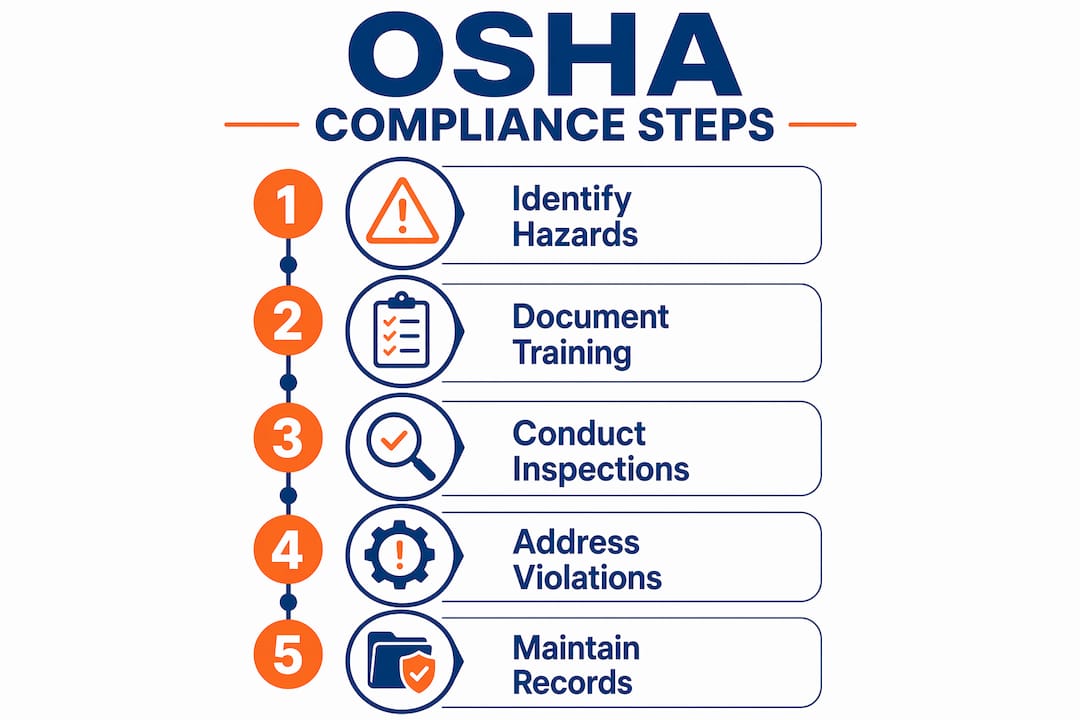
Effective OSHA compliance programs combine documentation, active hazard controls, employee engagement, and leadership accountability. A written binder on a shelf does not constitute a program. Here is the operational workflow that actually works.
Conduct a baseline gap assessment. Walk every work area with a copy of the applicable OSHA standards. Document every hazard, missing procedure, and training gap you find. Use OSHA’s free On-Site Consultation Program, available through your state plan, to get a professional assessment without triggering enforcement action.
Prioritize hazards by severity and citation frequency. Address life-safety hazards first: fall exposures, unguarded machinery, and chemical hazards without SDS coverage. Then move to administrative gaps like missing written programs and outdated training records.
Build a tiered, documented training system. New hire orientation covers all applicable standards before anyone starts work. Annual refresher training covers any standard where you have had a near-miss, incident, or regulatory update. Written programs and training records must correspond exactly to workplace reality and reflect current equipment and processes.
Implement near-miss reporting. A near-miss is a free lesson. Create a no-blame reporting system so workers flag hazards before they become injuries. Track every report, assign corrective actions, and close them out with documented follow-up.
Schedule quarterly internal audits. Assign a qualified person to audit compliance against each applicable standard every quarter. Use a written checklist tied directly to the OSHA standard language, not a generic form.
Run at least one mock OSHA inspection per year. Mock inspections and the OSHA On-Site Consultation Program help companies find problems before an enforcement inspector does. Treat the mock inspection exactly like the real thing: open conference, walkaround, document review, and closing conference.
Assign leadership accountability. Every corrective action needs an owner, a deadline, and a verification step. Safety cannot live only in the safety department. Supervisors must be held accountable for compliance in their areas.
Pro Tip: Treat your compliance program like a project with weekly tasks rather than a one-time annual review. Breaking compliance into manageable weekly steps lets you build and sustain a complete program in roughly three months instead of scrambling before an inspection.
For warehouse and logistics operations, the OSHA role in warehouse safety extends to forklift operations, racking systems, and pedestrian traffic controls, all of which require their own written procedures and training records.

OSHA inspections are triggered by five specific conditions: imminent danger situations, fatalities (which must be reported to OSHA within 8 hours), worker complaints, programmed inspections based on high-hazard industry targeting, and follow-up inspections from prior citations. Knowing the trigger helps you understand the scope of what is coming.
Every inspection follows the same four phases:
Prepare your front-line supervisors for the walkaround and your workers for private interviews. If your training is real and your hazard controls are visible, both conversations will go well. If your program exists only in a binder, the interviews will expose that immediately.
Common inspection pitfalls include expired or missing SDS binders, OSHA 300 logs that are not current, PPE that is available but not actually worn, and Lockout/Tagout procedures that do not match the actual equipment on the floor. Address these four areas before any inspection, planned or unannounced.
For operations involving powered industrial trucks, reviewing OSHA forklift inspection best practices before an audit will help you identify gaps that compliance officers specifically look for in warehouse and distribution environments.
OSHA citations arrive by mail after the inspection closes. Each citation letter describes the specific violation, the applicable standard, the proposed penalty, and the abatement deadline. Employers have exactly 15 working days to contest citations either informally through the area director or formally through the Occupational Safety and Health Review Commission (OSHRC).
The 2025 penalty structure breaks down as follows:
| Violation Type | Maximum Penalty | Typical Trigger |
|---|---|---|
| Other-than-Serious | $16,550 per violation | Minor paperwork or administrative gaps |
| Serious | $16,550 per violation | Hazard with substantial probability of serious harm |
| Willful or Repeated | $165,514 per violation | Knowing disregard or prior citation for same standard |
| Failure to Abate | $16,550 per day | Uncorrected violation past abatement deadline |
The informal conference with the area director is your most effective tool for penalty reduction. Bring documentation of corrective actions already completed, your compliance history, and evidence of good faith efforts. OSHA regularly reduces penalties by 25–50% for employers who demonstrate prompt correction and genuine cooperation.
Pro Tip: Never miss the 15-working-day contest window, even if you plan to cooperate fully. Filing a notice of contest preserves your negotiating position. You can always withdraw it after reaching an informal settlement.
Safety investments deliver a return of $4 to $6 for every $1 spent through reduced injury costs, fewer workers’ compensation claims, and less lost production time. That math makes compliance spending one of the highest-return investments a business owner can make.
OSHA compliance in 2025 requires active hazard control, documented training, and leadership accountability, not just paperwork.
| Point | Details |
|---|---|
| Focus on top-cited standards | Fall Protection, Hazard Communication, and Ladders account for the majority of FY 2025 citations. |
| Build a step-by-step program | Start with a gap assessment, then build training, audits, and near-miss reporting into weekly operations. |
| Prepare for inspections proactively | Mock inspections and the OSHA On-Site Consultation Program expose gaps before enforcement does. |
| Act fast on citations | Contest or resolve citations within 15 working days and document all corrective actions immediately. |
| Safety spending pays off | Every $1 invested in workplace safety returns $4–$6 through reduced injury and claims costs. |
Most safety managers I work with have the binders. They have the written programs, the training logs, the SDS binders organized by chemical family. What they often lack is the connection between those documents and what actually happens on the floor at 6 a.m. on a Tuesday.
Inspectors conduct private worker interviews specifically because they know documentation and practice often diverge. I have seen companies with flawless paperwork receive serious citations because workers could not demonstrate the Lockout/Tagout procedure on the actual machine in front of them. Training documentation alone is not enough. The worker has to be able to do it.
The companies that pass inspections cleanly share one trait: safety is a daily conversation, not an annual event. Supervisors talk about near-misses at shift start. Workers know they can flag a hazard without fear. Corrective actions get closed out, not just opened. That culture does not come from a compliance checklist. It comes from leadership treating safety as an operational standard, the same way they treat production output or quality metrics.
My honest recommendation: spend less time perfecting your written programs and more time verifying that workers can demonstrate what those programs require. Walk the floor with a standard in hand and ask workers to show you, not tell you, how they perform a task safely. That gap between the document and the demonstration is exactly where OSHA citations live.
— Juiced
Forkliftacademy has delivered OSHA-compliant training programs for over 20 years, serving businesses across the United States and Canada. If your compliance program includes powered industrial trucks or aerial work platforms, operator certification is a non-negotiable requirement under OSHA 29 CFR 1910.178.
Forkliftacademy offers forklift operator certification in both online and onsite formats, so you can certify your team without shutting down operations. For companies that want to build internal training capacity, the train-the-trainer program gives your designated trainers the credentials and curriculum to certify operators in-house. Both programs are built to meet current OSHA standards and include the documentation your compliance program requires.
Fall Protection, Hazard Communication, and Ladders are the top three cited standards in FY 2025, with Fall Protection alone generating 6,992 violations. Lockout/Tagout and PPE round out the most common enforcement areas.
Employers have 15 working days to contest a citation after receiving it, either informally through the OSHA area director or formally through the Occupational Safety and Health Review Commission.
OSHA initiates inspections based on imminent danger reports, fatalities reported within 8 hours, worker complaints, programmed high-hazard industry targeting, and follow-up checks on prior citations.
Yes. Standards like Hazard Communication, Lockout/Tagout, and Emergency Action Plans explicitly require written programs. Those programs must reflect your actual equipment, chemicals, and processes, not generic templates.
Request an informal conference with the OSHA area director within the 15-working-day window. Bring documentation of completed corrective actions and your compliance history. OSHA regularly reduces penalties for employers who demonstrate prompt correction and good faith.