

TL;DR:
- Proper pallet jack operation requires mastering equipment controls, load capacity awareness, and safety procedures before beginning work. OSHA mandates formal certification for powered jacks, including in-person training and competency evaluations, while manual jacks require only employer-provided safety training. Regular pre-use inspections, site-specific awareness, and disciplined handling habits are essential for safe, efficient warehouse operations.
Pallet jack job preparation is the process of acquiring the operating skills, safety knowledge, and certifications required to work legally and safely as a pallet jack operator. Warehouses, distribution centers, and retail stockrooms across the U.S. depend on operators who know more than just how to push a jack down an aisle. You need to understand equipment types, OSHA training standards, pre-use inspection procedures, and site-specific workplace rules before your first shift. This guide covers every step, from beginner pallet jack training through certification and day-one readiness.
Pallet jack operation divides into two distinct equipment categories, and the skills required differ significantly between them. Manual pallet jacks are hand-powered tools that use a hydraulic pump handle to raise forks. Electric pallet jacks, also called powered industrial trucks under OSHA definitions, use a motorized drive system and require a higher level of situational awareness to manage higher speeds and stopping distances. Transitioning from manual to electric demands real skill development, not just a brief orientation.
Before you touch either machine on the job, you need to master these core competencies:
Pro Tip: When learning to use a pallet jack for the first time, practice on an empty pallet in a clear aisle before handling any load. Muscle memory for steering and stopping builds faster without the pressure of a full load.
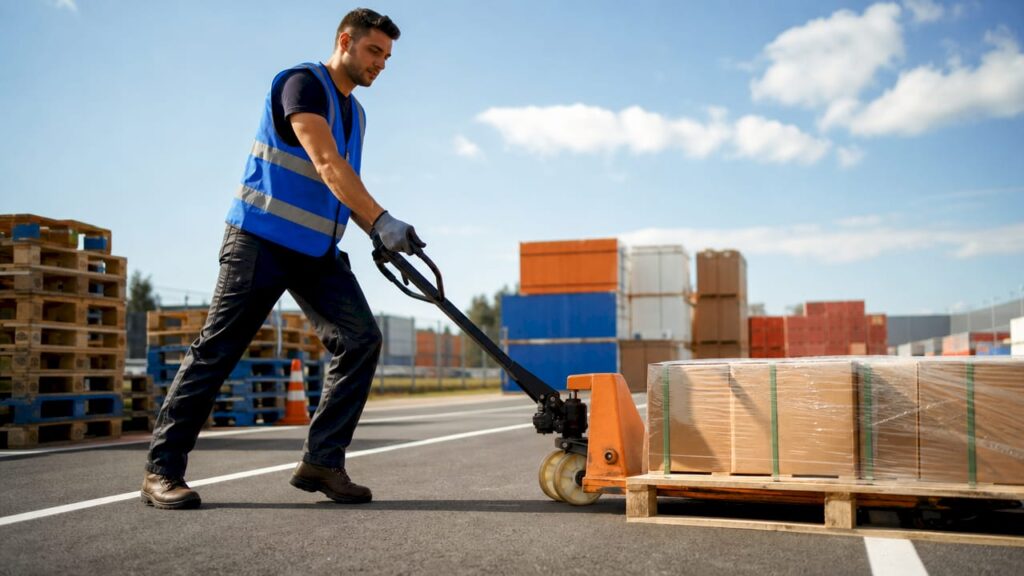
Load height matters more than most beginners expect. The correct lift height for moving a pallet is just 1 to 2 inches above the floor. Lifting higher shifts the center of gravity upward and increases tipping risk. It also stresses the hydraulic cylinder unnecessarily. Low and slow is the rule that experienced operators follow every time.
OSHA draws a clear line between manual and powered pallet jacks when it comes to formal certification. OSHA requires certification for all powered pallet jack operators under 29 CFR 1910.178, with renewal required every three years or immediately after any incident or observed unsafe behavior. That requirement carries real consequences. Failure to document training results in OSHA citations that can cost employers thousands of dollars per violation.
Manual pallet jacks sit in a different category. They are classified as hand tools, so no formal OSHA certification is required. Employers are still obligated to provide basic safety training to prevent injuries, but the documentation standard is lower. If your job involves an electric pallet jack at any point, even occasionally, the full certification process applies to you.
OSHA mandates a three-part training sequence for powered pallet jack operators:
“OSHA does not accept online-only certification for powered pallet jacks. Online training satisfies the formal instruction component, but the practical and evaluation portions must be completed in person.” (OSHA Training Format Requirements)
Employers can run in-house training programs if they have a qualified trainer who meets OSHA criteria. That trainer must conduct theory instruction, supervised practice, and a documented competency assessment. For individuals preparing independently, platforms like Forkliftacademy offer OSHA-compliant online coursework that covers the formal instruction component, which you then pair with hands-on practice at your workplace or a training facility. Understanding what pallet jack certification actually involves helps you ask the right questions before accepting any job offer.
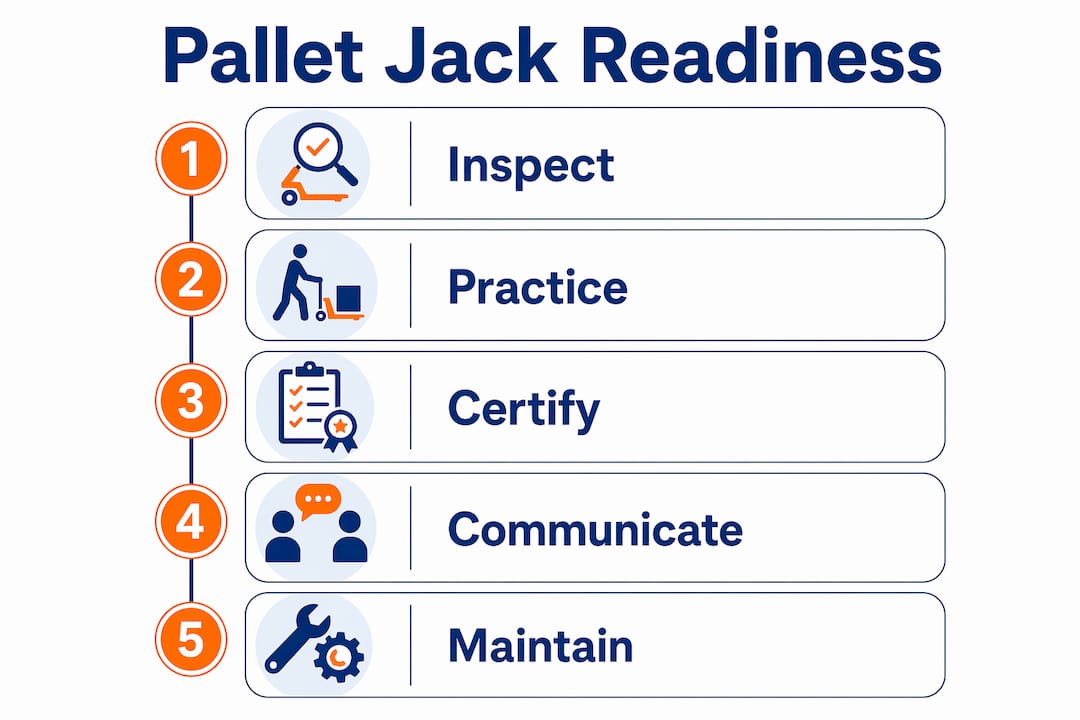
Practical readiness starts before you ever move a load. A structured pre-use inspection catches problems that cause accidents, and skipping it is the single most common mistake new operators make. Pre-operation checks must cover wheels, forks, hydraulics, controls, and load capacity labels. Regular inspections prevent accidents and protect the equipment from damage that compounds over time.
Follow this sequence every time you begin a shift:
Pro Tip: Use Forkliftacademy’s pallet jack inspection checklist as a printed reference during your first weeks on the job. Checklists build consistent habits faster than memory alone.
Once the equipment passes inspection, load handling technique determines whether you work safely or create hazards. The table below summarizes the critical technique standards every operator should internalize:
| Technique | Standard practice |
|---|---|
| Fork insertion depth | Forks must extend fully under the pallet, reaching the far stringer |
| Lift height while traveling | 1 to 2 inches above the floor only |
| Cornering speed | Slow to a near stop before turning; never swing wide into pedestrian zones |
| Ramp navigation | Always travel with the load uphill; never turn on a ramp |
| Load stacking | Keep loads stable and within the jack’s rated capacity before moving |
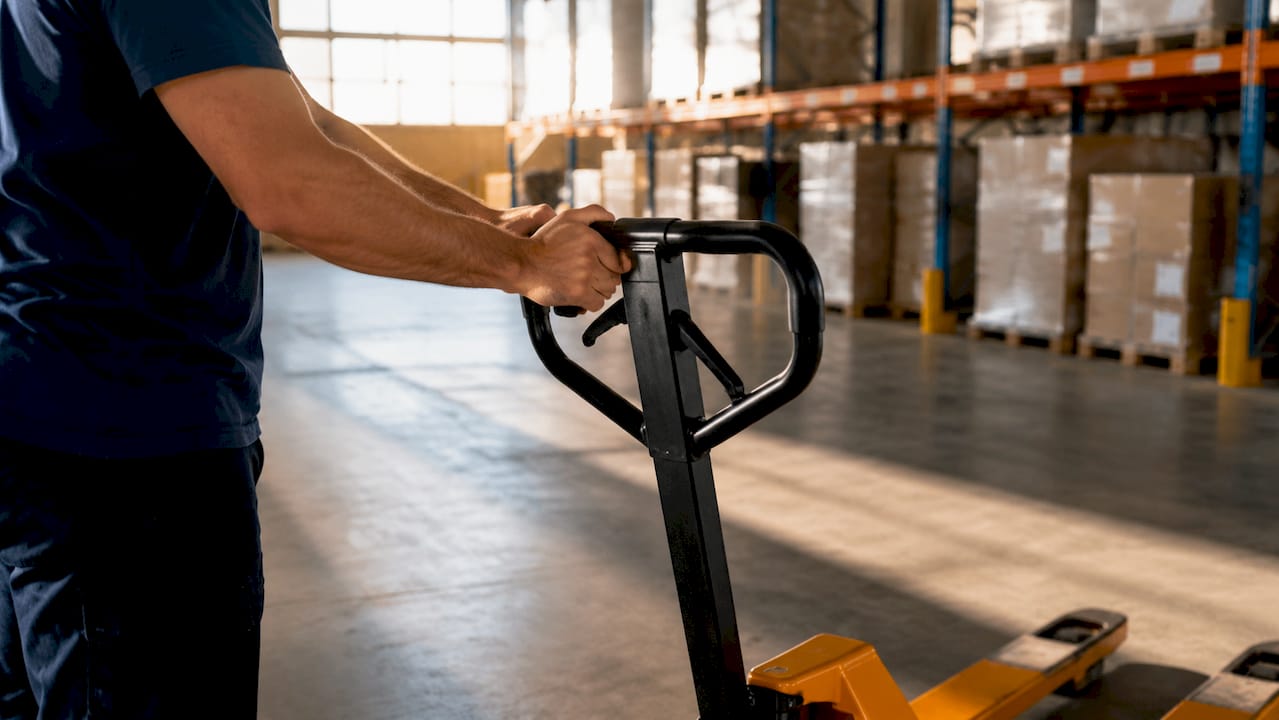
Ergonomic habits protect your body over a full career. Proper body mechanics mean keeping your back straight, pushing rather than pulling when possible, and using your legs as the primary power source. Twisting your torso while pulling a loaded jack is the movement pattern most likely to cause a back injury. Position yourself so you can push the jack in a straight line whenever the aisle layout allows.
Technical skills get you certified. Workplace awareness keeps you employed and injury-free. Every warehouse or distribution center runs on site-specific traffic rules, storage protocols, and communication norms that no online course covers in full. Your job preparation checklist must include learning these rules before your first solo shift.
Key areas to understand on any new site:
Effective communication about equipment status and navigation directly reduces accidents on the warehouse floor. New operators often underestimate how much of warehouse safety depends on verbal and visual communication rather than individual skill alone. Watching how experienced operators interact with their environment on your first days teaches things no manual covers.
Solid pallet jack job preparation combines equipment knowledge, OSHA-compliant certification, disciplined inspection habits, and site-specific workplace awareness to produce a safe, job-ready operator.
| Point | Details |
|---|---|
| Certification requirement | Powered pallet jack operators must complete OSHA three-part training and renew every three years. |
| Manual jack training | No formal OSHA certification required, but employer-provided safety training is still mandatory. |
| Pre-use inspection | Inspect forks, wheels, hydraulics, and controls before every shift to prevent accidents. |
| Lift height rule | Travel with loads only 1 to 2 inches above the floor to maintain stability and protect hydraulics. |
| Workplace awareness | Learning site-specific traffic rules and reporting equipment faults are non-negotiable operator responsibilities. |
Most job-related pallet jack injuries do not happen because operators lack certification. They happen because certified operators stop treating the pre-use inspection as a real task. I have watched experienced warehouse workers pump a jack twice, declare it fine, and move a 4,000-pound load without checking the forks once. That habit works until it does not.
The other pattern I see constantly is new operators over-pumping the hydraulic handle. Lifting the forks six inches off the ground feels more secure to a beginner. It is actually the opposite. Over-pumping the hydraulic mechanism is a textbook beginner error that risks tipping and damages the hydraulic system over time. The correct lift is the minimum clearance needed to roll freely. That is it.
My honest recommendation for anyone in beginner pallet jack training is to treat the first two weeks as an observation period, not just a performance period. Watch how the best operators on your floor handle tight corners, communicate with pedestrians, and respond when a load shifts. That behavioral knowledge compounds faster than any classroom module. Certification gets you in the door. Observation and practice keep you safe and employed.
— Juiced
Forkliftacademy has delivered OSHA-compliant forklift and pallet jack training for over 20 years across the United States and Canada. The platform’s online courses cover the formal instruction component of OSHA’s three-part training requirement, and onsite options are available in major U.S. cities for the hands-on and evaluation portions. Whether you are an individual preparing for your first warehouse role or a company building an in-house training program, Forkliftacademy makes the OSHA certification process straightforward and fully documented. Start your certification today and walk into your first shift with the credentials employers require.
No formal OSHA certification is required for manual pallet jacks since they are classified as hand tools. Employers are still required to provide basic safety training to prevent workplace injuries.
The online formal instruction component typically takes a few hours. The practical training and evaluation must be completed in person and depend on your employer’s schedule, but the full process is often completed within one to two days.
OSHA requires powered pallet jack certification renewal every three years, or sooner if an operator is involved in an incident or observed operating unsafely.
No. OSHA accepts online coursework for the formal instruction portion only. The practical training and evaluation must be completed in person with actual equipment.
Over-pumping the hydraulic handle to lift forks too high is the most frequent beginner error. The correct travel height is just 1 to 2 inches above the floor, which keeps loads stable and protects the hydraulic system.