


TL;DR:
- Workplace safety culture encompasses the shared values and behaviors that influence safety priorities at all levels of an organization. It operates beneath formal policies, shaping how risks are perceived and managed under pressure, thereby impacting safety outcomes. Building a mature safety culture requires long-term commitment, visible leadership, employee empowerment, open communication, and continuous learning.
Workplace safety culture is the shared set of values, beliefs, attitudes, and behaviors that determine how an organization prioritizes and manages safety at every level. It is not a policy document or a compliance checklist. It is the invisible force that shapes whether a worker speaks up about a hazard, whether a supervisor stops production when something looks wrong, and whether leadership treats safety as a core business value or a legal obligation. Organizations that understand this distinction, and act on it, consistently outperform those that treat safety as a procedural exercise.
Workplace safety culture, recognized by the UK Health and Safety Executive (HSE) and safety bodies worldwide as a foundational concept, describes the deeply ingrained patterns of thought and action that govern how risk is perceived and managed within an organization. The HSE defines it as the product of individual and group values, attitudes, perceptions, competencies, and patterns of behavior that determine the commitment to, and the style and proficiency of, an organization’s health and safety management.

The critical distinction is that safety culture operates beneath the surface of formal rules. Two organizations can have identical safety procedures and produce radically different outcomes, because culture shapes behavior under pressure in ways that procedures cannot. When a deadline looms and a shortcut is available, it is culture, not the employee handbook, that determines what happens next.
This concept connects directly to what researchers call the Just Culture framework, a system that distinguishes between honest mistakes, at-risk behaviors, and deliberate violations. It also connects to Stop Work Authority, the principle that any employee can halt unsafe operations without fear of retaliation. Both are markers of a mature safety culture, not just program names.
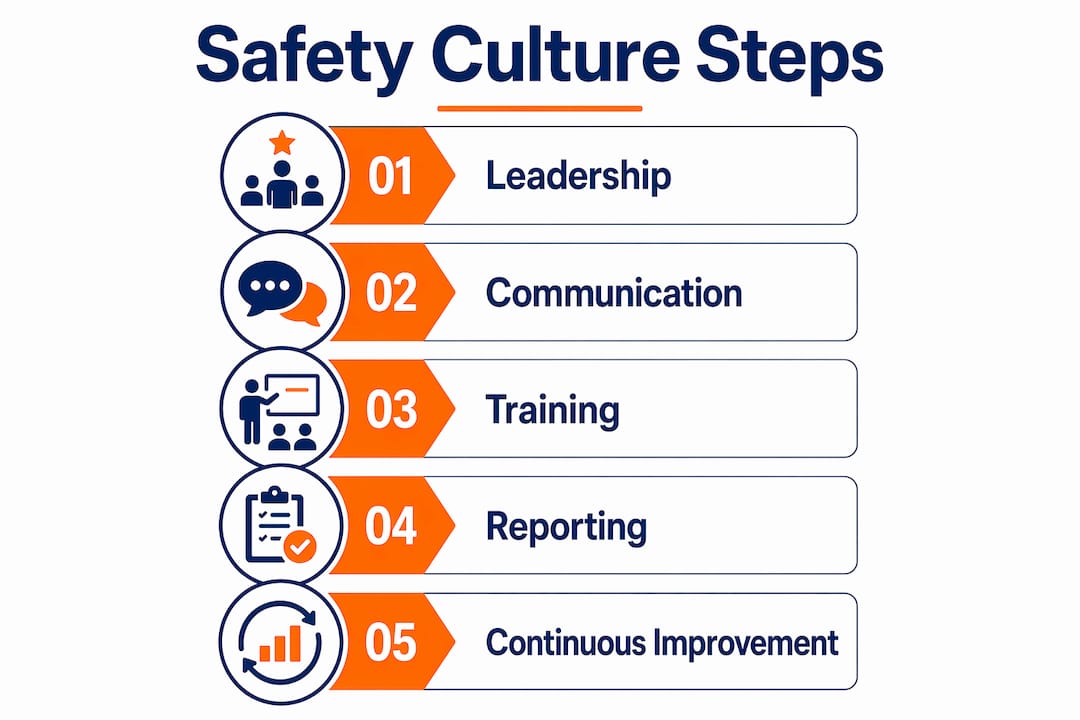
A mature safety culture is built from five interdependent components. Each one reinforces the others, and weakness in any single area undermines the whole.
Pro Tip: Measure your organization’s psychological safety by asking one question: “Would a frontline worker feel comfortable telling the site manager to stop an operation right now?” If the honest answer is no, your culture work starts there.
The business case for a strong safety culture is not abstract. Work-related injury and ill health impose a £22.9 billion annual cost in the UK alone, with health issues accounting for 72% and injuries for 28% of that figure. That number represents lost productivity, medical costs, legal liability, and reputational damage. Organizations with weak safety cultures absorb these costs routinely, often without recognizing the cultural root cause.
Beyond cost, a strong safety culture produces measurable operational benefits:
The connection between safety culture and workplace safety compliance is direct. Organizations that build genuine culture find compliance easier to maintain, because workers internalize the reasons behind rules rather than treating them as external constraints. A strong safety culture also maintains attention toward risk even under routine production pressure, which is precisely when most serious incidents occur.
These three concepts are frequently confused, and the confusion leads to misallocated effort. The table below clarifies the distinctions.
| Concept | Definition | Time horizon | How it is measured |
|---|---|---|---|
| Safety culture | Deep-rooted shared values and behaviors | Long-term, years to decades | Ethnographic observation, behavioral audits |
| Safety climate | Snapshot of employee perceptions and morale | Short-term, weeks to months | Surveys and questionnaires |
| Safety management system | Formal processes, procedures, and documentation | Ongoing, process-driven | Audits, compliance checks, documentation reviews |
Safety climate is best understood as a temporary snapshot gauged by surveys. It predicts incidents and reflects the current mood of the workforce, but it is not the same as culture. Culture is the enduring personality of the organization. Climate can shift in weeks. Culture takes years to change.
Safety management systems, such as ISO 45001 or OSHA’s Voluntary Protection Programs, provide the structural scaffolding for safety. But management style and unconscious bias toward production over safety influence outcomes more than formal systems alone. A well-documented system operated within a poor culture produces worse results than a simpler system embedded in a strong one. The culture determines how faithfully and intelligently the system is applied.
Building a mature safety culture requires a long-term program, not a one-time initiative. Organizations that treat it as a project with a start and end date consistently fail to sustain progress. The following steps reflect research-backed practices combining leadership commitment and worker empowerment.
Pro Tip: When reviewing workplace safety practices for your organization, check whether safety performance is included in manager compensation. If it is not, you have identified a structural barrier to cultural change.
A strong workplace safety culture reduces incidents, improves reporting, and drives organizational performance by embedding shared safety values into every operational decision, not just formal procedures.
| Point | Details |
|---|---|
| Culture beats procedures | Shared values and behaviors determine safety outcomes more than written rules alone. |
| Leadership visibility is critical | Regular safety walks and board-level safety metrics signal genuine organizational commitment. |
| Just Culture increases reporting | Removing blame from honest mistakes drives higher incident and near-miss reporting rates. |
| Climate surveys are leading indicators | Use annual surveys to diagnose cultural gaps before they produce serious incidents. |
| Long-term commitment is non-negotiable | Sustainable safety culture requires three to five years of consistent, integrated effort. |
The most common mistake I see organizations make is treating safety culture as something you build and then maintain. That framing is wrong, and it leads to wasted effort. Safety culture is not a destination. It is the daily accumulation of decisions made under pressure, most of them invisible to anyone in a safety role.
The organizations I have seen get this right share one characteristic: their leaders are genuinely curious about what is actually happening on the floor, not what the reports say is happening. They ask workers questions and listen to the answers. They change their own behavior when they hear something uncomfortable. That is not a program. That is a value system.
The uncomfortable truth is that safety culture reflects operational trade-offs between production and safety made in real time, every day. When a supervisor pushes a team to finish a load before the end of shift and a worker skips a pre-operation check, that is a cultural event. No training program prevents it unless the culture already treats that shortcut as unacceptable.
Patience is not optional here. Organizations that expect measurable cultural change in 12 months are setting themselves up for disappointment and cynicism. The ones that commit to a five-year horizon, measure progress honestly, and keep leadership accountable to visible safety behavior are the ones that actually move the needle.
— Juiced
Building a genuine safety culture in warehouse and logistics operations requires more than awareness. It requires trained leaders who model safe behavior and certified operators who understand why the rules exist. Forkliftacademy’s Train the Trainer program equips your internal safety leaders with the skills to deliver OSHA-compliant forklift training, embed safety standards into daily operations, and build the kind of frontline accountability that sustains culture over time. For organizations starting with operator certification, Forkliftacademy’s OSHA forklift certification courses provide a structured foundation for forklift safety culture in high-risk environments. Both programs are available online and onsite across the United States and Canada.
Safety culture is the shared values, beliefs, and behaviors within an organization that determine how seriously safety is prioritized in daily decisions and operations. It reflects what workers actually do when no one is watching, not just what the procedures require.
Safety culture is the long-term, deeply rooted personality of an organization regarding safety, while safety climate is a short-term snapshot of employee perceptions measured through surveys. Climate can shift in weeks; culture takes years to develop or change.
Just Culture is a framework that distinguishes between honest mistakes, at-risk behaviors, and deliberate violations when responding to safety incidents. It increases incident reporting by removing the fear of blame for errors made in good faith.
A safety culture assessment combines behavioral observation, near-miss reporting rates, safety climate surveys, and direct worker interviews to evaluate how deeply safety values are embedded in operations. The presence of Stop Work Authority and the quality of leadership safety behavior are strong qualitative indicators.
Meaningful cultural change typically requires three to five years of consistent, integrated effort. Short-term programs can shift climate temporarily, but lasting cultural change depends on sustained leadership commitment and safety values embedded in core business processes.