

TL;DR:
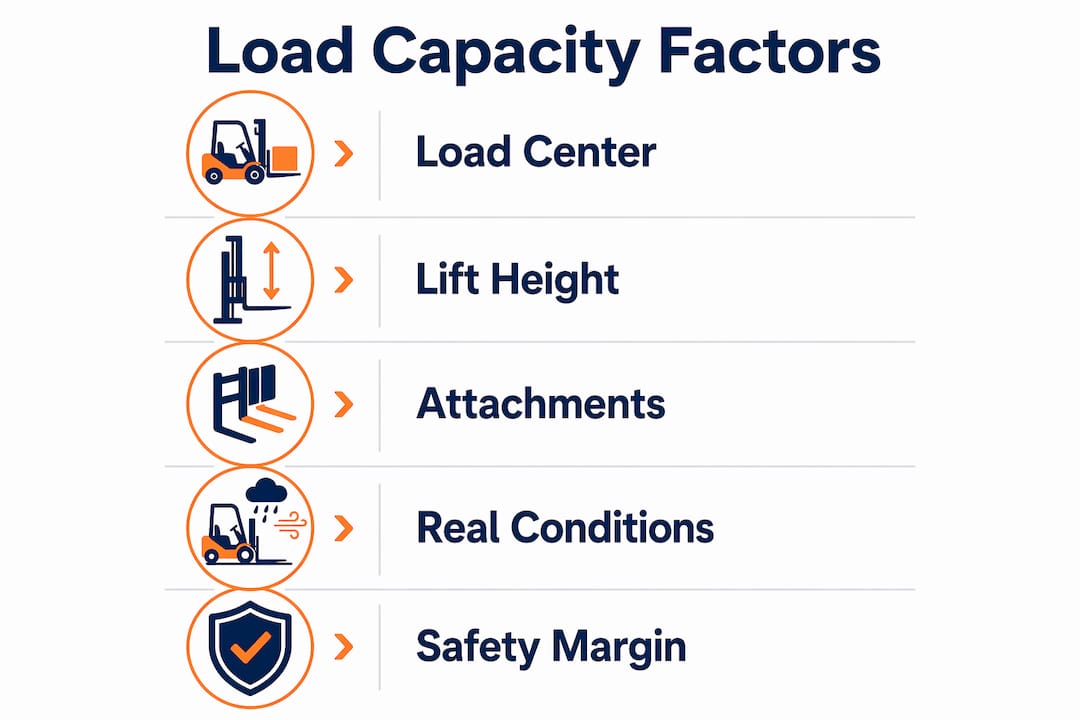
- Forklift load capacity varies based on load center distance, lift height, and attachments, not just the rated number.
- Operators must reference load charts and data plates carefully, maintaining a safety margin of 15 to 25 percent to ensure safe handling under real-world conditions.
Forklift load capacity is the maximum weight a forklift can safely lift under a specific set of conditions, defined by the rated load center, fork height, and mast position. Most operators know their machine’s headline number, say 5,000 pounds, but that figure only holds at ground level with a perfectly centered 48-inch pallet. Change any one variable and the real capacity drops, sometimes dramatically. Misreading that number is one of the leading causes of forklift tip-overs, OSHA citations, and equipment damage in warehouses across the United States. This article breaks down exactly how lift truck capacity works, how to read data plates and load charts, and what steps keep operators safe and compliant.
Load center is the horizontal distance from the face of the forks to the center of gravity of the load. The standard load center is 24 inches, which corresponds to a standard 48-inch pallet depth. Every rated capacity number on a data plate assumes this exact measurement. When the load center increases, the forklift’s effective lifting capacity decreases because of basic lever mechanics. The load sits farther from the fulcrum point, which is the front axle, placing greater stress on the machine’s counterbalance system.
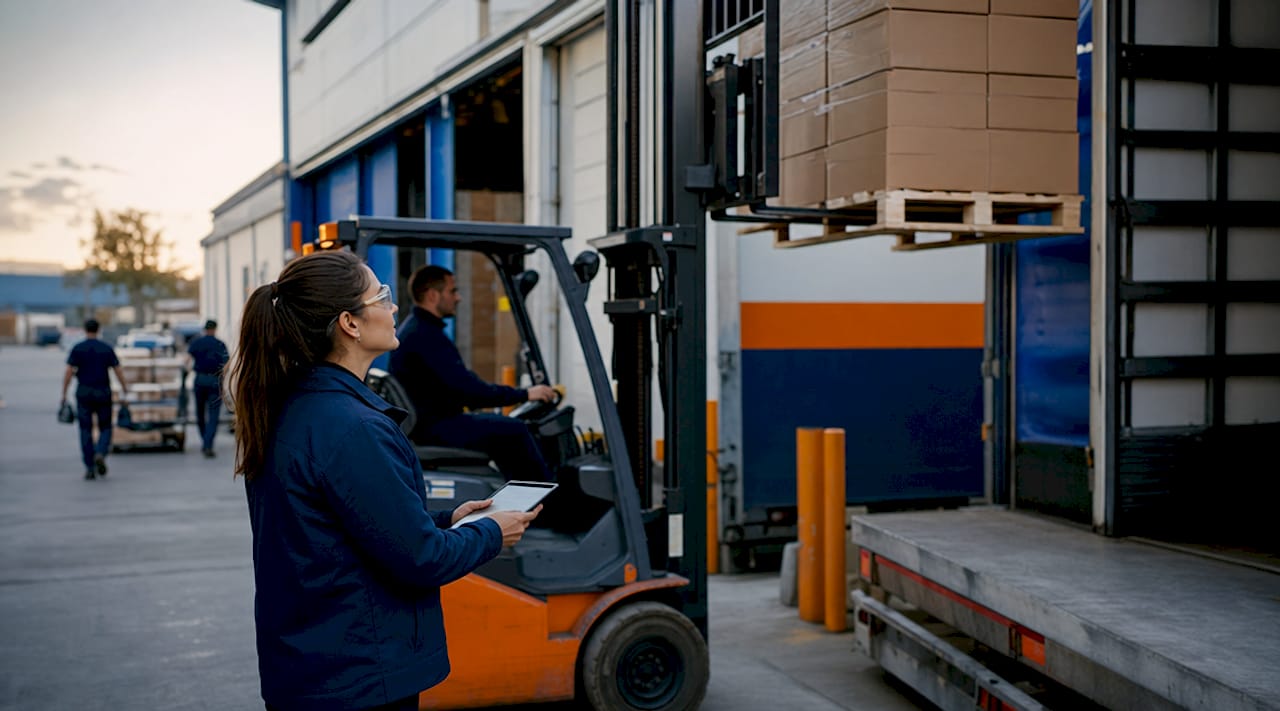
The math is direct and unforgiving. Moving from a 24-inch to a 36-inch load center on a 5,000 lb truck produces a 33% capacity reduction, dropping the safe limit to roughly 3,333 pounds. Operators who ignore this and attempt to lift the full rated load risk tipping the machine forward. That is not a near-miss scenario. That is a fatality risk.
To calculate the adjusted capacity for any non-standard load center, use this formula:
For example: (5,000 × 24) ÷ 36 = 3,333 lb adjusted capacity.
Lift height compounds the problem. As forks rise, the machine’s center of gravity shifts upward and forward, reducing lateral stability. At maximum lift height, a forklift retains only 60 to 70% of its ground-level capacity. That means a 5,000 lb rated truck may safely lift only 3,000 to 3,500 lb at full elevation. Most operators do not account for this, and the load chart on the machine exists precisely to close that gap.
Pro Tip: Never rely on memory for load center adjustments. Keep a laminated copy of the load chart inside the cab and reference it before every non-standard lift.
The data plate, sometimes called the capacity plate or nameplate, is the single most important document on any forklift. OSHA requires it to remain legible and attached to the machine at all times. It contains the rated capacity, the standard load center distance, the maximum lift height, the attachment configuration the rating applies to, and the model and serial number. If a data plate is missing or illegible, the forklift must be taken out of service until it is replaced.
Reading a load capacity chart requires understanding its two axes. The vertical axis represents fork height, and the horizontal axis represents load center distance. Each curve on the chart shows the maximum safe load for a specific combination of those two variables. The intersection of your actual lift height and your actual load center gives you the true safe working limit for that specific lift.
Common mistakes operators make when interpreting these charts include:
The difference between rated capacity and adjusted capacity is not a technicality. It is the difference between safe and unsafe operation. The rated capacity is the theoretical maximum under ideal conditions. The adjusted capacity is what the machine can actually handle in your specific situation.
Here is a sample of how load center affects capacity on a standard 5,000 lb forklift:
| Load center (inches) | Adjusted capacity (lb) | Reduction from rated |
|---|---|---|
| 24 (standard) | 5,000 | 0% |
| 30 | 4,000 | 20% |
| 36 | 3,333 | 33% |
| 48 | 2,500 | 50% |
These numbers illustrate why interpreting forklift capacity charts correctly is a non-negotiable skill for any operator or supervisor. A load that looks manageable by weight alone can exceed safe limits the moment it is not centered on the forks.
Attachments change the physics of every lift. A side-shifter adds weight to the carriage and shifts the effective load center forward, reducing capacity by 5 to 10%. Rotating clamps and heavy paper roll clamps reduce capacity by 20 to 30%. Any time an attachment is installed, the data plate must be updated to reflect the new capacity rating for that configuration. Operating with an outdated data plate is an OSHA violation, not just a safety concern.
Beyond attachments, several real-world conditions reduce what a forklift can safely handle:
Operators working in cold storage facilities or outdoor yards face compounding variables. Ice, drainage slopes, and wind resistance all affect the machine’s behavior under load. These are not edge cases. They are daily realities in most industrial environments.
Pro Tip: When adding any attachment, request the manufacturer’s derating specification in writing and have the data plate updated before the machine returns to service. Do not estimate the capacity reduction.
Reviewing forklift safety rules before operating with new attachments is a practical step that many facilities skip under time pressure. That shortcut is where accidents originate.
Safe load handling starts before the forks touch the pallet. A structured pre-lift process eliminates the guesswork that leads to overloading and tip-overs. Operators who follow a consistent checklist catch problems that experienced workers sometimes overlook out of habit.
Follow these steps before every lift:
Regular equipment inspections are part of this discipline. Forks should be checked for cracks, bends, and wear. Tires should be inspected for damage and inflation. Hydraulic systems should be tested for smooth, consistent operation. OSHA requires pre-shift inspections, and the OSHA compliance checklist for 2026 makes these requirements explicit.
The 15 to 25% safety margin is not a conservative suggestion. It is a practical buffer that accounts for variables no formula can fully capture: a load that shifts mid-travel, a floor joint that causes a sudden jolt, or a hydraulic system that responds slower than expected. Experienced operators build this margin into every lift automatically.
Forklift load capacity is a dynamic value that changes with load center distance, lift height, and attachment configuration, not a fixed number printed on a plate.
| Point | Details |
|---|---|
| Rated capacity has strict conditions | The data plate rating only applies at a 24-inch load center, ground level, and vertical mast. |
| Load center shifts reduce capacity fast | Moving from 24 to 36 inches drops capacity by 33% on a standard 5,000 lb forklift. |
| Lift height cuts capacity further | At maximum elevation, a forklift retains only 60 to 70% of its ground-level capacity. |
| Attachments require updated data plates | Side-shifters reduce capacity 5 to 10%; heavy clamps reduce it 20 to 30%. |
| Safety margins prevent accidents | Operating 15 to 25% below calculated capacity accounts for real-world variables and equipment wear. |
After years of working with forklift operators and safety managers, the single most persistent misconception I encounter is this: operators treat the rated capacity as the operating capacity. They see “5,000 lb” on the data plate, and that becomes the ceiling they work up to, not a theoretical maximum that applies only under a narrow set of ideal conditions.
The rated capacity is a starting point for calculation, not a green light for any lift under 5,000 pounds. I have seen experienced operators, people with years on the machine, attempt lifts that were technically within the rated capacity but completely outside the adjusted capacity for their actual load center and height. The machine did not tip over. But it came close enough to make everyone in the building stop what they were doing.
What actually works is treating load capacity as a matrix, not a number. Every lift has three variables: load weight, load center, and lift height. All three interact. Operators who internalize that relationship, who check the chart before the non-standard lift rather than after the incident, are the ones who build long, incident-free careers. The operators who rely on feel and experience alone eventually encounter a combination of variables that feel did not prepare them for.
Training is where this understanding gets built correctly. Not a one-time certification, but ongoing reinforcement that keeps the formula and the chart in active use. The lift truck best practices that separate safe facilities from dangerous ones are not complicated. They are consistent.
— Juiced
Understanding forklift load capacity on paper is the first step. Applying it correctly under real warehouse conditions is where certification training makes the difference.
Forkliftacademy has delivered OSHA-compliant forklift training for over 20 years across the United States and Canada. The curriculum covers load capacity calculations, data plate interpretation, attachment derating, and pre-lift inspection procedures. For facilities that need to train multiple operators, the train-the-trainer program equips your internal staff to deliver consistent, compliant instruction on-site. Individual operators can access full certification programs online, with practical components available at locations in key U.S. cities. Compliance is not optional. Confidence is trainable.
The standard load center is 24 inches, measured horizontally from the face of the forks to the load’s center of gravity. This measurement corresponds to a standard 48-inch pallet and is the reference point for all rated capacity figures on a data plate.
At maximum lift height, a forklift retains only 60 to 70% of its rated ground-level capacity. A 5,000 lb forklift may safely lift only 3,000 to 3,500 lb at full elevation, depending on the load center and mast configuration.
Yes. Side-shifters reduce capacity by 5 to 10%, while rotating clamps and heavy-duty attachments reduce it by 20 to 30%. Any attachment requires an updated data plate reflecting the new capacity rating for that configuration.
Operators should work 15 to 25% below the calculated adjusted capacity to account for floor conditions, load shifts, and equipment wear. This margin is a practical buffer, not a regulatory requirement, but it reflects best practice in safe material handling.
Use the formula: Adjusted Capacity = (Rated Capacity × Standard Load Center) ÷ Actual Load Center. For a 5,000 lb forklift with a 36-inch actual load center, the adjusted capacity is (5,000 × 24) ÷ 36 = 3,333 lb.