

TL;DR:
- Technology transforms forklift education through immersive simulations, AI personalization, and automated compliance tracking. VR training accelerates skill development and increases operator confidence but cannot replace OSHA-mandated hands-on evaluations on real equipment. Combining advanced digital tools with qualified oversight ensures safer, more consistent operator training that meets regulatory standards.
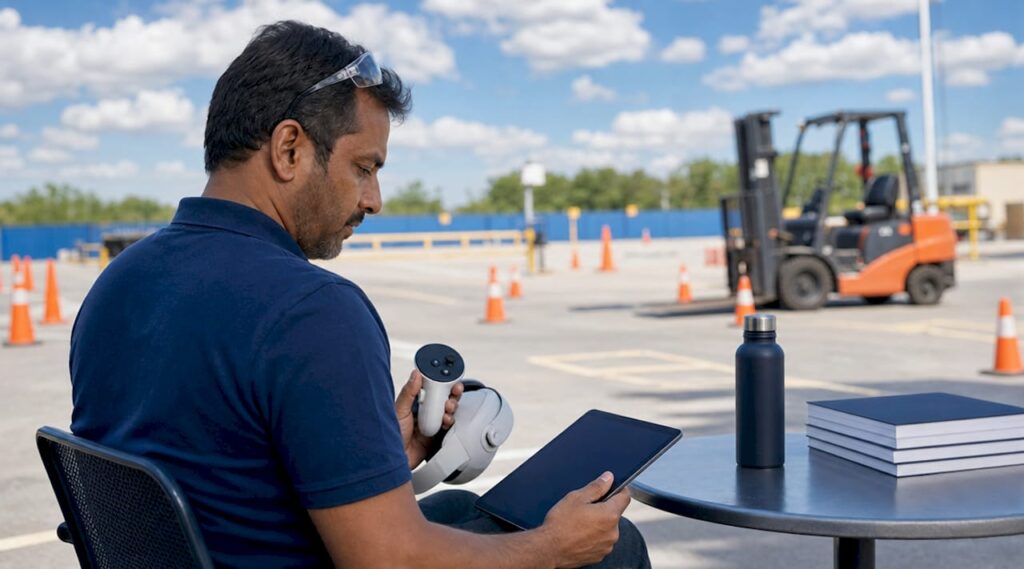
Technology transforms forklift education by replacing passive classroom instruction with immersive simulations, AI-driven personalization, and automated compliance tracking. VR learners complete training 4x faster and report 275% more confidence than classroom-only participants. That single data point reframes the entire conversation about how operators, managers, and educators should think about certification programs. Tools like Meta Quest 3 headsets, AI-powered learning management systems, and mobile digital platforms are no longer experimental. They are the new standard for organizations serious about safety and OSHA compliance.
Technology in forklift education covers every digital or hardware tool that improves how operators learn, practice, and get certified to operate powered industrial trucks. The industry term for this category is “technology-enhanced training,” and it spans three distinct layers: simulation and VR for skill-building, AI and digital platforms for personalized learning and compliance management, and sensor or telematics systems for real-world performance monitoring.
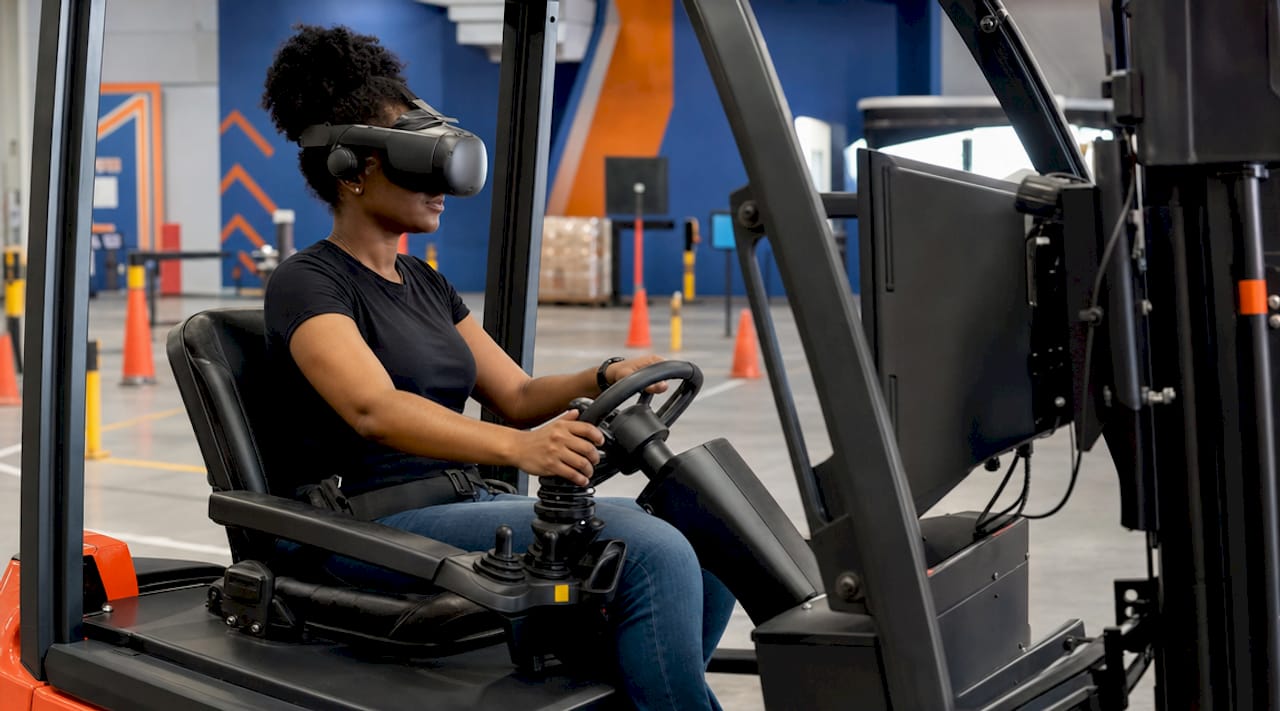
The practical impact is measurable. VR training scenarios cover pre-operation inspections, load handling, hazard navigation, and emergency events. Software tracks metrics like speed, travel path, inspection steps, and near-misses, giving trainers diagnostic data that a clipboard checklist simply cannot produce. This level of detail lets managers identify exactly where an operator struggles before that operator ever touches real equipment.
For managers overseeing multi-site operations, digital tools for forklift education solve a consistency problem that has plagued the industry for decades. One trainer at one facility cannot guarantee the same instruction quality as a trainer 500 miles away. Technology standardizes the content, the assessment, and the documentation simultaneously.
VR simulation gives operators a consequence-free environment to practice maneuvers that would be genuinely dangerous to rehearse on a live warehouse floor. Narrow aisle navigation, tip-over recovery responses, and pedestrian conflict scenarios can all be repeated until the operator builds genuine muscle memory. No product gets damaged. No one gets hurt.
The compliance picture is more nuanced. OSHA mandates that forklift training include formal instruction, practical training, and hands-on evaluation on actual equipment by a qualified person. VR satisfies the first two components effectively. It cannot replace the third. Any program that skips the on-site evaluation with real equipment is out of compliance, regardless of how sophisticated the simulation is.
The most important design principle for effective VR training is scenario specificity. Matching VR scenarios to the actual truck class and facility layout operators will use in real life is what drives skill transfer. A counterbalance forklift operator trained in a simulated narrow-aisle reach truck environment gains limited benefit. The spatial awareness developed in VR only transfers when the virtual environment mirrors the real one.
Pro Tip: Before purchasing any VR forklift training system, request a demo using your actual truck class and a layout that approximates your facility. If the vendor cannot customize scenarios to your operation, the skill transfer value drops significantly.
Here is a quick breakdown of what VR training covers versus what it cannot replace:
| Training component | VR simulation | Real equipment evaluation |
|---|---|---|
| Formal instruction | Yes | Not applicable |
| Practical demonstration | Yes | Required by OSHA |
| Hazard recognition practice | Yes | Partially |
| Emergency scenario rehearsal | Yes | Rarely feasible |
| Qualified evaluator sign-off | No | Mandatory |
VR is most effective as an intermediate training step between classroom theory and hands-on evaluation. Operators who arrive at their real-equipment evaluation having already rehearsed the scenarios in VR perform better and require fewer corrective interventions from the evaluator.
AI changes forklift safety training technology from a one-size-fits-all event into a continuous, personalized process. AI-driven curricula dynamically adjust difficulty and content based on individual learner performance and job role. An operator who consistently misses load center calculations gets more practice on that specific skill. An operator who excels at pre-operation inspections moves faster through that module. The result is training time spent where it actually matters.
The compliance management benefits are equally significant. Digital records reduce manual paperwork and enable real-time verification of training completion across every site in an organization. When OSHA conducts an inspection, a manager can pull up a complete, timestamped training record for every operator in seconds rather than searching through filing cabinets.
AI also operates at the preventive level. Predictive analytics identify seasonal and operational risk patterns using incident logs and maintenance data. If near-miss events spike every November when seasonal workers join the floor, the system flags that pattern and prompts targeted retraining before incidents occur rather than after.
One critical boundary applies to all AI-generated training content. AI generates drafts of scenarios, quizzes, and post-class follow-ups, but every piece requires expert review before use. Labeling AI-generated content and conducting subject matter expert sign-offs is not optional. It is a legal and ethical requirement for any OSHA-compliant program.
Here is how to build AI tools into a trainer’s workflow effectively:
Pro Tip: Treat AI as a research assistant and documentation tool, not a trainer replacement. The human-in-the-loop approach where AI aids expert judgment produces better compliance outcomes than fully automated programs.
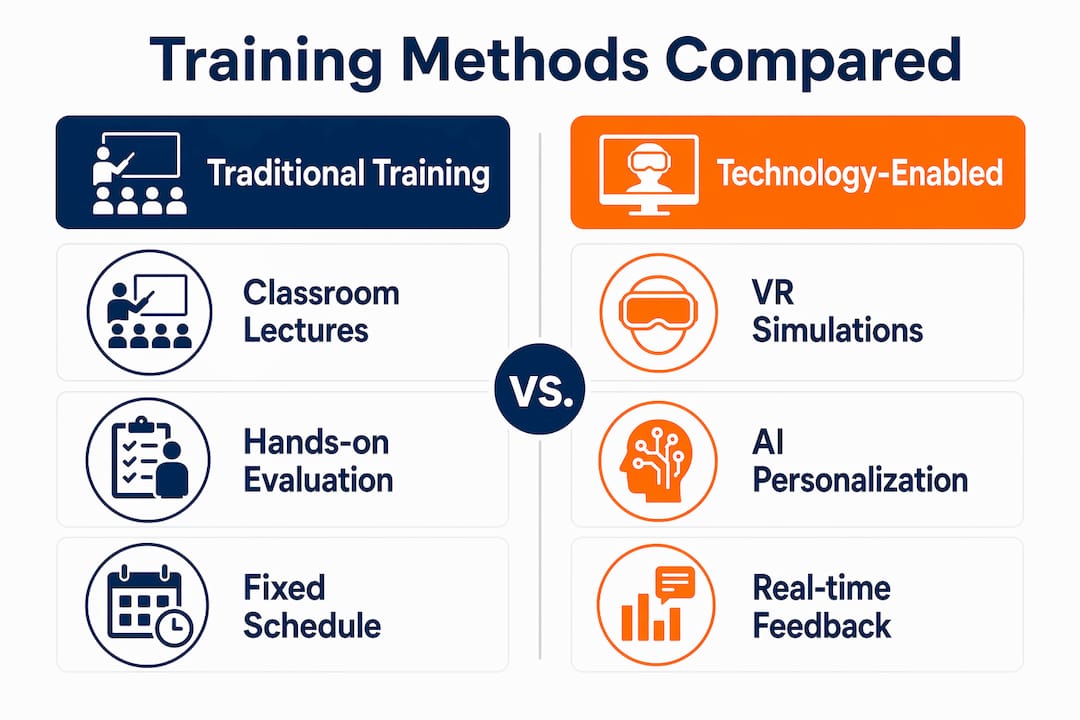
The core difference is not just delivery format. It is the quality and depth of data generated about operator performance. Traditional classroom and on-site training produces a pass/fail outcome. Technology-enabled training produces a performance profile.
| Factor | Traditional training | Technology-enabled training |
|---|---|---|
| Training time | Longer, fixed schedule | Faster, self-paced with VR |
| Engagement | Passive listening | Active simulation practice |
| Performance data | Pass/fail checklist | Granular metrics per scenario |
| Hazard exposure | Limited to real scenarios | Full range including emergencies |
| Compliance documentation | Manual, paper-based | Automated, real-time digital records |
| Upfront cost | Lower | Higher, with long-term ROI |
The upfront cost of VR hardware and software is the most common objection from managers. A Meta Quest 3 headset plus a quality VR training platform represents a real investment. The counterargument is operational ROI. Simulation training reduces incidents and downtime by raising operator proficiency before real-world exposure. One prevented forklift incident, which can cost tens of thousands of dollars in workers’ compensation, equipment damage, and lost productivity, typically exceeds the cost of an entire VR training setup.
Traditional training still has a non-negotiable role. No technology replaces the qualified evaluator conducting a hands-on assessment on actual equipment. The strongest programs use both methods: technology for instruction and practice, real equipment for final evaluation and certification sign-off. You can read more about online certification advantages to see how blended approaches work in practice.
Adoption fails most often not because the technology is wrong but because the implementation is rushed. Start with a training needs assessment that maps your actual truck classes, facility layouts, and the specific hazards your operators encounter. That assessment drives every technology decision that follows.
Pro Tip: Start with one truck class and one facility before rolling out technology-enabled training organization-wide. A controlled pilot generates the performance data you need to justify broader investment and refine your approach before scaling.
The future of forklift training points toward more adaptive, data-driven programs where AI continuously updates training content based on real incident patterns and individual operator performance histories. Organizations that build the data infrastructure now will have a significant advantage when those capabilities become standard.
Technology-enabled forklift training produces measurably better operators when VR simulation, AI personalization, and digital compliance tools are combined with mandatory real-equipment evaluation by a qualified person.
| Point | Details |
|---|---|
| VR accelerates skill-building | Operators train 4x faster and gain 275% more confidence compared to classroom-only instruction. |
| OSHA compliance still requires real equipment | VR covers instruction and practice but cannot replace hands-on evaluation on actual equipment. |
| AI personalizes and automates | AI adjusts content to individual performance gaps and automates OSHA-standard documentation. |
| Scenario specificity drives transfer | VR training must match actual truck class and facility layout to produce real-world competency gains. |
| Technology needs human oversight | AI-generated content requires expert review and sign-off before use in any compliant training program. |
After years of watching forklift training programs adopt new tools, the pattern I see most often is this: a manager buys a VR headset or an AI content tool, runs a few sessions, and then declares the technology either a success or a failure based on operator satisfaction scores. That is the wrong metric entirely.
The real value of technology in forklift training is diagnostic. VR performance data tells you exactly which operators struggle with load stability at speed, which ones skip inspection steps under time pressure, and which ones freeze during emergency scenarios. That information is worth more than any satisfaction survey. Most organizations collect it and then do nothing with it.
The second mistake I see is treating technology as a cost-cutting move rather than a quality investment. Organizations that buy the cheapest VR platform without customizing scenarios to their actual equipment and environment get poor skill transfer and then blame the technology. The tool is not the problem. The implementation is.
My honest view is that AI and VR will become as standard in forklift education as written tests are today. But the organizations that get the most value from them will be the ones that invest in trainer education first, customize scenarios to their real operational conditions, and use performance data to drive continuous program improvement. The technology is ready. The question is whether the people managing it are.
— Juiced
Forkliftacademy has delivered OSHA-compliant forklift certification programs for over 20 years, and its current offerings reflect exactly the kind of blended approach this article describes.
The Train the Trainer Online program equips your in-house trainers with the knowledge to run compliant evaluations, integrate digital tracking tools, and manage certification records across your entire operation. For organizations looking to certify individual operators or build out a full training program, the complete forklift training programs catalog covers every truck class with options for online instruction, onsite evaluation, and trainer certification kits. Every program is built around OSHA 1910.178(l) requirements, so your documentation holds up under inspection.
Forklift operator training uses VR simulation platforms, AI-powered learning management systems, mobile digital training apps, and sensor-based performance monitoring tools. Each technology addresses a different layer of the training process, from skill-building to compliance documentation.
No. OSHA requires hands-on evaluation on actual equipment by a qualified person, and VR cannot satisfy that requirement. VR covers formal instruction and practical demonstration but must be combined with real-equipment evaluation for a program to be OSHA-compliant.
AI analyzes individual operator performance data to adjust training content, identify risk patterns from incident logs, and automate OSHA-standard documentation. It functions as a trainer support tool, not a replacement for qualified human evaluators.
The most common mistake is using VR scenarios that do not match the actual truck class and facility layout operators work in. Mismatched scenarios limit skill transfer and require more corrective intervention during real-equipment evaluations.
Digital training platforms automate record-keeping, track certification expiration dates, and generate real-time completion reports across multiple sites. This reduces manual paperwork and gives managers instant access to documentation during OSHA inspections.