

TL;DR:
- Employers are legally responsible for providing OSHA-compliant forklift training, including formal instruction, practical training, and workplace evaluation. Documentation is critical, as OSHA citations often result from missing or incomplete certification records, not just lack of training. Prior training does not transfer, and re-evaluations are required every three years or after safety incidents and equipment changes.
Employer responsibility for forklift training is defined by OSHA as the legal obligation to provide every forklift operator with formal instruction, hands-on practical training, and a workplace-specific performance evaluation before that operator runs a forklift unsupervised. This mandate falls under 29 CFR 1910.178(l), the federal standard governing powered industrial truck operations. No government agency issues a forklift license. The employer owns the certification process from start to finish, including documentation, trainer designation, and ongoing re-evaluation. For HR managers and operations leaders in logistics and warehousing, understanding exactly what that obligation covers is the difference between a compliant program and a costly OSHA citation.
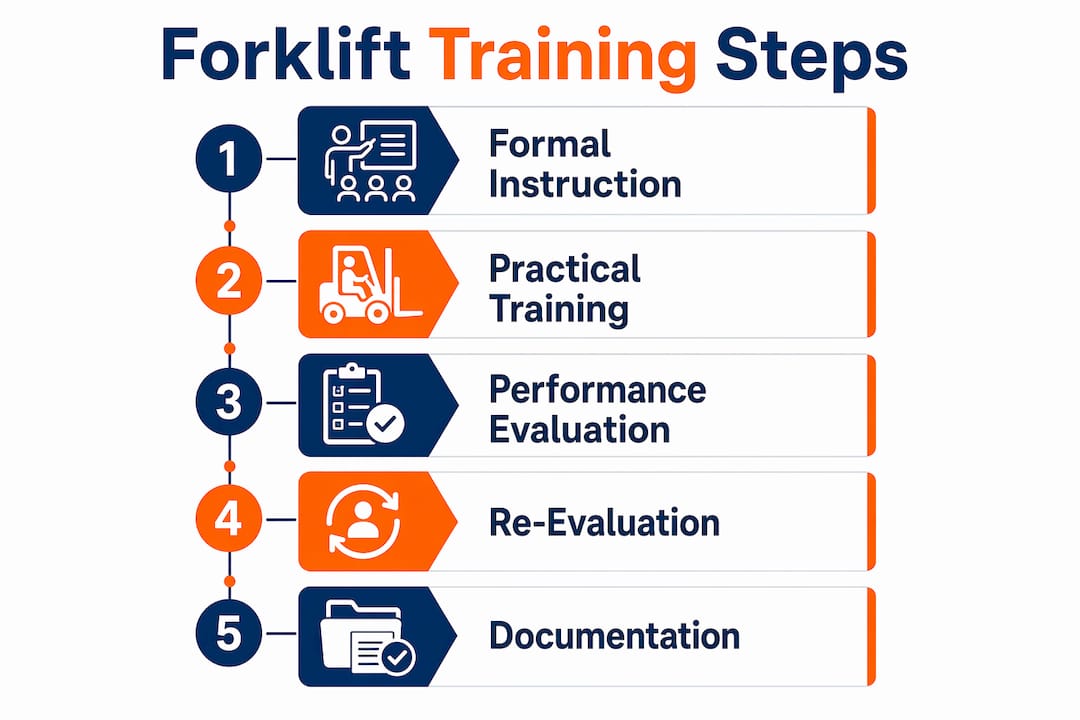
OSHA’s forklift training standard requires employers to deliver a three-part training program: formal instruction, practical hands-on training, and a performance evaluation conducted in the actual workplace before any unsupervised operation begins. Each component is mandatory. Skipping or substituting any one of them puts the employer out of compliance, regardless of how thorough the other two are.
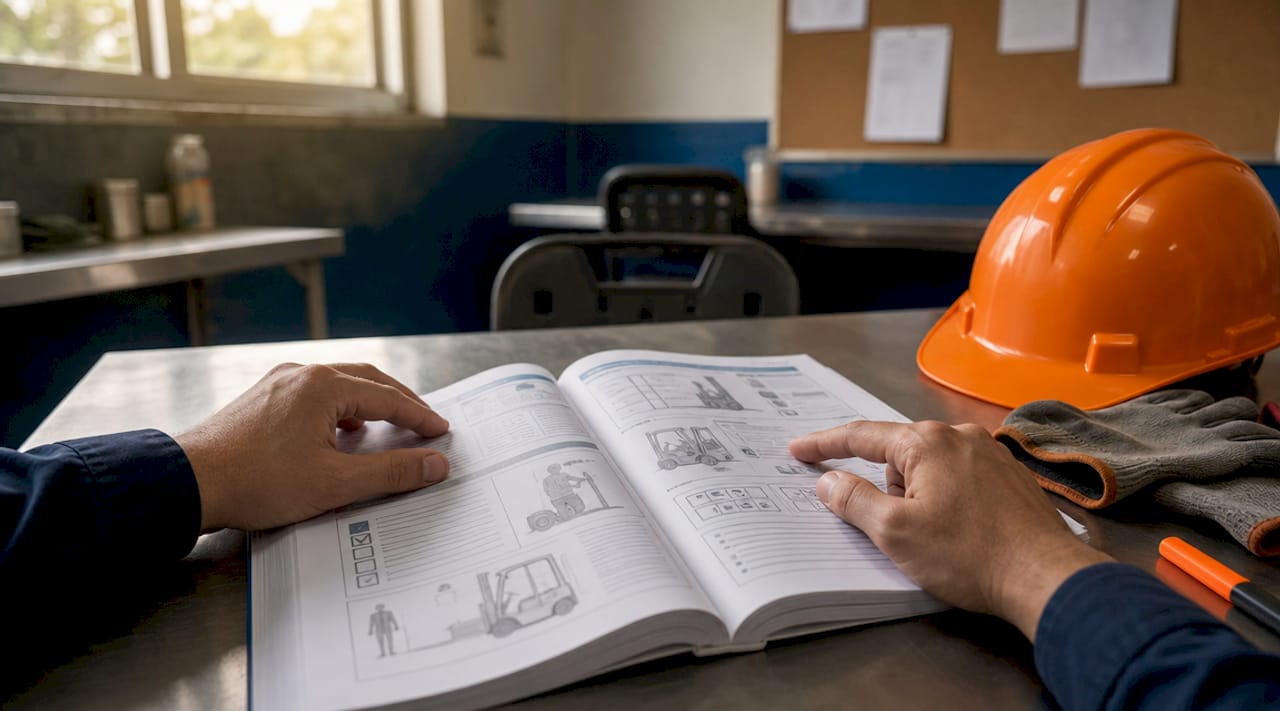
Formal instruction covers the theoretical side of forklift operation. This includes classroom sessions, online courses, video-based learning, or written materials covering topics like load handling, pre-operation inspections, refueling procedures, and pedestrian safety. Online delivery is acceptable for this component, which is why many employers use third-party platforms to complete it efficiently.
Practical training must be conducted in person, on the actual type of equipment the operator will use. OSHA requires that each operator be trained on each distinct class of powered industrial truck they will operate. A counterbalance sit-down certification does not cover reach truck operation. This is one of the most frequently misunderstood requirements in warehousing environments where operators routinely handle multiple equipment types.
Performance evaluation must be completed by a qualified trainer designated by the employer, in the specific workplace where the operator will work. The evaluator observes the operator performing actual job tasks and confirms competency before sign-off. Refresher training and re-evaluation are required every three years at minimum, and sooner if an operator is observed operating unsafely, is involved in an accident or near-miss, or is assigned to a new type of equipment or work environment.
Pro Tip: Schedule re-evaluation reminders in your HR system at the 30-month mark, not the 36-month mark. This gives you a six-week buffer to complete evaluations before the OSHA deadline without scrambling.
Several persistent myths cause employers to believe they are compliant when they are not. Addressing these directly protects your operation from citations and, more critically, from preventable injuries.
“OSHA issues forklift certifications.” OSHA does not approve, issue, or recognize any official forklift operator license or trainer certification. All certification is employer-based, meaning the employer signs off on operator competency and bears full legal responsibility for that determination.
“Online training alone satisfies OSHA requirements.” Online courses fulfill only the formal instruction component. The practical training and performance evaluation must be conducted in person, on-site, with real equipment. An operator who completes a 100% online course and receives a card has not met OSHA’s full training standard.
“Our trainer needs a government certification.” Qualified trainers must have the knowledge, training, and experience to train and evaluate operators. OSHA does not require formal trainer certification from any government body. Employers commonly use train-the-trainer programs or external providers to build that internal competency.
“One certification covers all forklifts.” Each operator must be trained and evaluated on each class of powered industrial truck they operate. Assuming a single certification covers all equipment types is a direct compliance violation.
“A third-party provider handles our liability.” The employer’s liability remains paramount. Third-party training providers cannot legally relieve an employer of certification responsibility. You can outsource the instruction. You cannot outsource the accountability.
“Most OSHA citations result from failure to maintain proper written certification documentation on site, not just from lack of training.” — OSHA Forklift Regulations: 2026 Compliance Guide
This distinction matters enormously. An employer can run excellent training sessions and still receive a citation because the paperwork was incomplete or unavailable during an inspection.
A compliant program requires more than good intentions. It requires a written structure with named roles, documented records, and a schedule that accounts for new hires, equipment changes, and periodic re-evaluations.
Employers must develop a written safety and training policy that names specific responsible parties for every function in the program. Vague policies fail audits. Your policy should identify the program administrator, the qualified trainer or trainers, the evaluator, and the person responsible for maintaining records. This document is what an OSHA inspector reviews first.
You have two options: qualify an internal employee through a train-the-trainer program, or contract with an external provider for the evaluation component. Internal trainers offer long-term cost efficiency and site-specific knowledge. External providers offer speed and credibility for initial program setup. Many employers use a hybrid approach, outsourcing formal instruction while keeping practical evaluation in-house.
Employers are legally responsible for maintaining written certification records that include the operator’s name, the date of training, the date of evaluation, and the identity of the evaluator. These records must be available on-site. The following fields are required in every certification record:
Pro Tip: Store certification records in a centralized digital system with automatic expiration alerts. A shared spreadsheet with no reminder function is how warehouses end up with expired certifications discovered only during an OSHA inspection.
Operators require site-specific evaluation even after completing generalized formal and practical training. Your program must address the actual conditions in your facility: narrow aisles, dock levelers, pedestrian traffic patterns, racking configurations, and floor surface conditions. Generic training that ignores your specific environment does not satisfy the workplace evaluation requirement.
| Documentation element | Compliance requirement |
|---|---|
| Written training policy | Must name program administrator, trainers, evaluators, and recordkeepers |
| Operator certification records | Must include name, training date, evaluation date, and evaluator identity |
| Equipment-specific records | Separate record required for each class of truck operated |
| Re-evaluation schedule | Every 3 years minimum; sooner after incidents or equipment changes |
| Site-specific hazard documentation | Must reflect actual workplace conditions in the evaluation |
More than 50% of forklift-related OSHA citations in recent years relate to inadequate operator training and missing certification documentation. That statistic means the majority of citations are preventable with proper recordkeeping alone, not just better training delivery.
The legal exposure extends beyond OSHA fines. When an untrained or improperly certified operator is involved in a workplace accident, the employer faces workers’ compensation claims, potential civil litigation, and increased insurance premiums. Insurers increasingly request proof of training compliance during policy renewals, and gaps in documentation directly affect coverage terms.
| Compliance status | Likely outcome |
|---|---|
| Full training and documentation on file | Reduced citation risk; strong legal defense in accident investigations |
| Training completed but records missing | High citation risk; limited legal defense despite actual training |
| Partial training (online only, no evaluation) | Direct OSHA violation; full liability in accident scenarios |
| No training program in place | Maximum citation severity; potential willful violation classification |
Proper training and documentation also shape workplace safety culture. Operators who go through a structured, documented program understand that their employer takes safety seriously. That perception reduces unsafe behavior and near-miss incidents over time. You can review the OSHA forklift compliance checklist to benchmark your current program against these standards.
Hiring a forklift operator who claims prior certification does not transfer their previous employer’s compliance record to you. Employers on multi-employer worksites must evaluate temporary employees claiming prior forklift training to determine adequacy before allowing operation. This applies to staffing agency placements, seasonal hires, and direct-hire operators with experience at other facilities.
Your obligations when onboarding an operator with prior training include:
Staffing agencies frequently assume that their client employer handles training, while the client employer assumes the agency handled it. OSHA holds the host employer responsible for ensuring that any operator working in their facility meets the standard, regardless of who employed them first. Document the evaluation you conduct, even when the operator has years of experience. The evaluation record is your legal protection.
For temporary employees on multi-employer worksites, the host employer’s forklift safety obligations extend to verifying that every operator on their floor meets the standard, not just their direct employees.
Employer responsibility for forklift training under OSHA requires formal instruction, hands-on practical training, a workplace-specific evaluation, and complete written documentation maintained on-site at all times.
| Point | Details |
|---|---|
| Three-part training is mandatory | Formal instruction, practical training, and workplace evaluation are all required before unsupervised operation. |
| Employer owns the certification | OSHA issues no forklift licenses; the employer signs off on every operator’s competency and bears full legal liability. |
| Documentation drives compliance | Missing records cause more OSHA citations than missing training; maintain complete files for every operator and equipment class. |
| Prior certification does not transfer | New and temporary operators must be evaluated at your facility before operating, regardless of prior experience. |
| Re-evaluation is recurring | Operators must be re-evaluated every three years, and sooner after incidents, equipment changes, or observed unsafe behavior. |
After working in forklift safety education for years, the pattern I see most often is not employers who skip training. It is employers who run decent training programs but treat documentation as an afterthought. They conduct evaluations, their trainers are qualified, and their operators know what they are doing. Then an OSHA inspector walks in and asks for the certification records. The supervisor opens a drawer, finds a folder with half the required fields blank, and the company takes a citation that the training itself would have prevented.
The second most common mistake is assuming that a third-party online course closes the compliance loop. It does not. Online instruction is a legitimate and efficient tool for the formal instruction component. But the practical evaluation must happen in your facility, on your equipment, with a qualified evaluator watching the operator work. No card or certificate from any external provider substitutes for that.
My honest recommendation is to build your program around internal qualified trainers. The upfront investment in a train-the-trainer program pays back quickly in reduced per-operator training costs and gives you complete control over evaluation quality and documentation. Outsourcing everything feels easier until you realize the host employer liability never left your desk.
The employers who handle this best treat forklift certification the same way they treat payroll: a non-negotiable administrative function with clear ownership, a defined schedule, and zero tolerance for missing records.
— Juiced
Forkliftacademy has supported employers across the United States and Canada for over 20 years with OSHA-compliant forklift training and certification programs built specifically for logistics and warehousing operations. The Train the Trainer online program qualifies your internal staff to conduct practical evaluations and sign off on operator certifications, giving you full control over compliance and documentation. For employers who need operator-level certification, Forkliftacademy’s OSHA forklift certification programs cover all major equipment classes with both online and onsite formats. Every program is designed to satisfy the formal instruction requirement under 29 CFR 1910.178(l), with supporting tools for recordkeeping and program management.
Forklift certification under OSHA is the employer-issued confirmation that an operator has completed formal instruction, practical training, and a workplace-specific performance evaluation as required by 29 CFR 1910.178(l). OSHA does not issue any official forklift license or certificate.
The employer is responsible for paying for forklift training. OSHA places the full obligation on the employer to provide and fund all required training, evaluation, and re-evaluation at no cost to the operator.
Operators must be re-evaluated at least every three years. Re-evaluation is also required after an accident or near-miss, observed unsafe operation, assignment to a new equipment type, or a change in workplace conditions.
Online training satisfies only the formal instruction component of OSHA’s three-part requirement. Practical hands-on training and a workplace-specific performance evaluation must be completed in person, on-site, with a qualified evaluator.
Yes. The host employer must verify that any forklift operator working in their facility meets OSHA’s training standard, including temporary and staffing agency employees. A competency evaluation must be conducted before any operator begins unsupervised work, regardless of prior certification.