
TL;DR:
- OSHA compliance mandates that employers eliminate recognized hazards and adhere to safety standards under the OSH Act.
- Effective safety programs save money, reduce injuries, and improve workforce morale, beyond just avoiding fines.
OSHA compliance is defined as an employer’s legal obligation to eliminate recognized workplace hazards and follow established safety standards under the Occupational Safety and Health Act. The OSH Act §5(a)(1), codified at 29 U.S.C. §654(a)(1), requires every covered employer to provide a workplace free from hazards likely to cause death or serious physical harm. That legal baseline applies whether or not a specific OSHA standard exists for the hazard in question. For employers and safety managers in the United States, understanding why comply with OSHA regulations goes far beyond avoiding fines. It means protecting workers, controlling costs, and building a defensible safety record before an inspector ever walks through your door.
What are the main benefits of complying with OSHA regulations?
OSHA compliance delivers measurable financial returns, not just legal protection. Every dollar invested in workplace safety programs returns between four and six dollars in reduced injury costs. That ratio reflects lower workers’ compensation claims, reduced medical expenses, and fewer lost workdays. For a mid-size warehouse or manufacturing operation, that math adds up fast.

The productivity argument is equally strong. Safer workplaces produce fewer disruptions. When workers trust that hazards are controlled, absenteeism drops and morale rises. High-turnover industries like warehousing and construction consistently report that visible safety investment improves retention, which cuts recruiting and onboarding costs that rarely show up on a safety budget but absolutely belong there.
OSHA also provides free resources most employers underuse. The On-Site Consultation Program offers no-penalty workplace assessments for small and medium businesses, identifying hazards before a formal inspection does. OSHA’s Outreach Training Program delivers standardized 10-hour and 30-hour courses through authorized trainers, giving your team a recognized credential. These programs exist specifically to help employers build compliance capacity without enforcement pressure.
Pro Tip: Request an OSHA On-Site Consultation before your next scheduled audit. Consultants cannot share findings with enforcement staff, so you get an honest hazard assessment with zero citation risk.
The broader picture is this: compliance with OSHA regulations is not a cost center. It is a risk management strategy that pays for itself through reduced liability, lower insurance premiums, and a workforce that shows up and stays.
What are the most frequently cited OSHA violations?
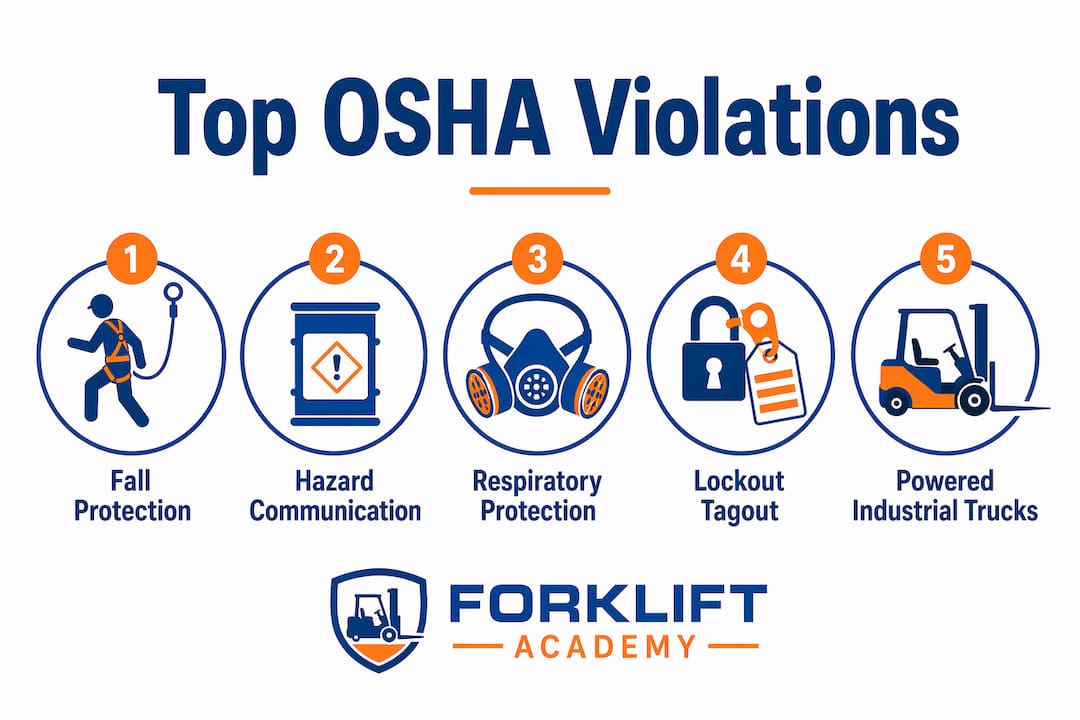
OSHA’s Top 10 Most Frequently Cited Standards for FY 2025 reveal where employers consistently fall short. Targeting these areas gives safety managers the highest return on compliance effort.
| Violation category | Primary risk |
|---|---|
| Fall protection (1926.501) | Fatal falls from elevated surfaces |
| Hazard communication (1910.1200) | Chemical exposure and toxic substance mishandling |
| Lockout/tagout (1910.147) | Uncontrolled energy release during maintenance |
| Respiratory protection (1910.134) | Lung disease from airborne contaminants |
| Ladders (1926.1053) | Falls from improper ladder use |
| Powered industrial trucks (1910.178) | Forklift collisions, tip-overs, and struck-by incidents |
Fall protection tops the list year after year because the hazard is universal and the citation is straightforward. Hazard communication violations often stem from incomplete Safety Data Sheets or employees who cannot identify the chemicals they work with daily. Lockout/tagout failures are particularly dangerous because they occur during maintenance windows when workers assume equipment is de-energized.
Powered industrial trucks, including forklifts, appear consistently because forklift safety compliance requires both operator certification and documented refresher training. A single uncertified operator is a citable offense regardless of how well the rest of your program runs.
The practical takeaway: build your internal audit checklist directly from this top-10 list. If your operation touches any of these categories, those are your highest-priority compliance gaps.
Why is training documentation critical to OSHA compliance?
Training completion is not the same as training compliance. Under 29 CFR 1910.119(g)(3), OSHA requires employers to demonstrate that employees both received and understood the training. An LMS completion record or a sign-in sheet proves attendance. It does not prove comprehension. That distinction is where many employers get cited.
OSHA inspectors increasingly ask for evidence of verified understanding, not just delivery. Common documentation failures include:
- Training records that list topics covered but not the standard addressed
- No post-training assessment or quiz results on file
- Remediation records missing when an employee failed an initial assessment
- No documentation of who conducted the training or their qualifications
The quality of your training records functions as an evidence package during an inspection. Each record should capture who was trained, when, which specific OSHA standard the training addressed, the assessment method used, the score or outcome, and any remediation completed. That level of detail is what separates a defensible program from a paper one.
Pro Tip: Treat every training record as if it will be subpoenaed. Build your documentation system to answer six questions: who, when, what standard, how assessed, what score, and what follow-up. If any answer is missing, the record is incomplete.
Implementing effective forklift safety training with verified comprehension is one area where many operations still rely on informal methods. A structured assessment tied to specific OSHA standards closes that gap and creates the paper trail that holds up under scrutiny.
What happens if employers neglect OSHA compliance?
The financial exposure from noncompliance is significant and escalating. Willful violations carry penalties of up to $165,514 per violation. Repeat violations carry the same ceiling. A single inspection uncovering multiple willful or repeat citations can generate seven-figure penalty exposure before any litigation begins.
The legal risk extends beyond civil penalties. Lax safety enforcement and tolerance of noncompliance can result in criminal prosecution when serious injury or death occurs. Courts have consistently held employers liable when supervisors allowed unsafe acts despite documented company safety rules. The logic is straightforward: if your written policy prohibits a behavior but your supervisors routinely ignore it, the policy provides no legal protection.
“Written rules alone do not provide safe harbor unless actively enforced and communicated to all relevant employees.” — Venable LLP, 2026
The misconduct defense, which allows employers to argue that a violation resulted from an employee’s unforeseeable behavior, fails when supervisors are the ones tolerating the unsafe act. That defense requires proof of strict, consistent enforcement. Without it, the employer absorbs full liability.
Beyond fines and criminal exposure, noncompliance creates reputational damage that affects hiring, contracting, and insurance costs for years. OSHA inspection results are public record. A pattern of citations signals to clients, insurers, and prospective employees that your operation treats safety as optional.
How can employers build an OSHA compliance program that goes beyond minimum standards?
Minimum compliance keeps you out of trouble. A proactive safety program keeps workers alive and your business competitive. Here is how to build one that actually functions:
- Write and communicate safety policies in plain language. Policies buried in employee handbooks do not count as communicated. Post critical rules at the point of hazard, review them in toolbox talks, and document every communication.
- Hold supervisors accountable for enforcement. Supervisor accountability is the single most important factor in whether a safety program functions in practice. Supervisors who tolerate violations create liability for the entire organization.
- Use OSHA’s free On-Site Consultation Program. Available in every state, this service provides confidential hazard assessments with no enforcement consequences. It is one of the most underused compliance tools available to small and mid-size employers.
- Conduct hazard recognition training for all employees. Workers who can identify hazards report them earlier. Early reporting prevents incidents and creates documentation that demonstrates your program’s proactive character.
- Track leading indicators, not just lagging ones. Injury rates tell you what already went wrong. Near-miss reports, hazard identification counts, and training completion rates tell you where your program is heading. Review both monthly.
- Audit against OSHA’s top-cited standards quarterly. Build a warehouse safety compliance checklist directly from OSHA’s published citation data and walk your facility against it before an inspector does.
The General Duty Clause means OSHA can cite you for hazards even when no specific standard exists, as long as the hazard is recognized and feasible abatement is available. A proactive program that identifies and controls hazards before they cause harm is the only reliable defense against General Duty Clause citations.
Key takeaways
OSHA compliance protects employers from citations, criminal liability, and financial loss while simultaneously reducing workplace injuries and building a safer, more productive workforce.
| Point | Details |
|---|---|
| Legal foundation | The OSH Act §5(a)(1) requires hazard-free workplaces even when no specific standard applies. |
| Financial return | Every dollar in safety investment returns four to six dollars in reduced injury costs. |
| Documentation standard | Training records must prove comprehension, not just attendance, to satisfy OSHA requirements. |
| Penalty exposure | Willful violations can reach $165,514 per citation, with criminal liability in fatality cases. |
| Proactive compliance | Auditing against OSHA’s Top 10 cited standards quarterly reduces citation risk and incident rates. |
The uncomfortable truth about “paper compliance”
After years of working with employers across material handling and warehousing, the pattern I see most often is not ignorance of OSHA rules. It is the gap between what a safety program says on paper and what supervisors actually enforce on the floor. Companies invest in written policies, conduct annual training, and file the paperwork. Then a supervisor lets a forklift operator skip the pre-shift inspection because the shift is short-staffed, and nobody documents it or corrects it.
That gap is where liability lives. OSHA compliance is not a documentation exercise. It is a behavioral standard that has to be modeled from the top down, every shift, every day. I have seen operations with excellent written programs receive willful citations because their enforcement was inconsistent. I have also seen smaller operations with modest programs avoid serious citations because their supervisors treated every rule as non-negotiable.
The employers who get this right treat compliance as the floor, not the ceiling. They use OSHA’s workplace safety requirements as a starting point and build from there. They invest in verified training, hold supervisors accountable by name, and review near-miss data the same way they review production numbers. That approach does not just satisfy an inspector. It actually prevents the incidents that destroy operations and end careers.
If your safety program would not survive a supervisor admitting under oath that they routinely allowed a cited behavior, your program is not a compliance program. It is a liability waiting to be triggered.
— Juiced
How Forkliftacademy helps you stay OSHA compliant
Forkliftacademy has delivered OSHA-compliant forklift and scissor lift certification programs for over 20 years, serving employers across the United States and Canada. Whether you need to certify a single operator or build internal training capacity across multiple sites, Forkliftacademy offers solutions that meet OSHA’s documentation and comprehension standards directly.
The Train the Trainer online program gives your designated safety staff the credentials and curriculum to certify operators in-house, with documentation built to withstand inspection. For operators who need direct certification, the OSHA forklift certification program covers all required competencies with verified assessment records included. Forkliftacademy also offers scissor lift certification for operations where aerial work platforms are part of daily work. Every program is designed to produce the training records OSHA actually requires, not just completion logs.
FAQ
What is OSHA compliance for employers?
OSHA compliance means meeting the legal obligations of the Occupational Safety and Health Act, including eliminating recognized hazards under the General Duty Clause and following specific OSHA standards. Employers covered by the OSH Act must maintain documented safety programs, conduct verified training, and correct identified hazards.
Why follow OSHA standards if my industry has a low injury rate?
A low injury rate does not eliminate citation risk. OSHA inspects based on complaints, referrals, and programmed schedules regardless of historical injury data, and willful violations can reach $165,514 per citation even in operations with no recent incidents.
How often does OSHA inspect workplaces?
Federal OSHA conducts roughly 30,000 inspections annually across more than 8 million worksites, and 28 state-plan programs conduct additional inspections under their own authority. Inspections are triggered by complaints, referrals, fatalities, and programmed targeting of high-hazard industries.
Does training completion satisfy OSHA’s training requirements?
No. Under 29 CFR 1910.119(g)(3), OSHA requires proof that employees both received and understood training. Attendance records and LMS completions alone are insufficient. Employers need documented assessments, scores, and remediation records to demonstrate verified comprehension.
What is the General Duty Clause and why does it matter?
The General Duty Clause under OSH Act §5(a)(1) allows OSHA to cite employers for hazards not covered by a specific standard, as long as the hazard is recognized and feasible abatement exists. It functions as a compliance backstop, meaning no employer can claim a hazard is acceptable simply because no explicit rule addresses it.
Recommended
- Workplace Safety Compliance: What Every Business Must Know – Top Osha Forklift Certification
- Understanding What is OSHA Compliance: A Complete Guide – Top Osha Forklift Certification
- Employee forklift training guide for OSHA compliance 2026 – Top Osha Forklift Certification
- Forklift safety checklist 2026: ensure OSHA compliance – Top Osha Forklift Certification