
TL;DR:
- OSHA mandates that employers provide documented, competency-based training and evaluations for lift operators, with no official license required.
- Operators must wear full-body harnesses at all times when elevated, while daily pre-use inspections and records are essential for compliance.
- ANSI A92 standards enhance OSHA requirements by emphasizing supervisor training and hazard prevention, leading to safer lift operations.
Regulatory compliance for lift operators is defined by OSHA standards 29 CFR 1926.453 and 29 CFR 1910.67, which govern aerial lift operation in construction and general industry respectively. These rules set the legal floor for who can operate a lift, what training they must receive, what protective equipment they must wear, and how equipment must be inspected before each use. ANSI A92 standards, specifically A92.22 and A92.24, provide the detailed training frameworks that help employers exceed those legal minimums. Together, OSHA and ANSI define a compliance program that protects operators, limits employer liability, and keeps worksites legally defensible. If you manage lift operations or work on one, understanding both layers is not optional.
What are the OSHA requirements for lift operator training and authorization?
OSHA’s aerial lift standard 29 CFR 1926.453 is unambiguous: only trained and authorized persons may operate aerial lifts. There is no government-issued lift operator license in the United States. The employer carries full responsibility for training each operator, evaluating their competency, and documenting that authorization before the operator ever touches the controls. That distinction matters because it places legal accountability directly on the employer, not a third-party licensing body.
Training content under OSHA must cover five core areas:
- Hazard recognition including overhead power lines, ground conditions, and load limits
- Equipment operation specific to the lift type the operator will use
- Fall protection requirements and proper use of anchorage points
- Pre-use inspection procedures before each shift
- Manufacturer instructions for the specific make and model in use
OSHA also mandates a 10-foot clearance from energized overhead power lines for all aerial lifts. This rule applies regardless of visibility or perceived line activity, and any conductive tools held by the operator count toward that distance. Training programs that skip this detail leave operators exposed to one of the most lethal hazards on any worksite.
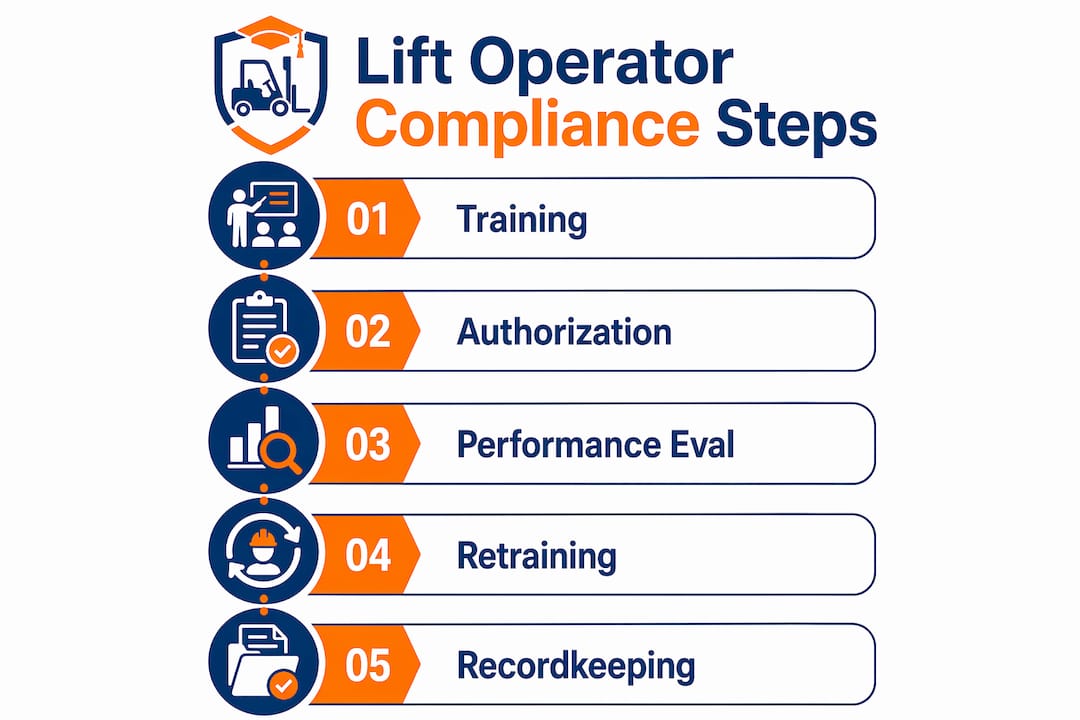
One of the most misunderstood aspects of OSHA compliance involves retraining intervals. Performance evaluations must occur at least every three years, but refresher training is not tied to a fixed calendar. It is triggered by specific events: an observed unsafe operation, an accident or near miss, or a change in workplace conditions or equipment type. Employers who treat the three-year evaluation as a training renewal date are misreading the standard, and that misreading creates gaps in actual operator competency.
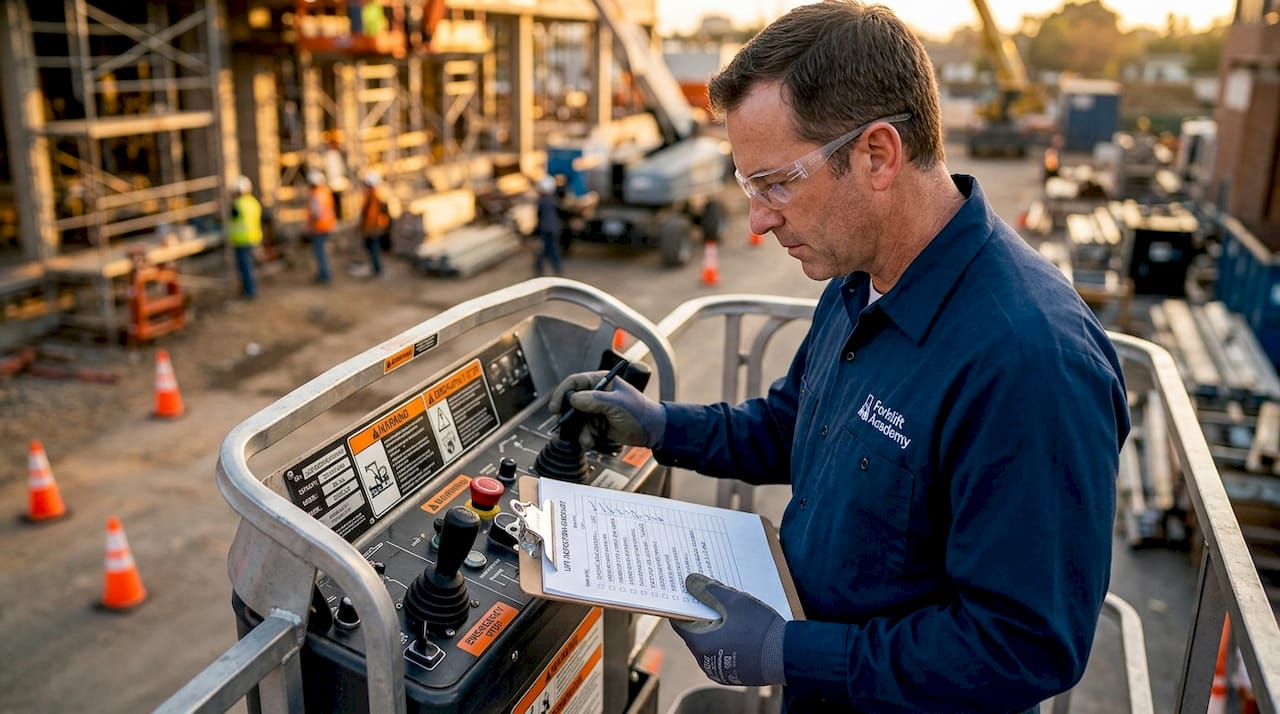
Documentation is the backbone of any defensible compliance program. Employers must maintain records of initial training, performance evaluations, and any retraining events. A 36-month compliance calendar for evaluations, tracked separately from event-triggered retraining, is the practical way to stay current. Forkliftacademy recommends building that calendar into your safety management system so evaluation dates never slip past their deadline.
Pro Tip: Keep a separate log for each operator that records their initial authorization date, lift types they are authorized to operate, evaluation dates, and any retraining events. This single document answers every OSHA audit question in one place.
How do fall protection and PPE requirements apply to lift operators?
Fall protection is not optional at any elevation in a lift. OSHA requires operators to wear fall protection at all times when elevated, and the type of system required depends on the regulatory context and equipment involved. The key distinction is between a fall arrest system and a fall restraint system.
- Full-body harnesses connected to the lift’s designated anchorage point are the current standard for fall arrest in aerial lift operation.
- Body belts with lanyards are still permitted as restraint systems, meaning they prevent the operator from reaching a fall position, but they cannot be used as fall arrest devices.
- Since 1998, body belts are prohibited as fall arrest equipment. Any employer still issuing body belts as the primary fall protection for elevated operators is out of compliance.
- Lanyards must be short enough to prevent the operator from being ejected from the platform if the lift contacts an obstacle or tips.
- Anchorage points must be manufacturer-designated. Operators cannot attach to a guardrail or any point not specified in the equipment manual.
The practical implication is straightforward. Full-body harnesses with shock-absorbing lanyards attached to the manufacturer’s anchorage point represent both the OSHA-compliant and the safest configuration for aerial lift work. Many employers go further by requiring harnesses even on scissor lifts, where OSHA’s fall protection requirements are less prescriptive, because the cost of a harness is negligible compared to the cost of a fall injury.
Pro Tip: When purchasing new harnesses for your crew, confirm the harness is rated for the specific lift type and that the lanyard length matches the platform dimensions. A lanyard that is too long defeats the purpose of the restraint system entirely.
A practical OSHA aerial lift compliance program treats PPE as a non-negotiable daily habit, not a situational choice. Safety coordinators should conduct random spot checks to confirm harness use during elevated work, and those checks should be logged. Documented spot checks demonstrate due diligence if an incident ever results in an OSHA inspection.
What are the inspection and maintenance obligations for lifts?
Pre-use inspection is a legal requirement, not a best practice suggestion. OSHA 29 CFR 1926.453 requires operators to test all controls before each shift to confirm proper operation. That means every operator, every day, before the first lift of the shift. The inspection is not a mechanic’s job. It is the operator’s responsibility, and training must cover exactly what to check.
| Inspection type | Frequency | Responsible party | Documentation required |
|---|---|---|---|
| Pre-use control test | Before each shift | Operator | Inspection checklist, signed |
| Routine maintenance | Per manufacturer schedule | Maintenance technician | Service log |
| Quarterly inspection (Canada) | Every 3 months | Qualified technician | Signed maintenance record |
| Annual inspection | Yearly | Certified inspector | Formal inspection report |
Canadian operations face additional obligations. Technical Safety BC’s mandatory maintenance directive requires at least quarterly checks for elevating devices, with maintenance logs retained for five years. Those logs must be legible, accessible, and signed by the responsible technician. This is a stricter standard than OSHA’s federal requirements, and U.S. companies operating in Canada must account for it.
Key documentation practices that apply across both jurisdictions include:
- Assign a named individual as the responsible party for each lift’s maintenance records.
- Store inspection logs in a location accessible to both operators and inspectors.
- Flag any defect found during a pre-use inspection immediately and remove the equipment from service until repaired.
- Never allow an operator to continue using a lift with a known defect, even a minor one, without documented authorization from a qualified technician.
Worksites that operate multiple lift types benefit from a compliance matrix. This is a simple document that maps each piece of equipment to its specific maintenance intervals, inspection requirements, and assigned responsible party. It removes ambiguity and makes it impossible to overlook a device during a busy operational period.
How do ANSI A92 standards complement OSHA regulations?
ANSI A92 standards are not law, but they function as the industry’s detailed playbook for lift safety. OSHA sets the legal minimum. ANSI A92.22 and A92.24 provide the training frameworks that tell employers exactly how to meet and exceed those minimums. Organizations that build their compliance programs around ANSI standards consistently demonstrate stronger safety records and face fewer OSHA citations.
| Standard | Scope | Key requirement |
|---|---|---|
| OSHA 29 CFR 1926.453 | Construction industry | Authorized operators, PPE, pre-use inspection |
| OSHA 29 CFR 1910.67 | General industry | Vehicle-mounted elevating platforms |
| ANSI A92.22 | Mobile elevating work platforms | Operator and supervisor training content |
| ANSI A92.24 | Training requirements | Competency-based evaluation and documentation |
The most underutilized element of ANSI A92 compliance is supervisor training. ANSI A92 supervisor training requires supervisors to understand how to select the correct lift for a task, identify site-specific hazards, interpret manufacturer manuals, and verify that operators under their oversight are properly trained and authorized. A supervisor who cannot answer those questions is a compliance gap, not just a knowledge gap.
ANSI A92 standards also serve as detailed best practices that help organizations build a genuine lift safety culture rather than a checkbox compliance program. The difference shows up in incident rates. Companies that train supervisors to the ANSI standard, not just operators, see fewer near misses because hazard identification happens before the lift goes up, not after something goes wrong. Forkliftacademy’s train-the-trainer programs are built to address exactly this gap by equipping internal trainers to deliver ANSI-aligned instruction consistently across shifts and locations.
Key takeaways
Regulatory compliance for lift operators requires OSHA-authorized training, documented performance evaluations every three years, full-body harness use at elevation, daily pre-use inspections, and ANSI A92-aligned supervisor oversight to build a legally defensible and genuinely safe program.
| Point | Details |
|---|---|
| OSHA authorization is employer-driven | No government license exists; employers must train, evaluate, and document each operator’s authorization. |
| Retraining is event-triggered | The 3-year evaluation is not a training renewal; refresher training activates after incidents or observed unsafe behavior. |
| Full-body harnesses are required | Body belts cannot serve as fall arrest devices since 1998; full-body harnesses at manufacturer anchorage points are the standard. |
| Daily inspections are mandatory | Operators must test all controls before each shift and document findings on a signed checklist. |
| ANSI A92 closes the gap | Supervisor training under ANSI A92.22 and A92.24 exceeds OSHA minimums and reduces incident rates. |
Why most compliance programs fail before the first inspection
After working in lift safety education for years, the pattern I see most often is not willful negligence. It is a structural misunderstanding of where compliance actually lives. Most managers assume compliance is a training event. You send the operator to a course, they get a card, and the box is checked. That is not what OSHA requires, and it is not what protects you when an inspector walks onto your site.
The real compliance program lives in three places: your authorization records, your inspection logs, and your retraining triggers. I have seen companies with excellent training programs get cited because they could not produce a signed pre-use inspection checklist from the morning of an incident. The training happened. The documentation did not. OSHA does not distinguish between the two.
The other failure point I see consistently is the gap between operator training and supervisor knowledge. Operators get trained. Supervisors do not. Then a supervisor authorizes a lift in conditions the operator was trained to refuse, because the supervisor never learned the hazard assessment criteria. ANSI A92’s supervisor training requirement exists precisely to close that gap, and it is the single highest-leverage investment a safety coordinator can make.
My recommendation: build a compliance matrix for every lift type on your site, assign named owners to each maintenance record, and put your supervisor training on the same schedule as your operator evaluations. If you do those three things, you will be ahead of the majority of operations currently running on assumption rather than documentation.
— Juiced
Get OSHA-compliant lift operator training that holds up to scrutiny
Forkliftacademy has delivered OSHA-compliant lift operator training for over 20 years, covering aerial lifts, scissor lifts, and forklifts through both online and onsite formats. Every program is built to meet the lift certification requirements that OSHA inspectors actually check: documented authorization, performance evaluation records, and equipment-specific training content. For safety coordinators who need to train internal instructors, the train-the-trainer online program gives your team the tools to deliver consistent, ANSI-aligned training across every shift. Stop relying on a training card and start building a compliance program that protects your operators and your organization.
FAQ
What does OSHA require for lift operator authorization?
OSHA requires employers to train each operator on the specific lift type they will use, evaluate their competency, and document that authorization before operation begins. There is no government-issued license; the employer is fully responsible for the authorization process.
How often does lift operator training need to be renewed?
OSHA mandates a performance evaluation at least every three years, but refresher training is triggered by specific events such as an accident, near miss, or observed unsafe operation, not by a fixed calendar interval.
What fall protection is required for aerial lift operators?
Operators must wear a full-body harness connected to the manufacturer’s designated anchorage point at all times when elevated. Body belts may only be used as restraint systems and are prohibited as fall arrest devices under OSHA standards.
Are ANSI A92 standards legally required?
ANSI A92 standards are not federal law, but they provide the detailed training and supervisor oversight frameworks that help employers meet and exceed OSHA’s legal minimums. Many insurers and general contractors require ANSI compliance as a condition of site access.
What records must employers keep for lift operator compliance?
Employers must maintain records of initial training, equipment-specific authorization, performance evaluation dates, and any retraining events. Inspection checklists signed by operators before each shift are also required and must be available during an OSHA inspection.
Recommended
- Forklift operator responsibilities list: 2026 compliance – Top Osha Forklift Certification
- Lift Operator License: The OSHA Compliance Guide for Managers – Top Osha Forklift Certification
- Scissor Lift Operator Workflow for Safety Compliance – Top Osha Forklift Certification
- Forklift Operator Requirements 2025: Complete Guide – Top Osha Forklift Certification