
TL;DR:
- Supervisors play a critical role in forklift safety by ensuring operator training, conducting proper inspections, and fostering a safety-focused culture. They must verify training components, enforce immediate removal of unsafe equipment, and document all safety activities to comply with OSHA standards. Active supervisory involvement and discipline are essential for sustainable, injury-free warehouse operations.
The role of supervisor in forklift safety is defined as the direct responsibility to train, monitor, and enforce safe forklift operations in compliance with OSHA’s Powered Industrial Truck standard, 29 CFR 1910.178. Supervisors are not passive observers. They are the operational backbone of any forklift safety management program, accountable for everything from verifying operator certification to pulling unsafe equipment from service before a single shift begins. Warehouses that treat supervision as a checkbox function consistently produce higher incident rates and fail OSHA audits. This guide gives you the specific responsibilities, workflows, and enforcement strategies you need to lead a compliant, injury-free operation.
What are supervisor responsibilities in forklift safety training?
Forklift operator training is not optional, and neither is supervisor oversight of that training. OSHA requires forklift operator training to include formal instruction, practical training, and a workplace evaluation before any operator works independently. As a supervisor, your job is to verify that all three components are completed, documented, and assigned to qualified individuals.
Here is what that looks like in practice:
- Verify trainer qualifications. Training documentation must name the specific trainer and evaluator responsible for each operator. Vague policies that list “the safety department” as the responsible party fail OSHA inspections. You need a named person with documented knowledge and experience. Forkliftacademy’s guide to forklift trainer responsibilities outlines exactly what qualifications that person must hold.
- Confirm all three training components are complete. Formal instruction covers written materials, videos, and lectures. Practical training puts the operator on the truck in a controlled setting. The workplace evaluation tests competency in the actual environment where the operator will work. All three must occur before unsupervised operation begins.
- Manage retraining and re-evaluation cycles. OSHA requires operator re-evaluation at least every three years, and sooner if an unsafe operation, accident, or near-miss is observed. Supervisors must track these cycles and trigger re-evaluation proactively, not reactively after an incident has already caused harm.
- Maintain audit-ready records. Every training event needs a record that includes the operator’s name, the date, the trainer’s name, the truck types covered, and the evaluation result. Store these records where they can be retrieved immediately during an OSHA inspection.
Pro Tip: Set calendar reminders 60 days before each operator’s three-year re-evaluation deadline. This gives you time to schedule training without pulling operators off the floor at the last minute.
How do supervisors manage shift inspections for forklift safety?
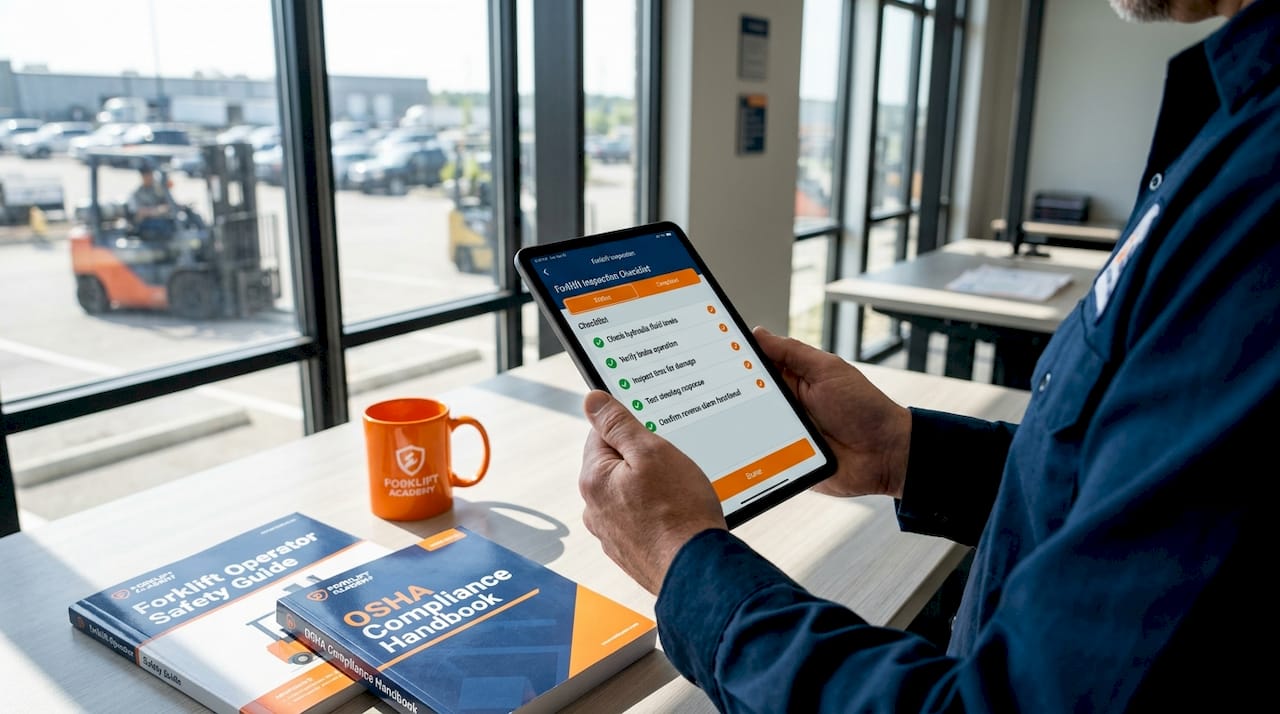
Pre-shift inspection is one of the most consistently mismanaged areas in forklift safety management. For multi-shift operations, OSHA mandates forklift inspections before each shift and after shifts if the truck will be reused. That means a forklift running across three shifts needs three documented inspections per day.
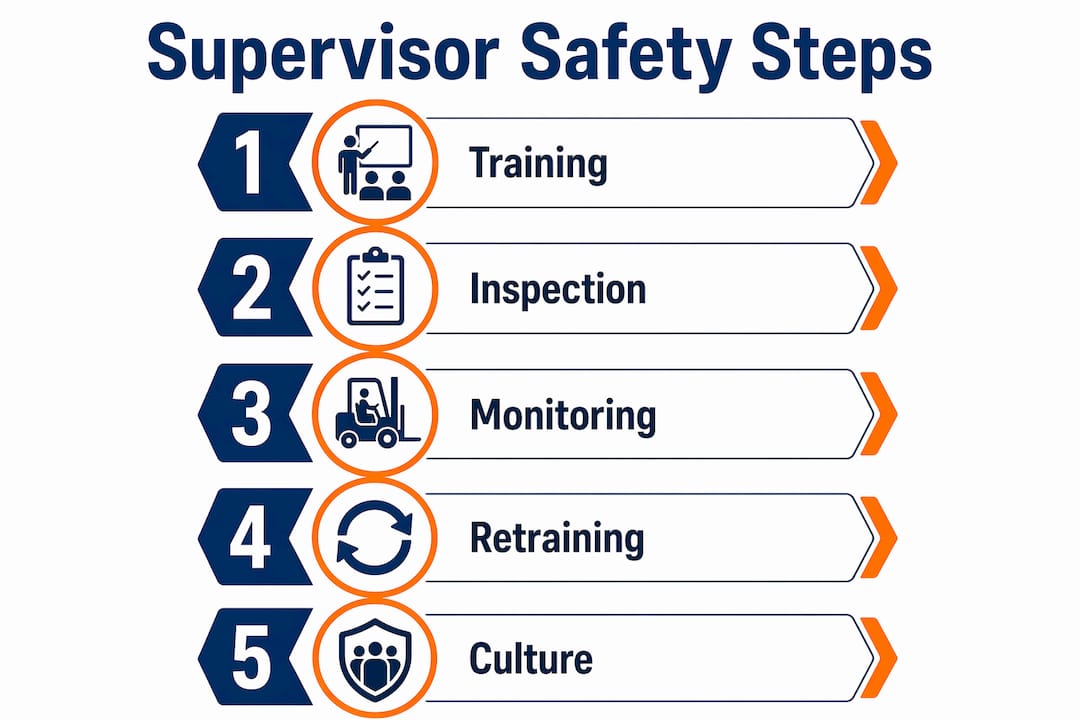
Supervisors must do more than tell operators to “check the truck.” Your role is to verify the inspection happened, confirm it was documented, and act immediately when a deficiency is found.
Common compliance failures supervisors must prevent:
- Operators signing off on inspection forms without physically checking the equipment
- Supervisors accepting verbal confirmation instead of reviewing written documentation
- Missing multi-shift inspection documentation across shift changes, particularly when different supervisors manage each shift
- Delaying removal of a defective truck because “we need it on the floor”
- Failing to tag out unsafe equipment and notify maintenance with a written work order
| Inspection practice | Compliant approach | Common failure |
|---|---|---|
| Documentation method | Signed checklist per shift, stored on file | Verbal confirmation or unsigned forms |
| Defect response | Immediate removal from service, tagged out | Continued use until end of shift |
| Multi-shift handoff | New inspection before each shift begins | Single daily inspection shared across shifts |
| Supervisor verification | Review completed forms before operations start | Assume operators completed the check |
Digital tools can greatly enhance compliance by verifying inspection completion and flagging deficiencies in real time. Mobile checklist apps replace paper logs and create a time-stamped audit trail that paper cannot match. This matters when OSHA asks for documentation from six months ago.
Pro Tip: Use Forkliftacademy’s forklift inspection checklist as a template for your digital inspection form. It covers every OSHA-required inspection point and is formatted for quick completion at shift start.
What processes should supervisors implement to monitor operators and trigger retraining?
Monitoring operator behavior is an active, ongoing responsibility. It does not end after initial certification. Retraining triggers function as distinct operational responses: unsafe observations and incident-based events each require a specific workflow, and supervisors must know the difference.
Here is how to build a functional monitoring and retraining process:
- Establish a routine observation schedule. Walk the floor during active forklift operations at least once per shift. Watch for speeding in pedestrian zones, improper load handling, failure to use horns at intersections, and distracted operation. Document what you observe, even when behavior is acceptable.
- Separate observation-triggered re-evaluation from incident-triggered retraining. When you observe unsafe behavior, remove the operator from duty immediately and schedule a re-evaluation before they return. When an accident or near-miss occurs, the operator must complete full retraining, not just a re-evaluation. These are two different OSHA responses.
- Remove operators from duty without exception. Operators showing unsafe behavior must be removed from operation, retrained or re-evaluated, and cleared before returning to independent work. Allowing an operator to “finish the shift” after observing unsafe behavior is a compliance violation and a liability.
- Document every intervention. Record the date, the specific behavior observed, the supervisor who intervened, the retraining or re-evaluation completed, and the clearance date. This documentation protects your facility during OSHA inspections and legal proceedings.
“There is no OSHA-issued forklift certification. Employers must document operator training and competence evaluations with qualified trainers — and supervisors are accountable for ensuring that documentation exists and is accurate.”
Forkliftacademy’s resource on implementing forklift safety training provides a practical framework for building these workflows into your existing operations without disrupting productivity.
How do supervisors build a lasting forklift safety culture?
A forklift safety culture does not emerge from a posted policy. It is built through consistent supervisor behavior, visible presence, and structured communication. A layered safety approach combines training, real-time floor support, and retroactive evaluation. Supervisors who are physically present during operations produce measurably better safety outcomes than those who manage from an office.
Practical behaviors that reinforce safety culture on the warehouse floor:
- Be visible during peak operation hours. Operators adjust their behavior when supervisors are present. Consistent presence normalizes safe practices rather than treating them as performance for inspections.
- Create a clear channel for hazard reporting. Operators who spot a malfunctioning truck, a damaged floor surface, or a blind intersection need a direct, no-consequence way to report it. Supervisors who respond quickly to reports build trust and get more reports.
- Coordinate with maintenance before problems escalate. When inspection forms flag recurring defects on the same truck, escalate to maintenance immediately. A pattern of repeated defects on a single unit signals a deeper mechanical issue that spot repairs will not fix.
- Conduct brief safety huddles at shift start. A two-minute conversation about the day’s hazards, recent near-misses, or updated traffic patterns costs nothing and reinforces that safety is an operational priority, not a compliance exercise.
The supervisor role in warehouse safety extends beyond forklifts. But forklift operations represent the highest-risk activity in most warehouse environments, which makes this the area where supervisory discipline produces the greatest return.
Key takeaways
Supervisors are the single most critical variable in forklift safety outcomes, responsible for training oversight, inspection enforcement, operator monitoring, and the cultural conditions that make compliance sustainable.
| Point | Details |
|---|---|
| Training verification | Supervisors must confirm all three OSHA training components are complete and documented before any operator works independently. |
| Inspection enforcement | Pre-shift inspections must be documented per shift, and defective equipment must be removed from service immediately without exception. |
| Retraining triggers | Unsafe behavior triggers re-evaluation; accidents or near-misses trigger full retraining before the operator returns to duty. |
| Documentation discipline | Every training event, inspection, and intervention must be recorded with named individuals and dates to survive an OSHA audit. |
| Safety culture | Visible supervisor presence, open hazard reporting, and coordination with maintenance are the behaviors that make compliance durable. |
What most supervisors get wrong about forklift safety
After working in and around forklift safety programs for years, the pattern I see most often is supervisors who treat their role as administrative rather than operational. They sign off on training records, review inspection forms at the end of the week, and assume that because no one has been hurt, the system is working. That assumption is the most dangerous thing in the warehouse.
The supervisors who actually prevent accidents are the ones who treat every shift as a live audit. They walk the floor, they ask operators questions, and they pull trucks from service without hesitation when something looks wrong. The ones who struggle are the ones who wait for an incident to tell them the system has failed.
The retraining trigger distinction matters more than most supervisors realize. Treating an unsafe observation the same as a routine re-evaluation cycle is a compliance error. Treating an accident the same as an unsafe observation is an even bigger one. These are distinct events that require distinct responses, and the documentation for each must reflect that.
My honest advice: invest in training for yourself, not just your operators. Supervisors who understand OSHA’s specific requirements for forklift programs, including what qualifies a trainer and what triggers mandatory retraining, make better decisions in real time. That knowledge is what separates a supervisor who prevents accidents from one who documents them after the fact.
— Juiced
Strengthen your forklift safety program with Forkliftacademy
Forkliftacademy has delivered OSHA-compliant forklift training across the United States and Canada for over 20 years. If you are a supervisor or safety manager looking to formalize your training program, the Train the Trainer online course gives you the tools to certify in-house trainers, build audit-ready documentation systems, and meet every OSHA requirement for operator evaluation. For facilities that need broader coverage, Forkliftacademy’s full range of forklift certification programs includes onsite options, evaluation-only formats, and business solutions designed for multi-shift warehouse environments. Your operators need qualified supervision. Forkliftacademy helps you become it.
FAQ
What is the supervisor’s primary role in forklift safety?
The supervisor’s primary role is to verify that all forklift operators are trained, evaluated, and documented before independent operation, and to enforce inspection and retraining requirements on an ongoing basis under OSHA 29 CFR 1910.178.
How often must forklift operators be re-evaluated?
OSHA requires re-evaluation at least every three years, and sooner if a supervisor observes unsafe operation, an accident occurs, or a near-miss is reported. Supervisors must initiate this process, not wait for operators to self-report.
Can a supervisor serve as the forklift trainer and evaluator?
Yes, provided the supervisor has documented knowledge, training, and experience to train and evaluate forklift operators on the specific truck types used at the facility. OSHA does not issue forklift certifications; the employer is responsible for documenting trainer qualifications.
What happens if a forklift fails a pre-shift inspection?
The truck must be immediately removed from service and tagged out until repairs are completed and verified. Supervisors who allow continued use of a defective forklift are in direct violation of OSHA 1910.178 and expose the facility to citations and liability.
How should supervisors document retraining after an incident?
Documentation must include the date of the incident or observation, the specific unsafe behavior or event, the retraining or re-evaluation completed, the name of the trainer or evaluator, and the date the operator was cleared to return to independent operation.
Recommended
- Essential Forklift Skills for Safe, Compliant Operations – Top Osha Forklift Certification
- Forklift compliance guide: Keep your warehouse safe in 2026 – Top Osha Forklift Certification
- How to comply with OSHA forklift rules: a manager’s guide – Top Osha Forklift Certification
- Forklift Operator Safety Rules: Essential Guide – Top Osha Forklift Certification