
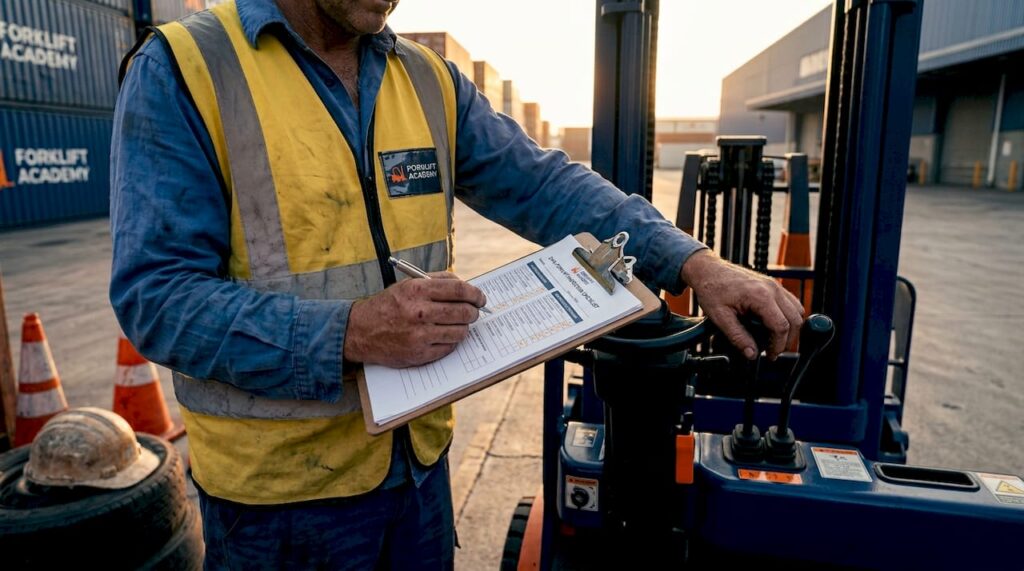

TL;DR:
- Forklift compliance is an ongoing process that requires continuous training, documentation, and site-specific evaluations. Employers are responsible for maintaining thorough records, conducting regular inspections, and updating training based on evolving site hazards. Failing to comply can lead to significant OSHA fines and safety risks, so embedding compliance into daily operations is essential for safety and legal adherence.
Forklift compliance gets treated like a one-time checkbox far too often. Train the operator, file the paperwork, move on. But the importance of forklift compliance goes well beyond that single moment. The Occupational Safety and Health Administration (OSHA) treats forklift safety as an ongoing, documented, and site-specific obligation, and the penalties for missing the mark have climbed sharply. In 2026, serious violation fines reach up to $16,550 per citation, with willful or repeated violations topping $165,514. This guide breaks down exactly what compliance requires, where most warehouses fall short, and how to build it into daily operations so it actually sticks.
| Point | Details |
|---|---|
| Compliance is a continuous process | OSHA requires ongoing training, evaluation, and documentation, not just a one-time certification event. |
| Documentation gaps trigger violations | Missing operator names, training dates, or evaluator records are among the most cited OSHA infractions. |
| Refresher training has specific triggers | Accidents, unsafe behavior, new equipment, or workplace changes all require refresher training before unsupervised operation. |
| Digital inspection systems outperform paper | Timestamped digital checklists create verifiable records that paper logs cannot reliably produce during audits. |
| Site-specific hazards need tailored training | Operators must be certified per forklift class, and training must reflect the actual environment where they work. |
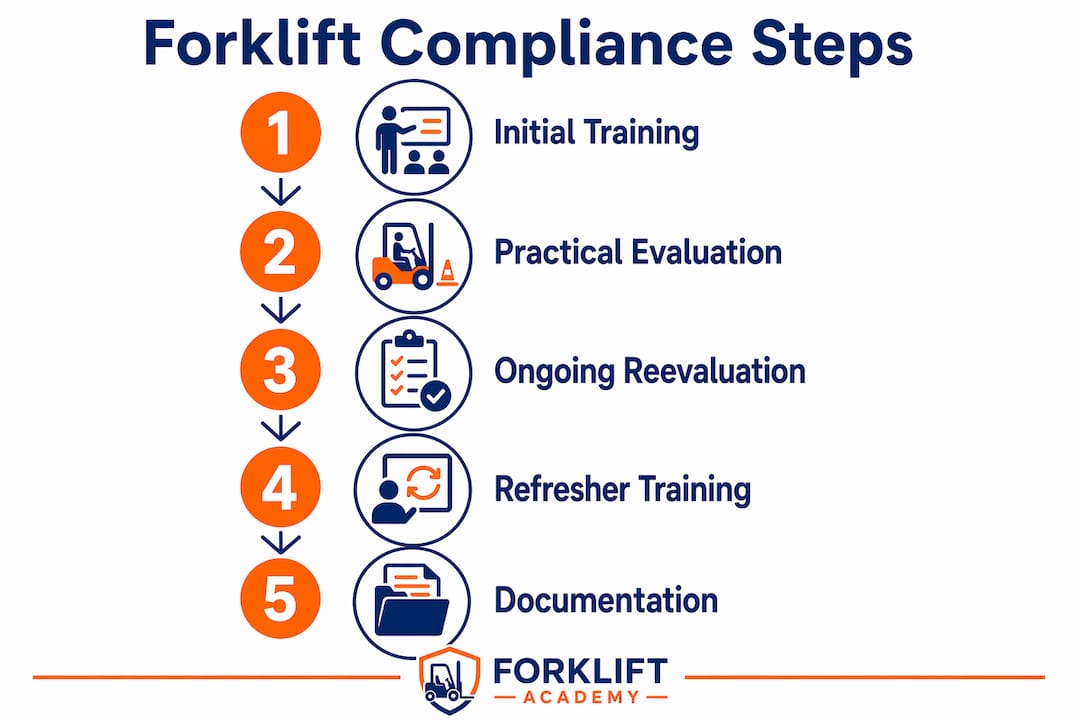
OSHA’s primary standard for forklift operators is 29 CFR 1910.178(l), and it mandates a three-part process before any operator runs a forklift unsupervised. Those three parts are formal instruction, practical hands-on training, and a workplace performance evaluation. All three must happen. Skipping or combining any of them puts your operation out of compliance immediately.
Here is what that three-part process looks like in practice:
Beyond initial certification, OSHA requires refresher training after specific triggers: observed unsafe operation, an accident or near miss, an unsatisfactory evaluation, assignment to a different truck class, or a significant change to workplace conditions. Even without any of those events, operators need a full reevaluation every three years.
One more piece that often gets missed: employers remain directly liable for operator certification even when they hire a third-party training provider. Outsourcing the training does not transfer the compliance obligation. You still need signed records in your files.
Pro Tip: Create a certification tracking spreadsheet that flags operators 60 days before their three-year evaluation deadline. That buffer gives you enough time to schedule training without rushing or letting certifications lapse.
Most OSHA forklift citations do not come from obvious safety failures. They come from paperwork problems and procedural gaps that build up quietly over months. Here is where warehouses tend to go wrong:
Pro Tip: Conduct an internal mock audit once a year. Pull five random operator files and check for every required documentation field. If you cannot quickly locate a complete record for each one, your filing system needs a structural fix before OSHA finds it first.
Compliance is not something you can prepare for in the week before an audit. It has to be embedded into the daily forklift safety compliance workflow so that the right actions happen automatically. Here is what that looks like across key operational touchpoints:
| Compliance Activity | Frequency | Key Requirement |
|---|---|---|
| Pre-shift equipment inspection | Every shift, before operation | Documented and signed by operator |
| Defect reporting and removal from service | Immediately upon discovery | Equipment must be tagged out until repaired |
| Operator certification verification | Before allowing unsupervised operation | All three training parts plus documentation complete |
| Refresher training review | After any trigger event | Documented and filed before return to solo operation |
| Full reevaluation | Every three years minimum | Separate record from initial training |
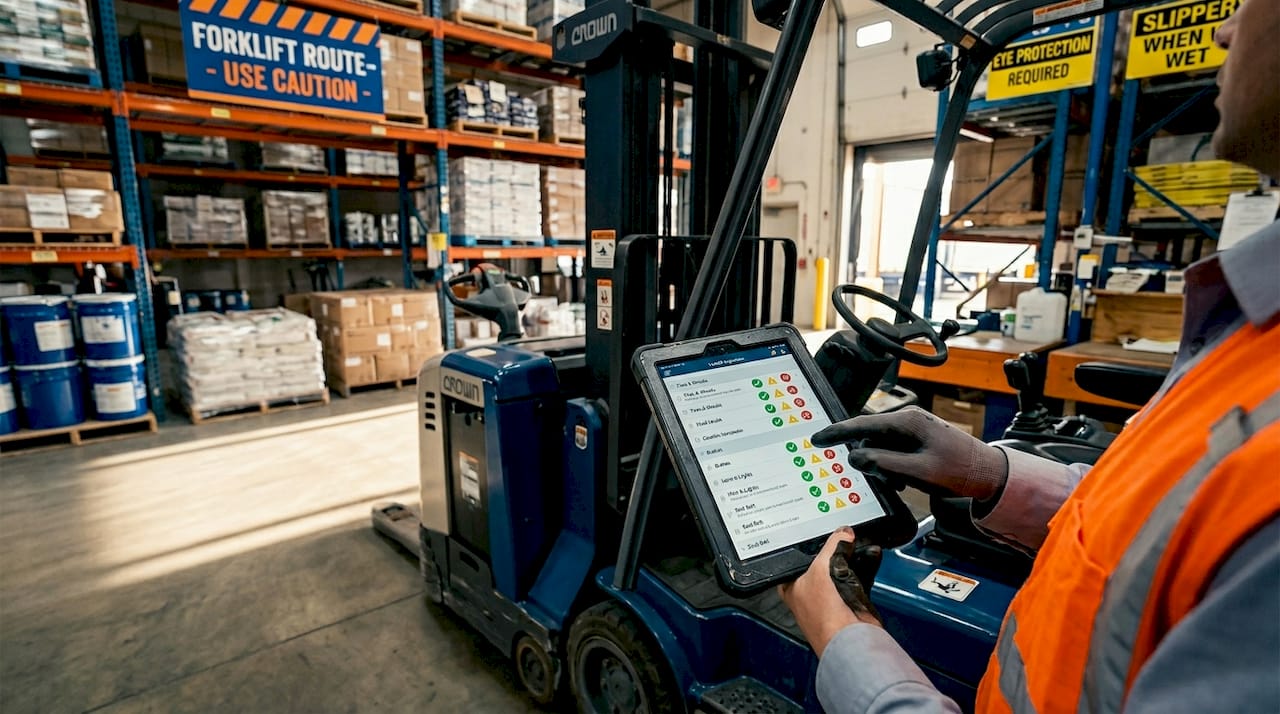
The biggest operational upgrade most warehouses can make is moving from paper inspection checklists to a digital system. Daily pre-shift inspections are legally required under OSHA 29 CFR 1910.178(q)(7), and paper logs routinely fail audits due to missing signatures, incomplete fields, or lost records. Digital checklists create timestamped, verifiable entries automatically.
The operational benefits compound from there. Digital systems integrated with telematics can route defect reports directly to maintenance work orders, flag uninspected trucks before operators attempt to start them, and generate audit-ready reports on demand. That is not a luxury upgrade. It is a practical response to the real cost of inspection gaps that show up during surprise OSHA visits.
Tying forklift safety into your broader site risk management also matters. Loading docks, in particular, are high-traffic zones where forklift incidents cluster. Treat dock operations as a distinct hazard category with its own protocols, including dedicated pedestrian lanes, speed limits, and spotter requirements during trailer loading.
Forklift safety regulations do not stay static. In 2025, New York’s Warehouse Worker Injury Reduction Program took effect, requiring warehouses to develop formal injury prevention plans, conduct site-specific risk assessments, and address loading dock hazards as a priority area. If your operation is in New York, this adds a compliance layer that sits on top of existing OSHA rules. Other states are watching closely, and similar frameworks are likely to spread.
Even where state-level regulations have not changed, the principle holds: compliance programs must reflect your actual site, not a generic template. Here is how to keep your compliance strategy current and specific:
The goal is a compliance program that updates itself in response to real conditions, rather than one that gets reviewed only when something goes wrong.
I’ve seen warehouses with binders full of certificates and operators who genuinely do not know how to respond to a tip-over. I’ve also seen facilities where the paperwork was thin but the culture was strong. Both have problems. But the second group gets into far less serious trouble, because their operators actually make sound decisions in the moment.
What I’ve learned after years of watching forklift safety programs succeed and fail is that the paperwork is not the point. The paperwork is evidence that the real work happened. When managers treat proactive operator education and daily equipment checks as genuine operational controls rather than audit preparation, the outcomes are different. Incident rates drop. Near misses get reported instead of buried. And when OSHA does show up, the records match the reality on the floor because they were never written to impress an auditor.
The resistance I hear most often is about refresher training. Managers say their operators are experienced and do not need it. That argument evaporates after the first serious incident. Experience reduces certain risks, but it also breeds complacency. Scheduled reevaluations catch the habits that experienced operators develop without noticing. Three years goes by fast, and the person who was sharp when certified may have developed several shortcuts by now.
Treat compliance as an operational control. Not a legal checkbox.
— Juiced
Whether you are building a compliance program from scratch or patching gaps before your next audit, Forkliftacademy has the resources to move you forward.
Forkliftacademy delivers OSHA-compliant certification programs for individual operators and large warehouse teams, covering every forklift class with the formal instruction, hands-on guidance, and documentation support that 29 CFR 1910.178(l) requires. For facilities that want to manage training internally, the Train the Trainer online program builds certified in-house instructors who can run evaluations and refresher training on your schedule. Both options generate the documentation your records need to survive an audit, and both integrate with the ongoing compliance workflows that keep your team safe year-round.
OSHA requires three components before an operator works unsupervised: formal instruction, practical hands-on training, and a workplace performance evaluation. All three must be documented with the operator’s name, training date, evaluation date, and evaluator’s identity.
Operators must be reevaluated at least every three years, even without any incidents. Refresher training is also required immediately after accidents, observed unsafe behavior, assignment to a new truck class, or significant changes to the work environment.
No. Online training can fulfill the formal instruction component, but OSHA also requires hands-on practical training and a site-specific workplace evaluation. Skipping either of those elements leaves the certification incomplete under 29 CFR 1910.178(l).
OSHA can issue fines up to $16,550 per serious violation and up to $165,514 for willful or repeated violations. Incomplete certification records are among the most frequently cited infractions.
No. OSHA holds the employer directly responsible for operator certification and documentation. Using an outside training provider does not relieve you of the obligation to maintain signed records or conduct workplace performance evaluations.