

TL;DR:
- Skipping forklift maintenance leads to costly emergency repairs, unplanned downtime, and workplace injuries. Implementing tiered inspections and fostering operator engagement significantly improves safety, reduces costs, and ensures regulatory compliance. Building a proactive maintenance culture with well-trained operators is essential for maximizing operational efficiency and safety.
Skipping forklift maintenance feels like saving time. In reality, you are loading up a debt that pays out in the worst ways: emergency repairs, unplanned downtime, and workplace injuries. 70% of unplanned breakdowns trace directly back to deferred or skipped routine servicing. That number alone reframes the importance of forklift maintenance from a back-burner task to a front-line priority. Whether you run a single lift or manage a fleet of twenty, understanding what systematic upkeep actually does for your safety record, budget, and daily throughput changes how you approach every shift.
| Point | Details |
|---|---|
| Tiered inspections catch issues early | Daily operator checks and scheduled technician service together prevent most mechanical failures before they happen. |
| Maintenance directly prevents accidents | Brake, hydraulic, and mast failures linked to neglect are among the most preventable causes of forklift incidents. |
| Preventive programs cut downtime 25-60% | Facilities that switch from reactive to scheduled maintenance see significantly fewer emergency repairs and better fleet availability. |
| Documentation is a legal asset | Auditable inspection records protect your operation during OSHA audits, insurance claims, and liability reviews. |
| Operator training reduces maintenance costs | Well-trained operators detect defects early, which correlates with 40-60% lower maintenance spending per operating hour. |
Preventive maintenance (PM) is the industry term behind what most people loosely call “regular upkeep.” It describes a tiered system where different roles perform different checks at different intervals. Understanding the structure tells you exactly who is responsible for what and when.
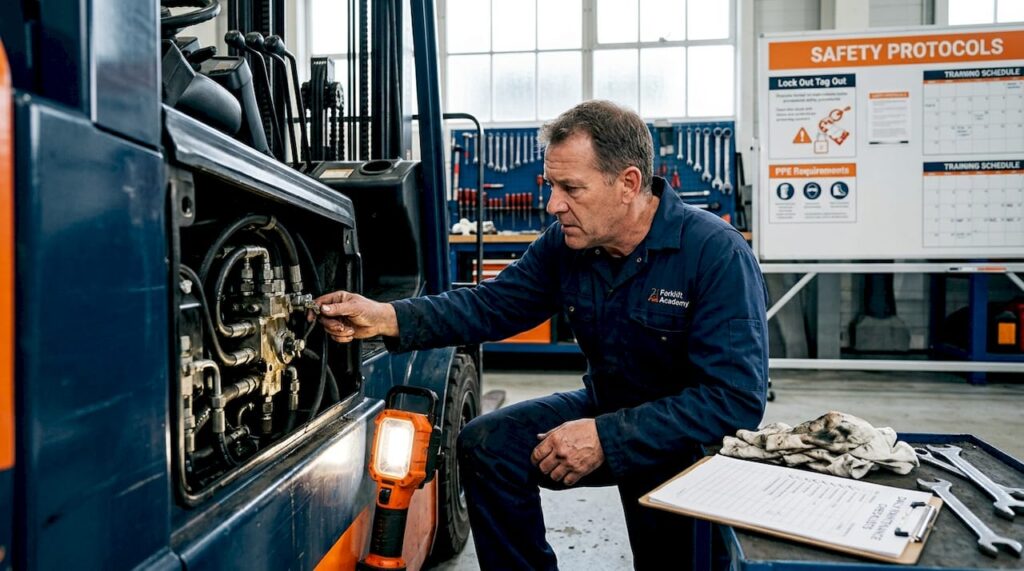
The first tier belongs to operators. Before every shift, a daily pre-operation inspection should take no more than 5 to 15 minutes. Operators check fluid levels, tire condition, forks and attachments, lights, horn, brakes, and the overhead guard. This is not optional. It is the front line of your entire maintenance program.
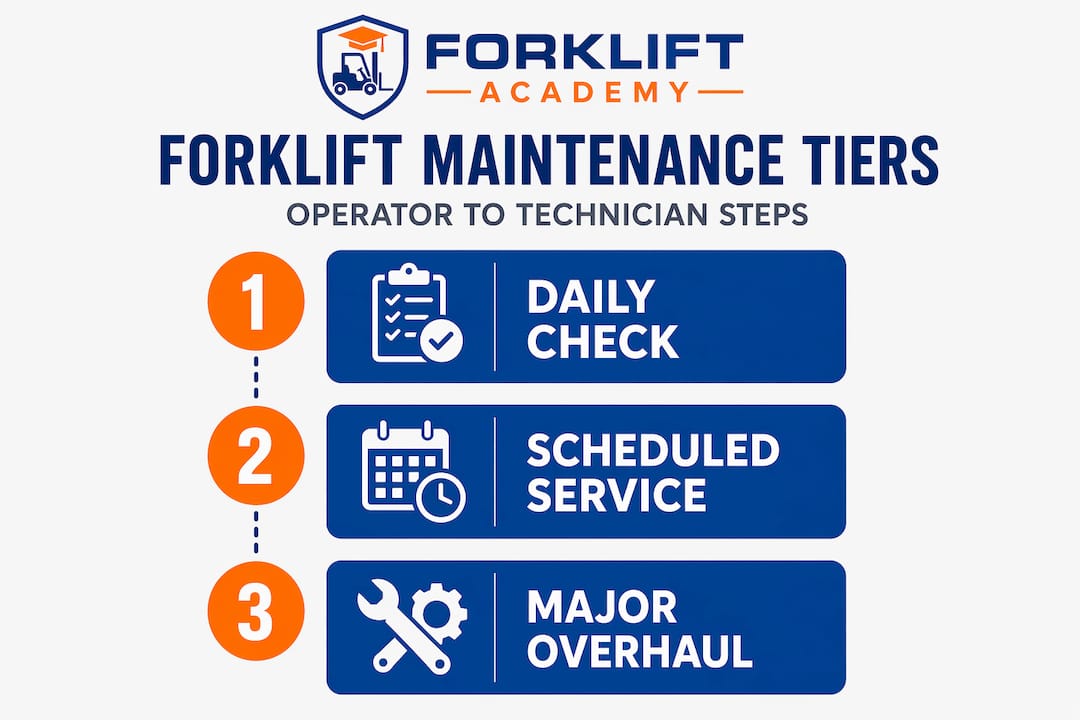
The second tier is technician servicing. Maintenance operates on time-based tiers ranging from monthly checks at roughly 250 operating hours up to annual comprehensive service at 1,000 hours. Technicians inspect battery condition on electric lifts, test hydraulic systems under load, measure brake pad thickness, and check mast chain tension. These are not tasks an operator can eyeball in a parking lot.
The third tier is annual or major service, where components with predictable wear cycles get replaced regardless of whether they look worn. Seals, filters, and belts fall into this category.
Pro Tip: Combine daily operator checklists with a digital logging system so defects are time-stamped and searchable. A paper log left in a break room cabinet does not protect you the way a documented, auditable record does.
A tiered maintenance approach combining both operator checks and scheduled technician service yields the best preventive outcomes. Neither works as well without the other.
Most forklift accidents do not happen because of bad luck. They happen because something mechanical failed that should have been caught weeks earlier. Brake failure, hydraulic leaks, mast drops, and tip-overs are all directly linked to maintenance neglect. These are not fringe scenarios. They represent the documented failure modes that preventable common failures appear in incident reports across warehouses and distribution centers every year.
Here is what that looks like in practice:
OSHA requires that forklifts be inspected before each shift, and that any defect affecting safe operation must be reported and the truck removed from service until repaired. Non-compliance creates both legal exposure and a direct path to preventable injury.
Documented inspection records are your legal foundation. Without them, a single incident can expose your facility to OSHA fines, civil liability, and insurance denial. With them, you demonstrate a pattern of due diligence that reduces risk at every level. Facilities that treat forklift incident prevention as a maintenance outcome rather than a behavioral one see measurably fewer recordable incidents.
The financial case for scheduled maintenance is not subtle. Reactive repairs cost more in every category: parts are more expensive under emergency conditions, technician time gets billed at premium rates, and the downtime during an unplanned breakdown grinds your operation to a stop at the worst possible moment.
The numbers from real operations make this concrete:
| Maintenance Approach | Downtime Reduction | Annual Repair Savings | Scheduling Predictability |
|---|---|---|---|
| Reactive (emergency repairs) | Baseline | None | Unpredictable |
| Scheduled preventive maintenance | 25-40% reduction | Significant | High |
| Full preventive PM program | Up to 60% reduction | ~$34,000 estimated | Very high |
Switching to scheduled maintenance reduces forklift downtime by 25 to 40% within six months. Facilities that commit to a full preventive program report up to 60% fewer unplanned outages and savings around $34,000 per year in emergency repair costs alone.
Hour-based scheduling drives those results. When technicians trigger service intervals based on meter hours rather than calendar dates, parts get replaced at their actual wear point. A forklift running two shifts a day in a freezer environment hits 1,000 hours much faster than the same model used four hours a day in a climate-controlled facility. Calendar-based schedules miss that. Hour-based tracking does not.
Pro Tip: Track operating hours per unit using your forklift’s hour meter, then set maintenance triggers in a spreadsheet or fleet management app. This takes about 20 minutes to set up and immediately improves how you plan technician visits.
Maintenance lapses translate into lost productivity in ways that operational leaders consistently underestimate. A two-hour breakdown in a busy receiving dock does not cost two hours. It costs the ripple effect across every downstream process waiting on that load.
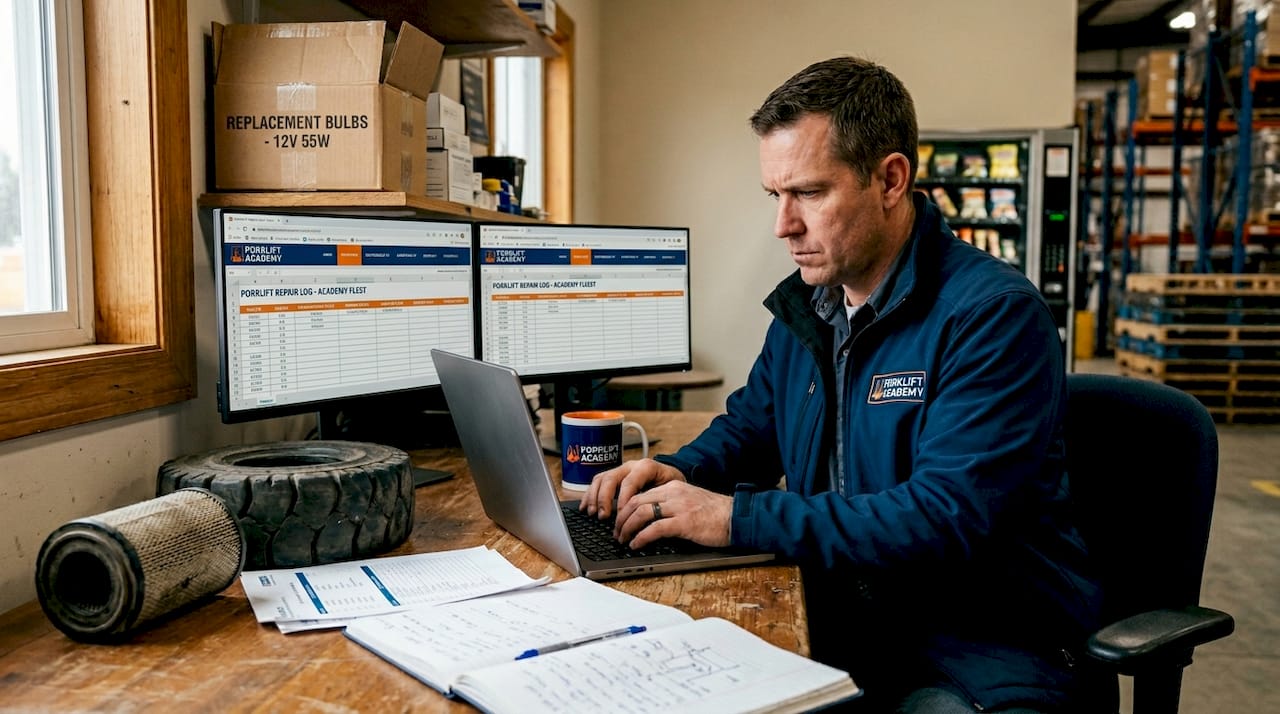
A maintenance program without documentation is just a habit. Habits get interrupted. Documentation survives turnover, audits, and insurance reviews.
The most effective programs share a few consistent characteristics:
Here is how two common documentation approaches compare:
| Documentation Method | Audit Trail | Trend Analysis | Operator Accountability |
|---|---|---|---|
| Paper checklists only | Limited | Difficult | Moderate |
| Digital logs with timestamps | Strong | Easy | High |
Operator engagement is the piece most programs get wrong. Operators are not just users of the equipment. They are the earliest detection system in your maintenance chain. A well-trained operator who knows what a worn mast chain sounds like catches that failure before a technician ever sees the machine. Effective operator training correlates with 40 to 60% lower maintenance costs per operating hour. That return comes directly from early defect detection and fewer compounding failures.
A forklift working in a refrigerated warehouse and one working outdoors in a humid Gulf Coast facility are not the same machine, even if they share a model number. Environment accelerates wear in ways that standard service intervals do not fully account for.
Heat degrades hydraulic fluid faster and strains cooling systems. High humidity accelerates corrosion on chains, mast rails, and electrical connectors. Dusty or debris-heavy environments clog air filters and contaminate hydraulic reservoirs. Any of these conditions can cut a component’s useful service life in half.
Adjusting preventive maintenance intervals based on operating hours and environmental stressors extends machine longevity more reliably than following the manufacturer’s standard schedule alone. Older machines in demanding conditions may need checks at 150-hour intervals rather than the standard 250. Newer units in controlled environments might safely extend to 300 hours.
The data-driven approach goes further. Tracking recurring issues through inspection records tells you which specific machines in your fleet are outliers. If one unit generates twice the defect tags of the others, the problem is not your maintenance program. The problem is that unit, and the data shows it before a breakdown forces the conversation.
Pro Tip: Add an “operating conditions” field to your maintenance log. Simple entries like “dusty,” “cold storage,” or “outdoor use” give your technician critical context that changes what they prioritize during a service visit.
I have worked around forklift operations long enough to see both failure modes up close. Facilities that struggle most with maintenance are rarely skipping it because they do not understand the importance of forklift maintenance. They skip it because the culture treats maintenance as someone else’s job.
In reactive environments, operators see themselves as drivers, not caretakers. Managers treat the maintenance log as a compliance checkbox rather than an operational tool. When a breakdown happens, the response is “fix it fast,” not “understand why it happened.” That cycle repeats until something costly or dangerous finally forces a reset.
The shift I have watched work is when managers start treating operators as the first line of defense. Not by adding paperwork, but by explaining what each check actually prevents. When an operator understands that a low hydraulic fluid reading today is the difference between a functioning lift tomorrow and a mast drop next week, they do the check differently. They own it.
From my experience, the biggest unlock in any PM program is not the technician schedule. It is getting operators to report defects without fear of being blamed for them. When a culture punishes the messenger, defects go unreported. When it rewards early detection, problems surface before they compound. That single shift in how management responds to flagged issues changes everything downstream.
— Juiced
The gap between a maintenance program that works on paper and one that actually works on the floor almost always comes down to operator knowledge. Certified, well-trained operators spot early defects, complete pre-shift checks with accuracy, and understand what to escalate before a problem becomes a breakdown.
Forkliftacademy has spent over 20 years delivering OSHA-compliant forklift certification programs across the United States and Canada. Programs are available online, onsite, and through a nationwide network of training locations. Whether you need to certify a single operator or build an in-house train-the-trainer program for your facility, the courses are designed to connect operator skill directly to workplace safety and regulatory compliance. Smarter operators are your lowest-cost maintenance tool.
Regular forklift maintenance prevents mechanical failures, reduces accident risk, and keeps operations running without costly unplanned downtime. 70% of unplanned breakdowns are linked to deferred or skipped routine servicing.
Operators should perform a daily pre-shift inspection before every use, while technicians conduct scheduled service at roughly 250-hour and 1,000-hour intervals.
Facilities with full preventive maintenance programs report up to $34,000 in annual savings from reduced emergency repairs and up to 60% fewer unplanned downtime events.
Yes. OSHA mandates pre-shift inspections before each use, and any unsafe defect must be documented and the forklift removed from service. Auditable inspection records are legally required for compliance and liability protection.
Well-trained operators detect defects earlier and complete inspections more accurately, which research links to 40 to 60% lower maintenance costs per operating hour compared to untrained counterparts.