

TL;DR:
- Selecting the right forklift depends on your warehouse’s aisle width, load type, lift height, and environment to optimize safety, efficiency, and costs. Different models like counterbalance, reach, and VNA trucks are tailored for specific tasks, with operator training crucial for safe operation. Emphasizing proper site measurement and fleet standardization ensures long-term operational effectiveness and compliance.
Not all forklifts are created equal, and the wrong machine in the wrong warehouse costs you more than money. It costs you throughput, floor space, and worker safety. The examples of warehouse forklifts available today range from simple pallet jacks to multidirectional heavy haulers, each designed for a specific job. Picking the right one depends on your aisle widths, load types, lift height requirements, and whether your facility runs indoors, outdoors, or both. This guide walks you through all the major forklift machine types, what each does best, and how to match the right truck to your operation.
| Point | Details |
|---|---|
| Match machine to aisle width | Narrow aisles need reach trucks or VNA trucks; wide aisles open up counterbalance options. |
| Power source matters indoors | Electric forklifts reduce emissions and noise, making them the preferred choice for enclosed facilities. |
| Specialization beats versatility for heavy loads | Multidirectional and side loader forklifts outperform standard trucks when handling long or awkward cargo. |
| Training determines real-world safety | OSHA-compliant certification is required for every operator regardless of forklift type. |
| Fleet standardization cuts costs | Limiting your fleet to a few compatible models reduces training burden and maintenance complexity. |
Before you look at specific models, you need to be clear on what your warehouse actually demands. Buying on specs alone without understanding your operational context is one of the most common and costly mistakes in equipment procurement.
Here are the primary factors to work through before comparing forklift types and names:
Pro Tip: If your warehouse handles multiple SKU types across different zones, map each zone’s requirements separately. You may need two or three different forklift types rather than one machine trying to do everything.
OSHA classifies forklifts into 7 classes covering 15 or more common types, each matched to specific environments and load profiles. Here are the main examples of warehouse forklifts you will encounter, along with their practical strengths.
The counterbalance forklift is the most recognized machine in any warehouse fleet. It carries its load on front forks and uses a heavy counterweight at the rear to maintain balance, eliminating the need for outrigger legs. This gives operators clear, unobstructed access to pallets and racking.
These trucks come in electric (Class I), LPG (Class V), and diesel variants. Electric counterbalance models are the standard choice for general indoor work. LPG and diesel versions handle outdoor loading docks and yard operations. Their main limitation is aisle width: they need significant turning room, which makes them impractical in high-density storage layouts.
Reach trucks are the go-to machine for high-bay warehouse storage in narrow aisles. Unlike counterbalance trucks, reach trucks use outrigger legs that extend to support the load, and the forks reach forward into the racking rather than requiring the truck to drive into position. This design allows operation in aisles as narrow as 8 feet.
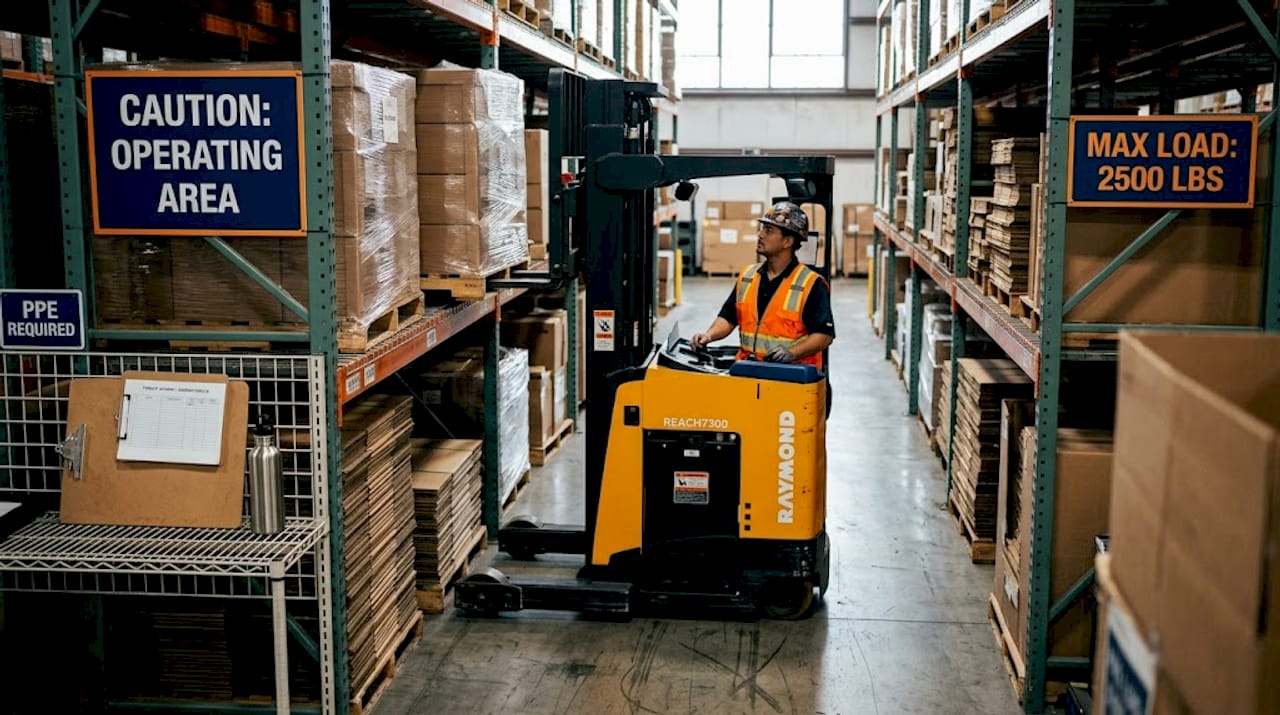
Most reach trucks are electric and designed exclusively for indoor use on smooth, level floors. They excel in distribution centers and retail supply chains where vertical storage density is the priority. If your facility uses racking that runs 30 feet or higher, a reach truck is likely your primary workhorse.
Order pickers are built for a fundamentally different task: picking individual cases or units from racking rather than moving full pallets. The operator platform rises with the forks, putting the worker at shelf level to manually pick items. This makes them the essential machine in e-commerce fulfillment centers and pharmaceutical warehouses.
Order pickers operate at low speeds and work best in environments with established safety protocols around fall protection and operator harness use. They are not designed for heavy pallet transport. Think of them as a precision instrument rather than a hauling truck.
Side loaders solve a problem that standard counterbalance and reach trucks cannot: handling long, awkward loads like timber, steel bar, pipe, and sheet metal without requiring wide turning aisles. The forks mount on the side of the truck, so the machine travels in a straight line while carrying its load perpendicular to the direction of travel.
These machines are common in steel service centers, lumber yards, and manufacturing facilities. They are less common in traditional pallet-based distribution but become indispensable when your loads regularly exceed 8 to 10 feet in length.
Multidirectional forklifts combine the strengths of counterbalance trucks, side loaders, and VNA trucks into one machine. They can travel forward, sideways, and diagonally, making them highly effective for handling long loads in confined spaces. Combilift’s heavy-duty series is one of the most recognized examples in this category, with the C10000XL to C12000XL series offering 10,000 to 12,000 lb capacity within an 88-inch width and 159-inch lift height.
These trucks are particularly valuable where warehouse layout and aisle geometry require controlled movement to maximize space while managing heavy or oversized loads. The trade-off is cost and training complexity, so they work best in operations where their unique capability is genuinely needed.
VNA and turret trucks represent the highest level of space optimization in warehouse design. Their forks rotate 90 degrees to place and retrieve pallets without turning the truck itself, which means aisle widths under 6 feet become usable. They almost always operate in conjunction with floor guide rails or wire guidance systems.
The storage density gains are significant. A warehouse running VNA trucks can fit roughly 40 to 50 percent more racking into the same footprint compared to a standard reach truck layout. The cost, however, is high: both the equipment and the facility modifications require substantial capital investment.
Not every warehouse needs a full-size forklift for every task. Pallet jacks and walkie stackers are economical solutions for horizontal transport and low-height stacking that would otherwise tie up a more capable machine.
Electric pallet jacks move pallets quickly across flat warehouse floors and are standard equipment in receiving and shipping departments. Walkie stackers add limited lifting capability, typically up to 12 feet, making them useful for staging areas and facilities with modest vertical storage needs. You can dive deeper into the real-world use cases for electric pallet jacks to understand where they deliver the most value.
Pro Tip: Electric pallet jacks significantly extend the life of your larger forklifts by handling short-distance horizontal moves that would otherwise accumulate hours on a more expensive machine.
When operations move outside the four walls of a warehouse, telehandlers and rough terrain forklifts take over. Rough terrain models use large pneumatic tires and high-clearance frames to handle uneven ground, gravel yards, and construction sites. Telehandlers add a telescoping boom, which allows load placement at height and reach, making them common in agriculture, construction, and outdoor lumber operations.
Neither type is designed for precision indoor work, but for mixed-use facilities with outdoor staging areas or yard storage, having at least one rough terrain machine in the fleet is often a practical necessity.
Compact electric forklifts have carved out a specific niche in the market: tight indoor spaces where a standard reach truck or counterbalance is simply too large. The Jungheinrich Ameise is a strong example, widely used in distribution centers, e-commerce hubs, and cold storage facilities where low emissions, low noise, and tight maneuverability are non-negotiable.
These machines address a real gap in the market, particularly as emissions regulations tighten and warehouses become denser. The Linde Xi16 to Xi20 P series also fits this category, offering high performance for intensive warehouse applications with a focus on energy efficiency and operator comfort.
| Forklift Type | Capacity Range | Aisle Width Needed | Power Source | Best Application |
|---|---|---|---|---|
| Counterbalance | 3,000–15,000 lb | 11–13 ft | Electric, LPG, Diesel | General indoor/outdoor pallet handling |
| Reach truck | 3,000–5,500 lb | 8–10 ft | Electric | High-bay indoor racking |
| Order picker | 1,000–3,000 lb | 6–8 ft | Electric | E-commerce piece picking |
| Side loader | 4,000–20,000 lb | 6–8 ft | Electric, Diesel | Long loads: timber, steel, pipe |
| Multidirectional | 5,000–12,000 lb | 6–8 ft | Electric, Diesel | Narrow aisles with long loads |
| VNA/Turret truck | 2,000–4,000 lb | Under 6 ft | Electric | Ultra-high-density storage |
| Pallet jack/walkie stacker | 2,200–6,600 lb | 6–8 ft | Electric, Manual | Horizontal transport, low stacking |
| Rough terrain/Telehandler | 5,000–20,000 lb | Open yard | Diesel | Outdoor, uneven terrain |
| Compact electric | 2,200–6,600 lb | 7–9 ft | Electric | Tight indoor spaces, cold storage |
Comparing specs on paper is straightforward. Translating those specs into the right decision for your specific facility is harder. Here is a practical decision framework:
Pro Tip: When evaluating a new forklift purchase, run a 30-day pilot with a rental unit before committing. Real-world usage in your specific facility will surface limitations that spec sheets never show.
Fleet standardization, focusing your fleet on two or three compatible models, simplifies maintenance schedules, reduces parts inventory, and makes cross-training operators much faster. The efficiency gains from a standardized fleet often outweigh the benefits of having a perfectly specialized machine for every task.
In my experience, too many operations let purchase price drive the forklift selection decision, and then spend years working around the wrong machine. I have seen warehouses running counterbalance trucks in aisles that are three feet too narrow, burning extra fuel and creating daily near-miss situations because nobody measured the floor plan before buying.
What I have learned is that aisle geometry and load type are far more important than raw capacity numbers when selecting different types of forklift trucks. A machine rated at 8,000 lb that cannot navigate your aisles is useless. A machine rated at 4,000 lb that fits perfectly and handles 95% of your loads is worth twice as much.
The other thing I see consistently underestimated is the impact of proper training on real-world forklift performance. The best machine in the wrong hands produces slower cycle times, more product damage, and higher incident rates. Certification is not just a regulatory checkbox. It is the difference between a forklift working for your operation and working against it.
I am also genuinely enthusiastic about the direction electric and multidirectional machines are heading. The technology has matured to the point where fleet standardization around electric models is increasingly realistic for most warehouse types. The combination of lower operating costs and improving performance specs makes the transition a smart long-term call for most facilities, not just the environmentally motivated ones.
— Juiced
Understanding the different forklift trucks in your facility is only half the equation. Every operator needs verified, OSHA-compliant training before getting behind the controls of any machine on this list.
Forkliftacademy delivers forklift certification programs for all major forklift classes, available online and at physical training locations across the United States and Canada. Whether you need to certify a single operator or build an internal train-the-trainer program for your entire warehouse team, Forkliftacademy has the courses, credentials, and 20 years of industry experience to back them up. Get your operators certified and keep your operation running safely and legally.
The most common types are counterbalance forklifts, reach trucks, order pickers, electric pallet jacks, and walkie stackers. Each is designed for a specific combination of load type, aisle width, and lift height requirement.
A counterbalance forklift uses a rear counterweight and requires wide aisles of 11 to 13 feet. A reach truck uses outrigger legs and extends its forks into racking, allowing it to operate in aisles as narrow as 8 feet with greater lift heights.
Start by measuring your aisle widths, maximum lift height needed, and your heaviest load weight. These three factors together will narrow your options to one or two forklift categories before you consider price or brand.
Yes. OSHA requires certified training for operators of all forklift classes and types, including pallet jacks classified as powered industrial trucks. Certification must be specific to the class of equipment being operated.
Electric forklifts work well in most indoor warehouse environments and are the preferred choice for cold storage, food handling, and high-density operations. They are not well-suited for outdoor use on uneven terrain, where diesel or LPG rough terrain models perform better.