
TL;DR:
- Proper forklift training includes hands-on practical evaluation on actual equipment, not just classroom instruction. Employers must document each operator’s training, evaluation, and any retraining to ensure OSHA and Canadian standards are met. Continuous site-specific training and timely assessments foster a safer workforce and prevent compliance issues.
Every year, forklift-related accidents send roughly 85 workers to their deaths and injure nearly 35,000 more in the United States alone. Behind most of those incidents is a common thread: operators who were never properly trained, or whose training skipped critical hands-on steps. For employers, the consequences go beyond human costs. OSHA (the Occupational Safety and Health Administration) fines for forklift violations regularly reach tens of thousands of dollars per citation. This guide walks you through the complete, step-by-step forklift training process required for compliance under both U.S. and Canadian regulations, so your team operates legally, safely, and with confidence.
Table of Contents
- What you need before forklift training begins
- Step-by-step forklift training process
- Common mistakes and how to avoid them
- Documenting and verifying forklift operator certification
- Why most forklift training programs miss the mark—and how to fix it
- Get certified with expert OSHA forklift training solutions
- Frequently asked questions
Key Takeaways
| Point | Details |
|---|---|
| OSHA and CSA set the rules | Both U.S. and Canada require formal, hands-on, and site-specific forklift training with proper evaluation. |
| Training has three essential stages | A complete process includes classroom instruction, supervised practice, and a documented performance evaluation. |
| Documentation is vital for compliance | Employers must keep comprehensive records and verify operator skills regularly. |
| Common errors undermine safety | Skipping site-specific training or proper recordkeeping risks accidents and fines. |
| Go beyond minimum standards | Investing in robust, site-tailored training improves real-world outcomes and safety culture. |
What you need before forklift training begins
Before a single operator climbs into a forklift cab, you need to have your regulatory foundation in place. Skipping this preparation phase is one of the most common reasons companies fail audits and face penalties they could have easily avoided.
Know your regulatory framework
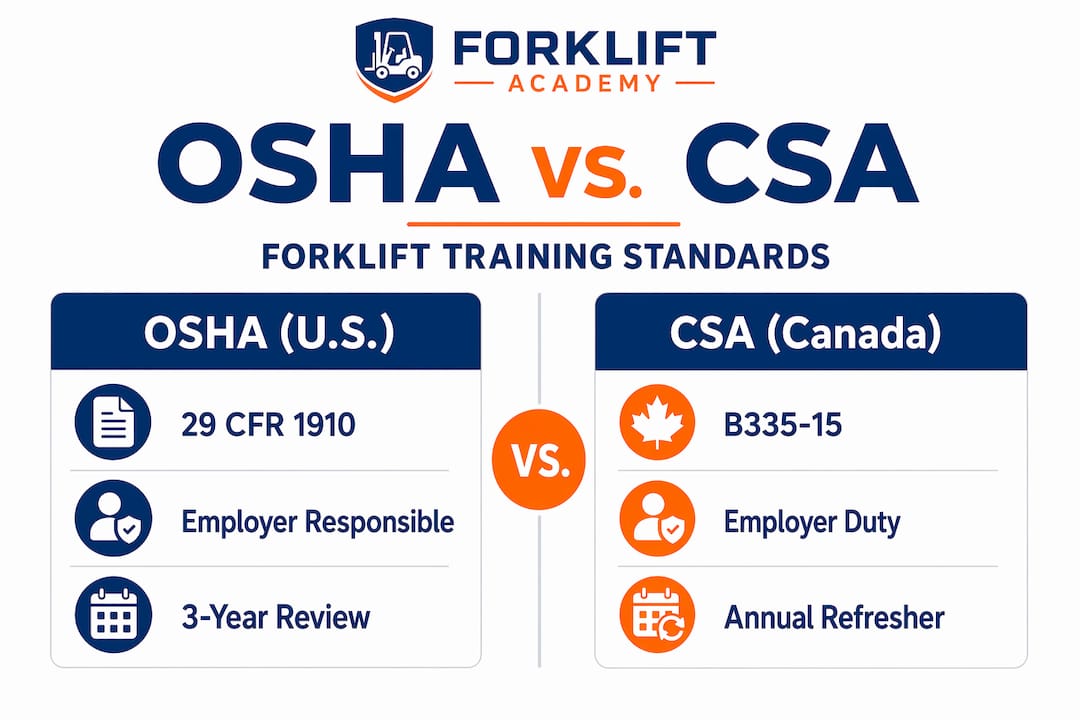
In the U.S., OSHA’s powered industrial truck standard (29 CFR 1910.178(l)) requires a complete training program plus operator evaluation before any employee operates a forklift unsupervised. This is a federal mandate, and it applies to virtually every industry, from warehousing and manufacturing to construction and retail distribution.
In Canada, forklift training is benchmarked to CSA B335-15 (the Canadian Standards Association standard for lift truck operation) and implemented through provincial occupational health and safety (OHS) legislation. Employers in provinces like Ontario, Alberta, and British Columbia must ensure operators are trained and evaluated before they touch a lift truck. The specifics can vary by province, so checking your local OHS authority is a smart first step.
Employer responsibilities differ by country
In the U.S., the employer bears direct responsibility for ensuring training happens and for keeping documentation on file. In Canada, the emphasis is similarly on employer due diligence, but the framework is province-driven rather than a single national standard. Understanding the business forklift training requirements for your specific location gives you a clear picture of what you’re legally obligated to provide.
What you need to gather before training starts
Here is a table of the key materials, documents, and resources you should have ready before any training begins:
| Item | U.S. Requirement | Canada Requirement |
|---|---|---|
| Regulatory standard | OSHA 29 CFR 1910.178(l) | CSA B335-15 + provincial OHS |
| Training materials | Formal instruction curriculum | Equivalent approved curriculum |
| Equipment access | Actual truck(s) used on site | Actual truck(s) used on site |
| Evaluation form | Written competency checklist | Employer-created or approved form |
| Instructor credentials | Demonstrated competency required | Competent person designation |
| Operator records file | Training date, evaluator, truck type | Training date, evaluator, truck type |
Before you kick off training, confirm you have access to the actual forklifts operators will use on the job. Training on a counterbalance forklift when operators will actually use a reach truck does not count as valid preparation under either standard.
- Gather site-specific hazard information for your facility
- Identify each truck type in use and match it to training content
- Confirm your instructor is qualified to evaluate operator performance
- Prepare blank evaluation forms for each operator
- Set up a secure recordkeeping system (digital or physical)
Pro Tip: Create a training checklist for each worksite and each truck type in your fleet. When you operate multiple sites or run mixed equipment, a standardized checklist ensures nothing gets missed during preparation, and it simplifies your response if you ever face an OSHA inspection.
Step-by-step forklift training process
With preparation complete, you’re ready to move through the official stages of forklift operator training. OSHA and CSA both follow a similar three-phase model, though the documentation requirements and specific content differ slightly between the two countries.
The three core training phases
The OSHA-compliant certification process follows a clear sequence: (1) formal instruction, (2) supervised practical training, and (3) performance evaluation with documented sign-off. Each phase builds on the previous one, and skipping any phase invalidates the entire training for compliance purposes.
- Formal instruction. This is the theory phase. It covers pre-operation inspection procedures, load capacity and stability principles, traffic rules and pedestrian safety, refueling and charging protocols, and workplace-specific hazard recognition. Formal instruction can be delivered in a classroom, through online modules, or via written materials. This is where the OSHA forklift training overview materials become especially useful for building a structured curriculum. Operators learn the “why” behind every safety rule before they ever touch a truck.
- Supervised practical training. After completing formal instruction, the operator must practice on the actual equipment in the actual work environment under direct supervision of a qualified trainer. This phase cannot be simulated or substituted. It must reflect real conditions, real loads, and real site hazards. If an operator will work in a cold storage facility with narrow aisles, training in an open parking lot is not sufficient. This is also where operators learn site-specific procedures: dock leveler operation, racking systems, pedestrian crossing zones, and emergency protocols.
- Performance evaluation and competency sign-off. The evaluator observes the operator performing their actual job tasks and documents that the operator can do so safely and competently. This evaluation must be conducted at least every three years in the U.S., but also any time a retraining trigger occurs (more on that in Section 4). The evaluator signs off, the date is recorded, and the documentation goes into the operator’s file.
Critical safety warning: Never skip the hands-on evaluation phase. Online or classroom training alone does not constitute OSHA-compliant certification. An operator who receives only theory training and then operates unsupervised creates legal liability for the employer and a direct safety risk for everyone in the facility. Documented, observed, practical evaluation is non-negotiable.
U.S. vs. Canada training process comparison
| Training phase | United States (OSHA) | Canada (CSA B335-15 / OHS) |
|---|---|---|
| Formal instruction | Required, can be online | Required, format varies by province |
| Practical, supervised training | Required on actual equipment | Required on actual equipment |
| Performance evaluation | Required, documented sign-off | Required, employer-documented |
| Recertification frequency | At least every 3 years | Varies by province; employer-driven |
| Operator “license” issued | Certification card recommended | No formal license; employer responsibility |
| Record retention | Employer file, no fixed term | Employer file; varies by province |
Following the complete forklift step-by-step guide format helps employers track every operator through each phase systematically. For companies managing large workforces or multiple sites, building this into your onboarding workflow ensures no one slips through the cracks.
Pro Tip: After each evaluation, issue a dated certification card to the operator and keep a matching record in your HR or safety management system. This gives you a two-layer verification method: a card the operator carries and a file you control.
Common mistakes and how to avoid them
Understanding the training steps is important, but avoiding common pitfalls is what ensures lasting compliance. Many employers complete training in good faith but still face citations because of execution errors that are entirely preventable.
The most common compliance failures
OSHA’s training requirements specify that training must address workplace-specific hazards and the exact type of powered industrial truck the operator will use. Generic, off-the-shelf training that does not match your site conditions or your equipment fleet is a compliance gap, even if you have paperwork showing the training happened.
- Generic training not tied to your equipment or site. Using a training video that covers counterbalance forklifts when your team runs order pickers is not compliant. Training content must match the specific truck type and the specific hazards in your facility.
- Skipping site-specific practical evaluation. Operators who complete online training but never receive a supervised, on-site practical evaluation are not OSHA-certified. This is the single most common mistake in employer-run programs.
- Failing to update records after incidents. If an operator is involved in an accident or near-miss and does not receive retraining and re-evaluation, the employer is doubly exposed: once for the incident itself, and again for the documentation failure.
- Ignoring equipment changes. Assigning an operator to a new truck type without retraining is a direct OSHA violation. Each truck type requires its own training and evaluation cycle.
- Losing or never creating documentation. If you cannot produce training records during an inspection, OSHA treats the training as if it never happened. Paper or digital, records must exist and be retrievable.
Compliance reminder: Documentation is your legal defense. Every training session, every evaluation, and every retraining event must be recorded with the operator’s name, the date, the truck type(s) covered, and the evaluator’s name. Without this, compliance cannot be proven, regardless of how well the actual training was conducted.
Building awareness of forklift hazard awareness into your training curriculum directly addresses the site-specific requirement. Coupling that with warehouse safety best practices creates a training ecosystem that stands up to scrutiny during audits.
Documenting and verifying forklift operator certification
After training is complete, ensuring it is properly documented and verifiable is the final safeguard for compliance. Many companies invest heavily in quality training but underinvest in the recordkeeping systems that prove that training occurred.

What records you must maintain
In the U.S., OSHA does not specify a fixed retention period for forklift training records, but best practice is to keep records for the duration of employment plus three years. In Canada, provincial OHS regulations set varying retention requirements, and employer responsibility is the cornerstone of the Canadian approach rather than any operator-issued license or government certificate.
Your documentation system should capture four types of records for each operator:
- Initial training record: Includes the date of training, the topics covered, the truck type(s) included, and the instructor’s name.
- Performance evaluation record: Documents the date of observation, the tasks evaluated, the evaluator’s determination of competency, and the evaluator’s signature.
- Refresher or retraining record: Created any time retraining is triggered by an incident, behavior observation, or equipment change, with full details of what was covered and why the retraining was triggered.
- Recertification record: Created at least every three years in the U.S., as OSHA mandates that evaluation of each operator’s performance be conducted at least once every three years.
How to verify current operator status
Use this step-by-step process to confirm that any operator in your facility is currently certified and compliant:
- Pull the operator’s training file and locate the most recent evaluation record.
- Confirm the evaluation date is within the last three years (U.S.) or within your province’s required interval (Canada).
- Verify the truck type on the evaluation matches the truck(s) the operator currently uses.
- Check that a qualified evaluator signed the record (not just the operator themselves).
- Confirm no retraining triggers (incidents, unsafe observations, equipment changes) have occurred since the last evaluation without a corresponding retraining record.
- Issue or reissue a certification card if the current one is expired or missing.
Working with a structured onsite forklift training organization can simplify this entire process, especially for companies managing dozens or hundreds of operators across multiple facilities.
Why most forklift training programs miss the mark—and how to fix it
Here is an uncomfortable truth that two decades of forklift training experience makes very clear: most compliance failures are not caused by employers who don’t care. They’re caused by employers who treat training as a box-checking exercise instead of a behavior-changing investment.
The typical approach looks like this: schedule an online course, print the certificate, file it, move on. Technically, some of those steps align with OSHA’s formal instruction requirement. But they do nothing to change how an operator actually behaves at 6 a.m. on a Tuesday when the dock is backed up and shortcuts seem tempting.
What actually moves the needle on accident rates and audit outcomes is training that is specific, observed, and reinforced. When operators practice in the real conditions of your actual facility with a qualified trainer watching and correcting, they build muscle memory and judgment. When supervisors consistently reinforce safe behaviors after training ends, the lessons stick.
The role of training in warehouse safety goes well beyond compliance. Facilities that invest in quality, site-specific practical training consistently show lower incident rates, lower equipment damage costs, and better audit outcomes. The minimum standard exists to protect workers. But the companies that build a genuine safety culture go beyond the minimum and treat every training cycle as an opportunity to improve, not just to document.
Our perspective: the three-year re-evaluation cycle is a floor, not a ceiling. Conducting annual operator observations, giving feedback in real time, and updating training when your facility layout or equipment changes keeps everyone sharper and far safer than waiting for a required retraining trigger to occur.
Get certified with expert OSHA forklift training solutions
Knowing the process is the first step. Having the right tools to execute it is what separates compliant, high-functioning operations from those that struggle during audits or, worse, after accidents. Whether you’re training a single operator or managing a workforce of hundreds, a structured program makes the difference.
Forklift Academy has spent over 20 years helping companies across the U.S. and Canada build OSHA-compliant training programs that actually work in the field. From individual operator courses to complete forklift training programs for entire fleets, the platform offers flexible online and onsite formats that satisfy all three OSHA training phases. For safety managers who want to build internal capacity, the Forklift Train the Trainer online program equips your in-house trainers with the skills and credentials to conduct and document evaluations properly. Start building a compliant, safety-first training program today.
Frequently asked questions
How often is forklift training required by OSHA?
OSHA requires that each operator’s performance be evaluated at least once every three years, with retraining required sooner if unsafe operation, an accident, or a near-miss occurs.
Do I need a forklift license or certificate in Canada?
There is no government-issued operator license in Canada. Instead, Canadian employer responsibility requires that employers ensure operators are trained and evaluated against CSA B335-15 standards before operating any lift truck.
What must be included in a forklift training program for OSHA compliance?
OSHA mandates formal instruction, practical training, and a documented performance evaluation covering the specific truck types and site hazards relevant to each operator’s actual job.
What triggers the need for forklift retraining?
Retraining is required when unsafe operation is observed, after an accident or near-miss, when an operator is assigned a different truck type, or when there is a significant change in the work environment.
Can forklift training be done entirely online?
No. OSHA and CSA both require a practical, hands-on component conducted on the actual equipment and worksite, validated through a performance evaluation conducted by a qualified observer.
Recommended
- Step by step forklift training for OSHA compliance 2026 – Top Osha Forklift Certification
- How to implement lift truck training for OSHA compliance – Top Osha Forklift Certification
- How to Comply With OSHA Forklift Rules: A Step-by-Step Guide – Top Osha Forklift Certification
- Forklift Evaluation Guide: Step-by-Step OSHA Compliance – Top Osha Forklift Certification