
TL;DR:
- OSHA and CSA require hands-on practical evaluation alongside formal instruction for forklift certification.
- Online training fulfills only theory requirements; in-person evaluation is essential for full compliance.
- Hybrid training combining online theory and onsite practice is the most effective, cost-efficient, and compliant approach.
Plenty of operators and employers assume that completing a quick online course means they’re fully certified to operate a forklift legally. That assumption can result in serious OSHA violations, failed audits, and real workplace injuries. The truth is that forklift certification under U.S. and Canadian regulations involves more than clicking through a slideshow and printing a certificate. This article breaks down exactly what OSHA and CSA require, what online and onsite training actually deliver, and how to choose the right path so your certification holds up when it matters most.
Table of Contents
- What OSHA and CSA require for forklift certification
- Online forklift certification: Flexibility and limitations
- Onsite forklift certification: Advantages for employers and new operators
- Online vs. onsite forklift certification: Side-by-side comparison
- Practical tips for staying compliant and choosing the right path
- Why hybrid forklift certification is the real-world solution most skip
- Achieve full OSHA compliance with professional forklift training
- Frequently asked questions
Key Takeaways
| Point | Details |
|---|---|
| Online covers only theory | Online forklift certification fulfills the classroom component but not the practical evaluation required by OSHA and CSA. |
| Onsite vital for beginners | In-person training is crucial for new operators and complex environments to meet safety and legal standards. |
| Hybrid is most compliant | Combining online theory with onsite hands-on training offers the best balance of flexibility, cost savings, and full compliance. |
| Employer is certifier | Employers must perform and document the final hands-on evaluation for legal certification. |
| Certification valid three years | All forklift certifications require refresher training and re-evaluation at least every three years. |
What OSHA and CSA require for forklift certification
Before diving into specific training formats, it’s critical to understand what OSHA and CSA actually require for legal forklift certification.
OSHA (Occupational Safety and Health Administration) governs forklift safety in the United States, while CSA (Canadian Standards Association) sets the standards in Canada. Both bodies recognize that safe forklift operation cannot be learned through theory alone. The regulations are specific about what training must include, and skipping any step creates a compliance gap that puts both operators and employers at legal risk.
According to OSHA’s standard, three components are required for valid U.S. forklift certification: formal instruction (which can be classroom or online), practical hands-on training, and a workplace performance evaluation conducted by the employer. All three must happen. None of them are optional.
In Canada, the rules are similarly structured. CSA B335 mandates theory training, a written test, hands-on practical training, and a practical evaluation. Fully online certification is not accepted under CSA standards, though a blended model of online theory combined with in-person practical training is widely used and accepted.
Here’s what both standards require:
- Formal instruction: Covers theory, safety rules, load capacity, pre-operation inspection, and workplace hazards
- Hands-on practical training: Conducted using the actual type of equipment the operator will use
- Written evaluation: Required under CSA; strongly implied under OSHA
- Practical workplace evaluation: Must be performed by a qualified person, usually the employer or a designated evaluator
One point that surprises many employers: online training alone satisfies only the formal instruction component. The hands-on evaluation must still happen on site, using the specific equipment the operator will work with. An online certificate without that evaluation is not full OSHA-compliant certification.
Pro Tip: No matter how thorough your online training is, your employer must still conduct and document an in-person performance evaluation before certification is complete.
For a detailed breakdown of what your workplace needs to stay compliant, the OSHA forklift compliance guide at Forklift Academy covers each regulatory requirement in plain language.
Online forklift certification: Flexibility and limitations
With requirements clear, let’s examine what online forklift certification actually provides and where it falls short.
Online forklift courses have grown significantly in popularity because they offer real advantages for certain situations. They are self-paced, meaning an operator can complete the theory component during a lunch break or after a shift. They’re also significantly more affordable than full in-person programs. Online courses typically cost between $50 and $80, compared to hundreds of dollars for full in-person certification programs. They offer 24/7 access, digital recordkeeping, and often cover multiple forklift classes in a single package.
Here’s what a typical online forklift course includes:
- Video lessons on forklift types, controls, and safety principles
- Modules covering OSHA regulations and workplace hazard recognition
- Quizzes and knowledge checks throughout the course
- A printable or digital completion certificate
Here’s what it does NOT include:
- Physical operation of a forklift
- Site-specific hazard training
- Hands-on performance feedback from a qualified instructor
- A formal evaluation on actual equipment
“Online courses alone do not provide full legal certification under OSHA or CSA standards. They fulfill the classroom instruction requirement only.”
That distinction matters a lot. An operator who completes only an online course and skips the hands-on evaluation is technically uncertified under federal law, even if they have a certificate in hand. If OSHA audits that workplace, the employer faces fines. If an accident occurs, the liability exposure is significant.
That said, online training has legitimate and valuable uses. Experienced operators renewing their credentials, workers who already have hands-on familiarity with their equipment, and employers who need a scalable way to cover the theory portion for large teams all benefit from online training. The online certification benefits become clear when you use these programs as the first step in a complete certification process rather than the entire process.
Pro Tip: Use online training as a supplement to required practical evaluation, not a substitute for it. The theory component is valuable preparation that makes hands-on sessions more productive and efficient.
The online vs. in-person guide at Forklift Academy walks through exactly how to structure a compliant program that uses both formats effectively.
Onsite forklift certification: Advantages for employers and new operators
While online training may suit experienced operators, in-person training offers unique benefits, especially for those new to forklifts or facing complex hazards.
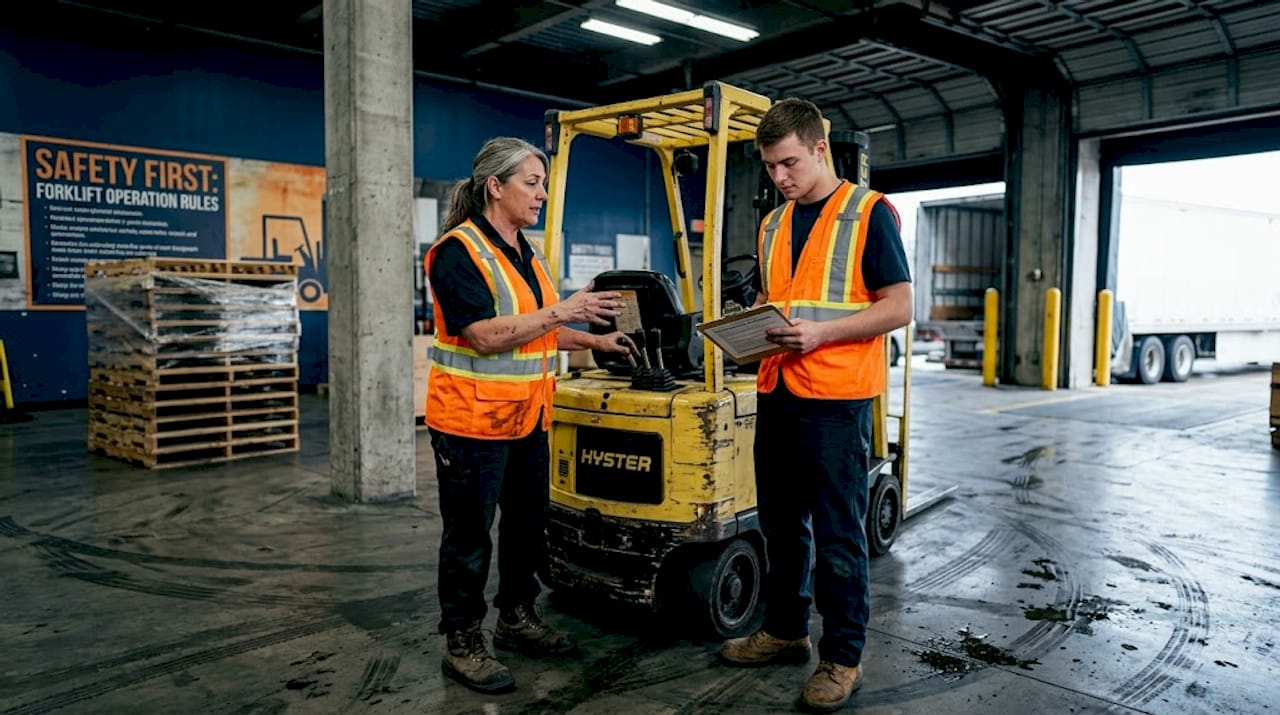
Onsite forklift certification puts operators in real conditions with a qualified instructor watching, correcting, and guiding them in real time. That direct feedback loop is something no online course can replicate. New operators especially benefit from being able to ask questions mid-maneuver, receive immediate corrections on technique, and build muscle memory through repetition on actual equipment.
The advantages of onsite training go beyond feedback:
- Equipment familiarity: Training happens on the exact models the operator will use on the job, including stand-up reach trucks, counterbalanced forklifts, order pickers, or narrow-aisle machines
- Site-specific hazard awareness: Instructors can walk operators through the actual racking configurations, pedestrian zones, loading docks, and floor conditions they’ll encounter every day
- Employer confidence: Many employers, particularly those with complex operations, require in-person training for all new hires regardless of prior experience
- Immediate evaluation: The hands-on evaluation can be conducted and documented on the same day, completing the entire certification process in one session
Research and expert guidance consistently show that in-person training produces higher employer acceptance and better safety outcomes for beginners. This is not just a preference; it reflects the reality that novice operators carry more risk and need more supervised practice before they can safely operate independently.
According to industry guidance, online training is suitable for experienced operators handling renewals, while onsite training is the better choice for novices and sites with specific hazards. This is the kind of nuanced decision that affects both compliance and safety outcomes.
Pro Tip: If your facility involves non-standard equipment, tight spaces, high pedestrian traffic, or complex racking systems, in-person training tailored to those conditions is worth every dollar. Generic theory alone won’t prepare an operator for those realities.
Employers should also reference the operator evaluation guide to understand what a proper OSHA-compliant evaluation looks like and how to document it correctly.
Online vs. onsite forklift certification: Side-by-side comparison
To summarize the above, here’s a clear comparison table showing how each credentialing path stacks up.
| Criteria | Online only | Onsite only | Hybrid (online + onsite) |
|---|---|---|---|
| Cost | $50 to $80 | $150 to $400+ | Moderate |
| OSHA compliant | Partial (theory only) | Yes, if complete | Yes, fully compliant |
| CSA compliant | No | Yes | Yes |
| Scheduling flexibility | High | Low to moderate | Moderate |
| Hands-on training | No | Yes | Yes |
| Site-specific training | No | Yes | Yes |
| Best for | Renewals, experienced staff | New operators, complex sites | Most operators and businesses |
| Audit risk | High if used alone | Low | Low |
| Instructor feedback | None | Real-time | Limited online; real-time onsite |
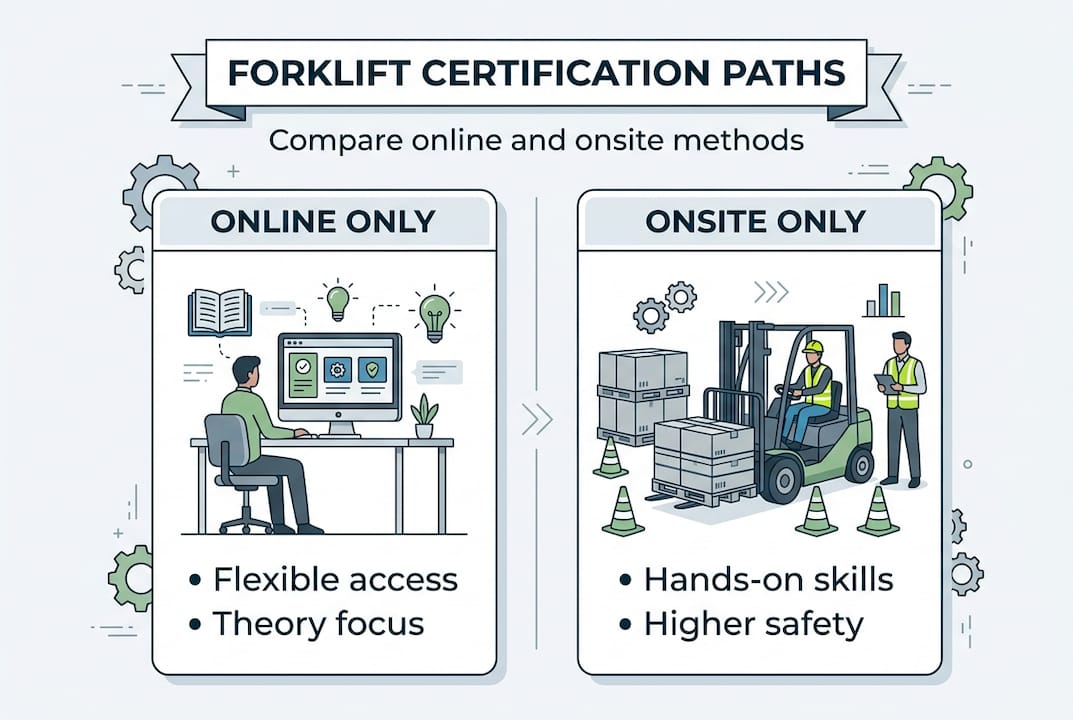
The table makes clear why online advantages like lower cost and flexible access are real but limited in scope. Used alone, online training creates a compliance gap that exposes businesses to audit risk and invalidation of certifications. The hybrid model eliminates that gap while preserving most of the cost and scheduling benefits that make online training attractive in the first place.
For a direct training comparison between program options, Forklift Academy breaks down the specific formats available and what each one covers.
Practical tips for staying compliant and choosing the right path
Armed with clear pros and cons, here’s how you can avoid common mistakes and stay 100% compliant.
One critical detail that many employers overlook: forklift certification is valid for three years, after which re-evaluation is required. Additionally, re-evaluation must happen sooner if an operator is observed operating unsafely, has an accident or near-miss, or is assigned to a new type of equipment. Waiting for the three-year mark without tracking individual operator status is a common compliance failure.
Another major mistake is assuming that the training provider certifies the operator. They don’t. The employer is ultimately responsible for final certification and must document the evaluator’s name, dates of training, equipment types covered, and the evaluation results. If that documentation doesn’t exist or is incomplete, the certification may be considered invalid during an OSHA audit.
Here’s a step-by-step process for making the right training decision:
- Assess operator experience. Is this person brand new to forklifts or a seasoned operator seeking renewal? New operators need in-person or hybrid programs. Experienced operators renewing credentials may qualify for online-first approaches.
- Check legal requirements for your location. U.S. employers follow OSHA 29 CFR 1910.178(l). Canadian employers follow CSA B335 standards for their province. Know which applies before you select a training format.
- Document everything. Training date, evaluator name, equipment type, and outcome must all be recorded and kept on file. Many employers use standardized forms or digital systems to track this across their workforce.
- Schedule hands-on reviews on a consistent cycle. Don’t wait for an incident to trigger re-evaluation. Build a recurring calendar reminder for each operator’s three-year recertification and review it whenever equipment changes.
The operator requirements guide at Forklift Academy provides detailed checklists for each of these steps, and the business compliance training section covers how to manage certification programs across larger teams efficiently.
Pro Tip: Keep a simple spreadsheet or digital log with every operator’s name, certification date, equipment type, and evaluator. During an OSHA inspection, this documentation is what stands between you and a citation.
Why hybrid forklift certification is the real-world solution most skip
Having walked through all the main differences, here’s a perspective that’s often overlooked in the rush for convenience.
The hybrid model, combining online theory with onsite practical evaluation, is not a compromise. It is the most practical, most compliant, and most cost-effective approach available for the majority of operators and businesses in North America. And yet it’s consistently underused because people assume it’s complicated.
Here’s what actually happens in practice: an operator completes the online theory module at their own pace, comes into the shift already grounded in the rules and concepts, and then spends focused time with an evaluator on actual equipment. That evaluator checks real skills, documents the session, and signs off on the certification. The hybrid approach delivers both the cost and flexibility benefits of online training and the compliance assurance of in-person evaluation.
Businesses that push back on hybrid often cite scheduling complexity. But the alternative, using online-only programs and hoping an audit never happens, is a far more expensive gamble. When OSHA investigates a workplace incident, the first thing they request is training documentation. If the hands-on evaluation records don’t exist, the fines start immediately. The real cost of skipping hands-on training only becomes visible during an accident or audit, and by then it’s too late.
“The real cost of skipping hands-on is revealed only during an accident or audit.”
We’ve worked with businesses of every size across the United States and Canada. The ones with the strongest safety records and the cleanest audit histories aren’t the ones who found the cheapest online certificate. They’re the ones who treated the employer certification responsibility seriously, documented every step, and built a training culture that treats hands-on evaluation as non-negotiable.
The employee forklift training guide at Forklift Academy lays out exactly how to build that kind of program, whether you’re managing five operators or five hundred.
Achieve full OSHA compliance with professional forklift training
Ready to ensure your certification is complete and audit-proof? Here’s how you or your team can take the next step confidently.
Forklift Academy offers top OSHA forklift certification programs built to meet both U.S. and Canadian regulatory requirements. Whether you need online theory modules for a team renewal, full onsite training for new operators, or a hybrid program that covers every compliance requirement from start to finish, there’s a format designed for your situation.
Our programs include structured OSHA operator evaluation components with documentation support, so employers know exactly what to record and how to maintain it. With over 20 years of experience and training locations across North America, we make it straightforward to build a certification program that holds up in any inspection. Find a training location near you and get your team certified the right way.
Frequently asked questions
Does online forklift certification alone meet OSHA requirements?
No, online training covers only the formal instruction portion of OSHA’s three-part requirement. You still need employer-conducted hands-on evaluation on the specific equipment the operator will use before certification is complete.
Is forklift certification from the U.S. valid in Canada?
No. Canadian law operates under CSA B335 standards, which require a separate hands-on practical evaluation and written test. U.S. certification does not transfer directly and cannot substitute for the Canadian process.
How long is forklift certification valid?
Certification is valid for three years, after which a full re-evaluation is required. Early re-evaluation is also required when operators switch to new equipment types or are observed operating unsafely.
Who is responsible for the final forklift certification?
The employer holds final responsibility for certification. They must document the evaluator, dates, and equipment types covered. The training provider issues a completion record, but the legal certification comes from the employer.
Is online certification a good option for new forklift operators?
No. New operators need direct instructor feedback and real hands-on practice to develop safe operating habits. Online training is best suited for experienced operators handling credential renewals or supplemental theory review.
Recommended
- Onsite Forklift Certification: Safer, Compliant Teams – Top Osha Forklift Certification
- Onsite forklift training: 70% fewer incidents & more – Top Osha Forklift Certification
- Online vs. In-Person Forklift Training: Which is Right for You? – Top Osha Forklift Certification
- Advantages of online forklift certification in 2026 – Top Osha Forklift Certification