

TL;DR:
- Annual forklift training significantly reduces incident rates and improves safety compliance.
- Regular retraining keeps operators current, minimizes skills decay, and ensures OSHA adherence.
- Consistent training enhances operational efficiency, worker retention, and reduces legal and financial risks.
Forklift accidents injure nearly 85 workers every day in the United States, according to the Bureau of Labor Statistics, and a significant share of those incidents trace back to one root cause: inadequate or lapsed training. Many business owners assume that a one-time forklift certification covers their operators permanently, but that belief costs companies millions in fines, lost productivity, and workers’ compensation claims every year. Annual forklift training is not a bureaucratic formality. It is a proven, practical tool that keeps your team sharp, your facility compliant, and your operation running without costly interruptions.
| Point | Details |
|---|---|
| Compliance protects your business | Annual forklift training aligns with OSHA standards and shields you from legal risks. |
| Safety improvements are proven | Regular retraining drastically cuts accident rates and boosts workplace efficiency. |
| Financial benefits add up | Staying up to date with training can reduce insurance premiums and prevent costly fines. |
| Effective training is practical | Best-in-class programs use hands-on assessment, timely reviews, and employee feedback. |
Let’s be clear about one thing upfront: OSHA does not hand out passes for outdated training. Under 29 CFR 1910.178(l), employers must ensure that forklift operators are competent to perform their work safely. That standard creates a continuous obligation, not a one-and-done event. While OSHA defines specific triggers for refresher training, such as unsafe operation, accidents, and changes in workplace conditions, the safest and most defensible posture for any warehouse or distribution center is to schedule formal retraining every year.
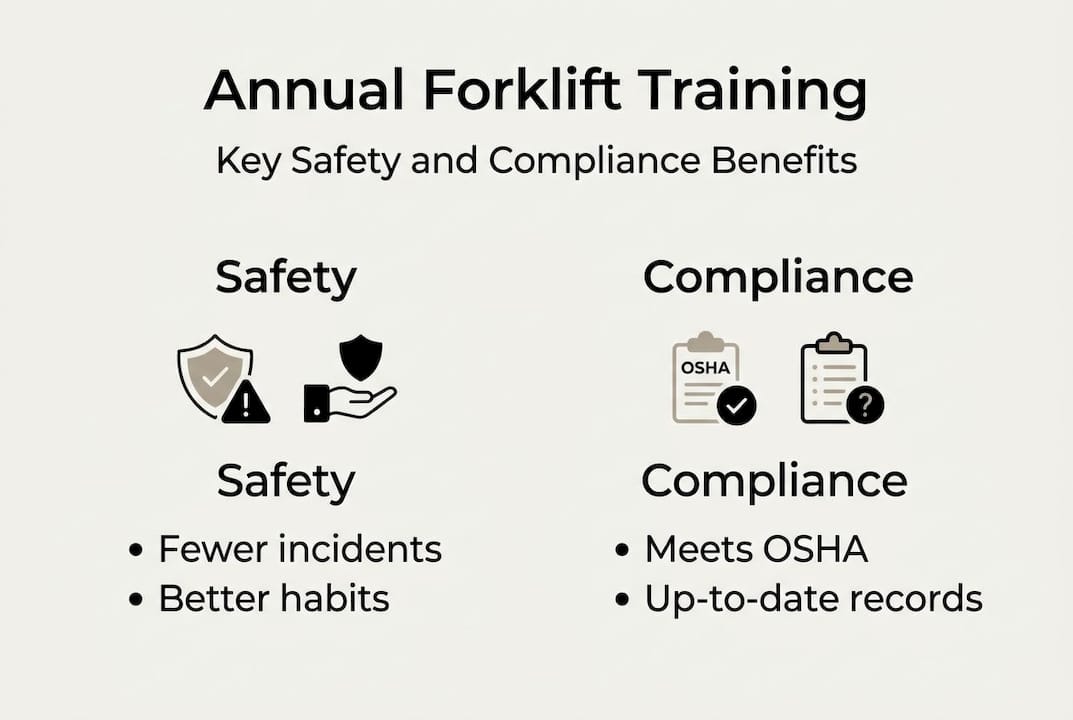
The numbers back this up. Consistent training cuts incidents by as much as 70%, a figure that should get the attention of every warehouse manager and operations director. That is not a marginal improvement. A 70% drop in forklift incidents means fewer injuries, fewer days away from work, and fewer regulatory headaches. When you consider that a single serious forklift accident can cost an employer well over $100,000 in direct costs alone, annual training pays for itself quickly.
Following the safety rules for warehouses is not optional in regulated environments, and annual training is the mechanism that keeps those rules front-of-mind for every operator on your floor.
Here is a snapshot of the core compliance and safety reasons to commit to yearly retraining:
| Metric | With Annual Training | Without Annual Training |
|---|---|---|
| Incident reduction | Up to 70% | Baseline or worsening |
| OSHA compliance status | Maintained | At risk |
| Near-miss reporting | Higher | Lower |
| Operator confidence | High | Declining over time |
“The most expensive training is the training you didn’t do. When a forklift accident happens, the costs are rarely limited to property damage. They extend into human suffering, legal liability, and reputational harm.”
Think of annual training the same way you think about vehicle maintenance. You don’t skip oil changes because the car ran fine last month. You keep up with scheduled service because you know that consistent maintenance prevents breakdowns. Forklift training works on the same principle: regular investment prevents catastrophic failure.
With the regulatory and safety need established, let’s look at how annual training actually impacts incident rates and day-to-day safety outcomes.
Forklift training done right does more than check a box. It systematically changes operator behavior, reinforces safe habits, and brings new hazard awareness into daily practice. The evidence is clear: warehouses with structured, recurring training programs see dramatically fewer accidents than those without.
| Safety Metric | Facilities With Annual Training | Facilities Without Annual Training |
|---|---|---|
| Forklift-related injuries per year | Significantly lower | 2-3x higher on average |
| Near-miss incidents reported | More frequent (healthy trend) | Underreported |
| OSHA recordable events | Fewer | More common |
| Operator error rate | Declining | Stable or increasing |
The behavioral change process that annual training drives follows a clear sequence:
This cycle of training also plays a critical role in adapting to change. OSHA updates its guidance periodically, and workplaces evolve constantly: new storage systems, higher stacking requirements, different product loads, and changing pedestrian zones all alter the risk environment. A solid training for warehouse safety program ensures your operators are always calibrated to the current reality of your facility, not the layout from three years ago.
For a full breakdown of the most effective accident prevention guide strategies, it helps to look at how leading distribution centers structure their programs around continuous feedback loops.
Pro Tip: The most common mistake companies make with refresher training is treating it as a lecture. Passive classroom instruction alone does not build muscle memory or fix dangerous habits. Make sure every annual training cycle includes hands-on evaluation where supervisors observe real operators on real equipment in the actual workspace. That on-the-floor time is where meaningful behavior change happens.
The benefits of training compound over time. Facilities that have maintained consistent annual programs for five or more years often report near-zero serious incidents because the culture has shifted. Safety is not an external requirement to those teams; it is simply how they work.
Understanding the safety improvements is only half the story. It’s also critical to know the true costs businesses risk by letting certifications lapse.
The financial exposure from skipping annual forklift training is far larger than most business owners realize. Reducing forklift risks through consistent training is one of the most cost-effective risk management decisions a company can make, because the alternative is a financial and legal liability that can threaten the business itself.
OSHA penalties for willful or repeated violations related to forklift training can reach $16,131 per violation per day under current federal guidelines. For egregious violations where multiple operators are untrained, those fines can stack rapidly. Significant OSHA penalties are not hypothetical risks. Inspectors prioritize powered industrial truck violations because the injury statistics are so consistent and well-documented. When an OSHA inspector walks into your facility and asks to see training records, you need current, complete documentation for every certified operator.
Here is what’s at stake legally and financially when annual retraining is skipped:
Pro Tip: Never wait until an accident happens to organize your training documentation. Build a centralized training log today that captures the operator’s name, the type of equipment certified on, the date of training, the name of the evaluator, and the date the next refresher is due. That simple record protects you during audits and demonstrates to insurers that you manage risk proactively. Some insurers will reduce premiums for operations with documented ongoing training programs, which is a direct financial reward for doing things right.
Canadian businesses face parallel obligations. Provinces such as Ontario, British Columbia, and Alberta each have occupational health and safety regulations that mirror or exceed U.S. OSHA standards for powered industrial truck operation. Annual training and documentation are not just a U.S. concern. North American businesses on both sides of the border benefit from treating annual retraining as a legal necessity, not an optional investment.
To truly reap the benefits of annual forklift training, it’s essential to run each cycle with structure and care. Here’s how top-performing operations do it.
Forklift training modules designed for annual retraining should be tailored to your specific facility, equipment fleet, and the current risk profile of your workforce. A generic refresher course that ignores your actual workplace conditions is better than nothing, but it is not the standard that protects your business or your team. The best programs follow a disciplined structure that turns annual retraining into a genuine performance and safety improvement event.
Here is the model process that high-performing warehouses follow:
Pro Tip: Involve your operators in the training design process by asking them to flag hazards, equipment issues, or workflow changes they’ve noticed over the past year. Frontline forklift operators often spot risks that supervisors miss. Their input makes the training more relevant, and asking for feedback builds buy-in that makes the learning stick.
Train-the-trainer programs are one of the most efficient ways to scale annual retraining across a large operation. By certifying one or more in-house trainers, you create the capacity to run retraining cycles without scheduling conflicts or outside vendor costs. This model also keeps your training content tightly connected to the actual conditions on your floor. Annual retraining that is documented, hands-on, and tailored to your workplace is the standard that satisfies both OSHA and the practical demands of running a safe operation.
Here is something most safety articles won’t tell you: the businesses that win on safety are not the ones that barely meet OSHA’s minimum requirements. They are the ones that genuinely invest in their people, and they see it come back in productivity, loyalty, and operational efficiency.
When you commit to annual forklift retraining, you send a message to every operator on your floor that their safety matters to you year-round, not just after an incident. That message has real business value. Employees who feel safe and valued report higher job satisfaction and lower turnover. In an industry where finding and keeping skilled forklift operators is a persistent challenge, that retention edge matters enormously.
The key benefits of OSHA training extend far beyond the training room. Well-trained operators move more product in less time, make fewer handling errors, and cause less wear on equipment. Those efficiency gains are measurable and they add up to real money over a full year of operations.
Think about it this way: your competitors who skip annual training are gambling with their workforce, their equipment, and their reputation. Every year you invest in structured retraining, you are building an operational foundation they don’t have. That gap compounds. Safety culture is not built in a single training event. It’s built through consistent, year-after-year reinforcement that becomes part of who your team is.
Ready to take action and make annual forklift training a seamless part of your safety strategy?
At Forklift Academy, we have spent over 20 years helping warehouses, distribution centers, and industrial operations across the U.S. and Canada build OSHA-compliant training programs that actually work. Our flexible OSHA forklift certification options are designed for businesses of every size, from single operators to entire facilities. If you want to build in-house training capacity, our Train the Trainer Online program gives your designated trainer the tools to run compliant annual retraining cycles without outside help. Learn more about our full OSHA lift certification process and find the solution that fits your operation today.
OSHA requires refresher training when operators are found operating unsafely, involved in an accident, or when workplace conditions change. Many businesses adopt annual training as their standard to ensure continuous compliance and avoid gaps in their safety documentation.
Failing to provide required forklift training can trigger significant OSHA penalties, potential civil lawsuits from injured workers, and increased workers’ compensation and insurance premiums that can impact your bottom line for years.
Most annual forklift retraining programs are completed in a single day, combining classroom instruction, equipment-specific review, and hands-on operator evaluation with documented results for every participant.
Yes. Consistent annual training keeps skills sharp, addresses new hazards, and adapts to facility changes, with incident rates dropping up to 70% in operations that commit to structured, recurring programs.