
TL;DR:
- OSHA training records are separate from injury logs and only needed if injuries occur during training.
- Employers must maintain detailed forklift and scissor lift certification records for at least three to five years.
- Quick access and organized documentation are crucial for passing inspections and reducing legal liabilities.
Many safety managers assume every forklift or scissor lift training session must be logged on an official injury reporting form. That belief, though common, creates unnecessary confusion and can pull your team’s attention toward the wrong documentation priorities. The good news: once you understand exactly which records belong where, maintaining compliance becomes far more manageable. This guide breaks down what the real training requirements look like, how training records differ from injury logs, and what your filing system must be able to produce when an inspector walks through your door.
Table of Contents
- What does and doesn’t require recordkeeping: The basics
- Required forklift and scissor lift training records
- When are training events recordable on the 300 log?
- How to organize, retain, and present training records
- What compliance officers really need to know
- Get expert support for recordkeeping and training
- frequently asked questions
Key Takeaways
| Point | Details |
|---|---|
| Training vs. injury logs | OSHA injury/illness logs do not include training records unless a recordable incident happens during training. |
| Certification requirements | Each forklift or scissor lift operator must have documented training with specific details to meet OSHA standards. |
| Retention best practices | Retain training records for at least 3-5 years even though OSHA sets no federal minimum. |
| Audit preparation | Organize records for easy retrieval to avoid violations and streamline OSHA inspections. |
What does and doesn’t require recordkeeping: The basics
Let’s start with the biggest misconception circling safety offices right now. Many compliance managers believe that forklift and scissor lift training activities must appear on the same forms as workplace injuries. They don’t, and mixing these up can actually make your audits messier.
OSHA’s recordkeeping regulations focus primarily on work-related injuries and illnesses. The three central forms are Form 300 (the injury and illness log), Form 300A (the annual summary), and Form 301 (the incident report). These forms do not cover training records; they track only work-related injuries and illnesses. Training documentation lives in a completely separate compliance lane.
“Training records are their own category of compliance documentation. They exist to verify that operators have received and passed the evaluations required by law, not to report injuries.”
There is one critical intersection, though. If a recordable injury or illness occurs during a training session, that event must be documented on the Form 300 log. At that point, you’re dealing with two separate processes simultaneously: one for the training program’s own certification records, and one for the injury event itself. Keep them distinct in your filing system.
Here’s a quick-reference table to clarify what belongs where:
| Documentation type | Where it lives | Purpose** | Form used |
|---|---|---|---|
| Work-related injury/illness | 300 log | Legal injury reporting | Forms 300, 300A, 301 |
| Training completion records | Training files | Program compliance | Custom employer cert |
| Training-triggered injury | Both | Training files + 300 log | All of the above |
| Equipment inspection records | Equipment files | Operations compliance | Custom employer log |
Once you internalize this split, a lot of the stress around forklift and scissor lift recordkeeping starts to lift. The forms aren’t trying to catch you out. They just serve different purposes.
Required forklift and scissor lift training records
Now that you understand the broad framework, let’s look at the exact documentation that needs to exist for every operator in your facility.
Under 29 CFR 1910.178(l)(6), employers must maintain a certification record for every powered industrial truck (forklift) operator. That certification must include the operator’s name, the date of training, the date of evaluation, and the identity of the person who performed the training and evaluation. The same documentation standard applies to scissor lift and aerial lift operators under related general industry and construction standards.
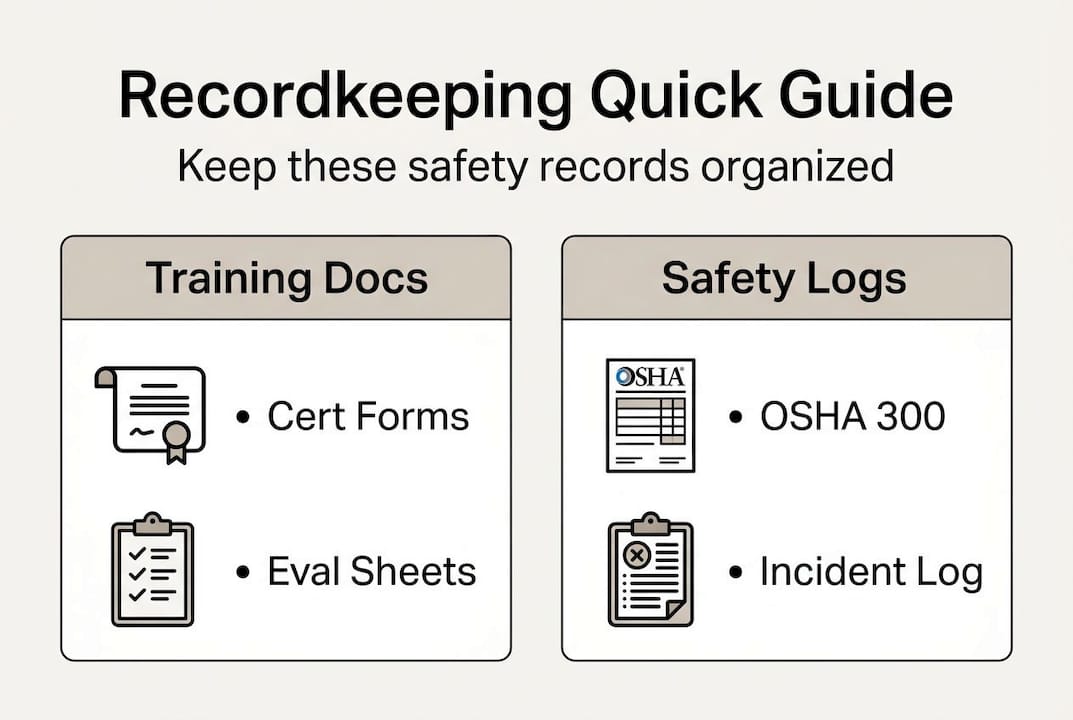
Here’s what a complete training record should contain:
- Full name of the operator as it appears on employment records
- Date training was completed (formal instruction phase)
- Date evaluation was conducted (practical skills assessment)
- Name and signature of the trainer and evaluator (can be the same person)
- Equipment type or truck class covered in training
- Location of training, especially if your company runs multiple sites
- Any retraining or refresher dates, along with the triggering reason
OSHA does not set a specific retention period for these records. However, industry best practice recommends keeping records for at least three to five years, with many legal advisors suggesting you hold them for the duration of the employee’s tenure plus three years. That window gives you protection during long-tail investigations or legal claims.
Pro tip: Create a standard one-page certification form and use it consistently across every training event. When an inspector arrives, consistency signals professionalism. A patchwork of different forms and formats raises more questions than it answers.
Certification is also not a one-and-done process. Per retraining requirements, operators must be evaluated at least every three years and whenever there are observed deficiencies, accidents, near-misses, or changes in equipment type or work conditions. Each of those events needs its own documentation entry.
When are training events recordable on the 300 log?
Here’s where the two worlds collide. Most of the time, training is training: it doesn’t touch the 300 log. But there are clear scenarios where a training activity triggers recordkeeping under injury and illness rules.
The threshold question is always: did the event cause a recordable injury or illness?
According to established recordkeeping guidance, a training-related injury becomes recordable if it results in any of the following:
- Death of the employee
- Loss of consciousness
- Days away from work
- Medical treatment beyond basic first aid
- Work restriction or job transfer
- A diagnosis of a significant injury or illness by a healthcare professional
For example, if an operator trainee drops a load during a hands-on evaluation and fractures their wrist, that injury meets recordable criteria. It goes on the 300 log as a work-related event, even though it happened in the context of training. The training file still captures the certification outcome, and the 300 log captures the injury separately.
“The setting of the injury does not change its recordability. An injury that happens during training is still a work-related injury if the employee was on the clock and performing work tasks.”
When a training incident triggers 300 log entry, you should also initiate a cause investigation. What went wrong in the evaluation setup? Was the trainee rushed? Was the equipment in proper condition? Document your findings, and use them to update your training protocols. That paper trail matters enormously if regulators return for follow-up or if civil litigation follows.
Statistically, warehouses and distribution centers see a disproportionate share of forklift injuries in the U.S. each year. Many of those incidents happen during informal or undocumented training. That’s a recordkeeping gap that exposes employers to serious liability.
How to organize, retain, and present training records
Having accurate records is only half the job. The other half is being able to find them, fast, when an inspector or attorney asks for them.

Under federal recordkeeping rules, training records must be available during inspections. Not “available eventually” or “on request within 30 days.” Available during the inspection. If you can’t produce them on the spot, that failure itself is a violation, even if training was properly completed and documented.
Here’s a side-by-side comparison of digital versus physical recordkeeping approaches:
| Feature | Digital system | Physical files |
|---|---|---|
| Search speed | Fast (search by name/date) | Manual, time-consuming |
| Security | Password-protected, backed up | Fire/water damage risk |
| Update process | Easy to add new entries | Filing space needed |
| Inspector access | Can print on demand | Must locate folder |
| Cost | Low to moderate (software) | Low (but labor-intensive) |
For most operations with more than 20 operators, a digital solution wins on every practical metric. But physical backups still make sense for critical certifications. A hybrid approach works well: maintain digital records as your primary system, and keep physical copies in a labeled binder organized by operator name or by equipment class.
Pro tip: Create a dedicated “inspection-ready folder” with the 10 most recently certified operators, your training program outline, trainer qualifications, and one blank copy of your certification template. When an inspector arrives, hand them this folder immediately. It signals organization and buys your team time to pull any additional records if needed.
During an actual inspection or audit, expect requests for:
- A current list of all certified operators
- The specific cert record for any operator the inspector observed or names
- Evidence of retraining after any incidents
- Your training program curriculum or materials
- The trainer’s own qualifications
Review your forklift safety documentation quarterly. That habit alone catches most gaps before they become citations.
What compliance officers really need to know
Here’s the uncomfortable truth that doesn’t appear in any regulatory plain-language guide: most forklift and scissor lift citations come not from lack of training, but from records that exist in some form but can’t be located quickly or clearly during an inspection. The training happened. The paperwork was created. But nobody could put their hands on it when it counted.
Auditors aren’t trying to catch you failing. They’re testing your system, not just your records. A compliance officer who walks in with disorganized but complete records often gets more scrutiny than one with fewer records that are crisp and ready. That feels counterintuitive, but it reflects a real pattern in enforcement interactions.
The contrarian advice here is: resist the urge to over-document. A four-page training certification form with 30 fields sounds thorough. In practice, it creates more chances for incomplete data, inconsistent completion, and confusion when operators transfer between sites. A clean, one-page template that consistently gets filled out beats an elaborate system that gets skipped or partially completed.
The real benefit of tight recordkeeping best practices isn’t just surviving audits. It’s reducing operational chaos when an incident occurs. When a forklift event triggers an investigation, every hour spent hunting for records is an hour not spent on corrective action, retraining, and getting operations back on track.
Get expert support for recordkeeping and training
Putting these practices into action is easier when your training programs are built with compliance in mind from day one.
At ForkliftAcademy.com, every forklift and scissor lift certification course is designed to produce the exact documentation elements that satisfy both operator certification standards and audit scrutiny. Training completion certificates include all required fields, formatted to match what inspectors expect. Whether your company operates a single warehouse or manages facilities across multiple states, our business-grade certification options give your compliance team ready-to-use records from day one. Stop building your documentation system from scratch. Start with proven tools and let us handle the compliance architecture.
frequently asked questions
Are forklift training records required on the 300 log?
No, forklift training records are not included on Form 300 unless a training session results in a recordable injury or illness. Training records and injury logs serve separate compliance functions.
What information must be on a forklift operator’s training certificate?
The certificate must list the operator’s name, training date, evaluation date, and trainer identity. Missing any of these elements means the certification is technically incomplete under 29 CFR 1910.178(l)(6).
How long should forklift training records be kept?
OSHA does not specify a mandatory period, but industry standard is three years, and many legal advisors recommend keeping records for the employee’s tenure plus three additional years for full legal protection.
Does an injury during hands-on training trigger a 300 log entry?
Yes. If the injury meets recordable criteria, it must be entered on the 300 log regardless of whether it occurred during training or regular operations.
Recommended
- Implement Train the Trainer Requirements 2025 Effectively – Top Osha Forklift Certification
- Forklift safety trends 2026: reduce accidents, ensure OSHA compliance – Top Osha Forklift Certification
- Forklift training: boost safety and efficiency in 2026 – Top Osha Forklift Certification
- Step by step forklift training for OSHA compliance 2026 – Top Osha Forklift Certification