
TL;DR:
- OSHA and Canadian standards require site-specific, hands-on forklift training with thorough evaluation.
- Ongoing refresher training every 3 years is essential, triggered also by incidents or workplace changes.
- Proper preparation, qualified trainers, and rigorous documentation are critical for OSHA compliance and safety.
Forklifts are #6 most-cited OSHA violation, and OSHA estimates that revised training prevents 11 deaths and over 9,000 injuries every year. Those numbers aren’t abstract. They represent real people on your floor, and real liability for your company. Whether you manage a single warehouse in Ohio or a network of distribution centers across Canada, building a compliant onsite forklift training program is one of the highest-impact safety decisions you can make. This guide walks you through every stage, from understanding what OSHA and CSA (Canada’s national standards body) actually require, to delivering training, documenting results, and keeping compliance current as your operation evolves.
Table of Contents
- Understanding legal requirements for forklift training
- Preparing your onsite forklift training program
- Step-by-step: Delivering effective onsite forklift training
- Maintaining compliance: Refresher training and special scenarios
- Our perspective: What makes onsite forklift training actually work
- Get expert forklift training support
- Frequently asked questions
Key Takeaways
| Point | Details |
|---|---|
| OSHA/CSA compliance | Both U.S. and Canadian rules require site- and equipment-specific hands-on training and documentation. |
| Step-by-step process | Effective onsite forklift training follows a cycle: assess, prepare, instruct, practice, evaluate, and certify. |
| Ongoing obligations | Refresher training must be conducted at least every 3 years and after incidents or changes. |
| Trainer responsibility | Employers must ensure trainers are adequately qualified by knowledge and experience, not just certification. |
| Real-world risk reduction | Site-specific customization and continuous engagement go beyond compliance to prevent accidents and fines. |
Understanding legal requirements for forklift training
Before you build anything, you need to know exactly what the law demands. In the U.S., the Occupational Safety and Health Administration (OSHA) sets the standard under 29 CFR 1910.178(l), which requires a three-stage process: formal instruction, practical training, and performance evaluation. Critically, that training must be tailored to the specific site and equipment your operators use. Generic online-only programs do not satisfy this requirement.
In Canada, employers must comply with CSA B335-15, which enforces practical skills assessment, trainer qualifications, and refresher training at least every three years. Provincial regulators like WorkSafeBC, WSIB in Ontario, and WCB Alberta each layer additional enforcement on top of the national standard, so you need to know your province’s specific rules.
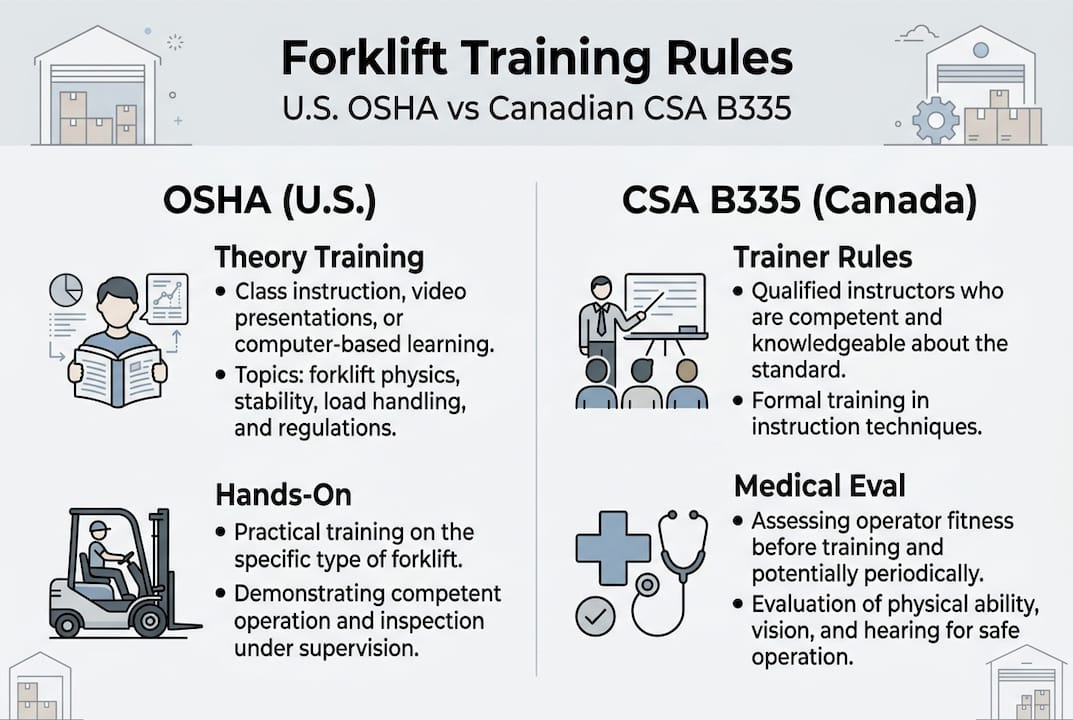
Here’s a side-by-side look at how the two frameworks compare:
| Requirement | OSHA (U.S.) | CSA B335-15 (Canada) |
|---|---|---|
| Formal instruction | Required | Required |
| Practical/hands-on training | Required | Required |
| Performance evaluation | Required | Required |
| Site and equipment specificity | Mandatory | Mandatory |
| Refresher cycle | Every 3 years minimum | Every 3 years minimum |
| Medical fitness check | Not specified | Recommended/provincial |
| Trainer qualification | Knowledge and experience | Formal qualification required |
| Documentation | Required | Required |
Both frameworks place the compliance burden squarely on the employer. You cannot outsource that responsibility to a third-party platform alone.
Key compliance steps to keep in mind:
- Confirm which OSHA standard or provincial regulation applies to your industry and equipment type
- Use our OSHA compliance checklist to audit your current program
- Verify that training is customized to your actual site layout, hazards, and forklift models
- Review the certification checklist to confirm documentation is complete
- Schedule refresher training proactively, not reactively
Important: Training that is not site-specific and equipment-specific is not compliant under OSHA or CSA standards, regardless of how many certificates you print. Review your workplace forklift safety protocols before your next audit.
Preparing your onsite forklift training program
Now that the legal framework is clear, it’s time to gather what you need for success. Preparation is where most programs either succeed or quietly fail. A checklist-and-go approach skips the groundwork that makes training stick.
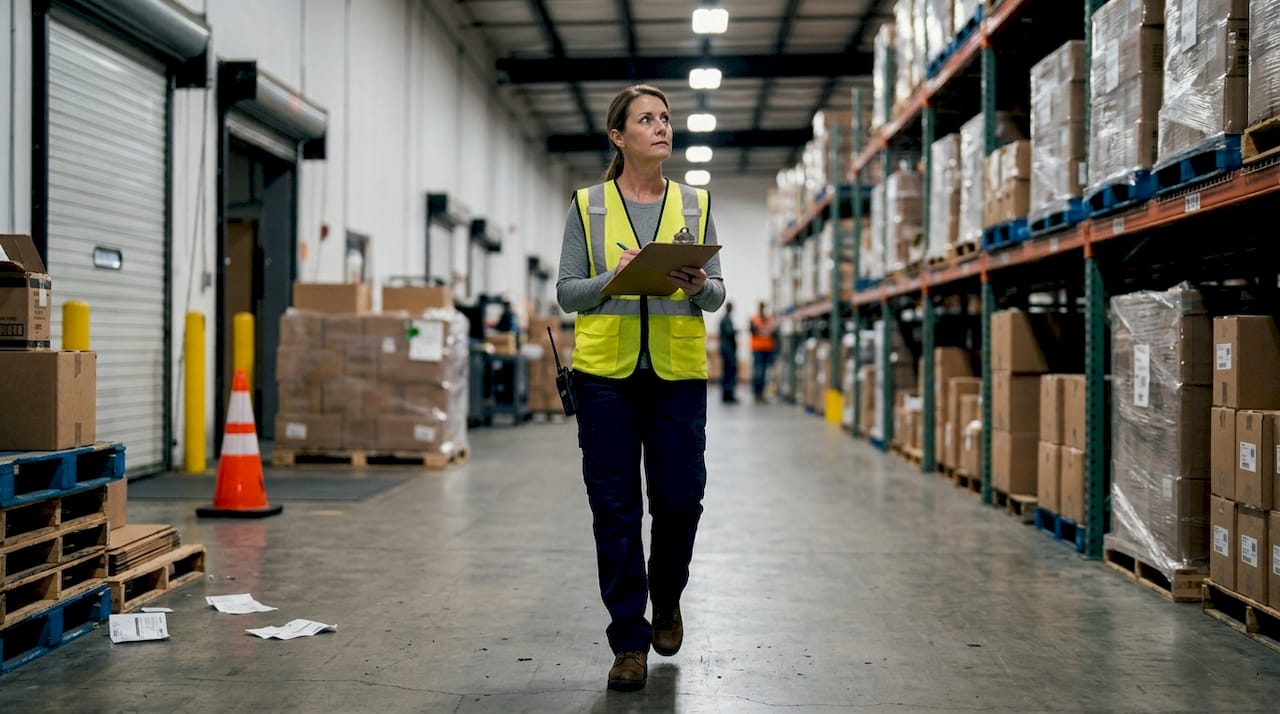
Start with a hazard and equipment assessment. Walk your facility and assess workplace hazards, document every forklift type in use, identify high-traffic intersections, loading dock hazards, narrow aisles, and any site-specific risks. This assessment directly shapes your training content.
Next, build your materials. Generic slide decks won’t cut it. Your instructional content should reference your actual equipment manuals, your facility’s traffic patterns, and your load types. Prepare written materials, visual aids, and hands-on checklists that reflect what operators will actually encounter on shift.
Then confirm your trainer. Under OSHA, trainers must be qualified by knowledge and experience, not just by holding a certificate. That means your trainer should have real operational experience with the specific equipment being taught. Document their qualifications in writing before training begins. Review our trainer responsibilities guide for a full breakdown of what that looks like in practice.
| Preparation item | Who is responsible | Output |
|---|---|---|
| Hazard and equipment assessment | Safety manager | Written hazard report |
| Training materials development | Safety manager + trainer | Site-specific manuals and checklists |
| Trainer qualification documentation | Safety manager | Signed qualification record |
| Scheduling and logistics | HR or safety team | Training calendar |
| Equipment readiness check | Maintenance team | Pre-training inspection log |
Site-specific customization strategies:
- Map your facility and mark all forklift operating zones in training materials
- Include photos or diagrams of your actual equipment models
- Address load types unique to your operation (racking systems, cold storage, outdoor yards)
- Incorporate your internal incident history so operators understand real risks, not hypothetical ones
- Use your training program setup resources to structure the full curriculum
Pro Tip: Blending online theory modules with in-person classroom review before the hands-on session saves time and improves retention. Operators arrive at the practical session with foundational knowledge already in place, which means your trainer spends more time on skill-building and less on basics.
Step-by-step: Delivering effective onsite forklift training
With resources ready, let’s put the program into action step by step. Execution is where compliance becomes real, and where documentation becomes your best protection.
Here are the six core steps for delivering a complete, OSHA-compliant certification program:
- Assess – Review the hazard assessment and confirm all equipment is in safe working order before training begins. No training on malfunctioning equipment.
- Prepare – Brief the trainer, confirm materials are site-specific, and ensure the training area is set up safely with cones, barriers, or signage as needed.
- Instruct – Deliver formal classroom or structured instruction covering OSHA rules, equipment controls, load handling, pre-shift inspection procedures, and site-specific hazards.
- Practice with supervision – Move operators onto actual equipment under direct trainer supervision. This is not optional. Hands-on practice must occur on the equipment types they will actually operate.
- Evaluate – Conduct a formal performance evaluation. Observe each operator individually and score their competency against a standardized checklist.
- Certify and document – Record operator details, training date, trainer name, equipment types covered, and evaluation results. Store records in a secure, accessible location.
Review the full forklift certification steps to make sure nothing is missed in your documentation process.
Safety warning: Skipping or shortcutting the hands-on evaluation is one of the most common compliance failures. An operator who passed a written test but has never been formally observed on equipment is not certified under OSHA standards, and your company bears full liability if that operator is involved in an incident.
Pro Tip: During the practical evaluation, ask operators to narrate what they’re doing and why. Verbalization reveals whether they understand the reasoning behind safe practices, not just whether they can mimic the motions. This technique surfaces knowledge gaps that a checklist alone will miss.
For operators who need to renew, the license renewal steps follow the same structure but can be streamlined based on documented prior performance.
Maintaining compliance: Refresher training and special scenarios
Training isn’t a one-time fix. Here’s how to ensure ongoing compliance and safety as your operation changes over time.
OSHA requires refresher training every 3 years at minimum, but several other triggers require immediate retraining regardless of when the last session occurred:
- An operator is observed operating unsafely
- An operator is involved in an accident or near-miss
- An evaluation reveals the operator is not performing adequately
- The operator is assigned to a new type of equipment
- Workplace conditions change (new racking layout, new traffic patterns, new loading areas)
For multi-site employers, blended online and onsite training is an effective strategy. Deliver standardized theory online across all locations, then conduct site-specific practical evaluations locally. This keeps content consistent while satisfying the hands-on requirement at each unique facility.
| Refresher trigger | Required action | Timeline |
|---|---|---|
| 3-year cycle | Full refresher training | Before expiration |
| Unsafe operation observed | Immediate retraining | Before next shift |
| Accident or near-miss | Retraining and incident review | Before return to duty |
| New equipment type | Equipment-specific training | Before operating |
| Workplace layout change | Updated site-specific training | Before change goes live |
For record management, centralize all operator files in one system, whether digital or physical. Each record should include the operator’s name, training dates, trainer name, equipment types, evaluation scores, and next scheduled refresher date. This makes audits fast and removes the risk of lost records.
Pro Tip: Track your incident rate and near-miss reports by operator and by equipment type. If certain operators or certain pieces of equipment appear repeatedly in your logs, that’s a signal to trigger refresher training and review your program content for gaps. This approach, combined with regular operator feedback surveys, turns your program into a living system rather than a static document. Use our reducing forklift risks resources and safe operations guide to benchmark your program against best practices. Also review your operator responsibilities documentation to confirm operators know what’s expected of them between training cycles.
Our perspective: What makes onsite forklift training actually work
After more than 20 years in forklift safety education, we’ve seen a consistent pattern. Companies that treat training as a compliance checkbox tend to repeat the same incidents. Companies that treat it as a genuine safety investment see measurable reductions in near-misses, damage claims, and injury costs.
The difference isn’t the paperwork. It’s whether the training reflects what actually happens on the floor. A program built around your real hazards, your real equipment, and your operators’ actual behaviors will outperform a generic program every time, even if both produce identical certificates.
The most overlooked step is iteration. Most safety managers audit their documentation but never measure program outcomes. Did injury rates drop? Did near-miss reports change? Did operators flag hazards they previously ignored? Those answers tell you whether your training is working. Build a feedback loop, review it quarterly, and adjust. That’s what separates a safety culture from a safety binder.
Explore our warehouse safety strategies to see how outcome-focused programs are structured in practice.
Get expert forklift training support
Building a compliant onsite forklift training program from scratch takes time, expertise, and the right tools. You don’t have to figure it out alone.
Forklift Academy offers everything safety managers need to run effective, OSHA-compliant programs. Start with our Train the Trainer Online course to qualify your in-house trainer quickly and confidently. For individual certifications, our OSHA forklift certification program covers all required stages. And if you need a clear roadmap for your compliance obligations, our OSHA compliance resources give you the guidance to stay audit-ready year-round. With over 20 years of experience and locations across the U.S., we make compliant training accessible for operations of any size.
Frequently asked questions
What are the minimum requirements for onsite forklift training according to OSHA?
OSHA requires formal theory, hands-on practice, and a performance evaluation, all customized to the specific equipment and site hazards. Training must be conducted by a qualified trainer with relevant knowledge and experience.
How often is forklift refresher training required?
Refresher training must occur at least every 3 years under OSHA, and sooner after accidents, near-misses, unsafe operation, new equipment assignments, or significant changes to the workplace.
Do Canada and the U.S. have the same forklift training rules?
The frameworks are similar, but CSA B335-15 adds requirements for trainer qualifications, medical fitness recommendations, and province-specific enforcement that go beyond federal OSHA standards.
Can forklift training be done 100% online?
No. While online modules can cover theory, hands-on practical evaluation must be conducted on actual equipment at the worksite. Online-only programs do not meet OSHA or CSA compliance requirements.
Who can be a forklift trainer?
Any person qualified by knowledge and experience with the specific equipment can serve as a trainer. No formal certification is required, but the employer must document and confirm the trainer’s qualifications before training begins.
Recommended
- How to Lead Onsite Forklift Training for OSHA Compliance – Top Osha Forklift Certification
- Step by step forklift training for OSHA compliance 2026 – Top Osha Forklift Certification
- Employee forklift training guide for OSHA compliance 2026 – Top Osha Forklift Certification
- How to prepare for onsite forklift training: 2026 OSHA guide – Top Osha Forklift Certification