
TL;DR:
- Forklift training must include formal instruction, practical assessment, and performance evaluation.
- Ongoing retraining is required after incidents or workplace changes, every three years.
- Effective programs embed safety into daily routines and prioritize qualified trainers and documentation.
Forklift incidents kill or seriously injure tens of thousands of workers every year. 85 fatalities and 34,900 serious injuries occur annually in the US alone, and Canadian warehouses face similar risks under their own regulatory framework. For warehouse and logistics managers, that’s not just a safety statistic. It’s a legal, financial, and human responsibility. The good news: OSHA and CSA compliance is achievable with the right structure. This guide walks you through the regulations, the build-out, the delivery, and the documentation you need to run a training program that actually protects your people and your operation.
Table of Contents
- Understand forklift training regulations in the US and Canada
- Step-by-step: How to build a compliant lift truck training program
- Effective training delivery: Blended learning for real-world results
- Documentation, evaluation, and continuous improvement
- What most managers get wrong—and how to do it better
- Discover expert forklift training solutions
- Frequently asked questions
Key Takeaways
| Point | Details |
|---|---|
| Follow compliance standards | Use OSHA (US) and CSA (Canada) guidelines for a legal and effective forklift training program. |
| Adopt blended learning | Combine online theory with hands-on practical evaluation for best retention and multi-site scaling. |
| Prioritize documentation | Keep thorough records of all training, evaluations, and retraining triggers to ensure compliance. |
| Measure and improve | Track incident rates and ROI to continuously enhance your training program’s effectiveness. |
| Qualified trainers matter | Designating well-trained, knowledgeable trainers is essential to safety and legal compliance. |
Understand forklift training regulations in the US and Canada
Before you build anything, you need to know exactly what the law requires. In the US, OSHA mandates a three-part training program under 29 CFR 1910.178(l): formal instruction, practical training, and a performance evaluation. These aren’t optional layers. All three must be completed before an operator is authorized to drive a powered industrial truck on your floor.
In Canada, the standard is CSA B335-15 (updated to B335:25), which governs forklift training requirements across provinces. While provincial enforcement varies, the core structure mirrors OSHA’s approach: theory, hands-on practice, and competency evaluation.
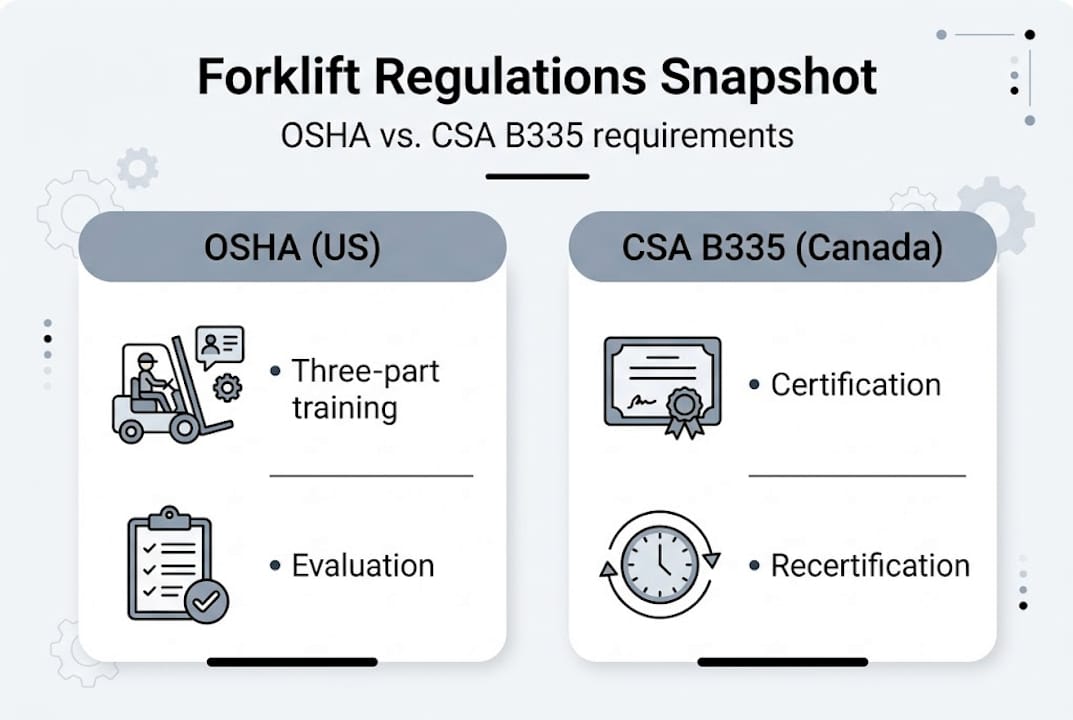
Here’s a quick comparison of the two frameworks:
| Requirement | OSHA (US) | CSA B335 (Canada) |
|---|---|---|
| Formal instruction | Required | Required |
| Hands-on training | Required | Required |
| Performance evaluation | Required | Required |
| Recertification cycle | Every 3 years | Every 3 years (varies by province) |
| Trainer qualification | Must be qualified | Must be competent |
| Documentation | Required | Required |
Both frameworks also require retraining when specific triggers occur. These include:
- An observed unsafe operation
- An accident or near-miss incident
- A change in workplace conditions
- Introduction of a new truck type or class
- A failed evaluation
For a deeper look at how these requirements apply to your operation, the OSHA compliance overview and the employee training guide are solid starting points.
Non-compliance carries real consequences. OSHA penalties for serious violations can exceed $16,000 per incident in 2026, and willful violations can reach $161,000 or more. Beyond fines, a single preventable accident can trigger OSHA investigations, workers’ compensation claims, and civil liability.
“Compliance isn’t just about avoiding penalties. It’s about building a workplace where your operators come home safe every day.”
Pro Tip: Review the official OSHA requirements and CSA B335 guidance side by side when designing your program. Knowing both standards helps you build one system that works across US and Canadian facilities without doubling your effort.
Step-by-step: How to build a compliant lift truck training program
With the legal standards clarified, here’s how you can build a training system that checks all the boxes and actually works.
Step 1: Conduct a needs assessment. Identify every powered industrial truck type in your facility and every operator who needs training. Map out workplace-specific hazards: racking configurations, pedestrian traffic zones, loading dock conditions, and surface types.
Step 2: Designate qualified trainers. Your trainer must have the knowledge, experience, and skill to evaluate operator performance. You can use internal supervisors, a third-party provider, or a train-the-trainer program to build in-house capacity.
Step 3: Develop your curriculum. Compliant programs require formal theory, hands-on practice, and evaluation, plus documentation and scheduled re-evaluation. Your theory content must cover truck controls, load handling, pre-shift inspections, and hazard recognition. Hands-on content must be specific to the actual equipment and environment your operators use.
Step 4: Deliver training in sequence. Theory first, then practical, then evaluation. Don’t skip steps or compress the sequence to save time. A rushed evaluation is one of the most common compliance gaps we see.
Step 5: Document everything. Record operator names, training dates, trainer identity, truck types covered, and evaluation results. Keep records accessible for OSHA or CSA inspections.
Step 6: Schedule recertification. Set calendar reminders for three-year re-evaluations. Build a trigger-based retraining protocol into your safety management system so incidents automatically generate a retraining event.
Here’s how internal and external training options compare:
| Factor | Internal trainer | External provider |
|---|---|---|
| Upfront cost | Higher (setup) | Lower per session |
| Long-term cost | Lower | Higher over time |
| Customization | High | Moderate |
| Scalability | Excellent | Depends on provider |
| Compliance risk | Requires oversight | Managed by provider |
For a detailed walkthrough, the step-by-step OSHA guide and forklift safety training steps cover each phase in depth. You can also review available training program options to find the right fit for your operation size.
Pro Tip: Check the training requirements details to confirm your curriculum covers every mandated topic before your first session. Missing even one required element can invalidate the entire certification.
Effective training delivery: Blended learning for real-world results
Once your program framework is set, delivering effective training is crucial. Here’s what actually works in the field.

Blended training, combining online theory with in-person practical, is the recognized best practice for both compliance and cost efficiency. Online modules handle the knowledge-based content efficiently. In-person sessions handle what online can never replace: actual hands-on operation and live evaluation.
Here’s what each format handles best:
- Online (theory): OSHA/CSA regulations, pre-shift inspection procedures, load capacity principles, hazard recognition, pedestrian safety, and refueling protocols
- In-person (practical): Equipment-specific operation, maneuvering in your actual facility, load handling with real racking and surfaces, and the formal performance evaluation
Selecting the right trainer for practical sessions matters more than most managers realize. Your evaluator must be able to observe and assess real-time performance, not just check a box. If your internal trainer isn’t confident evaluating a specific truck class, bring in an external evaluator for that component.
For multi-site operations, blended learning scales exceptionally well. Online theory can be standardized across all locations, while local trainers handle site-specific practical evaluations. This approach keeps your compliance consistent without requiring a centralized training team to travel constantly.
Language and comprehension are factors that get overlooked. If a significant portion of your workforce speaks English as a second language, your online theory modules should be available in their primary language. OSHA does not exempt non-English speakers from training requirements, and a misunderstood instruction is as dangerous as no instruction at all.
Truck class differences also matter. An operator certified on a Class 4 internal combustion sit-down truck is not automatically qualified to operate a Class 1 electric counterbalanced truck. Training is equipment-specific, and your delivery plan must reflect that. Review multi-site training strategies for guidance on managing this complexity across locations.
For more on structuring your delivery approach, the training delivery methods page covers format options in practical detail.
Pro Tip: Record your online theory completions automatically through your learning management system. This creates a time-stamped audit trail before the practical session even begins, which strengthens your compliance documentation significantly.
Documentation, evaluation, and continuous improvement
Delivering training isn’t enough. Maintaining strong documentation and evaluation keeps your operation safe and compliant year after year.
Your records must include, at minimum:
- Operator’s full name
- Training date(s)
- Trainer’s name and qualification
- Truck type(s) and class(es) covered
- Evaluation results (pass/fail and any observed deficiencies)
- Date of next scheduled re-evaluation
These records should be stored in a format that’s easy to retrieve during an OSHA inspection. Digital recordkeeping systems are strongly preferred over paper files, especially for multi-site operations.
Ongoing performance monitoring is where most programs fall short. Certification doesn’t end the safety obligation. Supervisors should conduct regular informal observations and flag behaviors that indicate a need for retraining. Near-misses must be reported and reviewed, not quietly dismissed.
| Monitoring method | Frequency | Purpose |
|---|---|---|
| Supervisor observation | Weekly | Catch unsafe habits early |
| Pre-shift inspection review | Daily | Confirm compliance with inspection protocol |
| Incident and near-miss review | After each event | Trigger retraining if needed |
| Formal re-evaluation | Every 3 years | Maintain certification currency |
Tying training into your daily warehouse safety routines is what separates compliant operations from truly safe ones. Daily inspections, pedestrian separation, and procedural controls are vital for sustainable results. Training sets the foundation, but daily reinforcement keeps it alive.
The ROI case for doing this right is strong. Proper training reduces incidents by up to 70% and injuries by 75%, delivering $4 to $6 in return for every $1 invested. When you factor in reduced workers’ compensation costs, lower equipment damage rates, and fewer OSHA penalties, the financial argument is clear. Review the injury statistics for context on what non-compliance costs in real terms.
For a detailed breakdown of returns, the training ROI analysis and the program setup guide are worth reviewing before you finalize your budget request.
“The best safety programs don’t just train operators once. They build a culture where safe behavior is the default, not the exception.”
What most managers get wrong—and how to do it better
After more than 20 years in forklift safety education, we’ve seen the same mistakes repeat across facilities of every size. The most common one: treating certification as the finish line instead of the starting point.
Managers who focus entirely on getting operators certified often skip the depth of hands-on evaluation. They rush the practical session, use an unqualified internal trainer, or accept a cursory performance review as sufficient. The paperwork looks fine. The operation isn’t.
The second mistake is ignoring retraining triggers. An operator who had a near-miss last month but wasn’t retrained is a liability waiting to materialize. A culture of ongoing safety, where supervisors actively observe and report, outperforms any one-off certification program by a wide margin.
The third mistake is underestimating the value of qualified trainers. A trainer who can’t articulate why a load center distance matters, or who can’t demonstrate proper mast tilt technique, cannot meaningfully evaluate an operator. Qualification isn’t a formality.
What works: treating training as a living system. Certification is the entry point. Daily reinforcement, periodic evaluation, and a clear retraining protocol are what actually reduce incidents. The operations that see the strongest results from effective OSHA training are the ones that embed safety into every shift, not just every three years.
Discover expert forklift training solutions
Implementing a fully compliant lift truck training program doesn’t have to mean starting from scratch or navigating regulatory language alone. Forklift Academy has supported warehouse and logistics managers across the US and Canada for over 20 years, providing OSHA and CSA-compliant training solutions built for real operational environments.
Whether you need scalable online theory modules, onsite practical training, or a train the trainer online program to build internal capacity, the tools are ready. Browse the full range of training programs to match your facility’s size and structure. For businesses managing multiple operators or sites, forklift certification for business offers turnkey solutions that simplify compliance and reduce administrative burden. Your operators deserve training that works. Your operation deserves a program that lasts.
Frequently asked questions
How often must forklift operators be retrained under OSHA and CSA rules?
Operators must be retrained every 3 years minimum, and sooner if there’s an incident, observed unsafe behavior, or changes in equipment or workplace conditions. Both OSHA and CSA treat these triggers as mandatory retraining events, not optional reviews.
Can forklift practical assessments be conducted online?
No. Practical evaluation must be in-person with the actual equipment and in the actual work environment. Online-only certification does not satisfy OSHA or CSA requirements for the hands-on and evaluation components.
Who is qualified to conduct forklift training in a warehouse?
A qualified trainer is someone with demonstrated knowledge, training, and experience in powered industrial truck operation and safety. Employers must designate qualified trainers and can use internal staff or external providers, as long as the trainer meets the qualification standard.
Is forklift training transferable between different types or classes of lift trucks?
No. Training is non-transferable across truck types and classes. An operator certified on one equipment class must receive separate training and evaluation before operating a different class of powered industrial truck.
What are the benefits of OSHA-compliant forklift training for my business?
Compliant training reduces incidents and injuries by up to 70% and 75% respectively, while delivering measurable ROI through lower workers’ compensation costs, reduced equipment damage, and fewer regulatory penalties.
Recommended
- OSHA Forklift Compliance Guide for Safe Operations – Top Osha Forklift Certification
- How to Lead Onsite Forklift Training for OSHA Compliance – Top Osha Forklift Certification
- How to Implement Forklift Safety Training for OSHA Compliance – Top Osha Forklift Certification
- Employee forklift training guide for OSHA compliance 2026 – Top Osha Forklift Certification