
Forklift accidents account for approximately 85 fatalities and 34,900 serious injuries annually in the United States, making proper operator training a life-saving necessity. OSHA mandates comprehensive training for all forklift operators to prevent these tragedies and ensure workplace compliance. This guide walks you through the complete step-by-step process to implement OSHA-compliant forklift training, covering legal requirements, preparation, execution, and verification to protect your workers and business.
Table of Contents
- Understanding OSHA Forklift Training Requirements
- Preparation: Tools, Materials, And Prerequisites For Effective Training
- Execution: Step-By-Step Forklift Training Process
- Verification And Safety Best Practices To Prevent Common Forklift Accidents
- Enhance Your Workplace Safety With Expert Forklift Training Programs
Key takeaways
| Point | Details |
|---|---|
| OSHA requires trained operators | Only certified, competent operators can legally operate powered industrial trucks under federal law. |
| Training includes evaluation and certification | Programs must combine formal instruction, hands-on practice, and written documentation of competency. |
| Proper procedures prevent accidents | Following stacking protocols and handling guidelines significantly reduces injury risks. |
| Documentation is mandatory | Employers must maintain written certification records including operator names, dates, and trainer details. |
| Regular retraining ensures safety | Operators need re-evaluation every three years or after incidents to maintain competency. |
Understanding OSHA forklift training requirements
OSHA’s Powered Industrial Truck standard (29 CFR 1910.178) establishes the legal framework for forklift training in the United States. This regulation protects workers by ensuring that only trained and competent operators handle powered industrial trucks. Without proper training, operators risk serious injury or death from tip-overs, collisions, and crushing incidents.
Employers carry full legal responsibility for training programs. You must provide both formal classroom instruction and practical, hands-on training before allowing anyone to operate a forklift independently. The standard applies to all industries using forklifts, from warehouses to construction sites.
Compliance requires three critical components:
- Formal instruction covering truck-related topics, workplace hazards, and operational requirements
- Practical training demonstrating safe operation in actual work environments
- Performance evaluation to verify operator competency before certification
Certification isn’t optional. You must create written records documenting each operator’s training, evaluation dates, and the trainer’s identity. These records prove compliance during OSHA inspections and protect your business from penalties.
“OSHA mandates that only trained and competent operators are permitted to operate powered industrial trucks.”
Understanding your basic forklift operator job description requirements helps structure training around real workplace needs. Review OSHA training requirements list forklift safety standards to ensure you cover all mandatory topics before beginning your program.
Preparation: tools, materials, and prerequisites for effective training
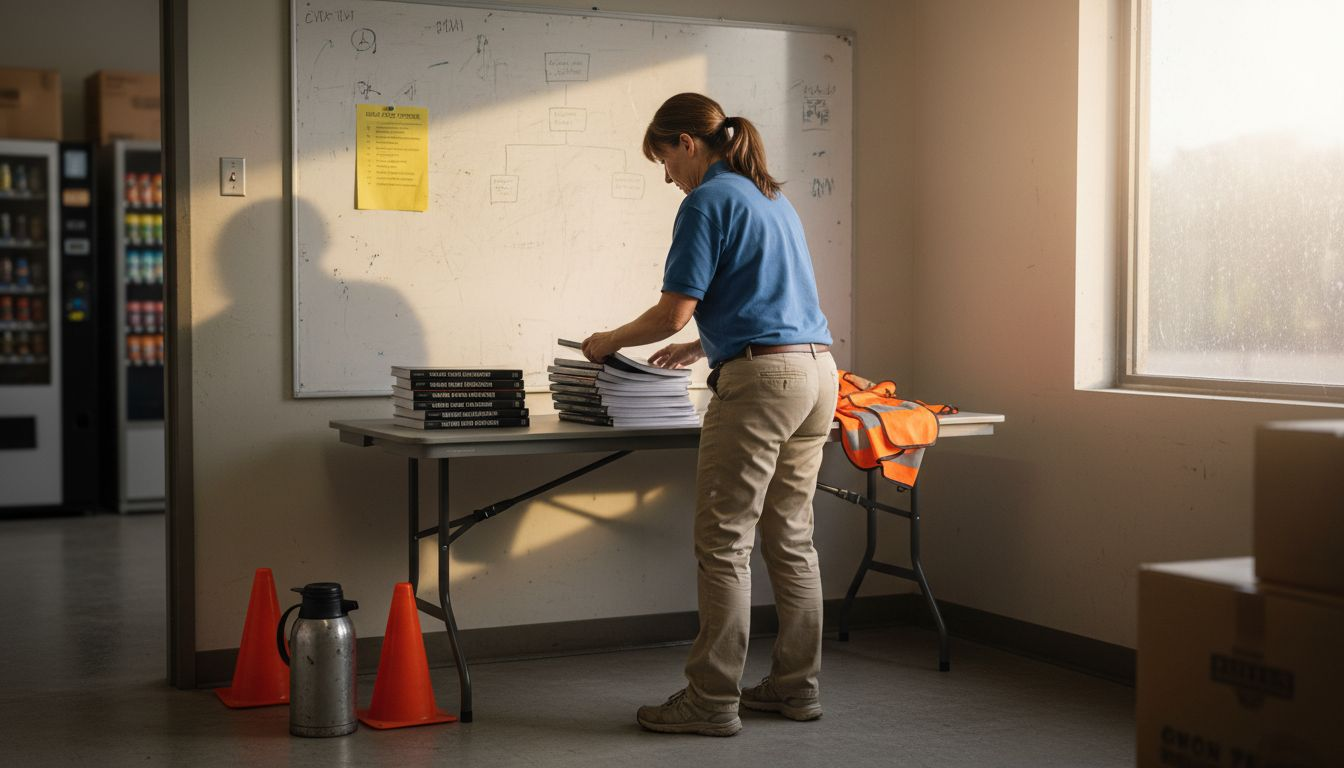
Successful training starts with thorough preparation. Gathering the right materials, creating a safe training environment, and verifying trainee prerequisites ensures your program meets OSHA standards from day one.
Your training toolkit needs these essential components:
- OSHA-approved training manuals and instructional materials
- Safety equipment including hard hats, high-visibility vests, and steel-toed boots
- Multiple forklift types matching your workplace equipment
- Certification forms and documentation templates
- Practice materials like pallets, loads, and obstacles for realistic scenarios
The training environment must mirror actual workplace conditions without compromising safety. Set up designated training areas with adequate space for maneuvering exercises, proper lighting, and clear visibility. Remove unnecessary hazards while maintaining realistic challenges operators will face daily.
| Preparation Category | Required Items | Purpose |
|---|---|---|
| Training Materials | Manuals, videos, presentations | Formal instruction foundation |
| Safety Equipment | PPE for all trainees | Injury prevention during practice |
| Practice Equipment | Forklifts, pallets, loads | Hands-on skill development |
| Documentation | Certification forms, evaluation checklists | OSHA compliance records |
| Training Space | Safe area mimicking workplace | Realistic skill application |
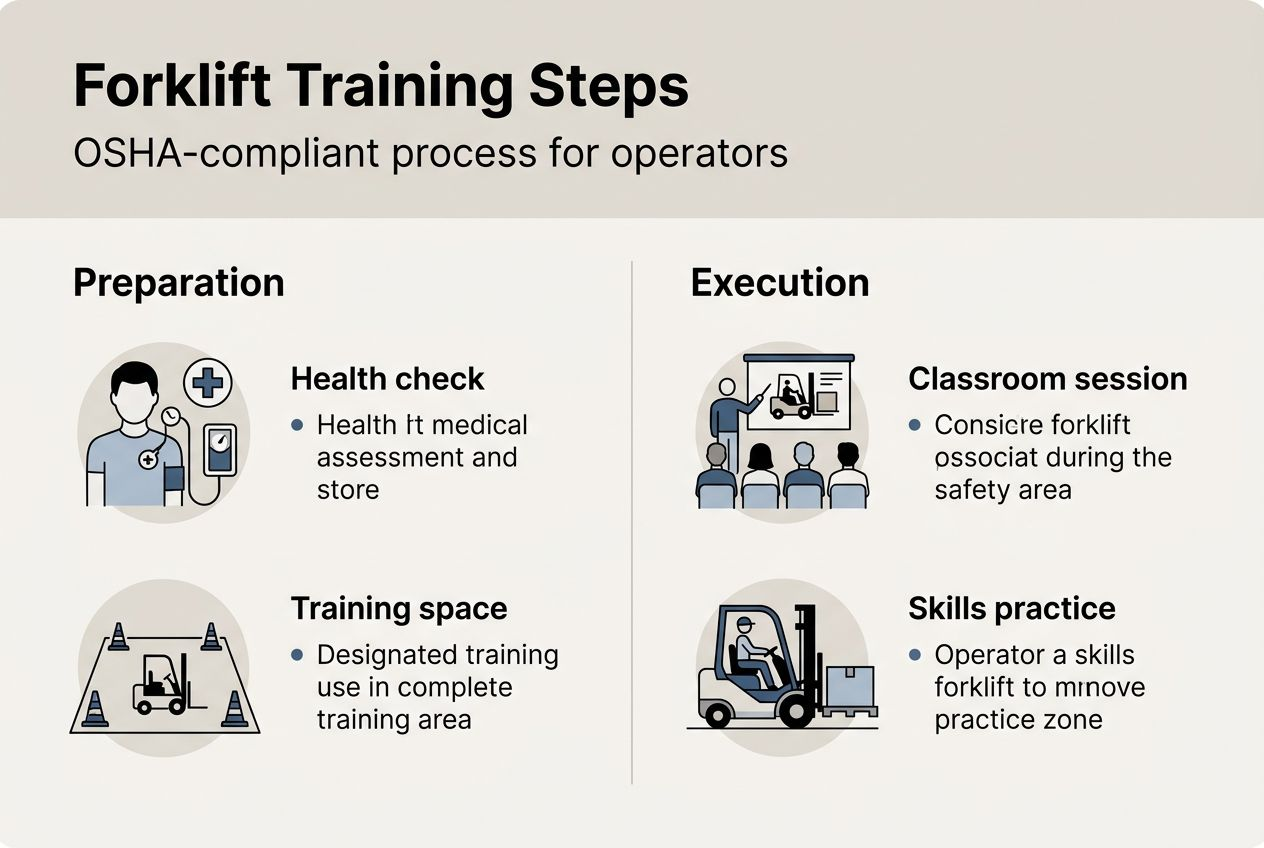
Before starting training, verify that trainees meet basic prerequisites. Conduct health screenings to ensure physical capability for forklift operation. Confirm basic literacy for understanding safety materials and written tests. Check that trainees hold valid driver’s licenses if required by your workplace policy.
Written certification must include the operator’s name, training date, evaluation date, and trainer’s name. Standardize these forms before training begins to streamline documentation.
Pro Tip: Create a forklift training program setup guide checklist specific to your facility. This ensures consistent preparation across multiple training sessions and different trainers.
Consider online forklift certification guide options for the classroom portion. Online modules let trainees complete formal instruction at their own pace before hands-on practice, saving time and resources.
Execution: step-by-step forklift training process
Implementing OSHA-compliant training requires a systematic approach that builds competency through progressive skill development. Follow these six sequential steps to create certified, safe operators.
- Formal classroom instruction: Begin with comprehensive theoretical training covering forklift types, physics of operation, load capacity, and stability principles. Teach OSHA regulations, workplace-specific hazards, and emergency procedures. Use presentations, videos, and written materials to address different learning styles. This foundation typically requires 4 to 8 hours depending on complexity.
- Practical demonstration: Move to equipment familiarization where instructors demonstrate proper techniques. Show pre-operation inspections, control operations, safe travel procedures, and load handling. Trainees observe without operating to build mental models of correct procedures. Point out common mistakes and their consequences.
- Supervised hands-on practice: Let trainees operate forklifts under direct supervision in controlled environments. Start with basic maneuvers like driving forward and backward, turning, and stopping. Progress to more complex tasks including load pickup, stacking, and navigating obstacles. Provide immediate feedback and correction.
- Performance evaluation: Assess each trainee’s competency through standardized testing. Combine written exams covering safety knowledge with practical demonstrations of operational skills. Evaluators must verify that operators can safely perform all job-related tasks independently. Only trained and competent operators can receive certification.
- Feedback and remediation: Address deficiencies identified during evaluation before certification. Provide additional instruction and practice time for trainees who don’t meet standards. Document all remediation efforts and re-evaluate until competency is achieved.
- Certification issuance: Upon successful completion, issue written certification documenting the operator’s qualification. Include all required information per OSHA standards and file records for future reference and compliance verification.
Pro Tip: Follow detailed OSHA forklift training steps to ensure you don’t miss critical elements. Use a forklift operator certification workflow checklist to track each trainee’s progress through all six steps.
Training duration varies based on trainee experience and equipment complexity. New operators typically need 15 to 25 hours total, while experienced operators transitioning to new equipment may complete training faster. Never rush evaluation, competency determines certification readiness, not time spent.
Verification and safety best practices to prevent common forklift accidents
Training doesn’t end with certification. Ongoing verification and adherence to safety best practices maintain competency and prevent the accidents that cause thousands of injuries annually.
Verify operator competency through multiple methods. Conduct regular performance observations during normal work activities. Schedule periodic refresher training to reinforce critical safety concepts. Document all evaluations to track operator performance over time and identify trends requiring intervention.
Common forklift accidents stem from preventable mistakes. Unstable pallet stacking causes fatal collapses when operators remove critical bracing or exceed safe stacking heights. Tip-overs occur when operators travel with elevated loads or take corners too fast. Pedestrian strikes happen when operators lack proper visibility or ignore right-of-way rules.
Implement these critical safety practices:
- Follow proper stacking protocols including stable base construction and secure load placement
- Maintain safe stacking heights per manufacturer specifications and load weight
- Secure materials with appropriate bracing, stretch wrap, or strapping before transport
- Conduct pre-operation inspections checking brakes, steering, and safety features
- Enforce pedestrian separation with designated walkways and warning systems
| Safety Practice | Implementation | Accident Prevention |
|---|---|---|
| Proper stacking | Stack, block, interlock, limit height | Prevents pallet collapse and crushing |
| Load securing | Wrap, strap, verify stability | Eliminates shifting and falling loads |
| Pre-operation checks | Daily inspection checklists | Identifies equipment failures before operation |
| Speed limits | Posted limits, enforcement | Reduces tip-overs and collisions |
| Visibility protocols | Mirrors, cameras, horn use | Prevents pedestrian strikes |
Retraining triggers include observed unsafe behavior, involvement in accidents or near misses, and changes to equipment or workplace conditions. OSHA requires re-evaluation every three years minimum, but many workplaces benefit from annual refreshers.
Continuous safety improvement requires data tracking. Monitor incident reports, near miss documentation, and damage claims to identify patterns. Use this information to target specific safety weaknesses in refresher training and operational procedures.
Maintain comprehensive records linking training to safety outcomes. This documentation proves due diligence during investigations and helps justify safety investments to management. Access your forklift safety checklist guide OSHA compliance resources to standardize verification processes.
Enhance your workplace safety with expert forklift training programs
Implementing comprehensive forklift training protects your workers and ensures OSHA compliance, but building programs from scratch takes significant time and expertise. Professional training solutions streamline the process while guaranteeing regulatory adherence.
Forkliftacademy.com offers flexible training programs designed for both individual operators and entire workforces. Choose online modules for convenient classroom instruction, then complete hands-on evaluation at your facility or our network of locations. This hybrid approach maximizes efficiency without sacrificing quality.
Our forklift training certification programs include all required documentation, evaluation tools, and OSHA-compliant materials. You receive ready-to-use certification forms that simplify record keeping and audit preparation. For larger organizations, train the trainer online programs empower your staff to deliver consistent, compliant training internally while maintaining quality standards.
FAQ
What are the essential components of OSHA-compliant forklift training?
OSHA-compliant training must include formal classroom instruction covering operational theory and safety, hands-on practical training in actual work environments, and comprehensive performance evaluation verifying competency. Written certification documenting the operator’s name, training dates, evaluation dates, and trainer identification is mandatory upon successful completion.
How often must forklift operators be re-evaluated and retrained?
Operators require re-evaluation at least every three years under OSHA standards. Additional retraining is mandatory after accidents, near misses, observed unsafe operations, or whenever operators transition to different forklift types or workplace conditions. Regular evaluations between required intervals help maintain consistent safety performance.
What documentation must employers keep after forklift training?
Employers must maintain written certification records including each operator’s name, the date of training, the date of performance evaluation, and the identity of the person conducting training and evaluation. These records prove OSHA compliance during inspections and must remain accessible throughout each operator’s employment and for the required retention period afterward.
Can forklift training be completed entirely online?
Formal classroom instruction can be completed online, but OSHA requires hands-on practical training and in-person performance evaluation in actual workplace conditions. Online modules effectively cover theoretical knowledge, safety regulations, and operational principles, but competency verification must occur through supervised equipment operation. Hybrid programs combining online theory with on-site practice offer the most efficient approach.
Who is qualified to train and certify forklift operators?
Trainers must have the knowledge, training, and experience to teach forklift operation and evaluate operator competence effectively. While OSHA doesn’t require specific trainer certifications, qualified individuals typically include experienced supervisors, safety managers, or professional training organizations with documented expertise. The trainer’s qualifications should match the complexity of equipment and operations being taught.
Recommended
- OSHA Forklift Training Steps for Safe Operation – Top Osha Forklift Certification
- Ensure forklift operator OSHA training compliance in 2026 – Top Osha Forklift Certification
- How to Implement Forklift Safety Training for OSHA Compliance – Top Osha Forklift Certification
- OSHA Forklift Compliance Guide for Safe Operations – Top Osha Forklift Certification