
TL;DR:
- Failing OSHA forklift training inspections can lead to costly citations, increased workers’ compensation premiums, and operational shutdowns. OSHA mandates a three-part training process—including formal instruction, practical training, and performance evaluation—conducted by qualified personnel with documented records. Maintaining comprehensive written programs, records, and ongoing refresher training ensures long-term compliance and promotes workplace safety.
Failing an OSHA inspection for forklift training violations can cost your company thousands of dollars in citations, spike your workers’ comp premiums, and shut down operations while investigators are on-site. Many warehouse and logistics managers assume that handing out certificates covers their liability, but OSHA’s actual requirements go far deeper than a printed card. This guide walks you through every layer of compliant forklift training, from understanding the legal standard to building records that hold up during audits, so you can protect your team and your business with confidence.
Table of Contents
- Understand core OSHA forklift requirements
- Get prepared: Documentation, people, and program setup
- Step-by-step: Conducting compliant forklift training
- Stay compliant: Refresher training and common pitfalls
- Manager’s perspective: What actually works (and what fails) in real-world OSHA audits
- Next steps: Get OSHA forklift training solutions for your team
- Frequently asked questions
Key Takeaways
| Point | Details |
|---|---|
| OSHA demands both training and evaluation | Certification means classroom and hands-on evaluation by a qualified person—not just an online course. |
| Proper records are essential | Auditors require proof of training, evaluation, and any refresher actions specific to each operator. |
| Refresher triggers matter | Incidents, unsafe acts, or operational changes make retraining and re-evaluation mandatory. |
| Preparation prevents citations | Develop a documented program and select experienced trainers to safeguard compliance. |
| Smart managers go beyond the minimum | Proactive safety and compliance programs outperform check-the-box certificate mills during OSHA audits. |
Understand core OSHA forklift requirements
Now that you know the stakes, let’s break down exactly what OSHA expects from warehouse and logistics managers.
OSHA classifies forklifts as Powered Industrial Trucks, commonly called PITs. This category includes counterbalanced forklifts, reach trucks, order pickers, pallet jacks, and other motorized material handling equipment. If your warehouse uses any of these machines, your operators must be trained and evaluated under OSHA’s specific standard.
The governing rule is 29 CFR 1910.178(l), which covers all general industry forklift operations. According to OSHA, forklift operator training requirements specify that all operator training must result in competent, evaluated operators, not just workers who completed a course. That distinction is critical.
What “compliant” training actually means
OSHA breaks training into three required components. Miss any one of them and your program is out of compliance, regardless of how much money you spent on it.
- Formal instruction: Lectures, written materials, video training, or e-learning that covers truck operation, hazard recognition, and workplace safety
- Practical training: Hands-on demonstrations by the trainer and exercises performed by the operator under direct supervision
- Performance evaluation: An in-workplace evaluation conducted by a qualified person to confirm the operator can safely perform their specific job duties
A common mistake managers make is treating an online course completion certificate as the finish line. It is not. Online content can satisfy the formal instruction component, but practical training and evaluation must still happen in person with the actual equipment the operator will use.
| Training component | Delivery method | Who is responsible |
|---|---|---|
| Formal instruction | Online, classroom, video | Qualified trainer |
| Practical training | In-person, on equipment | Qualified trainer, on-site |
| Performance evaluation | In-person, on equipment | Qualified evaluator |
Check the OSHA forklift compliance checklist to confirm all three components are built into your current program.
“A certificate alone does not prove compliance. OSHA requires a full training cycle that ends with a documented, in-person performance evaluation by a qualified person.”
Get prepared: Documentation, people, and program setup
With a clear sense of the requirements, preparation is the crucial next step to avoid fines and failed audits.
Before any training takes place, you need to build the infrastructure that supports it. This means written programs, qualified personnel, and a recordkeeping system that survives turnover, equipment changes, and surprise inspections.
Required elements of a written training program
Your written program should document:
- The scope of equipment covered (truck types and model numbers)
- The names or roles of qualified trainers and evaluators
- The topics included in formal instruction
- The format and criteria for practical training exercises
- The process for performance evaluation and documentation
- Conditions that trigger refresher training
- Procedures for new hires and equipment reassignments
This is not a one-page memo. Treat it like an operational standard operating procedure. OSHA inspectors will ask for it, and if it doesn’t exist, that’s an immediate violation.
Who can train and evaluate operators?
OSHA does not require trainers to hold a specific license, but they must have the knowledge, training, and experience necessary to train operators and evaluate their competency. That means your designated trainer should be proficient with the specific trucks being used, familiar with your facility’s layout and hazards, and capable of objectively evaluating operator performance.
Your warehouse forklift compliance guide can help you confirm whether your internal trainers meet these qualifications. Good trainers also tend to share other qualities with strong operations leaders, many of which align with good warehouse management traits.
In-house vs. third-party training: a practical comparison
| Factor | In-house training | Third-party training |
|---|---|---|
| Cost per operator | Lower over time | Higher per session |
| Customization | Tailored to your facility | Standardized, may need adaptation |
| Trainer availability | Depends on staff | On-demand scheduling |
| Audit defensibility | Strong if records are solid | Strong with established provider |
| Scalability | Requires train-the-trainer investment | Scales with vendor capacity |
Recordkeeping: what you must document
Training and evaluation records must be maintained and available to demonstrate compliance during OSHA inspections. For each operator, you should retain:
- The date training and evaluation were completed
- The name of the person who performed the evaluation
- The truck types the operator was evaluated on
- Any refresher training events and their dates
- Signed acknowledgment from the operator
Pro Tip: Use a dedicated digital folder or training management system for each operator. When an OSHA compliance officer walks in and asks for records, you want to pull them up in under two minutes, not spend an hour searching through filing cabinets.
Step-by-step: Conducting compliant forklift training
Once your people and paperwork are in place, here’s how to deliver a training process that will pass OSHA scrutiny.
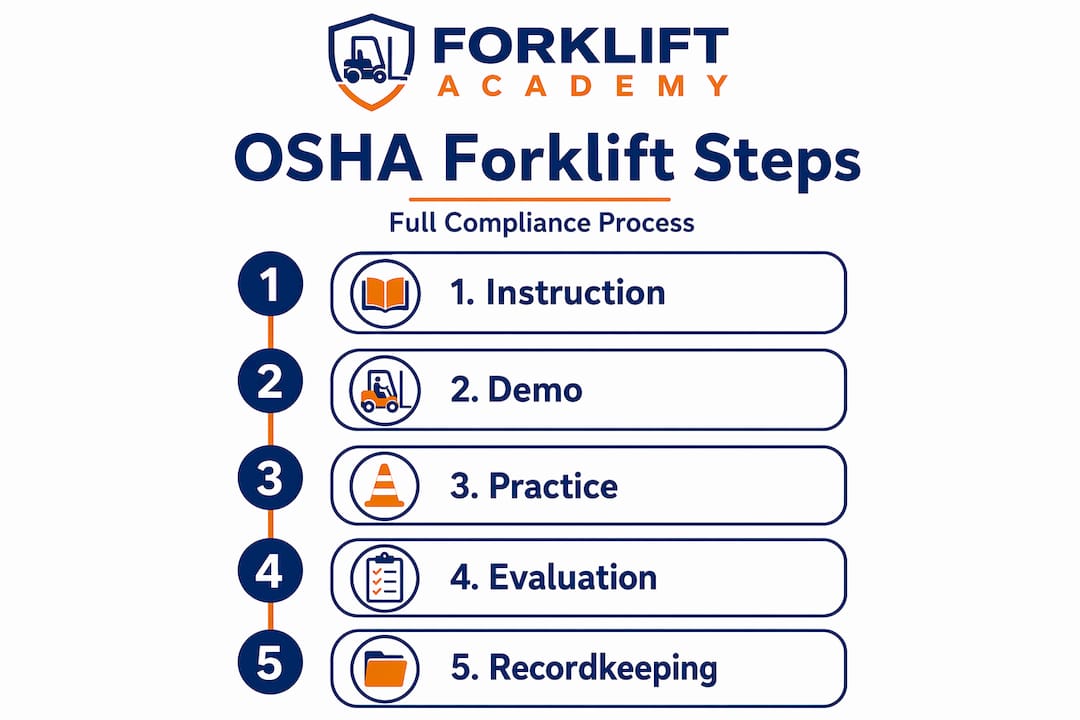
Many managers know the three components of training in theory but struggle to execute them in a sequence that holds up to inspection. Here is a practical order of operations.
Step 1: Conduct formal instruction
Begin with classroom or online content that covers the required OSHA topics. These include truck controls and instrumentation, engine or motor operation, steering and maneuvering, visibility, load capacity and stability, load manipulation and stacking, fueling and charging, surfaces and atmospheres for operation, and pedestrian traffic patterns in your facility.
Step 2: Demonstrate practical techniques
Your qualified trainer demonstrates each operation task before asking the operator to attempt it. This is not optional. OSHA requires employers to train and evaluate operators, including formal instruction, practical training, and a performance evaluation that is tailored to the truck type and workplace hazards present in that specific facility. Showing is a core part of teaching.
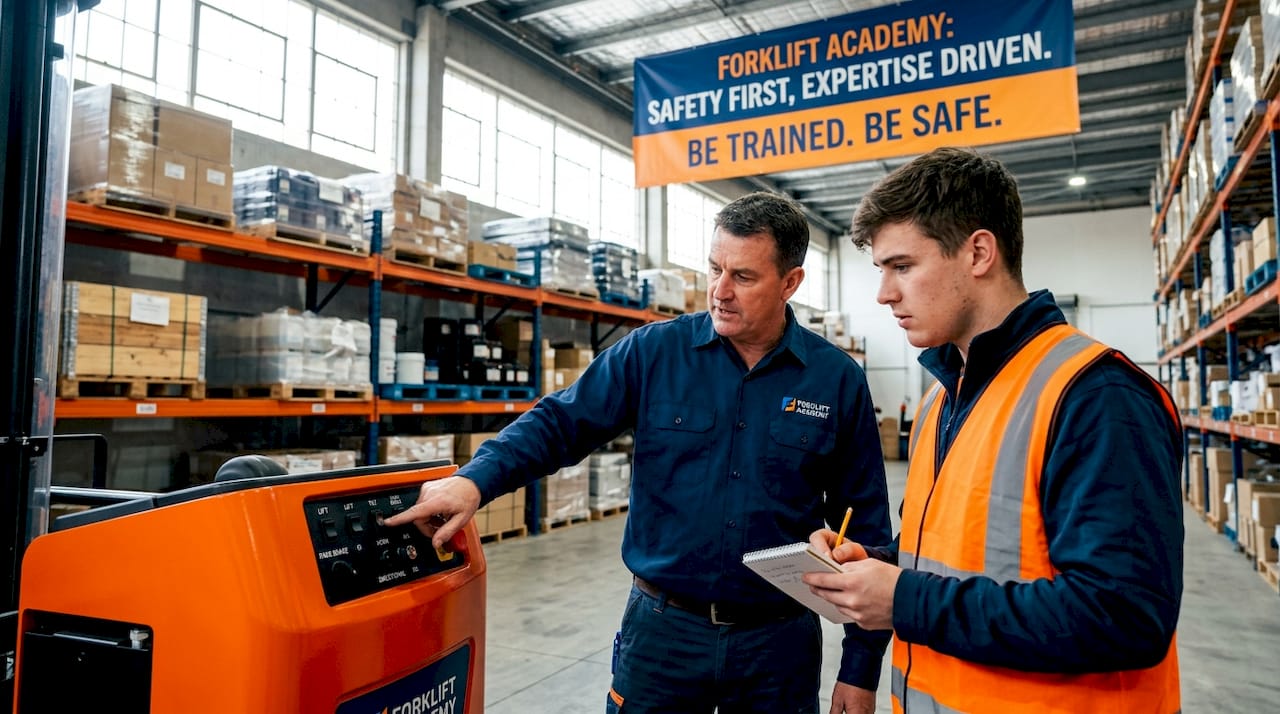
Step 3: Supervised hands-on practice
The operator practices each task under direct supervision. Direct supervision means the trainer or evaluator is physically present, watching, and able to intervene if something goes wrong. Remote observation does not count.
Step 4: Conduct a performance evaluation
Once the operator has practiced, a qualified person evaluates performance on the actual equipment in the actual workplace. OSHA allows flexibility in training delivery methods, but practical training and evaluation must still meet regulatory requirements, and direct supervision is non-negotiable for the evaluation phase.
Step 5: Document everything immediately
Complete your evaluation forms and training logs the same day training occurs. Include the evaluator’s signature, the operator’s acknowledgment, the equipment type, and the date. Delayed documentation is a common audit red flag.
Customizing training to truck type and workplace
An operator certified on a sit-down counterbalanced forklift is not automatically qualified to operate a reach truck or an order picker. Each truck type has different controls, load dynamics, and visibility characteristics. If your warehouse runs multiple truck types, each one requires a separate evaluation.
Workplace hazards also vary. A refrigerated warehouse presents different risks than an outdoor lumber yard. Training content and evaluation criteria must reflect the actual conditions your operators face. Review safe forklift operations guidance to build hazard-specific content into your program.
“Training that doesn’t match your actual trucks and your actual facility layout isn’t training. It’s a formality. OSHA knows the difference.”
Stay compliant: Refresher training and common pitfalls
Compliance isn’t one-and-done. Here’s how to stay audit-ready as warehouse operations change.
Getting your initial program right is important, but long-term compliance is where many managers fall short. OSHA’s standard requires ongoing attention, especially when circumstances change.
Triggers for mandatory refresher training
Refresher training and reevaluation is required when any of the following conditions occur:
- An operator is observed performing an unsafe action
- An accident or near-miss involving the operator takes place
- An evaluation reveals unsafe operation
- The operator is assigned to a different type of forklift
- Workplace conditions change in a way that affects safe operation
Each of these triggers is separate and independent. If a near-miss happens, you do not wait for the next annual review. You schedule refresher training within a reasonable timeframe and document it immediately.
Documenting refresher training
Refresher training follows the same documentation standards as initial training. Record the trigger event, the date of refresher training, what was covered, who conducted it, and the outcome of any reevaluation. Incomplete records for retraining events are a frequent citation during inspections.
Common compliance failures and how to avoid them
| Compliance failure | Why it happens | How to prevent it |
|---|---|---|
| No written training program | Managers assume informal training is sufficient | Create and maintain a formal written program from day one |
| Missing evaluation records | Documentation treated as an afterthought | Complete and sign forms immediately after each session |
| Using online-only training as the full program | Misunderstanding OSHA’s three-part requirement | Pair online content with in-person practical training and evaluation |
Reducing long-term risk also means staying current on reducing warehouse forklift risks, which includes both equipment maintenance and ongoing operator monitoring.
Manager’s perspective: What actually works (and what fails) in real-world OSHA audits
With all the technical steps covered, here’s what sets top-performing managers apart during real OSHA visits.
Here is the uncomfortable truth: most forklift training failures in audits are not about operator incompetence. They are about paperwork gaps and process shortcuts that managers made under time pressure. The operator knew how to drive. But nobody documented it properly. That is where fines happen.
The online certification trap
Online training platforms that market “full certification” are selling you the formal instruction component of a three-part requirement. That component has real value. But when managers assume that clicking through an online module is the end of the compliance story, they are exposed. OSHA’s requirement is not just classroom content; it includes practical training and performance evaluation by qualified persons. If your operators have online completion certificates but no documented in-person evaluation, you have a documentation problem waiting to become a citation.
This does not mean online training is bad. It means it needs to be one part of a complete program, not a standalone solution.
What audit teams actually look for first
When OSHA compliance officers arrive, their first request is typically your training records, not a demonstration of operator skill. They want to see that you have a written program, that every active operator has a complete training file, and that evaluations were conducted by someone who meets the qualified person standard. If those records are clean and organized, the conversation usually stays professional. If they are missing or incomplete, the tone changes fast.
Compliance as a safety tool, not just a legal shield
The best managers we work with treat the OSHA standard as a floor, not a ceiling. They use the three-part training structure to build operators who genuinely understand load physics, travel path hazards, and equipment limitations. When compliance is built into daily operations instead of treated as an annual checkbox, accident rates drop and near-misses get reported instead of ignored.
Review OSHA forklift compliance tips for specific practices that bridge the gap between regulatory documentation and real operational safety.
Next steps: Get OSHA forklift training solutions for your team
To put these insights into practice, here are resources to simplify compliance for your workforce.
Building a fully compliant forklift training program is manageable when you have the right support. At Forklift Academy, we have spent over 20 years helping warehouse managers move from compliance risk to audit confidence.
Whether you need to get individual operators through a structured OSHA forklift certification program, set up your own in-house trainers through our train the trainer online kit, or simply understand your next step in the lift certification process, we have a solution designed for your operational scale and schedule. Our programs combine online formal instruction with the in-person evaluation tools you need to satisfy all three OSHA requirements, available in both self-service and onsite formats across the U.S.
Frequently asked questions
Who can train and evaluate forklift operators under OSHA?
Training and evaluation must be conducted by someone with the knowledge, training, and experience to train operators and assess competence, as required under 29 CFR 1910.178(l)(2)(iii). There is no formal license required, but the person must demonstrably meet the qualified person standard for the specific trucks and workplace involved.
How often is forklift refresher training required by OSHA?
OSHA does not set a fixed annual schedule. Instead, refresher training is triggered by specific events such as observed unsafe operation, accidents, near-misses, equipment reassignment, or changes in workplace conditions.
What records must be kept to prove OSHA forklift training compliance?
For each operator, you must retain records of training dates, topics covered, the evaluator’s name, equipment types evaluated, and any refresher training. Training and evaluation records must be available for review during OSHA inspections.
Can forklift operator certification be done entirely online?
No. While online content can satisfy formal instruction requirements, OSHA requires practical training and performance evaluation by a qualified person, conducted in person on the actual equipment in the actual workplace. Online-only programs do not meet the full standard.
Recommended
- How to Comply With OSHA Forklift Rules: A Step-by-Step Guide – Top Osha Forklift Certification
- Forklift compliance guide: Keep your warehouse safe in 2026 – Top Osha Forklift Certification
- Forklift Safety Checklist Guide for OSHA Compliance – Top Osha Forklift Certification
- OSHA Forklift Compliance Guide for Safe Operations – Top Osha Forklift Certification