
TL;DR:
- OSHA requires employers to certify forklift operators in-house, not issue licenses or cards.
- Certification must be equipment-specific, documented, and renewed every three years or after incidents.
- Daily inspections and workplace-specific training are essential to maintain safety and compliance.
Most warehouse managers assume OSHA hands out some kind of forklift license, the way the DMV issues a driver’s license. That assumption is wrong, and acting on it can cost your operation thousands of dollars in fines. Under OSHA 29 CFR 1910.178, forklift certification is entirely the employer’s responsibility, not a government agency’s. This guide breaks down every stage of the lift certification process, what your documentation must include, what triggers retraining, and where most managers unknowingly fall short. If you manage a warehouse or distribution operation, these are the compliance details that protect your team and your business.
Table of Contents
- How OSHA defines lift certification: The foundation
- Step-by-step: The lift certification process explained
- What makes lift certification valid? Documentation and recordkeeping
- Essential safety checks: Daily inspections and operator eligibility
- Common pitfalls and expert strategies for managers
- Our take: Why documentation and site-specific focus are game-changers
- Next steps: Train, certify, and stay compliant with expert support
- Frequently asked questions
Key Takeaways
| Point | Details |
|---|---|
| Employer-issued certification required | OSHA does not issue forklift licenses; employers must certify each operator for their facility and equipment. |
| Three-step process | Certification demands classroom or online training, hands-on practice, and a documented evaluation. |
| Documentation is critical | Written proof of training, evaluation, and operator identity is required and must be kept up to date or fines apply. |
| Frequent retraining triggers | Recertification is needed every three years or after incidents, equipment changes, or unsafe behavior. |
| Daily safety checks | Operators must inspect vehicles before use each day to ensure ongoing OSHA compliance and workforce safety. |
How OSHA defines lift certification: The foundation
Let’s clarify what “lift certification” really means under OSHA’s standards.
The single biggest misconception in warehouse safety is that there is an OSHA-issued forklift license. There is not. OSHA does not issue forklift licenses. Employers must certify operators in-house using a structured, documented process. Understanding the distinction between a forklift license vs. certification is the first step toward real compliance.
Certification under OSHA is specific to three things: the operator, the type of equipment they will operate, and the facility where they will work. An operator certified on a stand-up reach truck in a Chicago warehouse is not automatically certified to run a counterbalance sit-down forklift in a different facility. That specificity is not a technicality. It is the core of why certification matters for real-world safety.
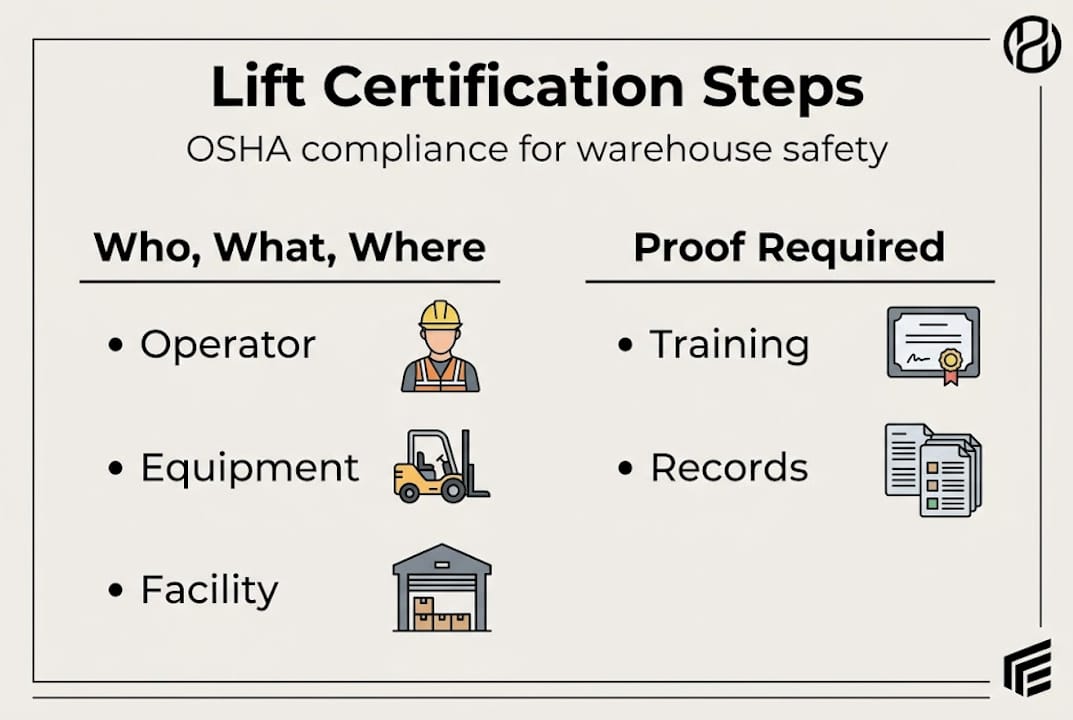
Here is a quick comparison that clears up the most common confusion:
| Common myth | OSHA reality |
|---|---|
| OSHA issues forklift licenses | Employers certify operators in-house |
| One certification works anywhere | Certification is site and equipment specific |
| Online training alone is enough | Hands-on evaluation is required |
| Certification never expires | Retraining required every 3 years or sooner |
OSHA also specifies when certification becomes invalid and retraining is required. Triggers include an observed unsafe operation, a near-miss or accident, an assignment to a different type of equipment, or a change in the workplace that could affect safe operation. Key requirements at a glance:
- Certification must be equipment-type specific (OSHA recognizes 7 forklift classes)
- It must reflect the actual worksite conditions
- Written records must be retained by the employer
- No government database or registry exists to verify certification
“Employers are responsible for ensuring every operator is properly trained and evaluated before operating powered industrial trucks on their site.”
This means the burden of proof always falls on you as the employer. If OSHA walks in for an inspection, you need records, not a verbal assurance.
Step-by-step: The lift certification process explained
Now that you know OSHA’s expectations, let’s walk through the actual certification stages your team must complete.
The operator certification workflow follows three required stages. Skipping any one of them puts your certification at risk.
- Formal instruction. This covers the rules, hazards, and operating principles related to the specific equipment and workplace. It can be delivered in a classroom or through an accredited online course. This stage addresses things like load capacity, stability, pedestrian safety, and relevant OSHA standards.
- Hands-on practice. Operators must practice operating the actual equipment they will use, under the direct supervision of a qualified trainer, on the actual or comparable site. Online training cannot substitute for this step.
- Performance evaluation. A qualified trainer must observe the operator performing real tasks with the equipment and confirm competency. This evaluation must be fully documented and include the trainer’s identity, the date, and the specific equipment evaluated.
All three stages must be completed before an operator works independently. The operator duties begin only after the full process is done.
| Certification stage | Format options | OSHA requirement |
|---|---|---|
| Formal instruction | Classroom or online | Required before hands-on |
| Hands-on practice | On-site only | Supervised by qualified trainer |
| Performance evaluation | On-site only | Documented, trainer-signed |
Blended programs combine online formal instruction with on-site evaluation. This is the format most warehouse operations find most practical. It reduces time off the floor while still satisfying every trainer responsibilities requirement under OSHA.
Pro Tip: Assign a dedicated internal trainer for your site. Having one person own the certification process reduces inconsistencies, keeps documentation tight, and gives OSHA inspectors a single point of contact.
What makes lift certification valid? Documentation and recordkeeping
Completing training is only half the job. The right paperwork makes all the difference.
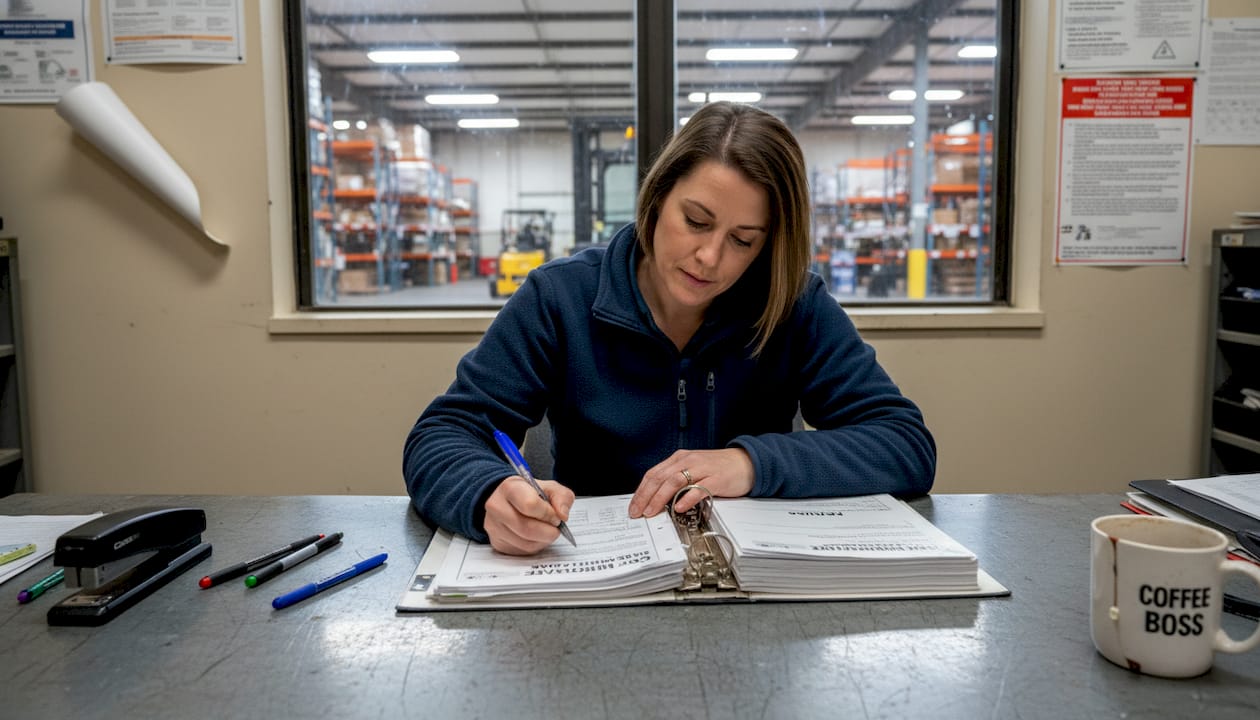
OSHA does not care how thorough your training was if you cannot prove it happened. Employers must document the operator’s name, the training and evaluation dates, and the trainer or evaluator’s identity. Every certificate your operation issues must contain all of these elements. A generic certificate downloaded from the internet does not meet this standard unless it reflects your specific operator, equipment, and site.
Here is what belongs on every valid certification record:
- Operator’s full name
- Date of training completion
- Date of evaluation
- Name and signature of the qualified trainer or evaluator
- Equipment type(s) covered
- Site or facility location
Retraining is required in specific situations, not just on a fixed schedule. Triggers include any accident or near-miss, observed unsafe behavior, assignment to a new equipment type, and changes to the workplace layout or operating conditions. Regardless of all of these, retraining is mandatory every three years at a minimum.
There is no central OSHA registry where you can verify an operator’s history. If an operator claims they were certified at a previous job, that means nothing for your facility. You must certify them for your site, your equipment, and your conditions. Their previous operator responsibilities do not transfer to your workplace automatically.
The financial stakes are real. OSHA penalties for missing or invalid certification records can exceed $15,000 per violation. Full OSHA compliance requirements around recordkeeping are not optional, and inspectors do check.
Pro Tip: Treat your certification binder like a legal document. Date-stamp every entry, keep backup digital copies, and review the file before any scheduled audit or inspection.
Essential safety checks: Daily inspections and operator eligibility
Safe certified operation relies on both qualified people and reliable equipment. Let’s cover the critical daily and eligibility checks.
Certification does not end when training is complete. Safe daily operations depend on two ongoing requirements: pre-use inspections and confirming operator eligibility. Both are OSHA mandated.
Operators must be at least 18 years old to operate powered industrial trucks in a general industry setting. This is a firm minimum with no exceptions. Beyond age, operators must be trained on the specific class of lift they are using. OSHA recognizes seven forklift classes, and training on a Class I electric sit-down forklift does not cover Class IV internal combustion forklifts.
Daily pre-shift inspections are not a suggestion. They are mandatory before every use. If a forklift is used across multiple shifts, each operator must complete an inspection before their shift begins. Items to check every time:
- Tires: check for wear, damage, or low pressure
- Brakes: test service and parking brakes
- Lights and horn: confirm all warning systems work
- Hydraulics: check for leaks and smooth function
- Forks: inspect for cracks, bends, or damage
- Data plate: confirm it is legible and matches the actual equipment configuration
If any issue is found, the operator must tag the equipment out of service and report it before anyone uses the lift. Continuing to operate a defective forklift while waiting for repairs is a direct OSHA violation.
Pro Tip: Use a printed daily inspection log kept with each forklift. A quick signature and date from the operator before each shift creates a documented trail that holds up in any inspection.
Tying daily checks back to certification, operators who skip inspections or operate unsafe equipment may trigger a retraining requirement under OSHA’s unsafe operation clause.
Common pitfalls and expert strategies for managers
Finally, let’s look at where managers trip up and what you can do differently.
The most frequent reasons warehouses fail OSHA inspections are preventable. They are not about ignorance of the rules. They are about execution. The top compliance failures include incomplete certification records, using generic or online-only training without on-site evaluation, missing retraining after equipment or site changes, and failing to document the trainer’s identity on file.
Here are the proven strategies that keep operations compliant:
- Run a documentation audit quarterly. Pull every operator’s file and check that all required fields are complete. Missing a date or a trainer signature is enough to invalidate a record.
- Use scenario-based training. Generic modules cover rules. Scenario training builds the judgment needed to handle real hazards like narrow aisles, mixed pedestrian traffic, and uneven loading docks.
- Build a retraining calendar. Set automatic reminders for every operator’s three-year renewal. Do not wait for an incident to prompt retraining.
- Address the most overlooked hazard directly. Load tip-overs account for a significant share of forklift fatalities. Training should include specific scenarios involving uneven loads, incline travel, and turning with elevated loads.
- Know your fines. Repeat or willful OSHA violations related to forklift certification can exceed $15,000 per violation, and inspectors do issue multiple citations from a single visit.
Knowing how to pass OSHA tests and understanding the inspection mindset helps you structure your program from the right angle. Inspectors look for gaps between your stated training program and your actual records.
Pro Tip: Add a self-audit checklist to your compliance calendar. Treat it like a mock inspection. If you can’t find a specific record in under 60 seconds, OSHA won’t either.
Our take: Why documentation and site-specific focus are game-changers
In our experience helping dozens of warehouse managers build certification programs, one pattern repeats: the operations that pass inspections cleanly are not always the ones with the most sophisticated training programs. They are the ones with the cleanest records.
This is the uncomfortable truth about OSHA compliance. An inspector cannot observe the training session that happened six months ago. They can only read what is in your file. If the paperwork is thorough, specific, and current, you pass. If it has gaps, you pay.
The most effective programs we have seen adapt to specific hazards in that facility, not just the minimum OSHA text. A cold storage warehouse has different risks than a lumber yard. Your training program and your trainer responsibilities guide should reflect that. Certification as a living process, one that updates when your site changes, is the posture that prevents both accidents and violations. Treat it like a set-and-forget task, and eventually, something will go wrong.
Next steps: Train, certify, and stay compliant with expert support
Armed with this knowledge, here’s where you can get practical support to make lift certification simple for your team.
Forklift Academy has spent over 20 years helping warehouse operations across the United States build clean, OSHA-compliant certification programs. Whether you need to certify a single operator or roll out a program for an entire team, we have the tools to do it right.
Our Train the Trainer Online program gives your internal staff the authority to certify operators on-site, reducing long-term training costs. For a complete overview of your options, explore our top OSHA forklift certification programs designed for fast compliance. If you want to review the regulatory requirements alongside your training options, our guide to forklift certification requirements is a practical starting point. Certification should not be complicated. Let us help you build a program that holds up.
Frequently asked questions
Does OSHA issue forklift licenses or cards?
No, OSHA does not issue forklift licenses or certification cards. Only employers can certify operators, and that certification is tied to specific equipment and specific worksites.
How often do forklift operators need to recertify?
Operators must be recertified at least every 3 years, or sooner after an accident, near-miss, unsafe operation, or a change in equipment or workplace conditions.
Are online-only forklift certification programs acceptable?
No. Online formal instruction is permitted as one part of training, but operators must also complete hands-on practice and an on-site evaluation by a qualified trainer before certification is valid.
What daily checks are required before forklift use?
Before each shift, operators must inspect tires, brakes, lights, hydraulics, forks, and the data plate. Any forklift with a defect must be taken out of service immediately.
Is there an age requirement for forklift operators?
Yes. Operators must be at least 18 years old under OSHA general industry regulations, and they must be trained on the specific class of equipment they will operate.
Recommended
- Step by Step Scissor Lift Certification for OSHA Compliance – Top Osha Forklift Certification
- Top Examples of Lift Certifications for OSHA Compliance – Top Osha Forklift Certification
- How to Get OSHA Forklift Certification: A Step-by-Step Guide – Top Osha Forklift Certification
- Forklift Certification Step by Step: Complete OSHA Guide – Top Osha Forklift Certification