 Skip to content


TL;DR:
- OSHA requires lift certifications to include formal instruction, hands-on training, and performance evaluation.
- Different lift types like forklifts and aerial lifts need equipment-specific, compliant training programs.
- Proper documentation, regular renewal, and matching certification to specific equipment are essential for compliance.
Choosing the right lift certification feels straightforward until you’re staring at a dozen programs, each claiming to be OSHA-compliant, and your next inspection is three months away. Warehouse managers and business owners across the U.S. and Canada regularly face this exact pressure. The stakes are real: a poorly chosen or incomplete certification puts operators at risk and exposes your business to serious penalties. This article walks you through what OSHA actually requires, gives you concrete examples of compliant forklift and scissor lift certifications, and helps you make a confident, informed decision for your team.
| Point | Details |
|---|---|
| OSHA-compliant essentials | OSHA requires both formal instruction and hands-on evaluation for valid lift certifications. |
| Forklift vs. scissor lift | While both need similar evaluations, each certification must match the specific equipment type and hazards. |
| Renewal and records | Lift certifications must be renewed every three years, with complete documentation for workplace compliance. |
| Selection process | Identify the lift type and specific site risks before choosing a certification program. |
OSHA doesn’t issue its own certification cards or endorse specific vendors. What it does is set clear, enforceable criteria that every training program must meet. If you understand those criteria, you can evaluate any program quickly and confidently.
According to OSHA 29 CFR 1910.178(l), a compliant forklift certification requires three non-negotiable components: formal instruction, hands-on training, and a performance evaluation. Every single element must be present. Skip one, and the certification doesn’t hold up during an audit.
Here’s what each component actually means in practice:
One detail many managers miss is that certification must match the specific lift type. A forklift certification doesn’t cover scissor lift operation. If your team runs both, they need both certifications. This isn’t a technicality OSHA overlooks.
Renewal is also clearly defined. OSHA compliance requirements specify that operators must be re-evaluated at least every three years, and also after any observed unsafe behavior, a workplace accident involving a lift, or a change in the operator’s assigned equipment or work environment.
Pro Tip: Don’t wait for the three-year mark if anything changes. An operator switching from a counterbalance forklift to a reach truck needs re-training before they touch the new equipment.
Statistic to know: Forklifts are involved in roughly 85 fatal accidents and nearly 35,000 serious injuries each year in the U.S. Proper, complete certification is one of the most effective controls available to reduce that number.
Now that you understand the standard, let’s look at what compliant forklift certification actually looks like in practice. There are several accepted formats, and the right one depends on your team size, schedule, and existing resources.
1. Employer-led certification program
This is the most common format for large warehouses with a designated safety officer or experienced trainer. The employer designs or purchases a curriculum, delivers formal instruction internally, conducts hands-on training on actual equipment, and performs the final evaluation. OSHA’s forklift certification standard requires that the person delivering training be knowledgeable, trained, and qualified. This doesn’t mean they need a separate license, but they must genuinely understand what they’re teaching.
2. Third-party online certification (with on-site practical)
This is increasingly popular. Operators complete formal instruction through an accredited online platform, then a workplace supervisor or safety officer conducts the hands-on evaluation on-site. Tips for passing the OSHA forklift test can help operators prepare for both the theory and practical components. This format works well for businesses that need flexible scheduling without sacrificing compliance.
3. Formal third-party classroom course
A safety organization or training company delivers the full program, including classroom instruction, hands-on training, and evaluation. This option suits smaller employers who don’t have an internal trainer or the equipment setup for practicals.
Regardless of format, every compliant forklift certification must cover:
For Canadian operations, the standard is CSA B335, which parallels OSHA’s structure closely. Businesses operating in both countries should verify that their chosen program addresses both standards. Our business forklift training guide outlines exactly what to look for.
Pro Tip: Always issue a physical or digital certification card upon completion. OSHA auditors expect documentation, and operators need proof of certification on request.
Forklifts aren’t the only lifts needing formal proof. Scissor lifts, boom lifts, and other mobile elevating work platforms (MEWPs) have their own specific standards, and the consequences of skipping proper certification are just as serious.
OSHA’s aerial lifts standard requires employer training on hazard awareness, fall protection, inspections, and practical evaluation before any operator uses a MEWP on the job. The practical component is mandatory, even if the theory was completed online.
Here are three common certification formats for scissor and aerial lifts:
“Operators must be trained by a qualified person on the specific aerial lift they will use, including the hazards it presents in the specific work environment.” This means a certification on a scissor lift doesn’t automatically transfer to a boom lift.
Core content in any compliant scissor lift program must include operation procedures, load capacity, guardrail requirements, pre-use inspection, fall protection systems, and emergency procedures. For operators in Canada, CSA B354 governs aerial lifts. The structure mirrors OSHA’s approach closely, and many reputable programs address both. Review our scissor lift training steps for a detailed breakdown of what the practical evaluation should cover.
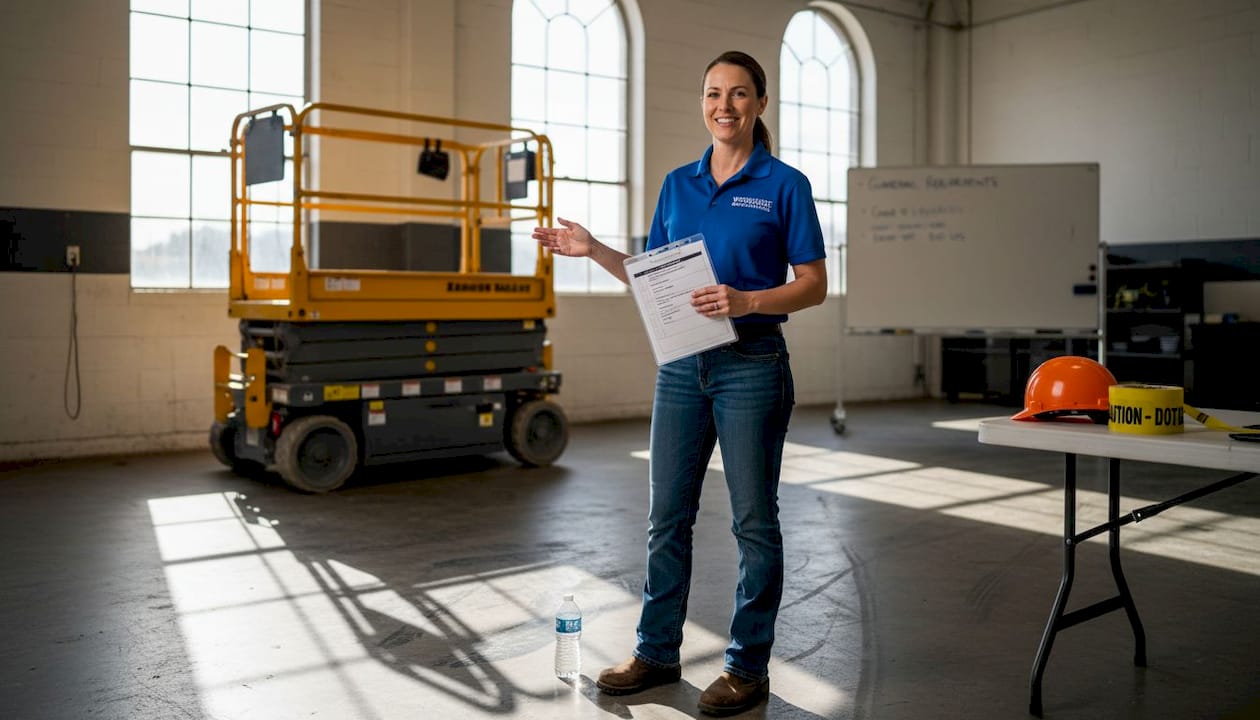
Seeing both certifications side by side makes it easier to plan training budgets, timelines, and documentation.
| Feature | Forklift certification | Scissor/aerial lift certification |
|---|---|---|
| Governing standard | OSHA 29 CFR 1910.178(l) | OSHA 29 CFR 1926.453 |
| Formal instruction required | Yes | Yes |
| Hands-on training required | Yes | Yes |
| Performance evaluation required | Yes | Yes |
| Online theory accepted | Yes | Yes |
| Equipment-specific training | Yes, per lift type | Yes, per lift type |
| Renewal interval | Every 3 years minimum | Every 3 years minimum |
| Canadian standard | CSA B335 | CSA B354 |
| Documentation required | Yes (records + cards) | Yes (records + cards) |
As you can see, OSHA’s standards for powered industrial trucks and aerial lifts share the same core structure. Both require instruction, hands-on practice, and evaluation. Both expire on the same cycle. The difference is in the specific content and the equipment covered.
This matters because some managers assume a general “lift certification” covers everything. It doesn’t. An operator certified on a counterbalance forklift still needs separate certification before stepping onto a scissor lift platform. Matching certification to job duties isn’t just a compliance checkbox; it directly protects your operators from equipment they haven’t been properly trained to handle.
For a detailed guide on building a full certification program for your workforce, the employee forklift training guide covers documentation, scheduling, and record-keeping in practical detail.
Knowing your options is half the battle. Here’s a simple process to pick and implement the right certification without second-guessing yourself.
Pro Tip: If an operator is involved in a near-miss, don’t wait for renewal. Immediate retraining is both an OSHA expectation and a genuine safety measure. The step-by-step forklift training guide walks through what that retraining should include.
Here’s something you don’t hear often: the most expensive or prestigious-sounding certification program is rarely the most effective one. After working with thousands of businesses across the U.S. and Canada, the pattern is clear. The companies with the strongest compliance records aren’t the ones with the fanciest training binders. They’re the ones who documented everything, matched training to the actual equipment, and re-evaluated operators consistently.
OSHA doesn’t grade certification programs by brand. It checks for three things: was there formal instruction, was there hands-on practice, and was there a documented evaluation? A well-run, well-documented employer-led program beats a generic name-brand course every time, because it reflects what actually happens in your facility.
The real risk isn’t choosing the wrong vendor. It’s skipping the practical component, losing the paperwork, or forgetting a renewal. Focus on those fundamentals. Use a solid business forklift training guide to build a repeatable system, and compliance becomes routine rather than stressful.
If you’re ready to simplify and strengthen your certification process, Forklift Academy offers everything your team needs in one place.
Our OSHA-compliant training programs cover forklifts, scissor lifts, and aerial platforms with clear documentation, certification cards, and renewal support built in. Whether you’re certifying a single operator or managing an entire warehouse fleet, our business forklift certification solutions are built for scale and speed. Need to build internal capacity? Our train the trainer online program gives your designated safety person the tools and authority to run compliant training in-house. With over 20 years of experience and programs recognized across the U.S. and Canada, we make compliance straightforward.
OSHA requires renewal at least every three years, and also after any incident, observed unsafe behavior, or change in equipment or work environment.
OSHA mandates training on operating instructions, load capacity, pre-use inspections, stability, and hazards specific to the operator’s actual workplace.
No. Online instruction satisfies the formal classroom component only. A physical hands-on evaluation at the actual worksite is still required before certification is valid.
Canadian standards follow a similar structure, with CSA B335 governing forklifts and CSA B354 covering aerial lifts. Both require formal instruction, hands-on training, and a documented practical evaluation.
Employers should retain records of each operator’s formal instruction, hands-on training dates, evaluator sign-off, and the issued certification card, stored and accessible for OSHA audit review.




 Optimized by Seraphinite Accelerator