
Forklift accidents kill roughly 85 workers and cause 34,900 serious injuries every year in the United States. That number is staggering on its own, but here is the part that should stop every warehouse manager cold: the majority of those incidents are preventable. OSHA compliance is not a paperwork exercise or a box to check before an audit. It is the difference between a worker going home safe and a family getting a phone call no one should ever receive. This guide breaks down what workplace forklift safety actually means, which OSHA rules apply to your operation, where accidents come from, and what your team needs to do differently starting today.
Table of Contents
- What is workplace forklift safety?
- Key OSHA requirements for forklifts: Training, inspections, and compliance
- Common forklift hazards and accident types in the workplace
- The mechanics of forklift stability: How tip-overs and load mishaps happen
- Best practices and essential rules for safe forklift operation
- Edge scenarios: Ramps, pedestrians, surfaces, and tip-over response
- Expert forklift safety training: Turn knowledge into compliance
- Frequently asked questions
Key Takeaways
| Point | Details |
|---|---|
| Most accidents preventable | Up to 70% of forklift incidents can be eliminated with proper training and consistent safety routines. |
| OSHA defines legal standards | Regulations mandate training, inspections, and best practices for all industrial workplaces using forklifts. |
| Focus on tip-over prevention | Understanding the stability triangle and enforcing load rules helps prevent the deadliest forklift accidents. |
| Continuous education matters | Refresher courses and hands-on practice are essential to a safe warehouse environment. |
| Practical protocols save lives | Clear, enforceable rules for daily operation and edge scenarios dramatically cut workplace injuries and costs. |
What is workplace forklift safety?
Workplace forklift safety is the full set of procedures, rules, and cultural habits that keep forklift operations from harming people or property. It covers everything from how an operator mounts the machine to how your facility marks pedestrian walkways. Think of it as a system, not a single rule.
OSHA standard 29 CFR 1910.178 is the federal regulation that governs powered industrial trucks in general industry. It sets the legal floor for what every warehouse, distribution center, and manufacturing facility must do. Staying within those OSHA forklift standards is not optional. Violations carry fines and, more importantly, real human consequences.
A complete forklift safety program includes:
- Operator training and certification before anyone touches the controls
- Pre-shift inspections to catch mechanical problems early
- Load handling procedures that match the equipment’s rated capacity
- Preventive maintenance schedules to keep machines in safe working order
- Facility layout controls such as marked lanes, speed limit signs, and pedestrian barriers
“A forklift safety program is only as strong as the culture behind it. Rules posted on a wall mean nothing if supervisors do not enforce them every single shift.”
The goal is straightforward: reduce accidents, protect workers, and stay on the right side of federal law.
Key OSHA requirements for forklifts: Training, inspections, and compliance
OSHA’s rules are specific, and ignorance is not a defense during an inspection. Here is what every warehouse manager must have in place.
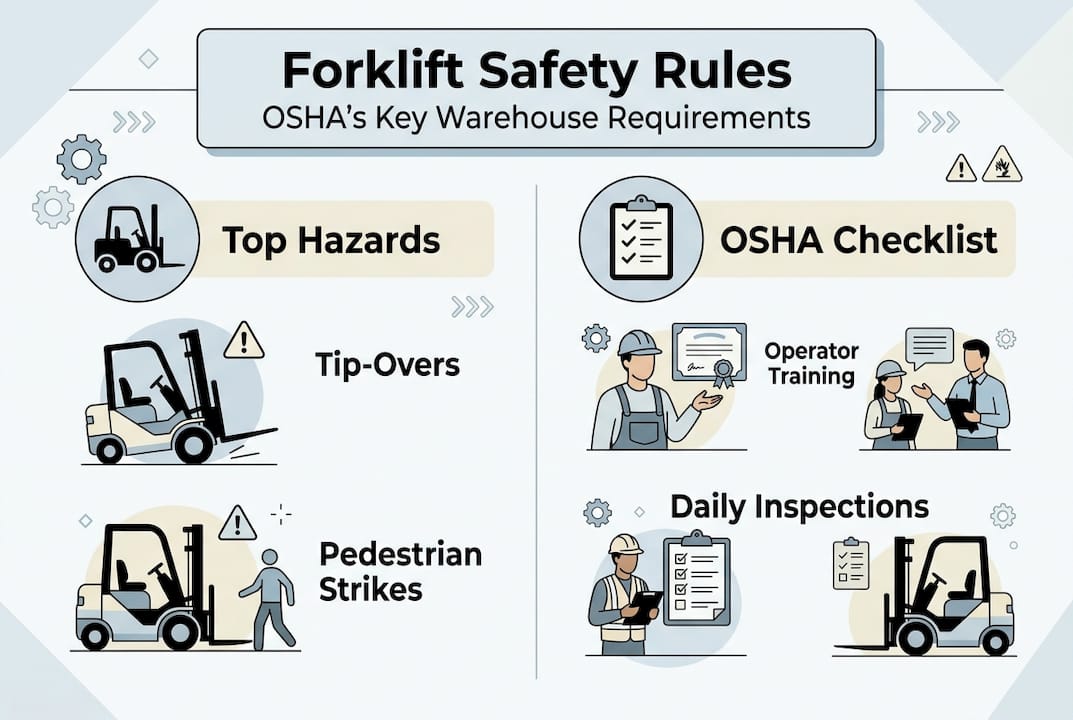
Operator training must include three phases: formal instruction (lecture or video), practical hands-on training, and a performance evaluation. No operator should be cleared to work independently until they pass all three. Refresher training is required every three years, or sooner after an observed unsafe act, a near-miss, an accident, or a significant change in the workplace.
Core OSHA compliance requirements at a glance:
| Requirement | Details |
|---|---|
| Initial training | Formal, practical, and evaluation phases |
| Refresher training | Every 3 years or after incidents |
| Pre-shift inspection | Required before every shift |
| Recordkeeping | Training dates, evaluator name, operator name |
| Equipment certification | Only trained operators may use forklifts |
The numbered steps every manager should verify:
- Confirm every active operator has a current training record on file.
- Schedule pre-shift inspection logs and review them weekly.
- Post the OSHA powered industrial trucks rule summary in the break room or near equipment.
- Set calendar reminders for three-year refresher deadlines.
- Document any incident that triggers early refresher training.
Use an OSHA compliance checklist to audit your current program and identify gaps before an inspector does. When you are ready to build or upgrade your program, a structured approach to implement safety training makes the process far less overwhelming.
Common forklift hazards and accident types in the workplace
Knowing the rules is step one. Understanding where accidents actually come from is step two.
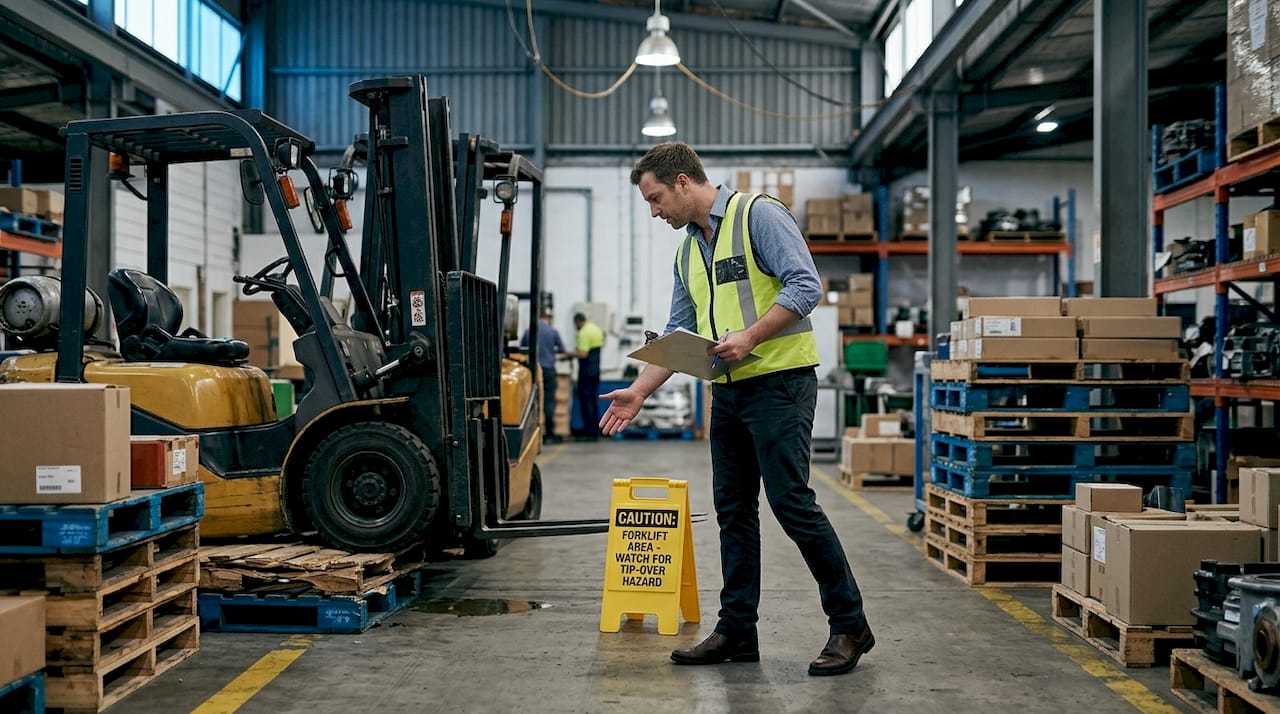
Tip-overs cause 24 to 42% of fatal forklift accidents, making them the single deadliest event type. Pedestrian strikes account for 36% of forklift fatalities. Those two categories alone represent the majority of deaths in warehouses and distribution centers every year.
Accident type comparison:
| Accident type | Primary cause | Risk level |
|---|---|---|
| Tip-over | Improper load, sharp turns, speed | Critical |
| Pedestrian strike | Poor traffic separation, blind spots | Critical |
| Load drop | Unstable or unsecured cargo | High |
| Collision with rack | Speed, poor visibility | High |
| Fall from elevated platform | Unauthorized riding | Moderate |
The most common risk factors across all accident types include excessive speed, wet or uneven floor surfaces, poor lighting, and operators who are distracted or fatigued. Managers who reduce forklift risks focus on these variables first because they appear in nearly every incident report.
- Mark pedestrian walkways with high-visibility floor tape and enforce them strictly
- Install convex mirrors at blind intersections inside the facility
- Use spotters in high-traffic zones during peak hours
- Follow safe load height guidance to prevent forward tip-overs during travel
“Most forklift accidents are not random. They follow predictable patterns. If you know the patterns, you can interrupt them before they become injuries.”
Building incident prevention strategies into your daily operations is what separates reactive safety management from proactive safety leadership.
The mechanics of forklift stability: How tip-overs and load mishaps happen
Understanding why forklifts tip over makes it much easier to coach your operators on what actually matters.
A forklift’s balance depends on what engineers call the stability triangle. Picture a triangle drawn between the two front wheels and the single rear axle pivot point. As long as the machine’s combined center of gravity (the forklift plus its load) stays inside that triangle, the machine stays upright. The moment that center of gravity shifts outside the triangle, a tip-over begins.
Several things push the center of gravity outside the triangle:
- Raising the load too high while traveling shifts weight forward
- Turning too fast throws weight to the outside of the turn
- Driving on a slope tilts the entire stability triangle
- Exceeding rated capacity adds more weight than the design accounts for
- Sudden braking lurches the load forward
The fix is straightforward in practice. Carry loads 4 to 6 inches above the ground during travel, keep the mast tilted back slightly, and never exceed the machine’s rated capacity. These are not suggestions. They are the physical requirements for keeping the center of gravity where it belongs.
To boost training effectiveness, use diagrams of the stability triangle during operator training. Visual learners retain this concept far better when they can see it drawn out.
Pro Tip: Post laminated capacity and speed limit reminders directly on the forklift dashboard and at the entrance to every loading zone. Operators who see the numbers constantly are far less likely to push past them.
Best practices and essential rules for safe forklift operation
Compliance creates the floor. Best practices raise the ceiling.
Every operator on your floor should follow these non-negotiable rules on every single shift:
- Complete a pre-shift inspection before operating the machine.
- Keep indoor travel speed below 5 mph at all times.
- Sound the horn at every intersection and blind corner.
- Wear the seatbelt. Every time. No exceptions.
- Never carry unauthorized riders on the forks or the machine.
- Put the phone away. Distracted operation is a leading cause of collisions.
Beyond the basics, advanced facilities add daily checklist sign-offs, immediate defect reporting protocols, and engineering controls like blue safety lights that project a beam in front of the forklift to warn pedestrians. These tools do not replace training, but they create a second layer of protection.
Use a structured training guide to onboard new operators and a separate operator training compliance process to track renewals. Facilities that maintain consistent training and inspection records consistently see lower DART (Days Away, Restricted, or Transferred) rates, which is the benchmark OSHA uses to measure injury severity.
Review the full list of OSHA safety rules with your team at least quarterly. Rules fade from memory. Repetition keeps them sharp.
Pro Tip: Encourage operators to report defects without fear of blame. A culture where people hide problems is a culture where accidents happen. Make defect reporting a positive behavior, not a disciplinary trigger.
Edge scenarios: Ramps, pedestrians, surfaces, and tip-over response
Generic training covers the basics. Your team also needs protocols for the situations that catch operators off guard.
Ramp operations require specific technique. When carrying a load up a ramp, drive forward so the load is on the uphill side. When descending, reverse down so the load remains uphill. Never turn on a ramp. The combination of slope and lateral weight shift is one of the fastest ways to trigger a tip-over. Special handling on ramps is a required topic in OSHA-compliant training for a reason.
Pedestrian management goes beyond painted lines. Use spotters in areas where forklifts and foot traffic must share space. Sound the horn before entering any area where a pedestrian might be present. Separate pedestrian and forklift routes wherever the facility layout allows.
Slippery or uneven surfaces demand reduced speed and heightened alertness. Wet loading docks, freshly cleaned floors, and outdoor yard surfaces all change how a forklift handles. Operators should treat any surface change as a reason to slow down.
Tip-over response is the scenario most operators hope to never use, but every operator must know it. If a tip-over begins:
- Stay inside the cab. Do not jump out.
- Hold the steering wheel firmly and brace your feet.
- Lean away from the direction of the fall.
- The seatbelt keeps you inside the protective overhead guard, which is designed to absorb the impact.
Review your inspection requirements regularly and use refresher sessions to walk through these edge scenarios with your team. Also review guidance on how to avoid unsafe practices that operators may develop over time without realizing it.
Expert forklift safety training: Turn knowledge into compliance
Reading about forklift safety is a strong start. Turning that knowledge into verified, documented compliance is where professional training makes the real difference. The gap between knowing the rules and consistently applying them on the floor is exactly where most preventable accidents live.
At Forklift Academy, we have spent over 20 years helping warehouse and logistics teams close that gap. Whether you need OSHA forklift certification for individual operators, onsite forklift training for your entire crew, or a train the trainer course so your internal team can manage ongoing compliance, we have a program built for your operation. Our courses cover every OSHA requirement, including refresher training triggers, pre-shift inspection protocols, and edge-case scenarios. If your goal is zero incidents, the right training program is the most direct path to get there.
Frequently asked questions
What are the main OSHA rules for forklift safety?
OSHA mandates that operators complete formal training and evaluation, perform daily pre-shift inspections, follow safe load handling procedures, and receive refresher training every three years or after any incident.
What is the stability triangle in forklift safety?
The stability triangle is the balance zone formed by a forklift’s two front wheels and its rear axle pivot point. When the combined center of gravity of the machine and its load moves outside this triangle, a tip-over occurs.
How often is forklift safety training required?
Refresher training is required every three years at minimum. It must also happen sooner if an operator is observed acting unsafely, is involved in an accident or near-miss, or if the workplace changes significantly.
How can managers reduce forklift accidents in the warehouse?
Facilities with consistent training and inspections see measurably lower injury rates. Managers should prioritize comprehensive operator training, daily inspection logs, clear pedestrian separation, and a workplace culture where hazard reporting is encouraged and never punished.
Recommended
- OSHA forklift compliance checklist 2026: Warehouse safety – Top Osha Forklift Certification
- Employee forklift training guide for OSHA compliance 2026 – Top Osha Forklift Certification
- Business forklift training guide: OSHA compliance 2026 – Top Osha Forklift Certification
- Warehouse Safety: Reduce Forklift Risks & OSHA Compliance – Top Osha Forklift Certification