
Warehouse managers face a critical challenge: ensuring forklift operators work safely while meeting strict OSHA training mandates. Operator error causes 70% of forklift accidents, making proper training essential for protecting workers and avoiding regulatory penalties. This guide walks you through preparing, implementing, and maintaining OSHA-compliant forklift training programs that reduce accidents and keep your operation running smoothly.
Table of Contents
- Understanding OSHA Forklift Training Requirements
- Preparing Effective Forklift Training For Your Employees
- Implementing And Evaluating Forklift Operator Training
- Common Forklift Training Challenges And How To Avoid Them
- Achieve OSHA-Compliant Forklift Training With Expert Solutions
Key takeaways
| Point | Details |
|---|---|
| OSHA mandates documented training | Standard 29 CFR 1910.178 requires formal instruction, practical evaluation, and performance documentation for all forklift operators. |
| Operator error dominates accidents | Poor training and inadequate supervision account for most warehouse forklift incidents, emphasizing the need for comprehensive programs. |
| Refresher training maintains safety | Operators must be re-evaluated every three years at minimum, with additional training after accidents or equipment changes. |
| Load handling prevents tip-overs | Proper stacking and load securing instruction reduces the risk of falling materials and vehicle instability. |
Understanding OSHA forklift training requirements
You need to know exactly what OSHA expects before building your training program. OSHA Standard 29 CFR 1910.178 establishes mandatory requirements covering truck operation, workplace hazards, and hands-on evaluation. These regulations apply to every powered industrial truck in your facility.
OSHA training must address specific topics:
- Operating instructions for the truck types your employees will use
- Workplace-specific hazards including surfaces, loading docks, and pedestrian zones
- Pre-operational vehicle inspection procedures
- Safe load capacity and stability principles
- Fuel handling or battery charging protocols
Training includes classroom instruction and practical exercises. You must evaluate each operator’s performance on the actual equipment they’ll operate. Performance evaluations are required at least every three years, but several conditions trigger immediate retraining. These include observed unsafe behavior, involvement in accidents, changes to workplace conditions, or assignment to different equipment types.
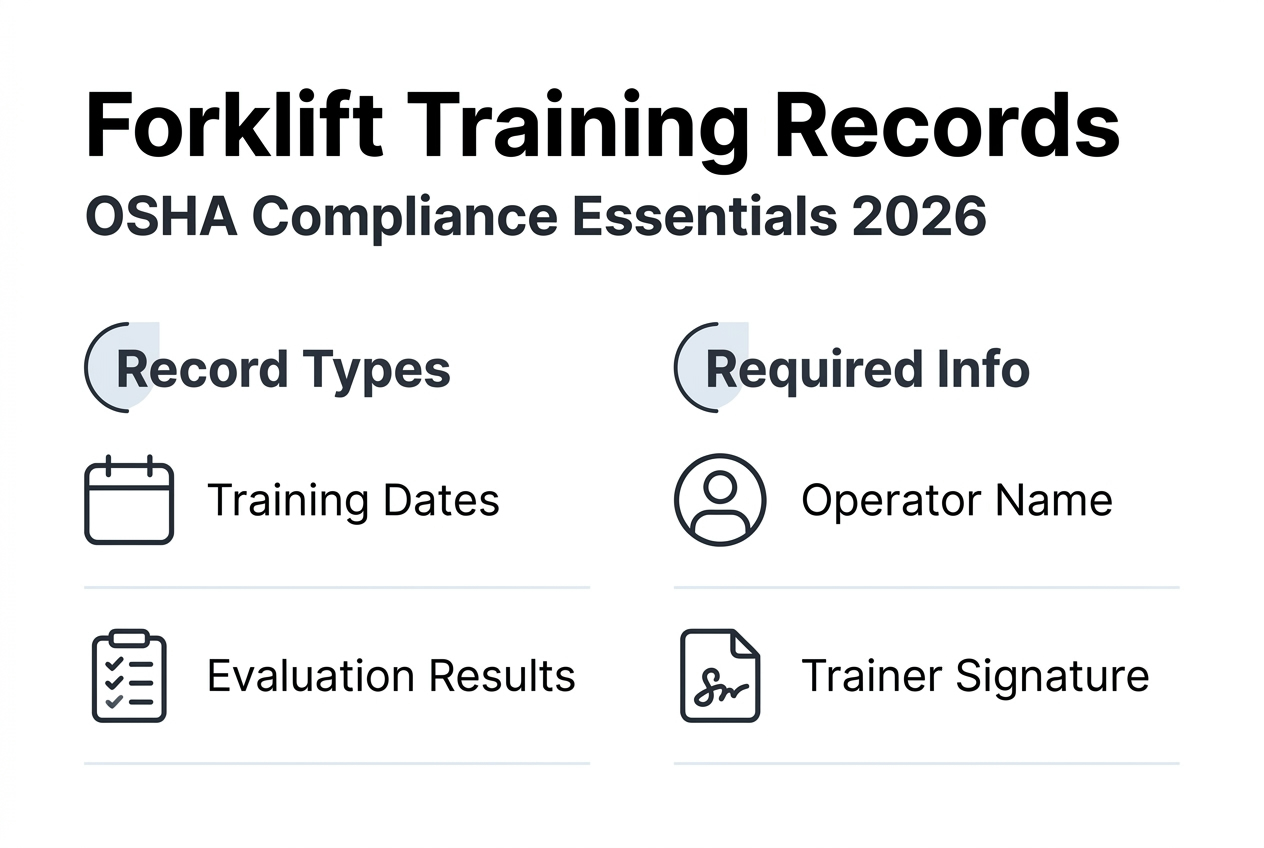
Documentation proves compliance during inspections. Your records must show the trainee’s name, training dates, evaluation results, and the trainer’s identity. Employers bear full responsibility for ensuring operators receive adequate instruction and demonstrate competency before working independently. Failing to meet these standards exposes you to citations, fines, and liability for preventable injuries.
Understanding these fundamentals helps you design programs that meet regulatory standards while protecting your workforce. The OSHA forklift certification guide provides additional details on certification processes. For a comprehensive breakdown, review the complete OSHA forklift training requirements list.
Preparing effective forklift training for your employees
Building a compliant program starts with understanding your specific workplace risks. Conduct a thorough hazard assessment of your facility before selecting training materials. Identify floor conditions, narrow aisles, blind corners, dock edges, overhead obstacles, and areas where pedestrians and forklifts interact.
Use this assessment to customize your training curriculum:
- Select OSHA-compliant materials that cover general safe operation principles
- Add site-specific instruction addressing your identified hazards
- Include modules on proper load stacking and securing techniques to prevent tip-overs
- Incorporate both classroom theory and hands-on skill development
- Ensure training covers the exact forklift models operators will use
Many operator errors stem from inadequate training or unfamiliarity with equipment. You reduce this risk by providing thorough initial instruction. Don’t overlook supervisor training. Supervisors should receive training to enforce safe practices and identify emerging risks before accidents occur.
Develop written training plans that outline learning objectives, instructional methods, and evaluation criteria. This structure ensures consistency across training sessions and provides clear benchmarks for operator competency. Your plan should specify both theoretical knowledge requirements and practical skill demonstrations.
Pro Tip: Create a training checklist that mirrors OSHA requirements and your workplace-specific hazards. Use this checklist during every training session to ensure nothing gets overlooked, and keep completed checklists as compliance documentation.
Choose qualified trainers who combine equipment expertise with teaching ability. Trainers must understand OSHA standards and your facility’s unique safety challenges. Whether you develop in-house programs or use external providers, verify that instruction covers all mandated topics. Review forklift training essentials to ensure your curriculum is comprehensive. The OSHA forklift training steps guide provides a structured approach to program development.
Implementing and evaluating forklift operator training
Delivering effective training requires structured execution. Follow this implementation sequence:
- Conduct formal classroom instruction covering safety rules, equipment features, and hazard recognition
- Demonstrate proper operating techniques including startup, maneuvering, and load handling
- Provide supervised practice sessions where trainees operate equipment under controlled conditions
- Evaluate operator performance on job-specific tasks using the exact forklift models they’ll use
- Document training completion and evaluation results before authorizing independent operation
Practical evaluation is non-negotiable. Observe each trainee performing real-world tasks like picking loads, traveling with cargo, placing materials at height, and navigating your facility’s unique challenges. Assessment should cover vehicle inspection, safe speed control, load center positioning, turning radius management, and proper parking procedures.
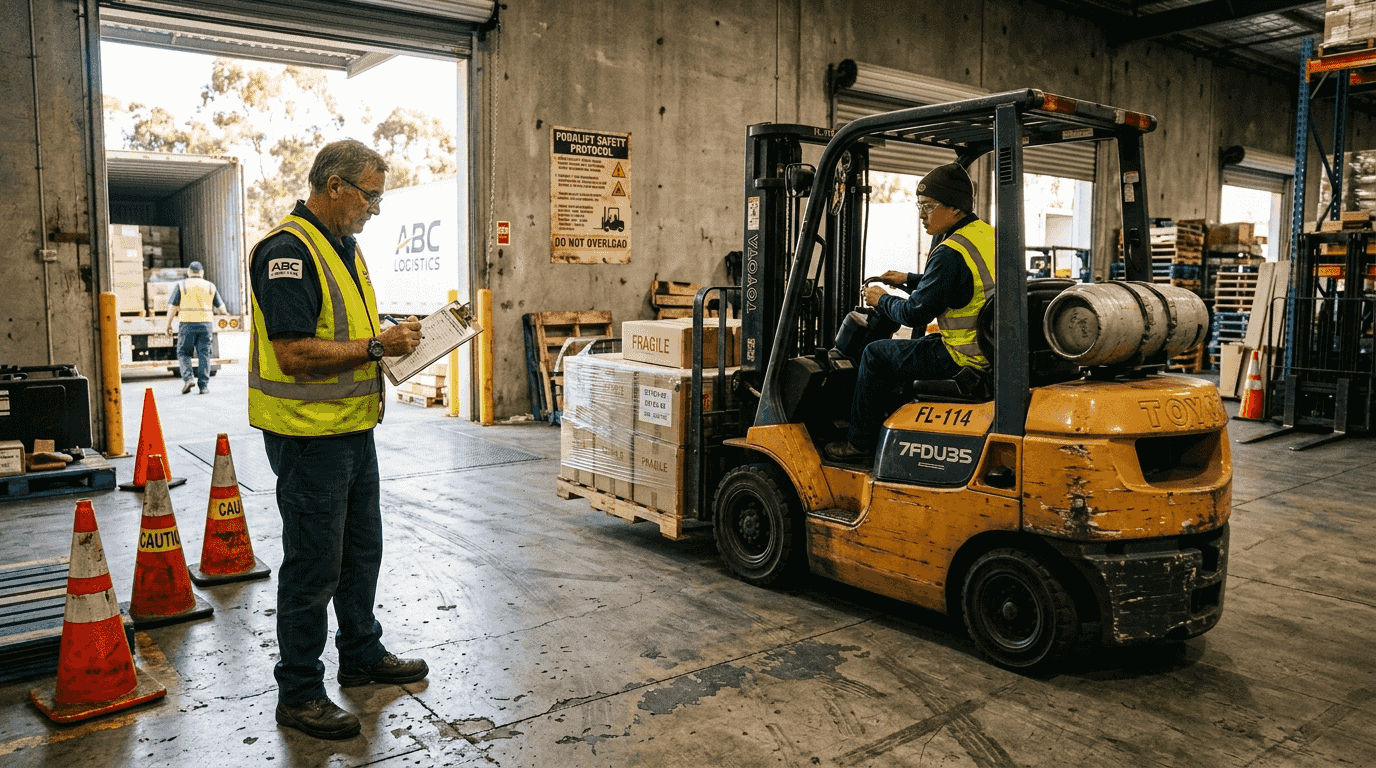
Regular evaluation and refresher training maintain operator competency and address workplace changes. Schedule re-evaluations when you observe unsafe behavior, after any accident or near-miss, when introducing new equipment, or following facility modifications. OSHA mandates re-evaluation at least every three years regardless of performance.
Pro Tip: Schedule evaluations during regular work hours when operators face typical conditions. Testing during slow periods or ideal circumstances doesn’t reveal how operators handle real pressure and challenges.
Track training and evaluation data systematically. Maintain individual operator files containing:
| Record Type | Required Information | Retention Period |
|---|---|---|
| Initial Training | Operator name, training date, topics covered, trainer identity | Duration of employment plus 3 years |
| Performance Evaluation | Evaluation date, tasks assessed, pass/fail results, evaluator name | Duration of employment plus 3 years |
| Refresher Training | Retraining date, reason for retraining, updated evaluation results | Duration of employment plus 3 years |
This documentation system proves compliance during OSHA inspections and helps you track operator development over time. Since operator error accounts for 70% of accidents, maintaining thorough evaluation records helps identify struggling operators before mistakes lead to injuries. For strategies on maintaining ongoing compliance, explore forklift training compliance 2026 resources.
Common forklift training challenges and how to avoid them
Even well-intentioned programs face obstacles that undermine safety. Recognizing these pitfalls helps you avoid costly mistakes.
Supervisor knowledge gaps create enforcement problems. When supervisors lack training, they can’t identify unsafe practices or coach operators effectively. This oversight allows bad habits to develop unchecked. Solution: Train supervisors on OSHA standards and safe operating practices before they oversee forklift operations.
Ignoring load handling principles causes preventable accidents. Many accidents involve tip-overs and falling materials from poor stacking and inadequate risk controls. Operators who don’t understand load center, capacity ratings, and proper stacking create dangerous situations. Solution: Emphasize load physics and stacking techniques during training, using real examples from your facility.
Operator complacency emerges over time. Experienced operators often skip safety checks or take shortcuts, leading to errors. Outdated skills compound this risk when operators never receive refresher instruction. Solution: Implement mandatory refresher training cycles and create a culture where following procedures is consistently reinforced.
Compare these training failure scenarios:
| Training Gap | Consequence | Best Practice Solution |
|---|---|---|
| No workplace-specific hazard instruction | Operators unprepared for site risks | Customize training to include facility-specific hazards and high-risk zones |
| Inadequate evaluation rigor | Incompetent operators certified | Use comprehensive practical assessments with clear pass/fail criteria |
| Missing load securing training | Tip-overs and falling cargo incidents | Dedicate training modules specifically to load stability and stacking safety |
| Absent refresher program | Skills decay and unsafe habits | Schedule regular re-evaluations and targeted refresher sessions |
Improper training, inadequate supervision, and failure to follow procedures account for most forklift accidents. You prevent these failures by building robust training systems and maintaining consistent oversight. Establish hazard reporting mechanisms so operators can flag unsafe conditions without fear of retaliation.
Another common mistake is treating certification as a one-time event. OSHA compliance requires ongoing effort. Equipment changes, facility modifications, and workforce turnover demand continuous training attention. Budget time and resources for regular program updates and operator skill maintenance. Learn more about proactive safety through forklift accident prevention OSHA strategies.
Achieve OSHA-compliant forklift training with expert solutions
Managing comprehensive training programs demands time and specialized knowledge that many warehouse operations struggle to provide internally. Forklift Academy delivers OSHA-compliant training solutions designed specifically for busy managers who need reliable, effective operator certification.
Our OSHA forklift training programs combine classroom instruction with practical evaluation, covering all mandated topics while addressing your site-specific hazards. Choose flexible online courses for cost-effective initial certification, or schedule onsite training that brings expert instructors directly to your facility. For organizations building internal training capacity, our train the trainer online certification equips your supervisors to deliver compliant instruction independently. Maintain ongoing compliance effortlessly with forklift refresher courses that keep operator skills sharp and documentation current. With over 20 years of experience helping warehouses meet OSHA standards, we provide the expertise and convenience you need to protect workers while satisfying regulatory requirements.
FAQ
How often must forklift operators be evaluated under OSHA?
OSHA requires performance evaluations at least once every three years for all certified operators. However, you must conduct additional evaluations immediately after any accident, near-miss incident, observation of unsafe operation, assignment to different equipment types, or changes to workplace conditions. These re-evaluation triggers ensure operators maintain competency as circumstances change.
What topics must OSHA forklift training cover?
Compliant training includes truck operating instructions, workplace hazard recognition, vehicle inspection procedures, load capacity and stability principles, refueling or recharging protocols, and pedestrian safety awareness. Training must address both general safety principles and the specific hazards present in your facility. Practical evaluation on actual equipment is mandatory before operators work independently.
What signs indicate an operator needs refresher training?
Schedule immediate retraining if you observe unsafe operating practices, involvement in accidents or near-misses, difficulty adapting to workplace changes, failure to conduct pre-operational inspections, improper load handling, or excessive speed. Operators struggling with new equipment types or showing signs of complacency also require refresher instruction before continuing regular duties.
What training records must employers maintain for OSHA compliance?
You must document each operator’s name, training completion date, evaluation results, topics covered, and the trainer’s identity. Records should clearly show both initial certification and any subsequent refresher training or re-evaluations. Maintain these records for the duration of employment plus three years after separation. Organized documentation proves compliance during inspections and helps track operator development.
Can online forklift training meet OSHA requirements?
Online training can satisfy the classroom instruction component of OSHA requirements, covering theoretical knowledge about safe operation and hazard recognition. However, practical hands-on evaluation remains mandatory and cannot be completed online. You must assess each operator’s actual performance using the specific equipment they’ll operate in your facility. Effective programs combine online theory with in-person practical evaluation.
Who qualifies to conduct forklift operator training and evaluation?
Trainers must possess knowledge, training, and experience to instruct operators and evaluate their competence. This typically means individuals with extensive forklift operation background, thorough understanding of OSHA standards, and familiarity with your workplace hazards. Employers are responsible for ensuring trainer qualifications, though OSHA doesn’t mandate specific credentials. Many operations use certified external trainers or develop internal train-the-trainer programs to build qualified instruction capacity.
Recommended
- Ensure forklift operator OSHA training compliance in 2026 – Top Osha Forklift Certification
- OSHA Forklift Compliance Guide for Safe Operations – Top Osha Forklift Certification
- OSHA Training Guide 2025 for Forklift Certification Success – Top Osha Forklift Certification
- How to Implement Forklift Safety Training for OSHA Compliance – Top Osha Forklift Certification