
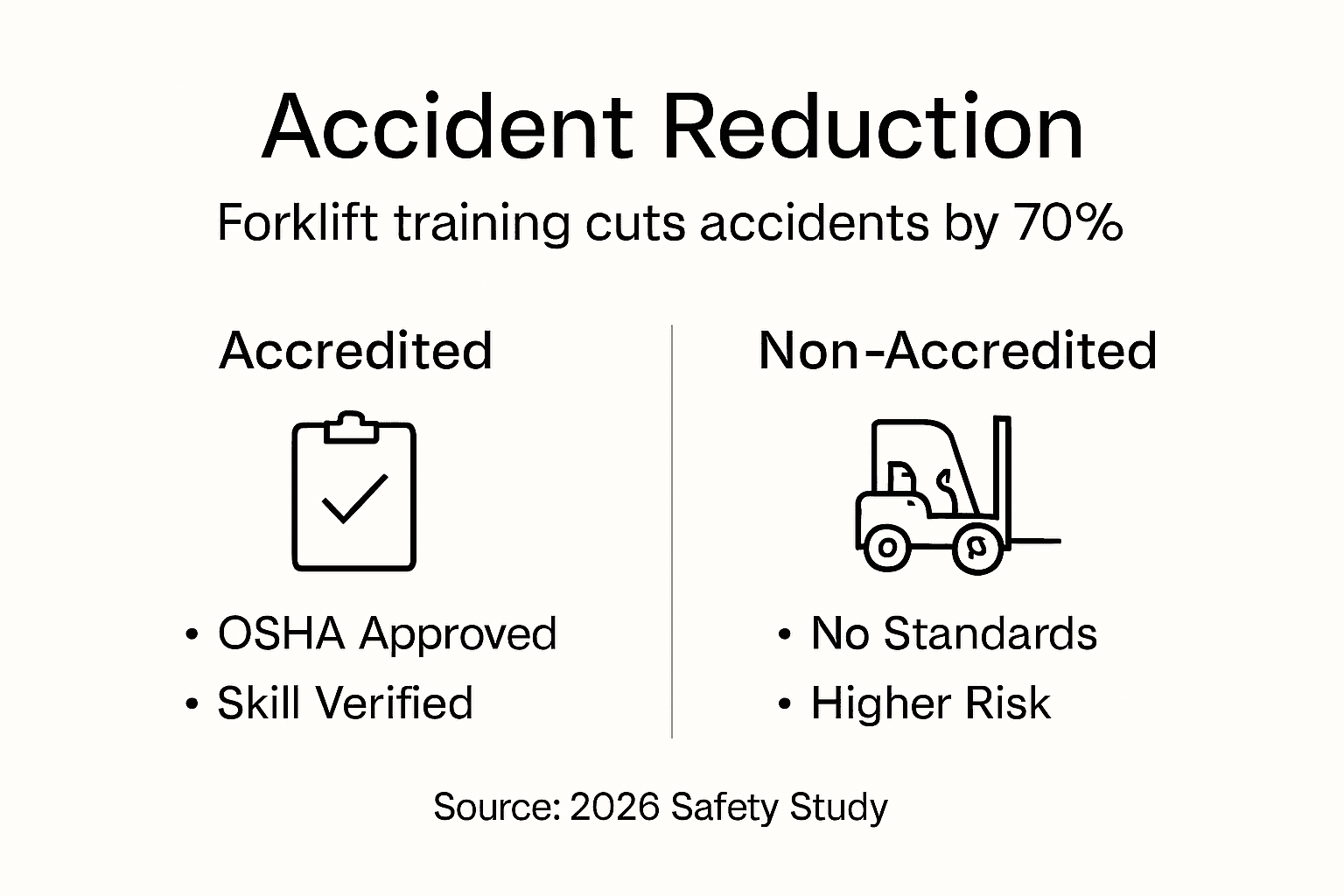
Every year, forklift accidents cause thousands of workplace injuries and millions in liability costs. Yet research shows accredited forklift training reduces accident rates by up to 70% compared to uncertified programs. Understanding what accreditation means and why it matters can transform your workplace safety culture while ensuring regulatory compliance. This guide explains how choosing accredited forklift training protects your business from avoidable risks and enhances operator competency.
Table of Contents
- Introduction To Accredited Forklift Training
- Why OSHA Compliance Matters
- Impact Of Accredited Training On Safety And Liability
- Comparing Accredited Vs Non-Accredited Forklift Training
- Training Delivery Methods And Compliance
- Business Benefits: Cost Savings And Risk Reduction
- Common Misconceptions About Forklift Training
- Conceptual Framework For Accredited Training
- Experience Certified Forklift Training Solutions
- Frequently Asked Questions
Key Takeaways
| Point | Details |
|---|---|
| Accident Reduction | Accredited training correlates with 70% fewer forklift-related incidents compared to non-accredited programs. |
| OSHA Mandate | Federal law requires formal instruction, practical training, and competency evaluation for all forklift operators. |
| Compliance Gaps | Non-accredited programs often lack updated curricula and practical assessments, increasing liability exposure. |
| Delivery Flexibility | OSHA accepts blended learning combining online theory with hands-on practical evaluation. |
| Business Impact | Accredited training reduces insurance premiums, downtime, and legal risks while improving workforce confidence. |
Introduction to Accredited Forklift Training
Accredited forklift training refers to programs formally recognized by regulatory bodies like OSHA and CCOHS that meet standardized safety curricula. These programs undergo regular review to ensure alignment with current workplace safety standards and legal requirements. For companies operating in the United States and Canada, choosing accredited training isn’t optional. It’s the foundation of legal forklift operation and workforce protection.
OSHA requires forklift operators to be trained and certified according to a standardized curriculum that includes formal instruction, practical training, and evaluation to reduce accidents. Canadian CCOHS regulations mirror these requirements, emphasizing documented competency assessments. The accreditation process ensures training providers continually update their materials to reflect emerging hazards, equipment innovations, and regulatory changes.
Core OSHA training requirements include:
- Formal classroom or online instruction covering truck-related topics, workplace hazards, and operating requirements
- Hands-on practical training demonstrating safe operation in the actual work environment
- Evaluation methods testing both knowledge retention and physical operation skills
- Documentation proving operator certification and periodic refresher training
- Employer responsibility to assess workplace-specific hazards and provide supplemental training
Accredited programs distinguish themselves through structured curricula approved by safety authorities. They provide certificates that withstand regulatory scrutiny during OSHA inspections. Understanding OSHA forklift training standards helps companies select providers that deliver genuine compliance rather than superficial certification.
Why OSHA Compliance Matters
OSHA standard 29 CFR 1910.178(l) mandates forklift operator training with specific components ensuring operator competency before unsupervised operation. This regulation applies to all powered industrial trucks and requires employers to certify operators have received training and been evaluated. Compliance isn’t merely procedural. It directly affects your company’s legal standing, financial health, and operational continuity.
Non-compliance carries serious consequences. OSHA penalties for training violations range from thousands to tens of thousands of dollars per citation. Serious violations involving willful neglect can trigger facility shutdowns pending corrective action. Beyond fines, inadequate training creates massive liability exposure. Companies face lawsuits from injured workers, criminal charges in severe cases, and skyrocketing insurance premiums.
Regulatory inspections examine training documentation meticulously. Inspectors verify:
- Written certification records including trainee name, training dates, and evaluator signature
- Evidence of both theoretical instruction and practical demonstration
- Workplace-specific hazard training tailored to your facility
- Refresher training documentation for incidents, near-misses, or observed unsafe operation
- Trainer qualifications demonstrating knowledge, training, and experience
The financial impact of workplace incidents extends far beyond immediate medical costs. Lost productivity, equipment damage, investigation expenses, and reputational harm compound initial injury expenses. A single serious forklift accident can cost a mid-sized company over $200,000 when accounting for all direct and indirect costs. Following the OSHA forklift compliance guide transforms compliance from a checkbox exercise into strategic risk management that protects your bottom line and workforce.
Impact of Accredited Training on Safety and Liability
Research consistently demonstrates that accredited forklift training programs reduce accident rates by up to 70% compared to uncertified alternatives. This dramatic reduction stems from standardized curricula emphasizing hazard recognition, safe operating procedures, and emergency response protocols. Operators trained through accredited programs demonstrate measurably better skills in load handling, pedestrian awareness, and equipment inspection.
Standardized assessments ensure competency before certification. Unlike informal training where supervisors subjectively judge readiness, accredited programs require operators to pass written tests and demonstrate specific maneuvers under observation. This rigor identifies knowledge gaps and skill deficiencies before they cause accidents. Companies report fewer property damage incidents, reduced injury severity, and lower workers’ compensation claims after implementing accredited training.
Liability protection represents a critical but often overlooked benefit. Courts and insurance carriers distinguish between employers who provided compliant training versus those who took shortcuts. Accredited certification demonstrates due diligence, potentially limiting legal exposure after incidents. Many insurers offer premium discounts of 10 to 20 percent for businesses maintaining accredited training programs and strong safety records.
Additional benefits include:
- Decreased injury-related downtime preserving productivity and schedules
- Enhanced employee confidence reducing stress and improving morale
- Lower equipment maintenance costs from proper operation reducing wear
- Improved safety culture encouraging hazard reporting and continuous improvement
Pro Tip: Track your facility’s incident rates, near-misses, and property damage for six months before and after implementing forklift safety training. Quantifying improvements builds internal support for ongoing training investment and provides data for insurance negotiations.
Comparing Accredited vs Non-Accredited Forklift Training
Understanding quality differences between accredited and non-accredited programs helps companies avoid costly mistakes. While both claim to train operators, only accredited programs guarantee regulatory alignment and comprehensive skill development. The distinctions matter significantly for compliance, safety outcomes, and legal defensibility.
| Feature | Accredited Training | Non-Accredited Training |
|---|---|---|
| Regulatory Recognition | OSHA/CCOHS approved curricula | No official approval or oversight |
| Curriculum Updates | Regular revisions reflecting current standards | Often outdated, static content |
| Practical Assessment | Mandatory hands-on evaluation | May skip or minimize practical testing |
| Audit Defensibility | Withstands regulatory inspection | Frequently rejected during audits |
| Accident Correlation | 70% lower incident rates | Comparable to untrained operators |
| Certification Validity | Recognized across jurisdictions | Limited or no legal standing |
Curriculum standards separate quality programs from superficial alternatives. Accreditation requires comprehensive coverage of OSHA topics including truck controls, load handling, stability principles, and workplace hazards. Content undergoes expert review ensuring accuracy and completeness. Non-accredited programs often use outdated materials ignoring recent regulatory changes or emerging best practices.
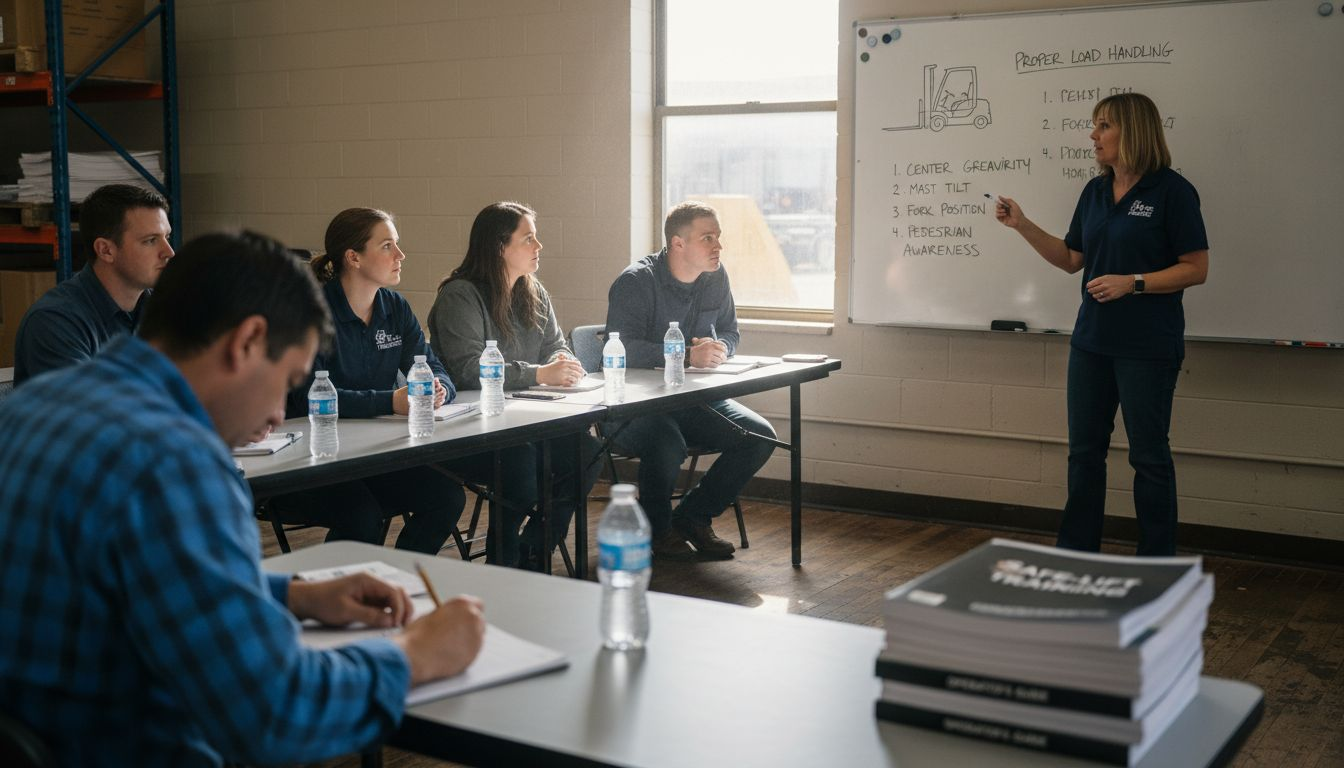
Practical skill assessment represents another critical distinction. Accredited training mandates observed operation demonstrating specific competencies: pre-shift inspection, safe load pickup and placement, pedestrian awareness, ramp navigation, and stacking procedures. Non-accredited programs may skip hands-on evaluation entirely or conduct cursory observations insufficient to verify competency. This gap directly correlates with higher accident rates.
Common shortcomings of non-accredited programs include:
- Generic content ignoring workplace-specific hazards
- Absence of qualified instructors with current knowledge
- No systematic evaluation or competency verification
- Missing documentation failing compliance requirements
- Lack of refresher training protocols
Long-term cost implications favor accredited training despite potentially higher upfront expenses. Companies choosing non-accredited alternatives face repeated training cycles after failed inspections, higher insurance premiums from poor safety records, and liability exposure from preventable accidents. Following a forklift certification checklist ensures your selected program meets all compliance requirements upfront.
Training Delivery Methods and Compliance
OSHA regulations accommodate multiple training delivery formats provided they meet core requirements for formal instruction, practical training, and competency evaluation. Understanding how different methods achieve compliance helps companies select approaches matching their operational needs, workforce distribution, and budget constraints.
Blended learning combines online theoretical instruction with in-person practical assessment. This approach allows operators to complete knowledge-based modules remotely at their own pace, then demonstrate hands-on skills with a qualified evaluator. OSHA explicitly permits this format provided the practical component occurs in the actual workplace using company equipment. Blended training offers flexibility without compromising skill development or regulatory compliance.
Onsite training brings instructors to your facility for complete instruction and evaluation. This method ensures workplace-specific hazard training and immediate application to your equipment and environment. Onsite programs work well for companies training multiple operators simultaneously or those with unique facility challenges requiring customized instruction. The approach strengthens safety culture by demonstrating management commitment to proper training.
Online-only training requires careful evaluation. Pure e-learning satisfies formal instruction requirements but cannot replace hands-on practical training and evaluation. Companies using online courses must supplement with documented practical assessment by a qualified person. This hybrid approach maintains compliance while maximizing scheduling flexibility.
Key considerations for each delivery method:
- Online theory modules accommodate shift schedules and remote locations
- Onsite practical training addresses facility-specific hazards and equipment
- Blended approaches balance cost efficiency with comprehensive skill development
- Trainer qualifications matter regardless of delivery format
- Documentation requirements remain identical across all methods
Pro Tip: For companies with 10 or more operators, consider train-the-trainer programs allowing qualified employees to conduct ongoing training and refresher courses. This investment reduces long-term costs while building internal safety expertise. Ensure your designated trainers complete accredited certification and maintain current knowledge through periodic updates.
Scalability benefits emerge with blended training for larger or geographically dispersed operations. Corporate safety managers can standardize theoretical instruction across multiple facilities while ensuring local supervisors handle practical assessments. This consistency improves audit readiness and simplifies compliance documentation. Learning how to lead onsite forklift training effectively maximizes your training investment regardless of chosen delivery method.
Business Benefits: Cost Savings and Risk Reduction
Accredited forklift training delivers measurable financial returns extending beyond regulatory compliance. While upfront costs may exceed informal alternatives, the long-term business value justifies investment through reduced accidents, lower insurance expenses, and improved operational efficiency. Forward-thinking companies view training as strategic risk management rather than grudging compliance spending.
Reduced injury-related downtime directly impacts productivity. Forklift accidents halt operations for investigation, equipment repair, and workforce disruption. Serious incidents can shut down entire departments pending OSHA reviews. Preventing even one major accident through better training preserves thousands of hours of productive capacity annually. Operators confident in their skills work more efficiently and make fewer costly mistakes.
Insurance cost reduction provides ongoing savings. Workers’ compensation carriers and commercial insurers assess premiums based on safety records and risk management practices. Companies demonstrating commitment to accredited training and low incident rates qualify for substantial discounts. These savings compound annually, often recovering training investments within 18 to 24 months.
Long-term ROI factors include:
- Avoided OSHA penalties and legal defense costs from compliance violations
- Reduced equipment damage from improved operation and maintenance practices
- Lower recruitment and replacement costs from better employee retention
- Enhanced company reputation attracting quality workers and customers
- Decreased management time spent on incident investigation and corrective action
Employee retention improves when workers perceive genuine organizational commitment to their safety. Quality training demonstrates respect for operator wellbeing beyond lip service. This cultural impact reduces turnover costs in industries already facing labor shortages. Operators who receive thorough initial training and regular forklift refresher courses develop loyalty and professional pride.
Schedule refresher training proactively rather than waiting for incidents or audit findings. OSHA requires evaluation and retraining when operators demonstrate unsafe behavior, are involved in accidents, receive assignments to different equipment types, or work in changed conditions. Leading companies implement annual refresher programs maintaining skills and reinforcing safety culture. This proactive approach prevents skill degradation and keeps compliance documentation current.
Common Misconceptions About Forklift Training
Several persistent misunderstandings prevent companies from fully appreciating accredited forklift training value. Addressing these misconceptions head-on helps decision-makers make informed choices protecting their workforce and business interests. Recognizing where conventional wisdom falls short enables smarter training investments.
- Training is only about passing certification tests. Many managers view forklift training as a one-time checkbox exercise focused solely on obtaining operator cards. Quality accredited programs emphasize ongoing hazard recognition, situational judgment, and continuous skill refinement. The certification represents competency verification, not training completion. Effective programs instill safety mindsets and decision-making frameworks operators apply daily throughout their careers.
- Online training cannot meet OSHA compliance standards. This misconception stems from outdated assumptions about e-learning quality. OSHA explicitly permits online theoretical instruction when combined with documented practical evaluation. Modern blended approaches deliver engaging content through interactive modules, video demonstrations, and knowledge checks. The key compliance factor is hands-on skills assessment in the actual workplace, not the delivery method for formal instruction.
- Non-accredited training provides sufficient operator preparation. Some companies believe any training satisfies legal obligations and develops necessary skills. Research demonstrates non-accredited programs often lack practical rigor, current regulatory alignment, and comprehensive hazard coverage. These gaps translate directly into higher accident rates, failed audits, and increased liability. Operators trained through substandard programs may possess superficial knowledge without genuine competency.
These misunderstandings create false economy encouraging inadequate training investments. Companies choosing the cheapest available option frequently pay multiples of savings through accidents, compliance failures, and operational disruptions. The real question isn’t training cost but the expense of inadequate preparation. Understanding why OSHA forklift certification is required clarifies the regulatory foundation making accreditation essential rather than optional.
Informed evaluation means assessing training programs on outcomes rather than convenience or price. Ask potential providers about their curriculum development process, instructor qualifications, practical assessment methods, and safety outcome data. Quality programs transparently share this information and welcome scrutiny. Avoiding these common pitfalls protects your investment and workforce.
Conceptual Framework for Accredited Training
A clear mental model helps companies systematically evaluate, select, and implement accredited forklift training that achieves lasting safety improvements. The three-pillar framework focuses attention on essential elements distinguishing effective programs from superficial alternatives. This approach transforms training from isolated events into integrated safety culture components.
The framework rests on three interconnected pillars: Compliance, Competency, and Culture. Compliance ensures training meets regulatory requirements providing legal defensibility and audit readiness. Competency develops operator skills through structured instruction and verified assessment. Culture embeds continuous safety improvement into daily operations through leadership commitment and accountability systems.
Evaluating training providers through this lens reveals quality differences. Strong programs explicitly address all three pillars with measurable objectives and assessment criteria. Weak programs focus narrowly on compliance documentation while neglecting genuine skill development and cultural integration. Your selection process should verify providers demonstrate understanding of and commitment to this comprehensive approach.
| Implementation Step | Purpose | Success Criteria |
|---|---|---|
| Assess Current State | Identify gaps in existing training and safety performance | Documented incident rates, near-miss trends, audit findings |
| Define Requirements | Specify compliance needs and operational objectives | Written training policy aligned with OSHA standards |
| Select Accredited Provider | Choose program meeting all three framework pillars | Verified accreditation, positive references, outcome data |
| Conduct Initial Training | Deliver formal instruction and practical evaluation | 100% operator certification with documented competency |
| Implement Refresher Schedule | Maintain skills and address changing conditions | Annual retraining with performance tracking |
| Monitor and Improve | Track safety metrics and adjust programs accordingly | Declining incident rates, positive culture indicators |
Prerequisites for successful implementation include management commitment communicated through resource allocation and personal involvement. Designated training coordinators need authority and time to develop programs properly. Companies must establish clear accountability ensuring operators and supervisors follow safe practices consistently. Without these foundational elements, even excellent training produces limited lasting impact.
Common failure points include treating training as one-time events rather than ongoing processes, skipping workplace-specific hazard instruction, failing to document evaluation thoroughly, and neglecting refresher training between certification cycles. Each mistake undermines one or more framework pillars compromising overall effectiveness. Understanding forklift trainer responsibilities helps companies support internal trainers and hold external providers accountable.
Integrate recordkeeping systems tracking initial certification dates, refresher training completion, incident involvement, and observed unsafe behaviors. This documentation proves compliance during audits while providing data for continuous improvement. Digital systems simplify tracking and generate automatic refresher reminders preventing lapses. Systematic record management transforms training administration from burden to strategic asset supporting your safety culture.
Experience Certified Forklift Training Solutions
Your commitment to workplace safety deserves training solutions meeting the highest compliance and quality standards. Forklift Academy delivers accredited, OSHA-compliant programs designed specifically for companies seeking reliable operator certification backed by over 20 years of industry expertise. Our flexible delivery options accommodate your operational needs whether training individual operators or entire workforces across multiple locations.
Our comprehensive programs combine rigorous theoretical instruction with practical skill assessment ensuring your operators achieve genuine competency, not just certification cards. Choose from online courses providing scheduling flexibility, onsite training addressing your facility-specific hazards, or blended approaches balancing efficiency with hands-on evaluation. Each format maintains full regulatory compliance while delivering measurable safety improvements.
Explore our top OSHA forklift certification programs designed for rapid deployment and lasting results. Companies training multiple operators benefit from our train-the-trainer certification enabling qualified employees to conduct ongoing training and refresher courses. This approach builds internal safety expertise while reducing long-term training costs. Contact us today to discuss solutions matching your specific compliance needs and operational requirements.
Frequently Asked Questions
What does accredited forklift training mean?
Accredited forklift training refers to programs formally recognized by OSHA or equivalent regulatory bodies as meeting standardized safety curricula and compliance requirements. These programs undergo regular review ensuring current alignment with workplace safety standards, include documented practical assessments, and provide certificates accepted during regulatory inspections. Accreditation guarantees the training delivers genuine competency development rather than superficial certification.
Is online forklift training recognized by OSHA?
OSHA explicitly permits online training for the formal instruction component of forklift certification provided it covers all required topics comprehensively. However, online courses must be supplemented with hands-on practical training and competency evaluation conducted by a qualified person in the actual workplace using company equipment. This blended approach combining online theory with in-person practical assessment fully satisfies OSHA requirements when properly documented.
How often must forklift operators renew certification?
OSHA requires forklift operator evaluation and retraining at least every three years, but circumstances may necessitate more frequent refresher training. Employers must provide additional training when operators demonstrate unsafe behavior, are involved in accidents or near-misses, receive assignments to different forklift types, or encounter changed workplace conditions. Many companies implement annual refresher programs maintaining skills and compliance documentation between certification cycles.
What are the main risks of non-accredited training?
Non-accredited programs often use outdated curricula lacking current regulatory requirements and emerging best practices. They typically minimize or skip practical skill assessments, providing no verification of operator competency. These gaps directly correlate with accident rates 70 percent higher than properly trained operators. Companies using non-accredited training face increased OSHA violation risk, failed audit findings, higher liability exposure, and elevated insurance premiums from poor safety records.
Can accredited training reduce insurance costs?
Yes, most commercial insurers and workers’ compensation carriers offer premium discounts for companies maintaining accredited forklift training programs and strong safety records. Discounts typically range from 10 to 20 percent based on demonstrated commitment to risk management and low incident rates. Insurance providers recognize that properly trained operators cause fewer accidents, reducing claim frequency and severity. These ongoing savings often recover training investments within two years while providing additional liability protection.
What qualifications should forklift trainers possess?
OSHA requires forklift trainers to have knowledge, training, and experience enabling them to train operators and evaluate their competence. This typically means current forklift operation expertise, understanding of OSHA regulations, instructional skills, and familiarity with workplace-specific hazards. Trainers should complete accredited train-the-trainer programs demonstrating they can deliver effective instruction and conduct valid assessments. Their qualifications must be documented as part of compliance recordkeeping.
Recommended
- OSHA Training Cuts Forklift Incidents 70%: Safety Guide – Top Osha Forklift Certification
- OSHA Recertification: 30% Fewer Forklift Accidents Explained – Top Osha Forklift Certification
- Role of Trainers in Forklift Safety: Cut 35,000 Injuries – Top Osha Forklift Certification
- Complete Guide to Forklift Training Requirements 2025 – Top Osha Forklift Certification