 Skip to content
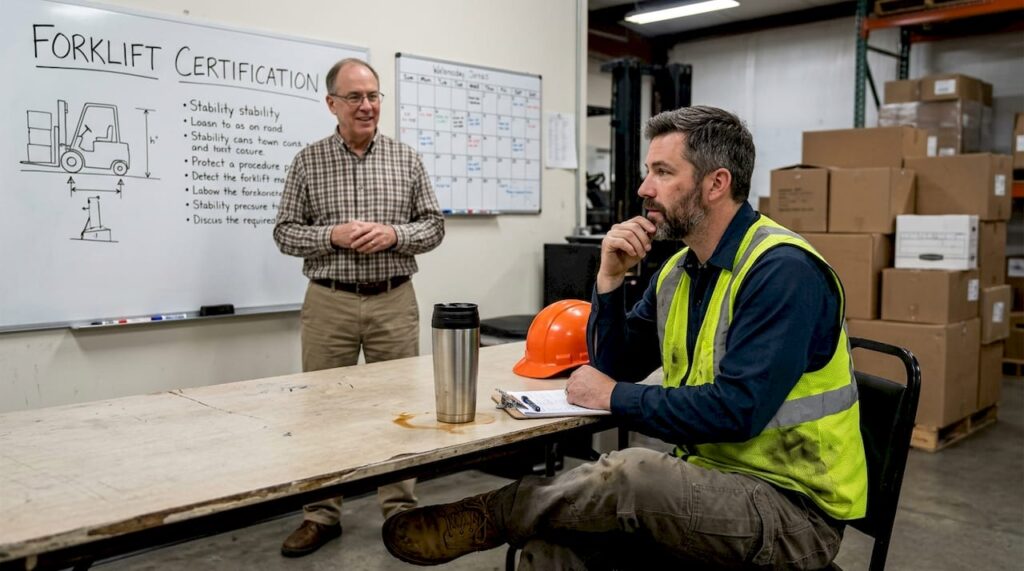

Every year, thousands of warehouse workers are injured in forklift accidents that could have been prevented. Many employers assume that years of hands-on experience make an operator safe, but OSHA estimates 70% of ~35,000 annual US forklift injuries preventable by training. The reality is that formal certification addresses legal requirements, reduces insurance costs, and protects your workforce in ways that informal experience simply cannot. This guide explains what forklift certification involves, why it’s legally required in both the US and Canada, and how it directly impacts your bottom line and workplace safety.
| Point | Details |
|---|---|
| Certification is mandatory | Both US and Canadian law require forklift operator certification and ongoing employer documentation. |
| Training prevents incidents | Formal operator training can cut forklift injuries by 30 to 70 percent and save lives. |
| Refresher training is critical | Certification lasts three years but must be renewed after accidents or equipment changes. |
| Experience is not enough | Years of operation without formal certification leaves workers and companies at greater risk. |
| Better safety means lower costs | Certified workplaces see fewer claims and lower insurance premiums, improving the bottom line. |
Forklift certification is a formal process that combines classroom instruction, hands-on training, and performance evaluation to ensure operators can safely handle powered industrial trucks. It’s not just a piece of paper. Forklift certification is legally required under OSHA 29 CFR 1910.178 in the US for all powered industrial truck operators, with employer responsibility for training, evaluation, and documentation.
Under this framework, employers must provide initial training, evaluate operator performance, and maintain records proving compliance. The certification process covers equipment-specific operation, workplace hazards, load handling, and emergency procedures. It’s designed to be site-specific, meaning training must reflect the actual conditions and equipment your operators will encounter.
Certification differs fundamentally from informal on-the-job experience. While experience builds muscle memory, it doesn’t systematically address hazard recognition, regulatory requirements, or proper documentation. Certification ensures every operator receives standardized instruction on safety protocols, equipment limitations, and legal responsibilities.
Key employer responsibilities include:
“Employers who fail to provide proper forklift training face OSHA citations, increased liability, and higher insurance premiums. Certification is not optional—it’s a legal requirement that protects both workers and businesses.”
For practical guidance on meeting these obligations, review our OSHA forklift training guide and forklift certification requirements. The official OSHA site provides the complete regulatory text and interpretations.
Both the United States and Canada enforce strict forklift certification requirements, though the specific regulations differ. In the US, OSHA 29 CFR 1910.178 has remained stable through 2025 and into 2026, maintaining its core requirements for employer-provided training, evaluation, and documentation. In Canada, CSA B335 updated with VR/simulation, more refined hazard identification, and enhanced trainer qualification requirements.
The CSA updates reflect growing acceptance of technology-based training methods. Virtual reality and simulation tools are now recognized as valid components of hands-on training, provided they accurately replicate workplace conditions. The standard also places greater emphasis on hazard identification specific to each worksite and requires trainers to demonstrate both technical knowledge and instructional competence.
US vs. Canadian Requirements:
| Aspect | United States (OSHA) | Canada (CSA B335) |
|---|---|---|
| Governing Standard | 29 CFR 1910.178 | CSA B335:25 |
| Training Components | Formal instruction, practical training, evaluation | Formal instruction, practical training, evaluation, enhanced hazard ID |
| Trainer Qualifications | Knowledge, training, experience | Documented competence, instructional ability |
| Technology Use | Permitted as supplement | VR/simulation explicitly recognized |
| Recertification Triggers | 3 years, incidents, unsafe acts, equipment changes | 3 years, incidents, unsafe acts, equipment changes |
| Documentation | Required, no specific format | Required, more detailed record-keeping |
For multinational employers operating in both countries, the key is to meet the higher standard. If your Canadian operations require enhanced trainer qualifications and hazard identification protocols, applying those same standards to US facilities ensures consistency and reduces compliance risk.
Pro Tip: Even if you operate only in the US, adopting CSA’s enhanced hazard identification protocols can strengthen your safety program and reduce incident rates. The investment in more thorough site assessments pays off through fewer accidents and lower insurance costs.
For businesses managing compliance across multiple locations, our business forklift training compliance guide provides jurisdiction-specific checklists. The OSHA regulations site offers detailed interpretations and enforcement guidance.
Meeting legal requirements means implementing specific systems and maintaining detailed documentation. Here’s what you need to do:
Identify all operators and equipment types. Catalog every forklift class in use and match operators to the specific equipment they’ll operate.
Select qualified trainers. Trainers must have the knowledge, training, and experience to teach operators and evaluate their performance.
Deliver formal instruction. Provide classroom or online training covering operating procedures, hazard recognition, and regulatory requirements.
Conduct hands-on training. Operators must practice with the actual equipment they’ll use in the actual environment where they’ll work.
Evaluate performance. Before allowing independent operation, trainers must observe and document that operators can safely perform all required tasks.
Maintain records. Keep training certificates, evaluation forms, and attendance records for each operator.
Employers are responsible for training, evaluation, and keeping certification documentation for all operators. This includes temporary workers, seasonal employees, and contractors operating equipment on your site.
The documentation requirements are specific. You must record the operator’s name, training dates, trainer’s name, and evaluation results. Many employers use standardized forms, but OSHA doesn’t mandate a specific format. What matters is that records clearly demonstrate compliance with all training requirements.
Pro Tip: Most employers miss recertification triggers for temporary employees and fail to document site-specific training when operators transfer between facilities. Create a checklist that includes these scenarios to avoid gaps in compliance.
Site-specific training is particularly important. An operator certified at one warehouse cannot simply transfer to another location without additional training on that site’s unique hazards, traffic patterns, and equipment. This requirement catches many multi-site employers off guard during OSHA inspections.
Our employee training obligations resource breaks down these requirements by scenario, and our OSHA compliance guide provides sample documentation templates.
The safety impact of proper certification is measurable and significant. Training can reduce incidents by 30-70% and cuts insurance costs. These aren’t theoretical benefits. They show up in your incident logs, workers’ compensation claims, and insurance premiums.
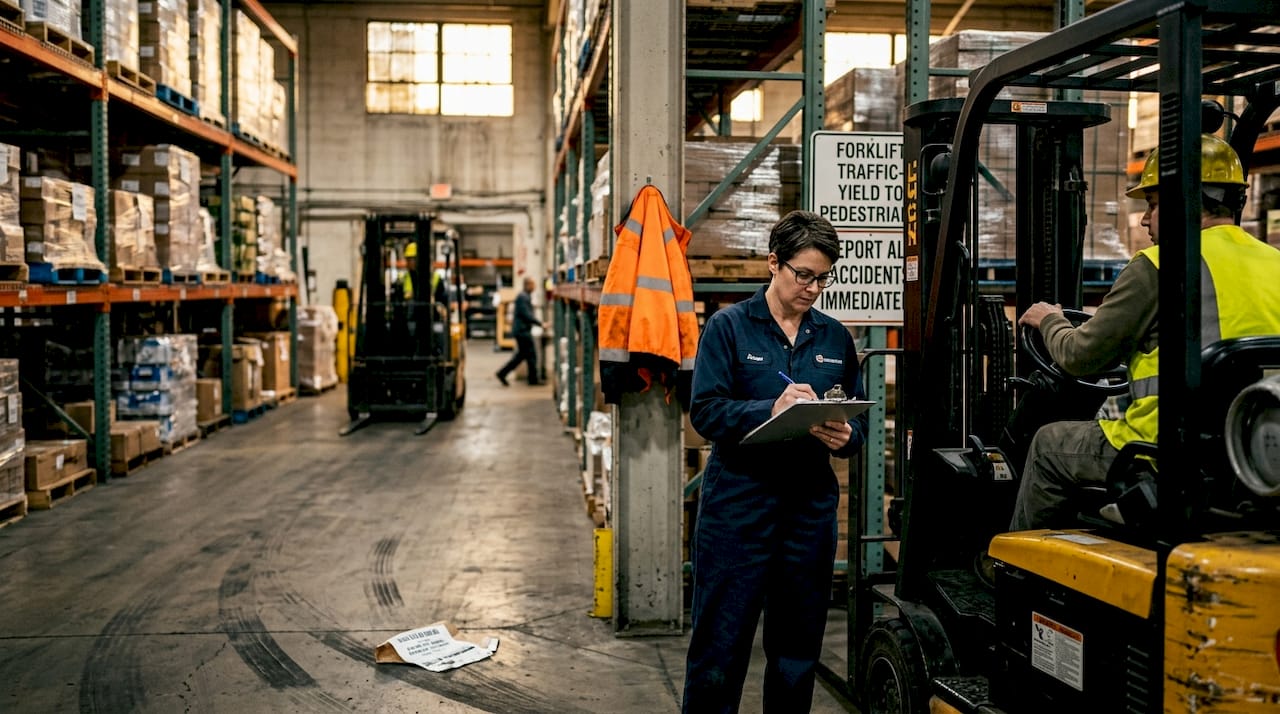
The numbers tell a stark story. OSHA reports 35,000 injuries, 79 deaths, and 8,140 nonfatal cases annually from forklift operations. The majority of these incidents involve operators who lacked formal training or whose certification had lapsed. Common scenarios include pedestrian strikes, load handling errors, and tip-overs during turns or on ramps.
Preventable Risk Areas:
Beyond injury prevention, certification affects your insurance costs directly. Carriers assess risk based on your training programs, incident history, and compliance record. Facilities with documented certification programs and low incident rates qualify for lower premiums. The savings often exceed the cost of training within the first year.
Safety Impact Data:
| Metric | Without Certification | With Certification | Improvement |
|---|---|---|---|
| Annual Incident Rate | 8-12 per 100 operators | 2-4 per 100 operators | 60-70% reduction |
| Average Claim Cost | $45,000-$65,000 | $15,000-$25,000 | 65% reduction |
| Insurance Premium | Baseline | 15-30% discount | Significant savings |
| Productivity Loss | 120-180 hours/incident | 40-60 hours/incident | 65% reduction |
Certification also improves workplace morale and productivity. Operators who receive proper training feel more confident and competent. They’re less likely to make errors, more likely to report hazards, and more engaged in safety protocols. This cultural shift reduces near-misses and creates a self-reinforcing cycle of safety awareness.
“Experience alone is insufficient. Complacency from years behind the wheel increases risks. Formal certification outperforms informal experience because it systematically addresses hazards that experienced operators often overlook.”
For deeper insights into how training shapes safety culture, explore our resources on trainer impact on safety, incident prevention, and boosting safety and efficiency.
Forklift certification follows a three-part structure mandated by OSHA: formal instruction, practical training, and performance evaluation. Each component serves a distinct purpose and must be completed before an operator can work independently.
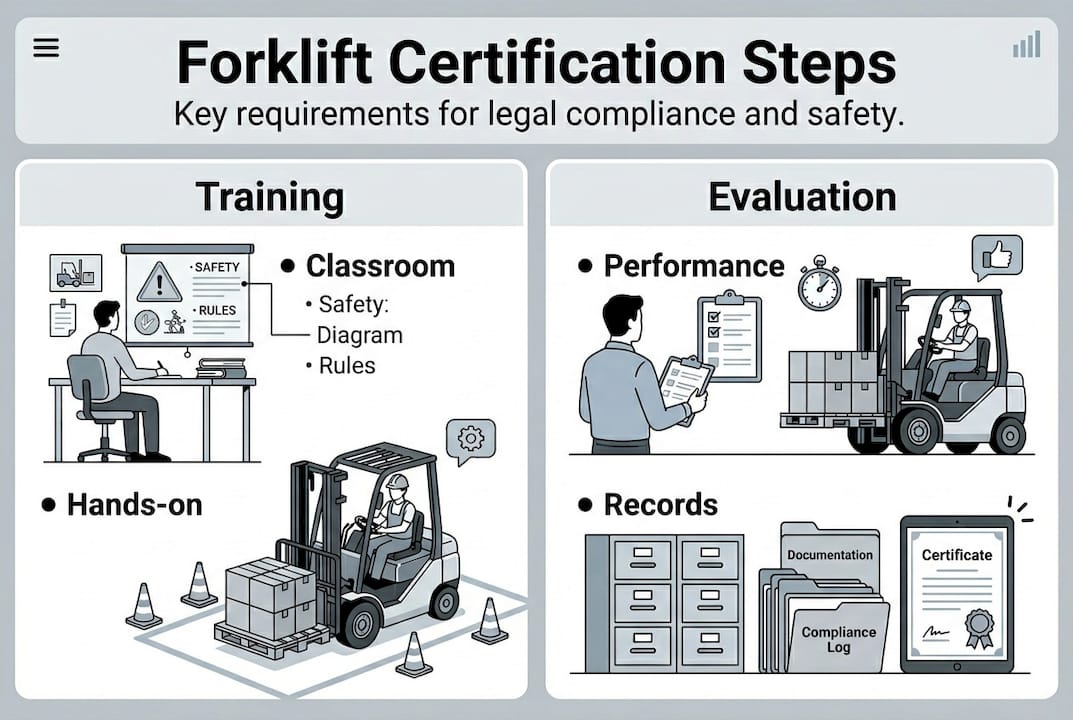
Formal instruction covers the theoretical knowledge operators need. This includes equipment components, operating principles, load capacity calculations, stability factors, hazard recognition, and regulatory requirements. Instruction can be delivered in a classroom setting or through online courses, but it must be interactive and allow operators to ask questions.
Practical training puts theory into action. Operators practice with the specific equipment they’ll use, in the actual environment where they’ll work. This phase covers pre-shift inspections, maneuvering in tight spaces, load handling, stacking, and emergency procedures. Formal instruction, practical hands-on training, and performance evaluation are all required; training must be site- and equipment-specific.
Performance evaluation verifies competence. A qualified trainer observes the operator performing all required tasks and documents their ability to operate safely. Only after passing this evaluation can an operator work without direct supervision.
Certification validity and renewal:
For new operators, the full certification process typically takes 8-12 hours spread over 2-3 days. Experienced operators seeking recertification often complete the process in 4-6 hours, though this depends on their performance during evaluation and any new equipment or procedures they need to learn.
Training program checklist:
Our guides on passing the forklift test, safety training best practices, and forklift certification renewal provide detailed preparation strategies for both new and returning operators.
Even well-intentioned employers make predictable errors that undermine compliance and safety. Recognizing these pitfalls helps you avoid them.
Assuming past experience is enough. Complacency among experienced operators commonly leads to incidents, as experience alone does not replace formal certification. Operators who’ve driven forklifts for years often skip pre-shift inspections, ignore load capacity limits, and develop unsafe shortcuts. Formal training breaks these patterns by reinforcing proper procedures.
Not keeping records updated. Training certificates expire, operators transfer between sites, and new equipment arrives. Without a system to track these changes, compliance gaps emerge. Many employers discover missing documentation only during OSHA inspections, when penalties are already in play.
Missing refresher triggers. The three-year recertification cycle is straightforward, but earlier refresher training is required after incidents, near-misses, unsafe behavior, equipment changes, or extended absences. Employers often miss these triggers, particularly for part-time or seasonal workers.
Overlooking temporary or new staff. Contractors, temporary workers, and new hires must receive the same training as permanent employees. If they operate forklifts on your site, you’re responsible for ensuring they’re properly certified. This requirement applies even if the worker has certification from another employer.
Common compliance failures:
Pro Tip: Build a culture that goes beyond minimum compliance by involving operators in hazard identification, encouraging near-miss reporting, and recognizing safe behavior. When safety becomes part of your operational identity rather than a checkbox exercise, compliance becomes easier and incidents become rarer.
For strategies to address these gaps, review our resources on reducing forklift risks and improving efficiency through training.
Now that you understand what certification requires and why it matters, the next step is selecting a program that meets your needs. The right certification program delivers OSHA-compliant training, fits your operational schedule, and provides the documentation you need for audits and inspections.
Look for programs that offer both online instruction and hands-on evaluation. Online components provide flexibility for classroom learning, while onsite evaluation ensures operators demonstrate competence with your specific equipment in your actual work environment. This combination meets regulatory requirements while minimizing disruption to your operations.
For businesses managing multiple locations or large operator populations, train-the-trainer programs offer significant advantages. These programs certify your internal staff to deliver training and evaluation, reducing long-term costs and ensuring consistent standards across your organization. You maintain control over scheduling, content customization, and ongoing compliance.
Explore our top OSHA forklift certification program for individual operator certification, or review our train the trainer online course if you’re building internal training capacity. Our OSHA forklift compliance resources provide additional guidance on program selection and implementation.
The investment in proper certification protects your employees, reduces your liability, and strengthens your safety culture. Choose a program that delivers real value, not just a certificate.
Yes, OSHA requires certification under 29 CFR 1910.178 in the US, and CSA B335 governs Canadian requirements. Both place responsibility on employers for training, evaluation, and documentation.
Certification is valid for three years, but earlier recertification is required after accidents, near-misses, unsafe operation, new equipment, operator absence over one year, or different forklift classes.
Training combines formal instruction, practical hands-on training, and performance evaluation, all specific to your site and equipment. Operators must complete all three components before working independently.
No, experience alone is insufficient because complacency increases risks. Formal certification systematically addresses hazards that experienced operators often overlook.
Trained sites see 30-70% incident reduction, which lowers insurance costs. Carriers offer premium discounts for documented certification programs and strong safety records.




 Optimized by Seraphinite Accelerator