 Skip to content

TL;DR:
- OSHA’s powered industrial truck definition covers motorized equipment used to move materials in industrial settings.
- Proper classification is essential for compliance, training, inspections, and injury prevention.
- Ongoing reviews and expert consultations help maintain OSHA compliance and mitigate liability risks.
Many warehouse and logistics managers assume that OSHA’s powered industrial truck rules apply only to the forklifts sitting in their loading dock. That assumption is one of the most common and costly compliance mistakes in the industry. OSHA’s definition is significantly broader, covering a wide range of motorized material handling equipment that may already be operating in your facility right now. Misidentifying even one piece of equipment can expose your operation to serious fines, untrained operators, and preventable injuries. This guide breaks down exactly what qualifies, what does not, and how to make confident classification decisions that hold up during an OSHA inspection.
| Point | Details |
|---|---|
| OSHA’s definition is broad | More than just forklifts qualify—many vehicle types are included as powered industrial trucks. |
| Exclusions matter | Failure to recognize excluded and gray-area equipment can lead to compliance mistakes. |
| Verify and document | Always check, record, and consult experts when uncertain about vehicle classification. |
| Ongoing review needed | Regular assessments help maintain compliance and minimize costly risks in your warehouse. |
Now that you know why the definition matters, let’s look closely at OSHA’s specific criteria.
OSHA regulation 1910.178 governs powered industrial trucks (PITs) in general industry workplaces. The standard defines a powered industrial truck as any mobile, power-driven vehicle used to carry, push, pull, lift, stack, or tier materials. That definition is intentionally wide. It was written to capture the full spectrum of motorized equipment used to move goods in warehouses, manufacturing plants, and distribution centers.
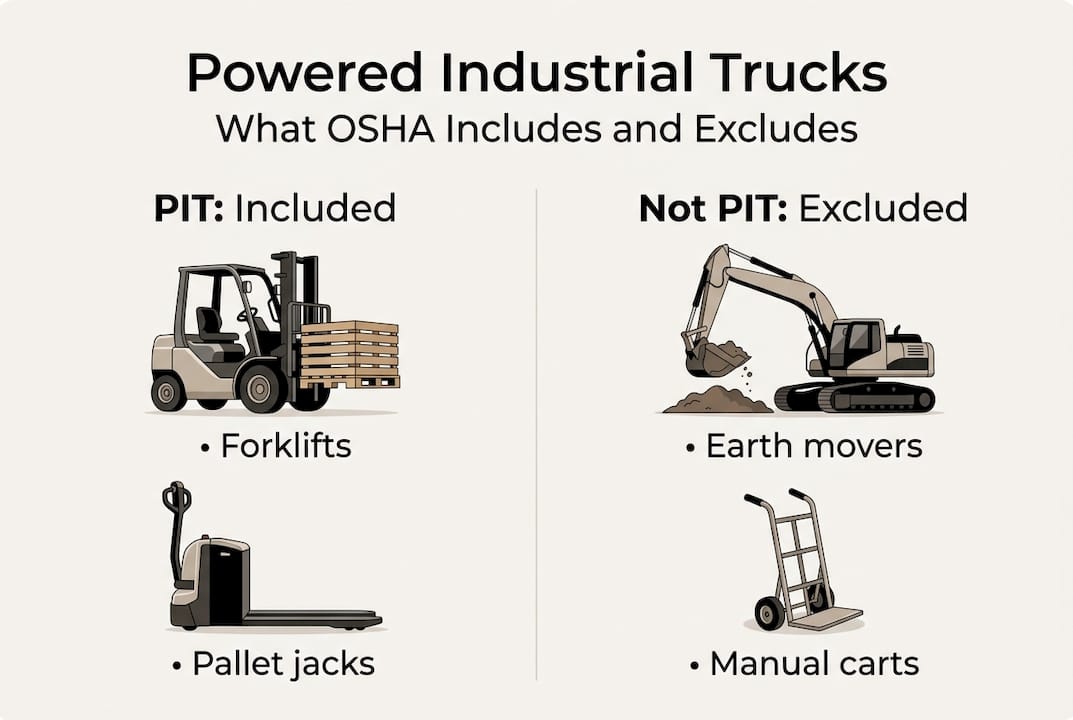
The OSHA powered industrial truck standards apply to equipment powered by electric motors or internal combustion engines. Hand-powered equipment, like a manual pallet jack you push by hand, falls outside the standard. The moment a motor drives the movement, OSHA’s rules likely apply.
Vehicle types that typically qualify as PITs include:
A common misconception is that only vehicles with an operator seat and forks qualify. That is wrong. If the equipment is motorized and moves materials in an industrial setting, it almost certainly falls under powered industrial truck compliance requirements.
Why does proper classification matter beyond paperwork? Because every PIT in your facility must meet specific requirements for operator training, pre-shift inspections, maintenance records, and safe operating procedures. Skipping those steps for a “minor” piece of equipment is exactly how OSHA violations and workplace injuries happen.
Key stat: OSHA reports that powered industrial truck incidents cause approximately 85 fatalities and 34,900 serious injuries in U.S. workplaces every year. Proper classification is the first step toward preventing them.
With the definition in hand, it’s time to see what equipment actually qualifies.
OSHA recognizes seven main classes of powered industrial trucks, each designed for specific environments and applications. Knowing which class your equipment falls into helps you apply the right maintenance standards and operator training requirements.
| Class | Type | Common example | Typical environment |
|---|---|---|---|
| I | Electric motor rider trucks | Sit-down counterbalanced forklift | Indoor warehouse |
| II | Electric motor narrow aisle trucks | Reach truck, order picker | Narrow-aisle racking |
| III | Electric motor hand trucks | Walkie pallet jack | Retail, distribution |
| IV | Internal combustion engine trucks (cushion tires) | Propane forklift | Indoor, smooth floors |
| V | Internal combustion engine trucks (pneumatic tires) | Diesel forklift | Outdoor, loading docks |
| VI | Electric and internal combustion engine tractors | Tow tractor | Airport, large facilities |
| VII | Rough terrain forklift trucks | Telescopic handler | Construction, lumber yards |
This powered industrial truck guide can help you match specific equipment to the correct class. Each class carries its own nuances for safe operation and training requirements.
Some equipment causes real confusion. Tow tractors (Class VI) are often overlooked because they do not carry loads directly. They pull carts. But they still qualify as PITs. Similarly, motorized hand pallet jacks look simple, yet they are Class III PITs and require trained operators.
Machines that are frequently mistaken for PITs but are not included:
Pro Tip: When you receive new equipment, ask the manufacturer for its OSHA classification before it ever enters your facility. That one step eliminates guesswork and gives you documented evidence of due diligence if OSHA ever audits your operation.
Understanding what’s excluded can be just as important as knowing what’s included.
OSHA deliberately carved out certain vehicle categories from the PIT standard. Earth-moving equipment and vehicles used primarily for earth moving or over-the-road hauling are excluded from the PIT standard. The reasoning is practical: those vehicles are governed by separate regulatory frameworks and operate in environments far removed from industrial warehouse settings.
| Included (PIT) | Excluded (not PIT) |
|---|---|
| Electric walkie pallet jack | Manual hand pallet jack |
| Propane counterbalanced forklift | Semi-truck or tractor-trailer |
| Reach truck | Agricultural tractor |
| Order picker | Bulldozer or excavator |
| Motorized tow tractor | Golf cart (personal use) |
Gray areas are where managers get into trouble. Consider these borderline cases and how to think about them:
Agricultural tractors adapted for use inside a warehouse or distribution center may qualify as PITs depending on how they are used. If the primary function shifts to moving materials indoors, OSHA may apply the PIT standard.
Personnel carriers (vehicles that move workers, not goods) are generally excluded, but if the vehicle is also used to tow loads, it may cross into PIT territory.
Tow tractors in airports or large manufacturing campuses sometimes fall into a gray zone depending on their configuration. Review the OSHA powered truck exclusions guidance carefully for these cases.
Here is a simple process for evaluating questionable vehicles:
Skipping this process is a risk you cannot afford. One misclassified vehicle can create a gap in your training records, your inspection logs, and your insurance documentation all at once.
If you’re still uncertain about a piece of equipment, here’s how you should proceed.
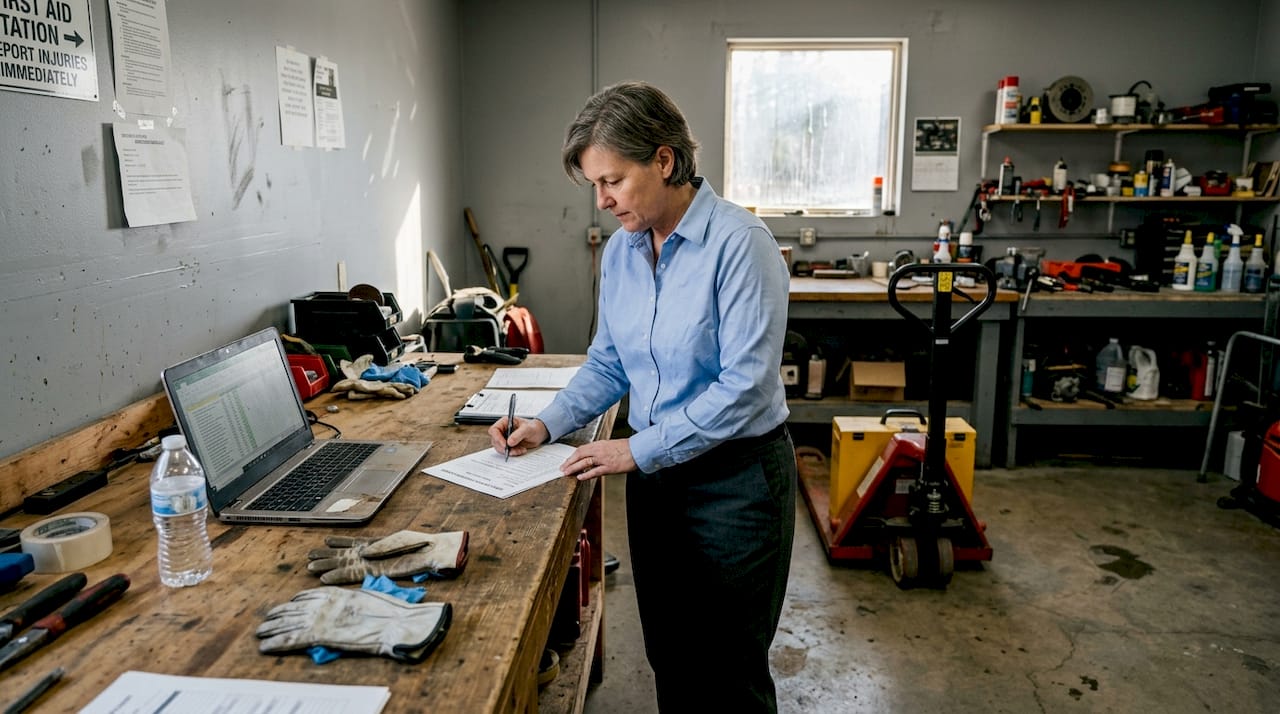
Consulting OSHA regulations and a qualified trainer are the recommended starting points for any classification question. Do not rely on a vendor’s sales description or a coworker’s opinion. Those sources carry no regulatory weight.
Follow these steps to verify whether a vehicle qualifies as a PIT:
Understanding the forklift operator job details can also help you frame what tasks require a trained PIT operator versus a general worker.
Pro Tip: Build and maintain a PIT register for your entire facility. List every motorized vehicle, its OSHA class, the date of last inspection, and the names of certified operators. During an OSHA audit, this register demonstrates that your compliance program is active, organized, and taken seriously. It can be the difference between a warning and a citation.
Once you have confirmed a vehicle’s classification, act on it immediately. Schedule operator training, establish a pre-shift inspection routine, and add the vehicle to your maintenance schedule. Compliance is not a one-time event.
Looking beyond definitions, there’s a deeper issue every manager should consider.
Most managers think of PIT misclassification as a paperwork problem. It is not. It is a liability problem. If an operator is injured on a vehicle that was never classified as a PIT, your company may face OSHA fines, workers’ compensation claims, and civil litigation simultaneously. The fact that the vehicle was not on your training records will not protect you. It will be used as evidence against you.
There is also an insurance angle that rarely gets discussed. Many commercial insurance policies require that operators of motorized equipment be properly trained and certified. A misclassified vehicle with an untrained operator can void coverage for an incident involving that equipment. That is a financial exposure most operations cannot absorb.
The most overlooked risk is organizational drift. You classify your fleet correctly today, then a new piece of equipment arrives six months later and nobody thinks to evaluate it. Advanced forklift training programs help build the internal culture where classification and compliance are automatic habits, not afterthoughts. Assign someone ownership of the PIT register and make fleet reviews a standing agenda item in your safety meetings. Compliance is a living process, not a checkbox.
If you want confidence in your compliance strategy, it pays to leverage specialized support.
Knowing what qualifies as a powered industrial truck is the foundation, but building a fully compliant operation requires trained operators, documented procedures, and a training program that keeps pace with your fleet.
Forklift Academy has supported warehouses and logistics operations across the U.S. for over 20 years. Our OSHA forklift training programs are designed to meet 29 CFR 1910.178 requirements for every class of PIT in your facility. Whether you need to certify individual operators or build internal training capacity, our forklift certification options make it straightforward. For operations that want to train employees in-house, our train the trainer course gives your designated trainers the credentials and tools to run a compliant program on your schedule.
Yes, if it is powered by an electric motor or internal combustion engine, a powered pallet jack qualifies as a powered industrial truck under OSHA’s 1910.178 standard. Manual pallet jacks pushed by hand do not qualify.
No. Earth-moving and over-the-road hauling vehicles are excluded from the PIT standard. Most agricultural tractors are also excluded unless they have been specifically adapted for industrial material handling inside a facility.
Check the OSHA 1910.178 definitions and consult a qualified trainer or safety professional who can review the equipment’s function and provide a documented classification decision.
You should review your entire fleet at least once a year and immediately whenever new equipment is added, existing equipment is modified, or operator roles change significantly.




 Optimized by Seraphinite Accelerator