 Skip to content

TL;DR:
- Proper daily habits and reinforcement are essential to prevent forklift incidents and ensure safety.
- Routine pre-shift inspections and correct load handling practices are critical for operational safety.
- Ongoing training and active management behavior build a safety culture that exceeds compliance standards.
Every year, U.S. warehouses report 85 fatalities and 34,900 injuries tied to forklift incidents, and 70% of those are preventable with proper training. That number should stop you cold. Many warehouse managers assume that posting safety rules and running annual certification is enough to stay safe and compliant. It isn’t. Real forklift safety lives in daily habits, operator behavior, and how managers reinforce standards on the floor. This guide covers the five areas where most facilities fall short: daily inspections, load handling, hazard navigation, operator rules, and training compliance for both OSHA and CSA standards.
| Point | Details |
|---|---|
| Inspections save lives | Daily pre-shift checks and immediate tagging of defective forklifts are your best insurance against tragedy. |
| Load rules prevent tip-overs | Carrying loads low, using the stability triangle, and knowing limits dramatically lower accident risk. |
| Proper ramp navigation is critical | Following the right procedures for ramps and inclines can stop a simple mistake from becoming fatal. |
| Regular training is mandatory | OSHA and CSA require ongoing operator and trainer education to stay compliant and safe. |
| Managers make the difference | Active leadership, not just written policies, fosters true forklift safety on the floor. |
Forklift incidents don’t just hurt people. They shut down operations, trigger OSHA investigations, and expose your company to serious legal liability. A single serious injury can cost a facility hundreds of thousands of dollars in workers’ compensation, equipment damage, legal fees, and lost productivity. The human cost is even harder to measure.
Here’s the number that should drive every decision you make about training: 85 fatalities and 34,900 injuries happen every year in the U.S. alone, and 70% are preventable. That means most of those incidents didn’t have to happen. They happened because someone skipped a step, ignored a rule, or assumed the forklift was fine without checking.
“Compliance is the floor, not the ceiling. The warehouses with the best safety records don’t just meet the standard, they exceed it every single day.”
One of the most dangerous myths in warehouse management is treating training as a checkbox. Managers schedule a course, operators get a card, and everyone moves on. But certification without reinforcement fades fast. Operators revert to shortcuts. Inspections get rushed. Load limits get pushed.
The real risks of ignoring fundamentals include:
Understanding workplace forklift safety isn’t just about following rules. It’s about building a system where every operator, every shift, applies the fundamentals without thinking twice. That starts with a solid OSHA forklift training guide and the will to actually enforce it.
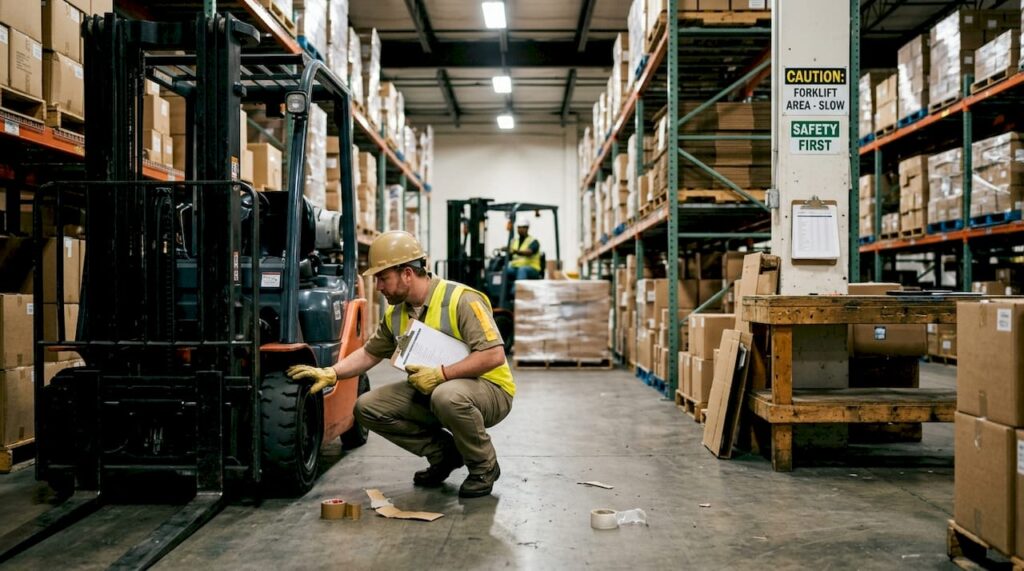
Preventing accidents starts before a single pallet is moved. Every shift, before an operator climbs into the seat, a pre-shift inspection must happen. This isn’t optional, and it isn’t a formality.
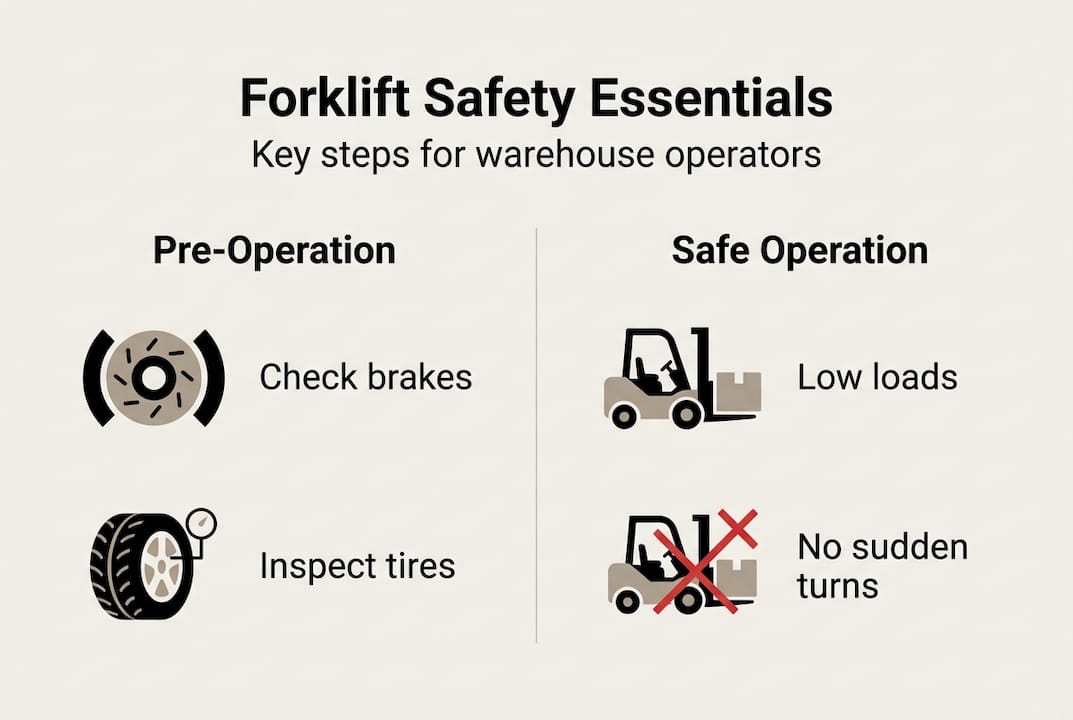
Daily pre-shift inspections are required under both OSHA and CSA standards. Operators must check brakes, steering, forks, tires, hydraulics, and all safety devices before operating. If any defect is found, the unit must be tagged out and removed from service immediately. No exceptions.
Here’s a numbered checklist every operator should follow:
| Inspection area | U.S. OSHA focus | Canada CSA B335-15 focus |
|---|---|---|
| Brakes | Functional check required | Functional check required |
| Forks | Visual inspection | Dimensional check included |
| Tires | Condition check | Condition and pressure check |
| Safety devices | Horn, lights, belt | Horn, lights, belt, stability systems |
| Documentation | Defects reported to supervisor | Written record required |
Pro Tip: Set up a physical red-tag zone in your facility, a clearly marked area where defective forklifts are parked and locked out until repaired. This removes any ambiguity about whether a tagged unit is safe to use.
Where managers most often miss inspection failures: they assume operators are completing checks thoroughly when they’re actually rushing through them. Walk the floor occasionally and review the step-by-step forklift inspection process with your team. Spot-check inspection logs against actual equipment condition. Your OSHA compliance guide should include a clear policy on what happens when an operator skips or falsifies an inspection record.
Once the forklift passes inspection, it’s the operator’s technique with loads that makes the difference between a safe shift and a serious incident.
The single most important rule: carry loads 4 to 6 inches off the ground, with the mast tilted back. This keeps the center of gravity low and stable. Operators who travel with loads raised are dramatically increasing tip-over risk.
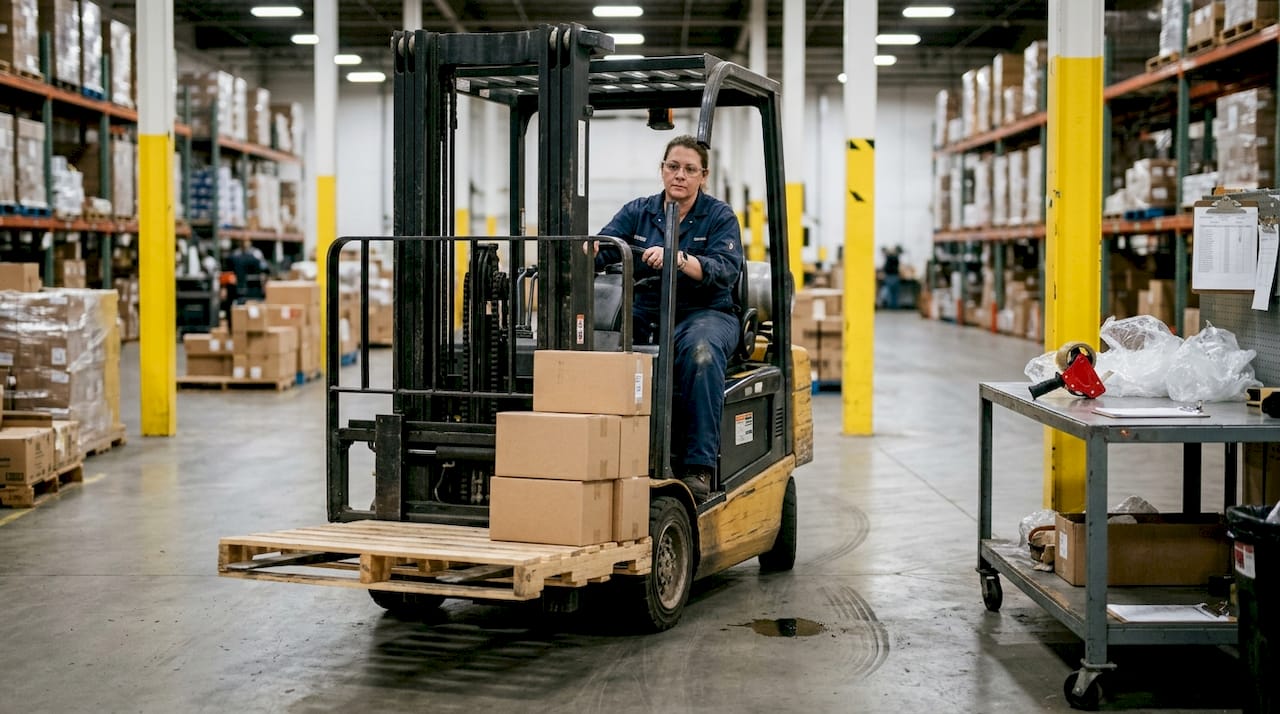
Every forklift has a data plate that specifies its rated capacity at a given load center. Exceeding that capacity, even slightly, shifts the center of gravity forward and outside the stability triangle. That’s when tip-overs happen.
The stability triangle is the three-point support formed by the two front wheels and the center of the rear axle. As long as the combined center of gravity of the forklift and load stays inside that triangle, the unit is stable. Add a heavy load, raise the forks, or turn sharply, and that center of gravity shifts. Push it outside the triangle and the forklift tips.
| Forklift class | Typical rated capacity | Standard load center |
|---|---|---|
| Class I (electric rider) | 3,000 to 6,000 lbs | 24 inches |
| Class IV (internal combustion) | 4,000 to 8,000 lbs | 24 inches |
| Class V (internal combustion) | 5,000 to 15,500 lbs | 24 inches |
| Reach truck | 2,500 to 5,500 lbs | 24 inches |
Key load handling rules to enforce on your floor:
Pro Tip: Just because a forklift lifts a load doesn’t mean it’s safe to travel with it. A load that’s within capacity at a 24-inch load center may exceed capacity if the weight is shifted farther from the forks. Always check the data plate for the specific load center distance. Review forklift training for load safety to ensure your operators understand this distinction.
Safe load movement is just one part. Navigating hazardous areas and emergencies can turn deadly if the rules aren’t followed precisely.
Ramps and inclines follow a simple but critical rule: when loaded, drive forward uphill and back downhill. When unloaded, reverse that direction. The load always faces uphill. This keeps the weight distribution stable and prevents the load from sliding off the forks.
Never turn on a ramp. Ever. A lateral shift in weight on an incline is one of the fastest ways to cause a tip-over. Always complete turns before reaching the ramp and reassess the route if conditions change.
For tip-over emergencies, most operators have the wrong instinct. The natural reaction is to jump. That instinct is wrong and often fatal. If a tip-over is imminent, stay in the cab, keep your seat belt fastened, and brace or lean away from the direction of the fall. The cab’s rollover protection structure is designed to protect you. Jumping puts you directly in the path of the falling machine.
Emergency tip-over response steps:
Reviewing forklift operator responsibilities with your team before incidents happen, not after, is the mark of a proactive safety program.
Even with perfect rule application, training gaps cause most legal and operational trouble. Here’s how to close them.
In the U.S., OSHA requires operators to complete classroom instruction, practical training, and a formal evaluation before operating independently. Recertification is required every three years, or sooner if an operator is observed operating unsafely, is involved in an incident, or is assigned a different type of forklift.
In Canada, CSA B335-15 requires basic, specific, and practical training phases, with provincial OHS regulations such as Ontario’s OHSA Reg 851 adding additional requirements. Canadian standards also impose stricter qualifications on who can deliver training, meaning your trainer’s credentials matter more.
| Training stage | U.S. OSHA | Canada CSA B335-15 |
|---|---|---|
| Classroom/basic instruction | Required | Required |
| Specific equipment training | Required | Required |
| Practical evaluation | Required | Required |
| Recertification cycle | Every 3 years | Varies by province |
| Trainer qualifications | Competent person | Stricter formal requirements |
Your compliance roadmap in simple steps:
For a full breakdown of business training and compliance requirements, and practical guidance on implementing forklift training programs that hold up to audit scrutiny, start with a structured review of your current documentation.
Here’s the uncomfortable truth: most facilities that have had a serious forklift incident had all the paperwork in order. They had training records, signed policies, and posted rules. What they didn’t have was a manager who walked the floor and said, “That’s not how we do it here.”
Rules on paper don’t move forklifts. People do. And people take shortcuts when no one is watching, when they’re tired, when they’re behind on a deadline. The facilities with the lowest incident rates aren’t the ones with the most detailed policy manuals. They’re the ones where supervisors actively coach, where unsafe behavior gets corrected immediately, and where safety is a daily conversation rather than an annual event.
Ensuring operator training compliance is the foundation. But what sits on top of that foundation is leadership behavior. If your managers walk past a raised load traveling across the floor without saying a word, you don’t have a safety culture. You have a safety document.
If this guide made one thing clear, it’s that real forklift safety requires more than a one-time certification. It requires ongoing training, active reinforcement, and programs built to meet both OSHA and CSA standards.
At Forklift Academy, we’ve spent over 20 years building OSHA forklift certification programs that work for individual operators and entire warehouse teams. Whether you need online courses, onsite training, or a train the trainer online solution to build internal capacity, we have a program that fits. Our forklift training certification options are designed to simplify compliance, reduce incident risk, and build the kind of safety culture that actually protects your people.
The stability triangle is the three-point support formed by a forklift’s two front wheels and the center of the rear axle. Keeping the combined center of gravity of the forklift and its load within this triangle prevents tip-overs.
OSHA guidance requires operators to carry loads 4 to 6 inches off the ground during travel to maintain stability and reduce the risk of striking obstacles or pedestrians.
Stay in the cab, keep your seat belt fastened, grip the steering wheel, and lean away from the direction of the fall. Jumping out is the leading cause of tip-over fatalities.
OSHA requires operators to complete a formal evaluation every three years, or sooner if unsafe operation is observed, an incident occurs, or the operator is assigned a different type of equipment.




 Optimized by Seraphinite Accelerator