 Skip to content

TL;DR:
- Many forklift accidents are caused by myths that lead to inadequate training and unsafe practices.
- OSHA mandates formal training for all forklift operators, regardless of experience, to ensure safety.
- Addressing misconceptions and reinforcing proper protocols through ongoing training reduces workplace injuries.
Forklift accidents still kill roughly 85 workers and seriously injure nearly 35,000 more every year in the United States. Yet walk into almost any warehouse safety meeting, and you will still hear someone say forklifts are simple and don’t require specialized training. That single belief has contributed to more preventable incidents than most managers realize. This article targets the myths that quietly undermine your training programs, your OSHA compliance, and ultimately your team’s safety. Each section pairs the myth with evidence, regulatory facts, and steps you can act on immediately.
| Point | Details |
|---|---|
| Training is non-negotiable | All forklift operators must complete formal OSHA-required training, not just informal instruction. |
| Slow speeds still carry risk | Many accidents happen at low speeds in tight or congested warehouse areas, making awareness critical. |
| Myths undermine safety culture | Failing to debunk persistent forklift myths can erode compliance and increase incident rates. |
| Shared safety responsibility | Supervisors, managers, and all warehouse staff must contribute to safety, not just operators. |
| Smart tech is not a substitute | Advanced safety equipment works only when paired with continuous, myth-aware training programs. |
Myths about forklift safety do not just live in break rooms. They show up in onboarding scripts, informal coaching, and even in how supervisors respond to near misses. Identifying them by name is the first step toward fixing them.
Here are the five myths safety managers encounter most often, paired with the reality:
“OSHA standard 1910.178 requires that no powered industrial truck be operated unless the operator has been trained and evaluated. Employers who skip this step expose their workforce to serious injury and face substantial penalties.” This is not a gray area. Review your employee training guide to confirm your program covers every required element.
These myths persist partly because forklifts look familiar. They have wheels, a seat, and a steering mechanism. That visual familiarity breeds a false sense of ease. Breaking that assumption is where every strong safety program begins.
Once you can name the myths, the next move is replacing them with specific, verifiable facts. The table below gives you a side-by-side view that works well in training sessions and safety audits.
| Common myth | OSHA and factual reality |
|---|---|
| High speed causes most accidents | Most accidents occur at low speed in tight spaces; technique and awareness are the real variables |
| Training is optional for experienced workers | OSHA 1910.178 requires training and evaluation for every operator, regardless of experience |
| Loads can be carried high for better visibility | OSHA 1910.178 mandates low load carriage with backward tilt for stability |
| Only the operator needs safety training | All personnel in forklift zones must understand safety protocols |
| Capacity limits have a built-in buffer | Rated capacity is a hard limit; no buffer exists for field conditions |
Key statistic: The majority of forklift injuries trace back to improper training or failure to follow established procedures, not equipment failure. That means your training program is your most powerful safety tool.
OSHA standard 1910.178 is worth reading closely. It does not just require training; it specifies the content, the evaluation method, and the conditions under which retraining is mandatory. Use your OSHA warehouse safety checklist to verify your current program maps to every requirement in that standard.
The low-speed accident data is particularly important for managers who rely on speed limit signage as their primary control. Speed signs help, but they do not address the real causes: poor spatial awareness, inadequate pedestrian separation, and operators who have not practiced maneuvering in confined areas. Your forklift training steps should include scenario-based practice in the actual spaces where your operators work.
Operational context matters too. A forklift moving at 3 mph in a narrow aisle with poor lighting is far more dangerous than one moving at 8 mph in an open yard with clear sightlines. Training must reflect that reality.
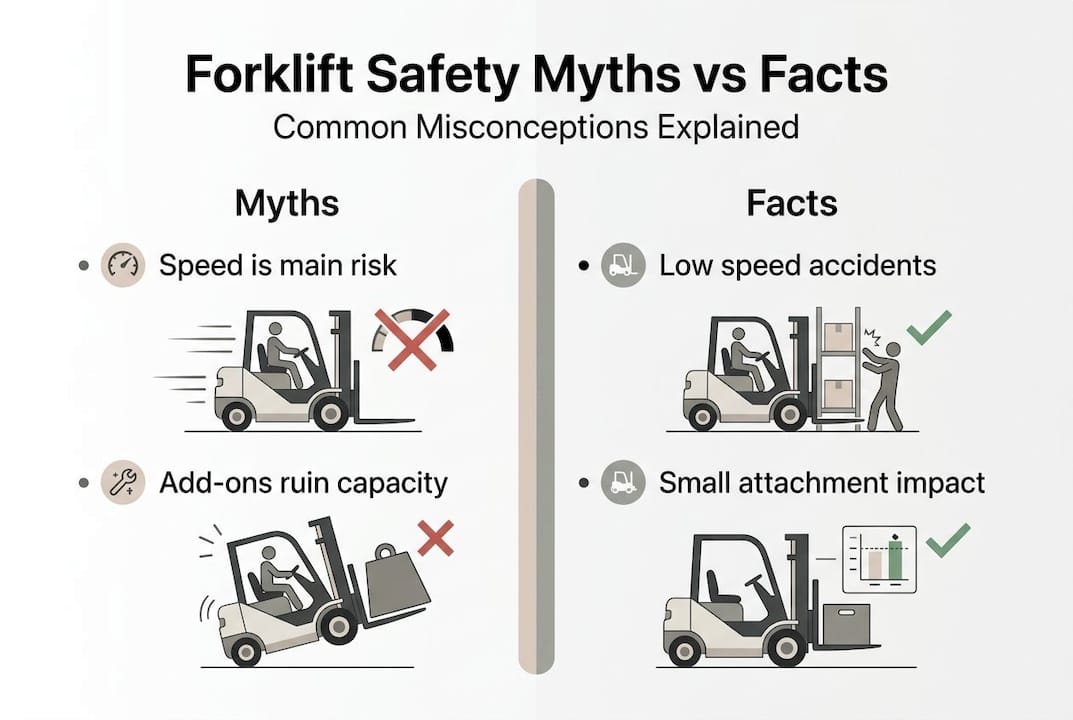
Some of the most dangerous myths are not about speed or training requirements. They are about what operators and managers assume is safe once basic training is complete.
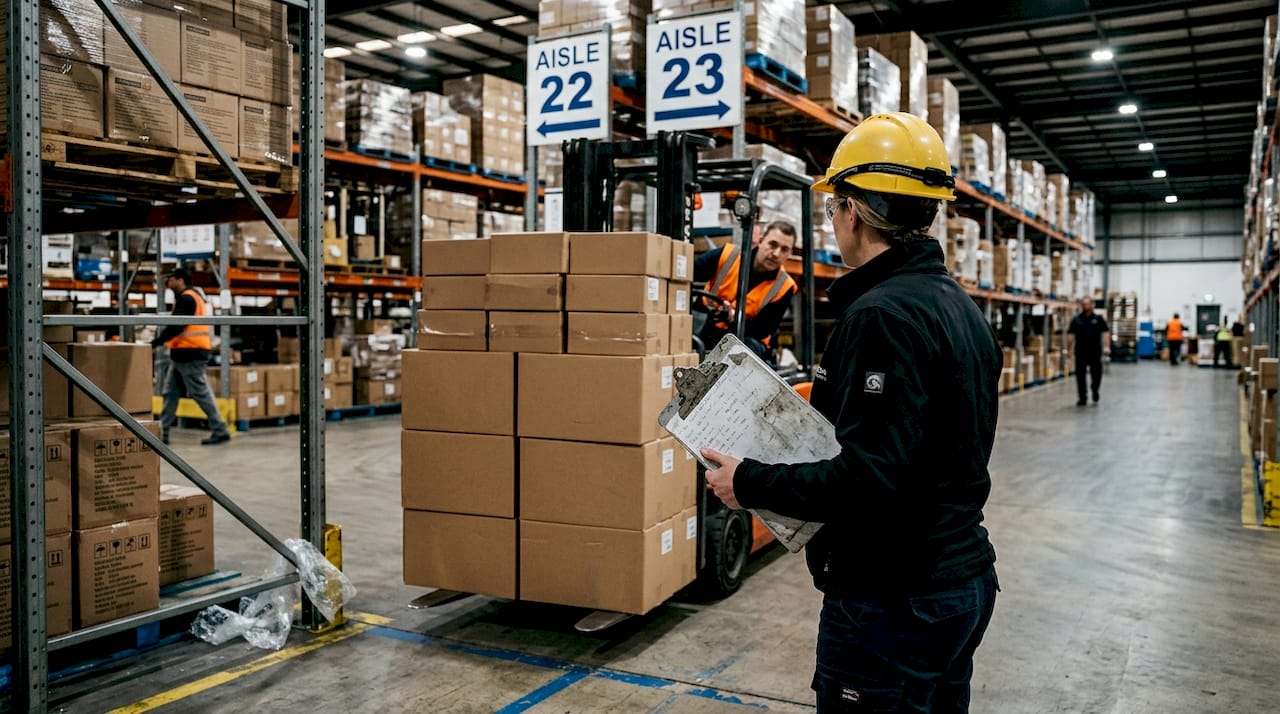
Blind spots are bigger than most people think. Pedestrians remain at risk even when they believe they are outside the operator’s path. Horns, mirrors, and safety cameras reduce risk, but they do not eliminate it. Pedestrian safety zones, physical barriers, and clear communication protocols are essential layers.
Attachments are widely misunderstood. Many operators and even some managers believe that adding an attachment dramatically reduces a forklift’s safe lifting capacity. In practice, attachments only slightly reduce capacity while often improving control and efficiency for specific tasks. The key is using the right attachment for the job and verifying the adjusted capacity rating before use.
The behavioral paradox is the most overlooked risk. When warehouses upgrade to forklifts with proximity sensors, better cameras, and automatic speed reduction, operators sometimes respond by taking more risks. This is called risk homeostasis, and safer equipment can unintentionally enable riskier behavior when it is not paired with updated training. Technology is a supplement, not a replacement.
Best practices for managing these hidden risks:
Pro Tip: When you add new safety technology to your fleet, run a scenario-based walkthrough within 30 days. Observe whether operators are relying on the tech instead of their training. If they are, that is a retraining trigger, not a tech failure.
Knowing the myths is not enough. You need a structured process to remove them from your safety culture and replace them with verified, OSHA-aligned practices.
Steps to audit and reinforce your forklift training program:
The table below maps legacy beliefs to current standards and suggests corrective actions:
| Legacy belief | Updated standard | Corrective action |
|---|---|---|
| Speed is the main risk factor | Low-speed incidents dominate accident data | Add slow-speed maneuvering scenarios to training |
| Experienced operators don’t need refreshers | OSHA requires retraining after observed unsafe acts | Build a retraining trigger system into your safety program |
| Loads can be raised for better sightlines | Carry loads 4-6 inches off the ground with a backward tilt | Update operator SOPs and post reminders at loading areas |
| Safety is the operator’s job alone | Shared responsibility across all roles is required | Train all warehouse personnel, not just operators |
Signage, floor markings, and regular safety briefings reinforce these updates between formal training sessions. Your workplace safety compliance strategy should treat these as living systems, not one-time installations.
For managers looking to build a stronger foundation, improving forklift training starts with honest program audits and a commitment to updating content when standards or equipment change. That cycle of review and refresh is what separates compliant programs from truly safe ones.
The forklift safety industry has a technology fixation. Proximity sensors, automatic braking, overhead guards with cameras, and AI-powered collision alerts are all real innovations. We are not dismissing them. But here is the uncomfortable truth: warehouses that invest heavily in new safety tech without addressing the human beliefs underneath their incidents often see flat or worsening injury rates.
The reason is straightforward. Safer equipment can enable riskier behavior when operators trust the machine more than their own judgment. That trust is built on myths, not facts. An operator who believes forklifts are only dangerous at high speeds will not change that belief because a proximity sensor beeped at them. They will just slow down slightly and carry on.
Myth-busting, by contrast, changes the mental model. When an operator genuinely understands that most accidents happen at low speeds in familiar spaces, their entire approach to routine tasks shifts. That shift is durable in a way that a sensor alert never will be.
Our position at Forklift Academy, backed by over 20 years of training experience, is that training for effective safety outcomes requires confronting false beliefs directly, not just adding new tools on top of them. Technology should amplify a strong safety culture, not substitute for one.
Pro Tip: Validate every new safety technology purchase with a human-centered walkthrough. Ask your operators what the new tool changes about how they think, not just what it does.
Moving from myth-busting to measurable safety improvement requires the right programs and documentation behind your team.
Forklift Academy offers OSHA-compliant solutions built for exactly this challenge. If you are ready to upgrade your internal training capacity, the train the trainer certification program equips your designated trainers with the tools and authority to deliver consistent, compliant instruction across your entire operation. For operators who need current credentials, our OSHA forklift certification programs are available online and onsite. And if you need a clear map of what your program must include, the OSHA compliance guide walks you through every requirement with practical guidance. The right training is available for any warehouse size or need.
Yes, OSHA mandates formal training and certification for every forklift operator. Failure to comply can result in significant fines and increases incident risk across your operation.
Not entirely. Accidents occur at low speeds in tight spaces far more often than people expect, which means overall technique, awareness, and training matter more than speed control alone.
No. Forklift attachments only slightly reduce lift capacity, and the tradeoff is often improved control and productivity when the attachment is matched correctly to the task.
Carry loads 4-6 inches off the ground with a slight backward tilt. OSHA 1910.178 requires loads to be carried as low as safely possible to maintain stability during travel.
No. Safer equipment may encourage riskier behavior when operators begin relying on technology instead of their training, making robust and ongoing operator education more important than ever.




 Optimized by Seraphinite Accelerator