 Skip to content

TL;DR:
- Proper forklift safety checklists are legally required to prevent accidents and OSHA citations.
- Digital tools improve compliance through enforced completion, automated reporting, and real-time monitoring.
- Regular review and operator training are essential for effective forklift safety workflows.
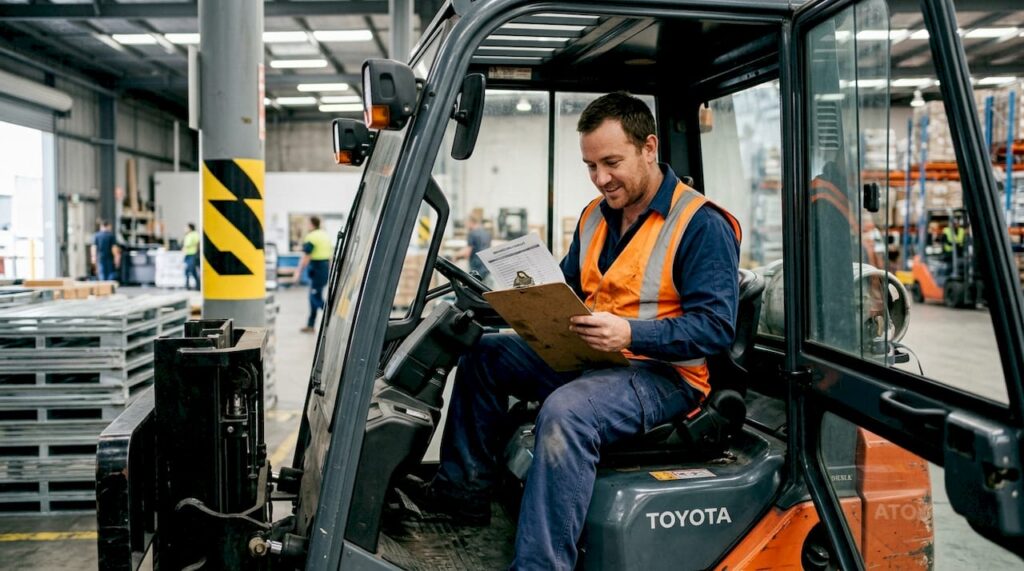
A forklift operator starts a shift, skips the pre-start check because the paper form is missing, and drives a machine with faulty brakes into a storage rack. One worker is injured, product is destroyed, and your facility faces an OSHA citation that costs thousands of dollars. This scenario plays out in warehouses across the U.S. and Canada every year, and nearly every time, a missed or incomplete safety checklist is at the root of it. A well-structured forklift safety checklist workflow does more than satisfy regulators. It protects your people, your equipment, and your bottom line. This article walks you through exactly how to build and sustain one.
| Point | Details |
|---|---|
| Checklist compliance is critical | Consistent, thorough safety checklists are required to prevent accidents and avoid regulatory fines. |
| Digital workflows boost safety | Digital tools ensure all checklist steps are completed and provide crucial compliance records. |
| Audit and refine regularly | Regular review and improvement of your workflow keeps your warehouse safe and OSHA-compliant. |
| Training is foundational | Effective staff training underpins any successful forklift safety process. |
Before you can build an effective workflow, you need to know what the law actually demands. In the United States, OSHA standard 29 CFR 1910.178(q)(7) requires that forklifts be inspected before each shift. If a forklift is used around the clock, it must be inspected at least once every 24 hours. These are not suggestions. They are enforceable requirements, and violations can result in fines that reach into the tens of thousands of dollars per incident.
For operations in Canada, the rules are equally firm. CCOHS forklift requirements include visual and operational checks at shift start, verified operator training, adherence to load limits, mandatory seatbelt use, and strict prohibitions against unsafe practices like traveling with elevated loads or carrying passengers. The CSA B335-15 standard provides the technical framework that employers must follow.
So what does a compliant checklist actually cover? Here are the core items regulators expect you to inspect:
The stakes behind these requirements are real. Forklift incidents account for nearly 85 deaths and roughly 34,900 serious injuries in the U.S. each year. When you review OSHA forklift compliance requirements, you see that most violations trace back to skipped or incomplete pre-shift inspections.
| Checklist category | OSHA required | CSA B335-15 required |
|---|---|---|
| Pre-shift inspection | Yes | Yes |
| Operator sign-off | Yes | Yes |
| Load limit verification | Yes | Yes |
| Seatbelt check | Yes | Yes |
| Written/digital record | Yes | Yes |
A solid forklift safety checklist guide helps you map these requirements to your specific equipment and environment, so nothing falls through the cracks.
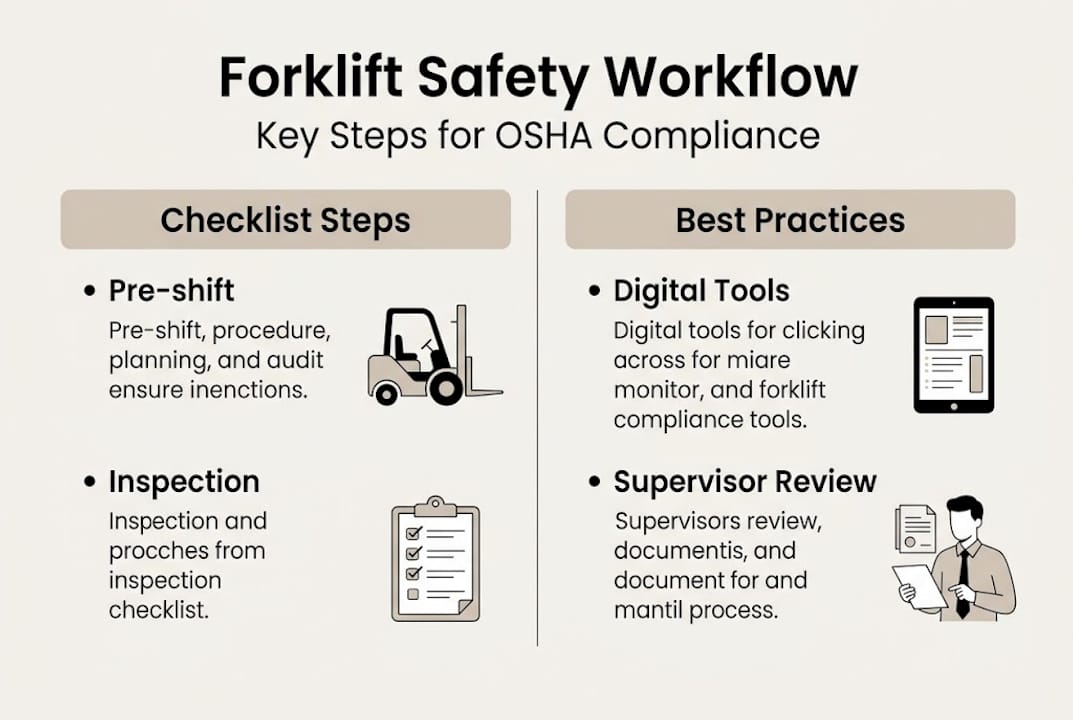
Knowing what is required is only the first step. The next is choosing the right format and tools to make your workflow stick. Most warehouses still rely on paper forms, and while paper is better than nothing, it comes with serious limitations. Forms get lost, fields get skipped, and there is no way to verify that a check actually happened versus someone just signing off to move on.

Digital checklist advantages are significant: digital tools enforce completion by requiring every field to be filled before the form submits, auto-generate work orders when failures are logged, timestamp and GPS-verify each inspection, and provide real-time dashboards for managers. When a critical failure is detected, the system can automatically lock out the forklift from service. That kind of built-in accountability simply is not possible with paper.
Here is a direct comparison to help you decide:
| Feature | Paper checklist | Digital checklist |
|---|---|---|
| Completion enforcement | None | Mandatory fields |
| Audit trail | Manual filing | Automatic, timestamped |
| Work order generation | Manual | Automatic |
| Real-time manager visibility | None | Live dashboard |
| Equipment lockout on failure | Manual | Automatic |
| Record storage | Physical files | Cloud-based |
When you are ready to build your workflow, follow these steps:
Pro Tip: Use your digital platform’s template library as a starting point, then layer in the essential forklift safety items specific to your equipment type. You will save hours of setup time and avoid missing critical inspection points.
For operators who want a quick reference during the inspection itself, reviewing forklift inspection procedures gives a clear breakdown of what each check should look like in practice.
With your tools and templates in place, here is how to put the workflow into action every single day.
“A checklist that lives in a drawer is not a safety program. It is a liability waiting to happen.”
Two of the most common workflow mistakes are skipping the physical walkthrough and backdating records. Both destroy the value of your process and expose your facility to serious risk. Focus on reducing forklift risks by treating each inspection as a non-negotiable start-of-shift requirement, not an optional formality.
Pro Tip: Rotate supervisors who verify checklists. When the same person signs off every day, patterns of rubber-stamping can develop. Rotating responsibility keeps everyone sharp and reinforces that forklift safety best practices are a shared commitment.
Executing the workflow daily is essential, but it is not enough on its own. You need to regularly verify that the process is working and adjust it when it is not. This is where most warehouses fall short. They implement a checklist, assume it is running smoothly, and never look at the data.
Here is what you should track on a monthly basis:
Digital platforms make this tracking automatic. The digital audit features in modern checklist tools generate reports that show completion rates, failure trends, and maintenance response times without any manual data entry.
| Metric | Target benchmark | Warning sign |
|---|---|---|
| Checklist completion rate | 100% | Below 95% |
| Critical failure response time | Under 2 hours | Over 4 hours |
| Repeat failures on same unit | 0 per month | 2 or more |
| Audit trail gaps | 0 | Any missing records |
Signs that your workflow needs adjustment include rising incomplete submissions, operators reporting that the checklist takes too long, or maintenance logs showing issues that were never flagged during inspections. When you see these signals, revisit your process.
Review the OSHA inspection process periodically to confirm your checklist still aligns with current standards. Regulations can update, and your workflow must keep pace. Ongoing operator training is a key part of this. When operators understand the purpose behind each inspection item, completion quality improves. Pair your checklist program with regular refresher training to keep standards high. Reviewing ensuring safe forklift operations gives you a practical framework for tying training to your audit results.
Here is something most safety guides will not tell you directly: paper checklists are not just inconvenient. They are a structural weakness in your safety program. The industry term for it is “pencil-whipping,” where operators check every box without actually inspecting anything. With paper, there is no way to prove it did not happen.
We have seen warehouses with spotless paper records that still experienced serious incidents, because the records reflected what operators wrote, not what they actually did. Digital checklists outperform paper by enforcing completion, auto-generating work orders, timestamping inspections with GPS verification, and locking out forklifts on critical failures. That is accountability built into the system, not dependent on individual discipline.
The transition to digital feels like extra work upfront, but modernizing your checklist process pays off quickly in fewer missed checks, faster incident response, and cleaner compliance records when OSHA comes knocking. The warehouses that resist this shift are not saving time. They are accumulating risk.
A strong checklist workflow is only as effective as the people running it. Operators who understand OSHA standards, know what to look for during inspections, and recognize when to pull a machine from service are your best defense against incidents and citations.
At Forklift Academy, we have spent over 20 years helping warehouses across the U.S. and Canada build exactly that kind of team. Our Forklift Trainer Online Certification equips your in-house trainers to deliver consistent, compliant safety instruction. Pair that with our OSHA Compliance Guide to make sure your checklist workflow meets every current standard. Certified operators run better workflows. Better workflows prevent accidents. It really is that straightforward.
OSHA requires a pre-operation inspection covering all critical systems including brakes, lights, steering, warning devices, and seat belts before each use or at minimum once per 24-hour period.
Digital workflows enforce completion, provide timestamped audit trails, automate maintenance reporting, and can instantly lock out unsafe equipment without any manual intervention from a supervisor.
Checklists must be completed before every shift or each time a new operator takes control of the forklift. CSA B335-15 requires visual and operational checks at shift start as a minimum standard in Canada.
The forklift must be immediately tagged out and removed from service until repairs are completed. Critical failures auto-lockout the forklift in digital systems, removing the risk of human error in that decision.
Yes. Timestamped digital records with verifiable completion data meet OSHA documentation requirements and are often more defensible than paper records during an inspection.




 Optimized by Seraphinite Accelerator