 Skip to content

TL;DR:
- Distinguishing between forklift operators and trainers is essential for safety and OSHA compliance.
- Proper training reduces forklift incidents by up to 70%, but roles require different qualifications.
- Clear separation of responsibilities and documentation helps prevent accidents and regulatory violations.
Many warehouse managers assume that a skilled forklift operator naturally makes a good trainer. That assumption creates real compliance risk. The two roles carry completely different responsibilities, authority levels, and OSHA obligations. Mixing them up, or leaving them undefined, is one of the most common reasons warehouses fail audits and face preventable injuries. Proper training reduces forklift incidents by 70%, yet operator error still drives most accidents. This guide breaks down exactly what each role requires, how they differ, and what you need to do to staff both positions correctly for full compliance.
| Point | Details |
|---|---|
| Operators vs trainers | Operators execute daily forklift duties, while trainers instruct and certify for compliance. |
| OSHA requirements | Operators require certification every three years; trainers need proven knowledge and experience. |
| Safety impact | Training by qualified trainers reduces incidents by up to 70% and improves warehouse safety. |
| Choosing trainers | Selecting trainers with instructional skill and site insight drives better compliance. |
A forklift operator is the person behind the controls. Their job is to move materials safely, efficiently, and in accordance with OSHA standards every single shift. That sounds straightforward, but the scope of what operators are responsible for is broader than most people realize.
According to the operator responsibilities guide, forklift operators must safely operate industrial trucks, perform pre-shift inspections, adhere to safety standards, and maintain accurate logs. Every one of those tasks carries compliance weight. A missed inspection entry or a skipped pre-shift check can become a liability issue the moment an incident occurs.
Here is what a typical operator’s daily duties look like:
Operators must also stay current with the warehouse safety standards that govern their specific work environment. A cold storage facility has different hazards than a lumber yard, and operators need site-specific awareness to work safely.
The numbers behind operator error are sobering. Operator error causes 70 to 87% of accidents, and proper training reduces incidents by up to 70%. That gap between trained and untrained operators is not a small margin. It represents dozens of preventable injuries every year in a single large facility.
Understanding certification requirements is also part of the operator’s compliance picture. Operators must be certified before they operate independently, and that certification must be renewed on a regular schedule.
Pro Tip: Always instruct operators to keep their forks at 4 to 6 inches during travel. This low travel height keeps the center of gravity stable and dramatically reduces tip-over risk, which is the leading cause of operator fatalities.
Reviewing the full operator requirements guide and building a daily checklist around it is one of the simplest ways to reduce incident exposure. Operators who know their duties clearly and follow training best practices consistently perform better and stay safer.
A forklift trainer does not just drive a forklift well. They teach others how to do it safely, evaluate competency, and carry direct responsibility for whether their trainees meet OSHA standards. That is a fundamentally different job.
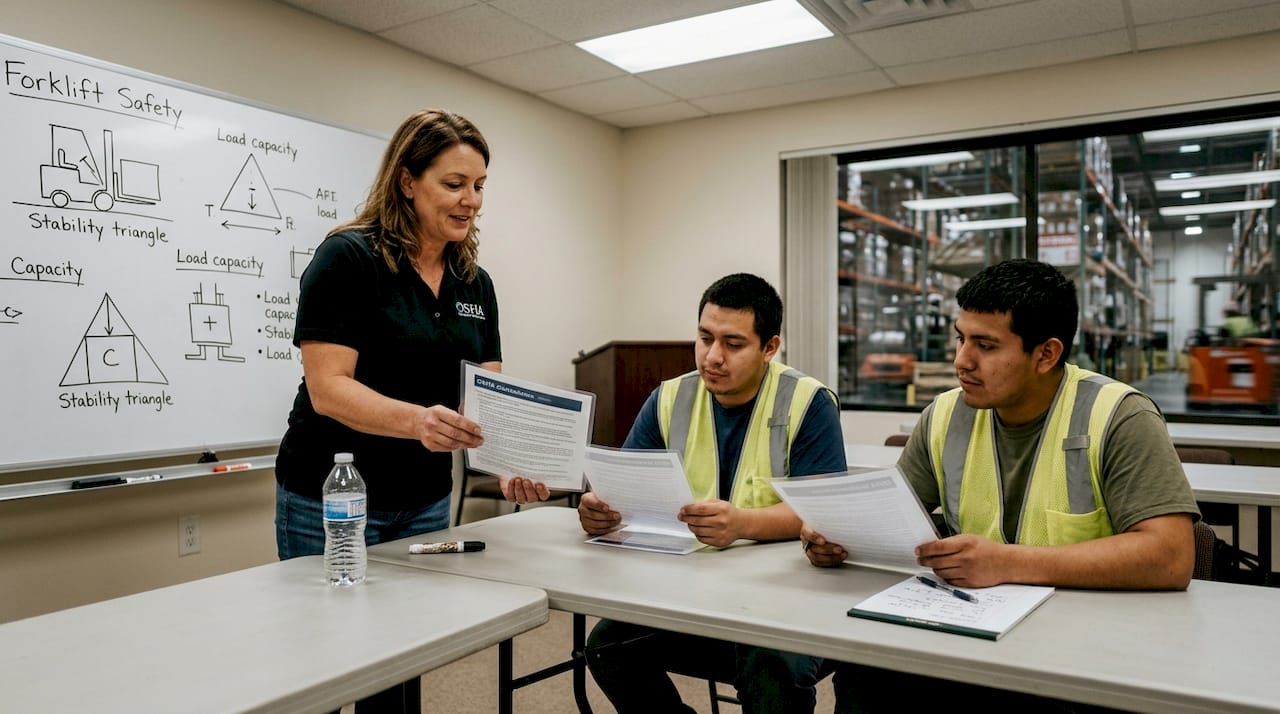
Forklift trainers deliver OSHA-compliant training, evaluate operator competency, and conduct both classroom and field instruction. They are the link between regulatory requirements and real-world safe behavior. Without a qualified trainer, your certification program has no foundation.
Here is what effective forklift trainer responsibilities include:
One of the most important things to understand about trainer qualifications is that OSHA does not require a formal trainer certification. Instead, OSHA 29 CFR 1910.178(l)(2)(iii) states that trainers must have the knowledge, training, and experience necessary to train operators and evaluate their competency. That standard is performance-based, not credential-based.
Review the full breakdown of trainer qualifications to understand what OSHA actually looks for when auditing your training program.
“OSHA compliance hinges on practical evaluation, not just classroom theory.”
This matters because many facilities assume that sending someone to a one-day trainer course is enough. It is not. Trainers must demonstrate they can adapt their methods to your specific environment. A trainer who learned in a flat warehouse may not be prepared to train operators working on loading docks with uneven surfaces.
Pro Tip: If you use in-house trainers, document their instructional qualifications separately from their operator records. OSHA inspectors will ask for evidence that your trainer was qualified to train, not just qualified to operate.
Understanding your OSHA training requirements and mapping them to your trainer’s documented skills is the clearest path to audit readiness. Review trainer responsibilities in detail before assigning anyone to the role.
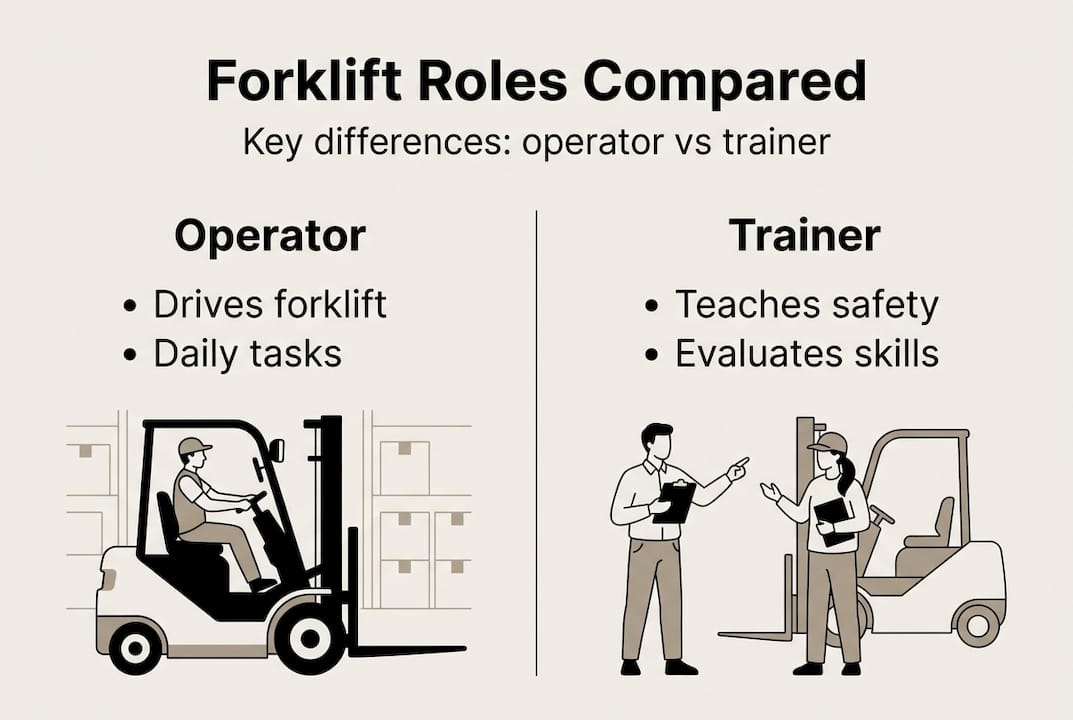
Seeing these roles next to each other makes the differences impossible to ignore. Here is a direct comparison of the key aspects that matter most for staffing and compliance decisions.
| Aspect | Forklift operator | Forklift trainer |
|---|---|---|
| Primary duty | Operate equipment safely | Instruct and evaluate operators |
| OSHA requirement | Certification required | Knowledge and experience required |
| Certification renewal | Every 3 years | No formal renewal cycle |
| Authority | Follows safety rules | Sets and enforces training standards |
| Documentation | Inspection logs | Training records and evaluations |
| Site-specific training | Receives it | Designs and delivers it |
Operators need OSHA certification valid for 3 years, while trainers are required to demonstrate expertise rather than hold a specific certificate. That distinction has real staffing implications. You cannot simply rotate your best operator into a trainer role without verifying they meet the OSHA knowledge standard.
For more on the value of keeping certifications current, see operator certification benefits and review the full certification overview for context.
When deciding whether to use in-house or third-party trainers, consider the following factors:
Navigating the OSHA certification process is easier when you know which role you are filling and what each one requires. Do not let the overlap in physical environment fool you into thinking the roles are interchangeable.
When roles are blurred, accountability disappears. That is when accidents happen and audits get failed. Clearly separating operator and trainer responsibilities is not just good practice. It is a structural safety decision.
Training cuts incidents by up to 70%, yet approximately 85 deaths and 35,000 injuries occur annually from forklift accidents in the U.S. Those numbers reflect facilities where training is inconsistent, undocumented, or assigned to people who were not qualified to deliver it.
Here is what happens when the roles get mixed up or left vague:
The table below shows how training quality directly affects safety outcomes:
| Training status | Incident rate impact | Compliance risk |
|---|---|---|
| No formal training | Baseline high risk | Immediate OSHA violation |
| Informal operator-led training | Moderate reduction | High audit exposure |
| Qualified trainer, documented | Up to 70% reduction | Low audit exposure |
| Refresher after incident | Sustained reduction | Demonstrates good faith |
To drive down your incident rate, start with an audit of your current staff certifications and trainer qualifications. Use incident reduction strategies and align your program with risk reduction standards that OSHA expects.
For external benchmarks, the OSHA training benchmarks resource is a practical reference point for building your compliance calendar.
Pro Tip: Any time an operator is involved in an incident or observed behaving unsafely, document refresher training immediately. OSHA views prompt corrective action as evidence of a functioning safety program, and it protects you during any subsequent review.
Most warehouses promote their best operators into trainer roles. The logic seems sound. If someone is great at the job, they should be able to teach it. But operational skill and instructional skill are not the same thing, and confusing them is one of the most persistent problems in warehouse safety programs.
A skilled operator knows what to do. A qualified trainer knows how to explain it, demonstrate it, assess it, and correct it under pressure. Those are different cognitive tasks. Trainers must adapt instructional methods to site-specific hazards, not just teach generic skills. A trainer who cannot adjust their approach for a new dock layout or a different forklift model is not fully qualified, regardless of how many years they have operated.
The real gap we see is not in technical knowledge. It is in instructional technique and documentation discipline. Trainers who were never taught how to teach often skip the evaluation step or keep informal records. That is exactly what OSHA looks for during an audit. Review trainer adaptation tips to understand what a fully prepared in-house trainer program actually looks like.
Understanding the difference between operators and trainers is the first step. Building a program that satisfies OSHA and actually reduces injuries is the next one.
At Forklift Academy, we have spent over 20 years helping warehouse managers and HR teams build compliant, effective training programs. Whether you need to certify your operators quickly or develop qualified in-house trainers, we have the tools to make it happen. Our Train the Trainer Online program gives your designated trainers the instructional foundation OSHA expects. For operator certification, our OSHA Forklift Certification course covers all required topics in a flexible online format. And if you want a full picture of your compliance obligations, our OSHA Compliance Guide walks you through every requirement step by step.
Operators handle daily equipment use and material handling, while trainers deliver instruction and formally assess operator competency per OSHA standards. The roles require different skills, documentation, and levels of accountability.
No. OSHA requires trainers to have knowledge, training, and experience, but no formal certificate is mandated. What matters is the trainer’s demonstrated ability to instruct and evaluate operators effectively.
Certification must be renewed every three years, or sooner if an operator is involved in an accident, observed operating unsafely, or assigned to a different type of equipment.
Proper training can reduce incidents by up to 70% according to OSHA data, making it the single most effective tool for lowering injury rates and avoiding regulatory penalties.
Yes. An experienced operator who can demonstrate competency in both operating and instructing may qualify as a trainer under OSHA regulations, provided their qualifications are documented.




 Optimized by Seraphinite Accelerator