
Every North American warehouse manager knows the pressure to keep operations running smoothly while meeting strict OSHA safety standards. Without reliable forklift inspection documents, even routine shifts can turn into emergencies with costly equipment failures. This practical guide breaks down the step-by-step OSHA compliance process so you can confidently implement a comprehensive forklift checklist and build stronger workplace safety for your team.
Table of Contents
- Step 1: Prepare Inspection Documents And Checklist
- Step 2: Inspect Forklift Components Visually
- Step 3: Test Operational Controls And Safety Features
- Step 4: Document Findings And Address Issues
- Step 5: Verify Compliance And Finalize Inspection
Quick Summary
| Key Point | Explanation |
|---|---|
| 1. Thorough Inspection Documents Required | Create detailed forklift documents, including checklists, to maintain safety standards and comply with regulations like OSHA. |
| 2. Systematic Visual Component Checks | Conduct a walk-around inspection of vital forklift components to identify issues before operations start, preventing accidents. |
| 3. Test Operational Controls and Features | Verify all control mechanisms and safety systems function correctly to ensure equipment reliability and operator safety. |
| 4. Document Findings for Maintenance Actions | Record the results of your inspections systematically to support ongoing safety and maintenance needs in the workplace. |
| 5. Final Compliance Verification is Crucial | Review all documentation and safety systems to ensure compliance with regulations and to safeguard against future issues. |
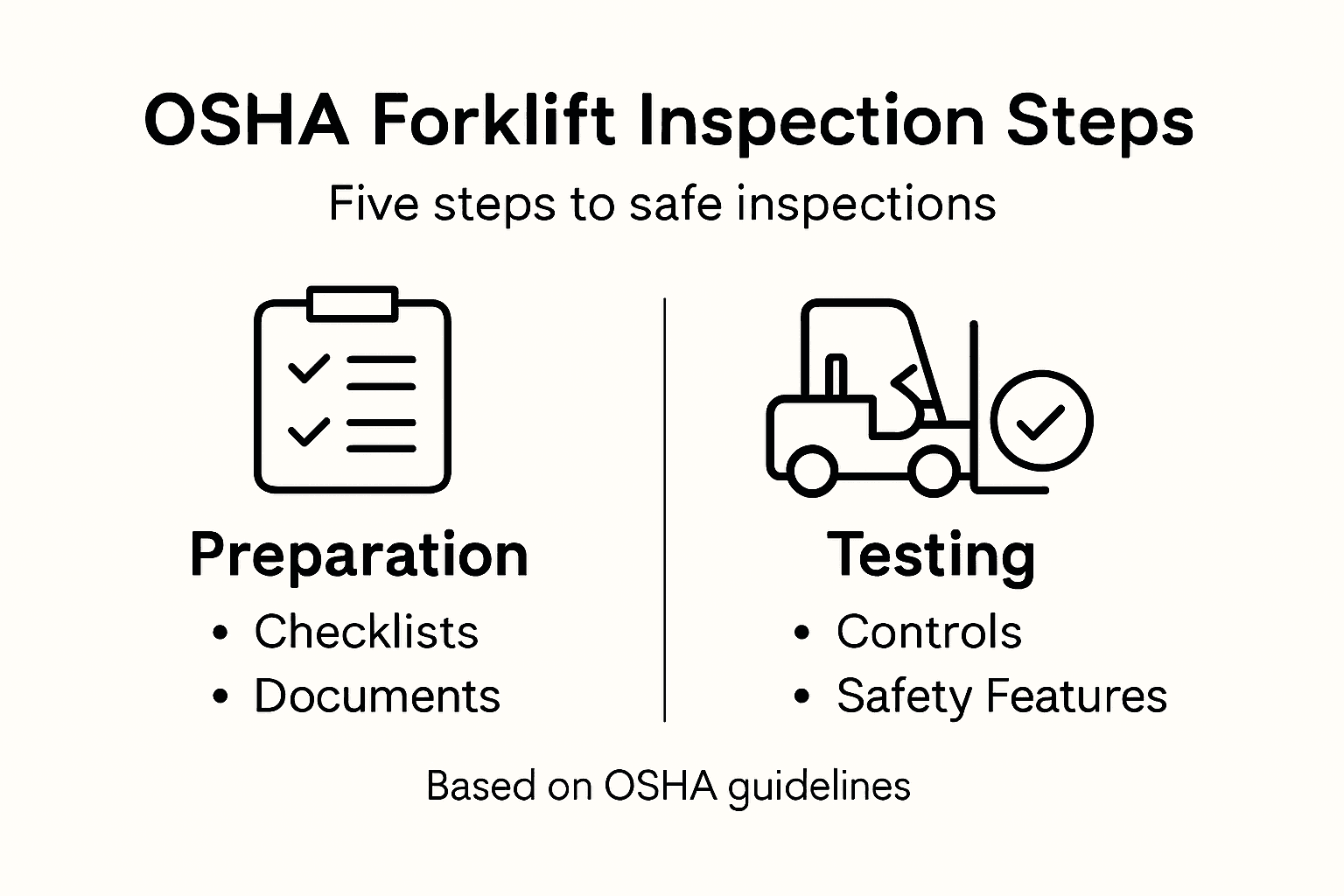
Step 1: Prepare inspection documents and checklist
Preparing thorough forklift inspection documents ensures your workplace maintains rigorous safety standards and complies with OSHA regulations. In this step, you’ll create a comprehensive checklist that enables systematic and reliable equipment assessment before each operation.
Starting with a standard checklist, you’ll want to cover all critical functional areas of your forklift. Comprehensive forklift checklists are essential for documenting maintenance needs and preventing potential equipment malfunctions. Your checklist should include detailed visual and operational inspection points such as:
- Tire condition and pressure
- Overhead guard integrity
- Fork alignment and structural soundness
- Fluid levels and potential leaks
- Safety decal visibility
- Control mechanism functionality
- Seat belt and restraint system
- Lighting and electrical systems
Documenting each inspection systematically helps create an audit trail that demonstrates your commitment to workplace safety. Pre-operation inspections require marking each component as either acceptable or deficient, with space to describe any identified issues.
A well-designed inspection checklist is your first line of defense against potential equipment failures and workplace accidents.
When creating your document, use clear, easy-to-read formats that operators can quickly complete during pre-shift assessments. Consider developing digital or printed templates that can be easily stored and referenced.
Here’s how each inspection document enhances workplace safety:
| Document Type | Main Purpose | Safety Impact |
|---|---|---|
| Visual Inspection Checklist | Standardizes daily equipment review | Reduces risk of overlooked defects |
| Maintenance Log | Records repairs and replacements | Tracks recurring safety issues |
| Issue Report Form | Details observed problems and actions | Enables prompt hazard resolution |
| Compliance Verification Sheet | Confirms regulatory requirements met | Supports OSHA inspection defense |
Pro tip: Laminate your physical checklists or create digital versions that can be quickly updated to ensure your inspection process remains current with the latest safety requirements.
Step 2: Inspect forklift components visually
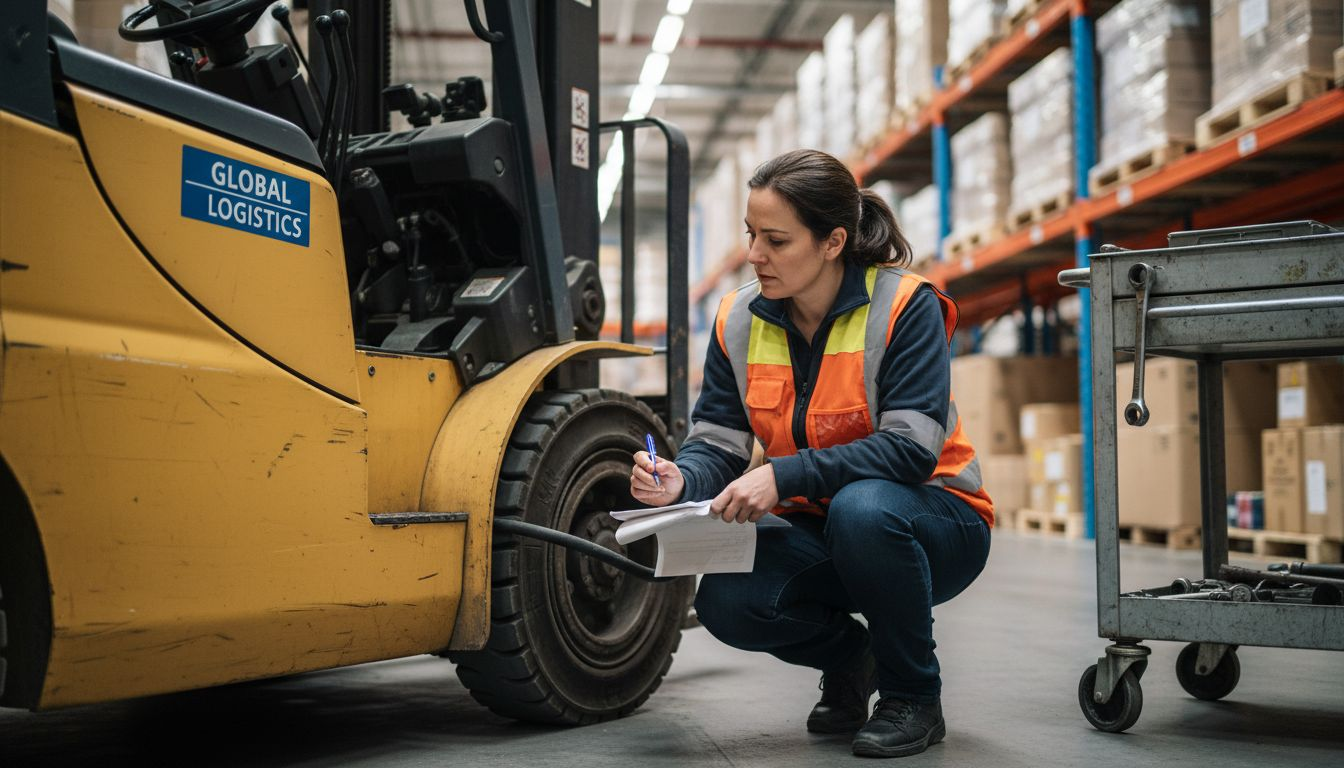
Visually inspecting your forklift before operation is a critical safety step that helps identify potential equipment issues before they become serious problems. You’ll systematically examine each component to ensure your forklift is safe and ready for work.
Begin with a comprehensive visual inspection of key components using a methodical walk-around approach. Your inspection should cover multiple critical areas:
- Tire condition and inflation
- Overhead guard structural integrity
- Fork alignment and damage assessment
- Hydraulic fluid and brake fluid levels
- Battery connections and electrical systems
- Warning decals and load rating plates
- Seat belt and restraint system functionality
- Mast and carriage condition
- Nuts and bolts tightness
Pay special attention to potential wear points and any signs of damage. Forklift pre-shift inspections require a detailed examination of engine components, belts, air cleaners, radiators, and hydraulic systems.
A thorough visual inspection can prevent equipment failure and potential workplace accidents.
Ensure you document any observed issues or potential concerns, no matter how minor they might seem. Any component showing signs of wear or damage should be flagged for further investigation or maintenance.
Pro tip: Use consistent lighting and take your time during visual inspections – rushing can cause you to miss critical details that could compromise workplace safety.
Step 3: Test operational controls and safety features
Testing your forklift’s operational controls and safety features is a critical step that ensures equipment reliability and operator safety. During this phase, you’ll systematically verify each control mechanism and safety system to confirm they function precisely as intended.
Forklift operator evaluations require comprehensive testing of various operational components. Your systematic check should include:
- Horn functionality and sound level
- Steering responsiveness and smoothness
- Brake performance and stopping distance
- Hydraulic control system operation
- Mast tilting and lifting mechanisms
- Acceleration and speed control
- Backup alarm and warning systems
- Emergency stop button reliability
- Load handling and stability controls
Pay close attention to safety feature verification, which includes checking seat belts, warning decals, and load securing attachments. Each control should be tested under controlled conditions to minimize potential risks.
Thorough operational testing is your primary defense against equipment malfunction and potential workplace accidents.
Document any irregularities or performance issues immediately. Even minor control inconsistencies can signal potential future problems that might compromise workplace safety.
Pro tip: Perform control tests in an open area with no personnel or obstacles, and always maintain a slow, controlled speed during initial system checks.
Compare how visual and operational checks address forklift risks:
| Inspection Method | Focus Area | Typical Issues Detected | Business Benefit |
|---|---|---|---|
| Visual Check | External components | Wear, damage, leaks | Prevents sudden breakdowns |
| Operational Test | Controls and features | Malfunctions, performance lag | Ensures safe equipment use |
Step 4: Document findings and address issues
Documenting your forklift inspection findings is a critical step that transforms your visual and operational checks into actionable maintenance insights. You’ll create a comprehensive record that ensures equipment safety and supports ongoing workplace risk management.
Inspection documentation practices require systematic and thorough reporting of all observed conditions. Your documentation should include:
- Detailed description of identified issues
- Severity level of each problem
- Immediate recommended actions
- Photographic evidence of defects
- Date and time of inspection
- Inspector’s name and credentials
- Equipment identification number
- Status of each inspected component
Reporting unsafe conditions requires immediate communication with supervisors. Mark each item as either functional or requiring repair, with clear explanations of any detected problems.
Comprehensive documentation is your strongest defense against potential equipment failures and workplace accidents.
Prioritize issues based on their potential impact on safety and operational efficiency. Minor issues might require scheduled maintenance, while critical problems demand immediate equipment removal from service.
Pro tip: Create a digital backup of all inspection documents and maintain a consistent, standardized reporting format to streamline future maintenance tracking.
Step 5: Verify compliance and finalize inspection
Finalizing your forklift inspection involves a comprehensive review to ensure you’ve met all safety requirements and documented every critical detail. This crucial step transforms your inspection from a routine check into a legally defensible safety protocol.
OSHA forklift inspection compliance requires meticulous verification of several key elements. Your final compliance check should encompass:
- Complete documentation review
- Verification of all safety systems
- Confirmation of repair recommendations
- Validation of operational readiness
- Review of inspector’s credentials
- Signature and timestamp verification
- Cross-referencing with previous inspections
Safety device functionality verification demands a systematic approach to ensure no critical component is overlooked. Double-check that all safety mechanisms are operational and all identified issues have been appropriately addressed.
A thorough compliance verification is your final safeguard against potential workplace accidents.
Ensure your documentation is comprehensive, clear, and ready for potential regulatory review. Any unresolved issues should be explicitly noted and escalated to the appropriate maintenance personnel.
Pro tip: Create a standardized digital checklist with mandatory fields to ensure consistent and thorough compliance verification across all forklift inspections.
Elevate Your Forklift Inspection Skills with Expert OSHA Training
Mastering the OSHA forklift inspection process starts with understanding critical safety steps like preparing detailed checklists, performing thorough visual and operational checks, and documenting findings properly. These essential practices can prevent equipment failures and avoid workplace accidents—but putting them into action consistently is often challenging for operators and supervisors alike.
At Forkliftacademy.com, we specialize in helping individuals and businesses overcome these challenges with OSHA-compliant training and certification programs designed to build confidence and ensure workplace safety. Whether you need hands-on instruction, evaluation-only courses, or comprehensive onsite training solutions, our proven programs reflect over 20 years of industry expertise. Explore the latest safety techniques and regulatory compliance insights through our Forklift Safety Archives – Top Osha Forklift Certification and deepen your skills to protect your team every day.
Don’t leave forklift inspections to chance. Start improving your inspection process today with certified training from Forkliftacademy.com. Visit our website to find the right course or business training solution to master OSHA standards, enhance safety, and reduce risks now. Your workplace safety depends on it.
Frequently Asked Questions
What is the purpose of a forklift inspection checklist?
A forklift inspection checklist is designed to ensure that all critical components of the forklift are thoroughly assessed for safety and operational readiness. To master the OSHA Forklift Inspection Process, create a standardized checklist that includes areas like tire condition and safety features before each use.
How often should I conduct forklift inspections?
Forklift inspections should be conducted daily before the start of each shift to ensure safety and compliance with OSHA regulations. Make it a routine to complete your inspections each day to prevent equipment failures and accidents.
What should I document during a forklift inspection?
During a forklift inspection, document any identified issues, including their severity and recommended actions for repairs. Ensure you record the date, inspector’s name, and the status of each component to maintain a comprehensive maintenance log.
How do I verify compliance with OSHA forklift standards?
To verify compliance with OSHA forklift standards, conduct a thorough review of your inspection documentation and confirm all safety systems are operational. Assess previous inspection records and ensure all recommendations for repairs have been addressed to maintain compliance.
What steps should I take if I find an issue during an inspection?
If you discover an issue during an inspection, classify its severity and mark it for immediate action or further evaluation. Promptly communicate with your supervisor to take necessary measures, especially for critical safety concerns.
Why is a systematic approach important during forklift inspections?
A systematic approach is essential during forklift inspections because it ensures no component is overlooked, thus maximizing workplace safety. Follow a methodical checklist for visual and operational assessments to identify potential risks effectively.
Recommended
- Forklift Safety Checklist Guide for OSHA Compliance – Top Osha Forklift Certification
- Forklift Inspection Procedures Explained for OSHA Safety – Top Osha Forklift Certification
- Forklift Safety: How to Prepare for OSHA Inspections – Top Osha Forklift Certification
- Forklift Inspection Requirements: Ensuring OSHA Compliance – Top Osha Forklift Certification