
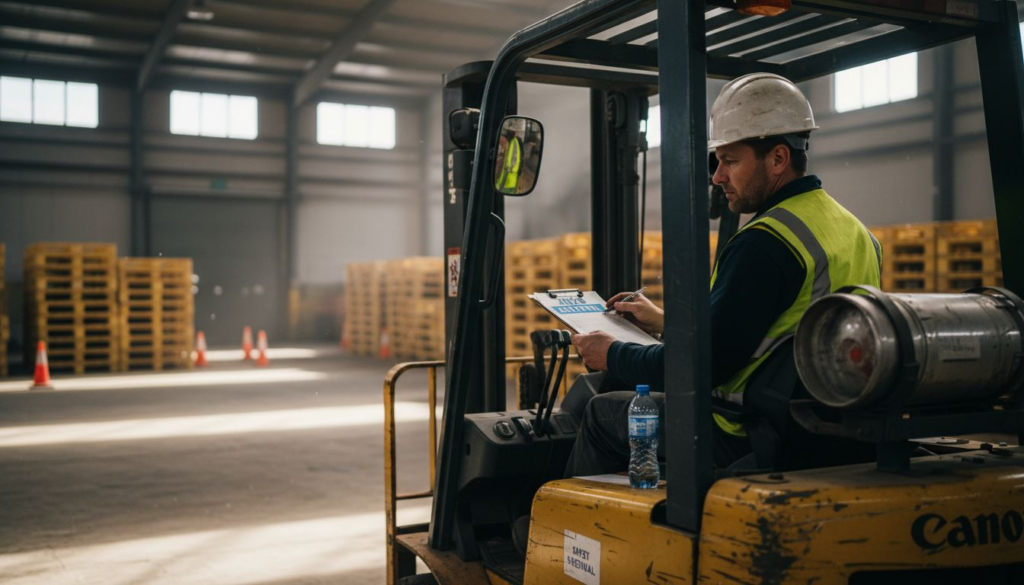

Renewing forklift certification can reduce operator-related accidents by up to 35%. That’s not just a number—it’s fewer injuries, lower costs, and stronger workplace safety. OSHA requires certification renewal every three years, but many operators overlook this requirement. Renewal isn’t just about checking a compliance box. It keeps skills sharp, updates knowledge on new regulations, and protects both workers and employers from costly penalties.
| Point | Details |
|---|---|
| OSHA mandates renewal every three years | Certification must be renewed every three years minimum to maintain legal compliance and workplace safety. |
| Renewal dramatically cuts accidents | Training reduces forklift incidents by approximately 35% through skill reinforcement and safety focus. |
| Skipping renewal invites major risks | Not renewing increases OSHA fines up to $13,494 per violation plus liability exposure. |
| Training reflects current standards | Renewal courses update operators on new regulations and technology changes annually. |
| Multiple renewal options available | Choose online, onsite hands-on training, or evaluation-only formats based on workplace needs. |
OSHA standard 29 CFR 1910.178(l) requires forklift operator recertification every three years, or sooner after accidents or unsafe operation. This isn’t optional. It’s federal law.
The three-year rule sets the baseline, but certain events trigger immediate renewal. If an operator causes an accident, demonstrates unsafe behavior, or switches to a different forklift type, they must complete forklift certification renewal before operating again. These requirements protect everyone in the warehouse.
Proper timing matters for audits and inspections. OSHA can request certification records at any time. Employers must document when each operator completed initial training and subsequent renewals. Missing or expired records result in citations.
Key compliance actions include:
Your certification date determines everything. If you completed initial training in March 2023, renewal is due by March 2026. Don’t wait until the last minute. Schedule early to avoid gaps that leave you and your employer vulnerable.
Renewal training does more than satisfy regulators. It saves lives and prevents injuries.
Operators who complete renewal training score 25% higher on safety skills tests compared to those who let skills drift. Memory fades. Shortcuts creep in. Complacency causes about 20% of forklift accidents. Renewal courses combat this directly by reinforcing critical operational skills.
The safety gains are measurable. Workplaces with current certification programs see 35% fewer forklift-related injuries annually. That means fewer lost workdays, lower workers’ compensation costs, and stronger safety culture. Numbers like these make renewal one of the best safety investments you can make.
Key operational improvements include:
Pro Tip: Schedule forklift recertification two months before your current certification expires. This buffer prevents skills gaps and ensures you never operate with expired credentials.
Consider what happens without renewal. An operator with three-year-old training may not know about updated hazard communication standards or new equipment features. Their skills decay gradually. They might not notice until an accident exposes the weakness. Regular OSHA forklift training prevents this scenario entirely.
OSHA fines for not maintaining valid forklift certification can exceed $13,000 per violation, and lack of renewal is linked to higher accident liability. One expired certification can trigger citations for every shift that operator worked without current credentials.
Insurance companies pay close attention to certification status. If an operator causes property damage or injury while working with expired certification, your insurance may deny the claim entirely. You’re left covering medical bills, equipment repairs, and legal fees out of pocket.
Litigation risk skyrockets when certification lapses. Lawyers in workplace injury cases immediately request training records. Expired certifications become evidence of negligence. Companies with current certification see 30% fewer liability findings in accident lawsuits because they demonstrate commitment to safety.
Financial risks include:
Three steps protect you from these risks:
The cost of renewal training is minimal compared to a single OSHA fine. A typical renewal course costs $60 to $150 per operator. One citation eliminates your entire training budget for the year. Smart managers view renewal as essential business insurance.
Forklift safety standards evolve constantly. Training content updates annually with 10-15% changes in regulations reflected in renewal courses to keep operators informed.
OSHA revises workplace safety rules based on accident data and industry feedback. New hazard communication requirements, updated load chart standards, and revised pedestrian safety protocols appear regularly. Renewal courses incorporate these changes so operators always work with current knowledge.
Technology advances faster than regulations. Modern forklifts include features like proximity sensors, stability control systems, and digital load monitors that didn’t exist five years ago. Renewal training familiarizes operators with these technologies so they can use them effectively.
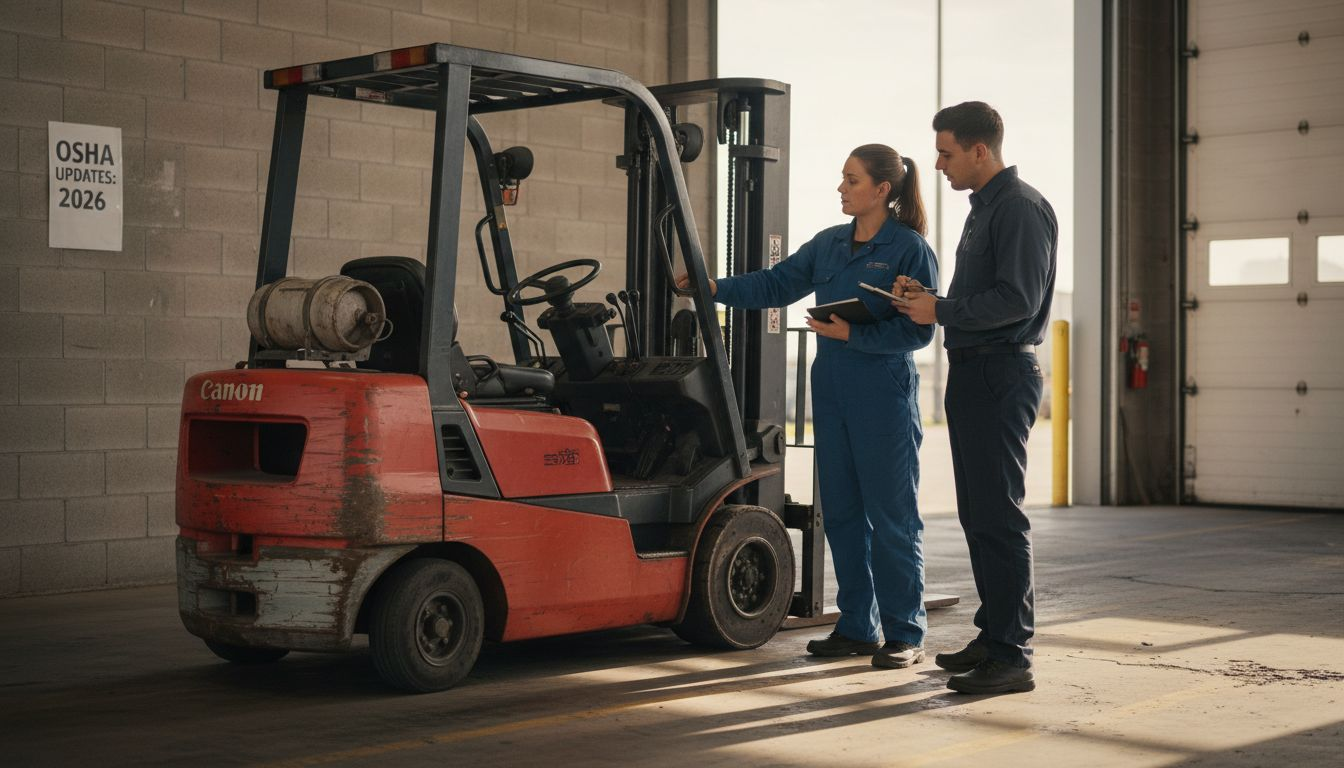
Pro Tip: Choose renewal courses that include hands-on technology demonstrations. Reading about new safety features isn’t the same as actually using them during training.
| Training Area | Update Frequency | Key Changes in 2026 |
|---|---|---|
| OSHA Regulations | Annual | Enhanced pedestrian detection requirements, updated load chart standards |
| Equipment Technology | Quarterly | Advanced stability systems, telematics integration, electric powertrain updates |
| Safety Protocols | Biannual | Revised hazard communication, updated PPE requirements |
| Industry Best Practices | Annual | New warehouse layout standards, improved charging station protocols |
Operators achieve 25% higher test scores after renewal demonstrating improved knowledge retention. This matters because higher knowledge translates directly to safer operation. An operator who understands why stability systems work uses them correctly instead of viewing them as annoyances.
Consider lithium-ion battery technology. These batteries charge faster and last longer than traditional lead-acid batteries, but they require different handling procedures. Operators trained before 2023 may never have encountered them. Renewal training closes this gap.
Confusion about renewal requirements leads operators and managers to make costly mistakes. Let’s clear up the most common misunderstandings.
Misconception: Renewal is only needed when changing jobs.
Fact: OSHA requires renewal every three years regardless of whether you stay in the same position. Your certification expires based on time, not job changes.
Misconception: Renewal training is optional after initial certification.
Fact: It is legally required. Operating with expired certification violates federal law and exposes you to penalties.
Misconception: Online training is as effective as onsite hands-on training.
Fact: Onsite practical training yields better safety results. While online courses offer convenience, they can’t replicate real equipment handling.
Misconception: No accidents means no renewal needed.
Fact: Renewal is mandatory regardless of incident history. A clean safety record doesn’t exempt you from the three-year requirement.
Some managers believe certification never expires if operators work continuously. This isn’t true. The three-year clock starts from your certification date and runs regardless of employment status or accident history.
Others think a quick refresher video satisfies renewal requirements. OSHA requires formal training that includes both classroom instruction and practical evaluation. Watching a safety video doesn’t qualify.
You have three main paths to renew forklift certification: online courses, onsite hands-on training, and evaluation-only recertification.
Online renewal offers flexibility and efficiency. You complete coursework at your own pace, take the exam when ready, and receive certification immediately upon passing. This works well for small operations or experienced operators with strong foundational skills. However, it lacks the practical component that reinforces muscle memory.
Onsite hands-on training produces superior safety improvements and skill reinforcement. Instructors observe your operation in real time, correct bad habits, and ensure you can handle equipment safely. Research shows onsite renewal training leads to 40% better reduction in safety incidents compared to online-only training.
Evaluation-only suits experienced operators with recent practical experience. You demonstrate competency through hands-on testing without repeating full coursework. This saves time while still verifying skills.
| Renewal Method | Time Required | Cost Range | Best For | Safety Impact |
|---|---|---|---|---|
| Online Only | 1-2 hours | $60-$100 | Small operations, tight schedules | Moderate |
| Onsite Hands-On | 3-4 hours | $100-$150 | High-risk environments, new operators | High |
| Evaluation-Only | 30-60 minutes | $75-$125 | Experienced operators, regular practice | Moderate to High |
| Hybrid | 2-3 hours | $85-$135 | Mid-size operations, varied skill levels | High |
Best practice recommendations:
Pro Tip: Schedule renewal during slower operational periods to allow focus on training without production pressure.
Don’t sacrifice quality for convenience. The cheapest, fastest option may not provide the safety value your workplace needs. Invest in comprehensive renewal that actually improves operator competency.
Initial certification and renewal training serve different purposes with distinct content focus.
Initial certification covers comprehensive basic forklift operation and safety principles. New operators learn equipment components, operating controls, stability principles, load handling fundamentals, and OSHA regulations from the ground up. This training typically requires 8 to 12 hours including classroom instruction and supervised practical exercises.
Renewal focuses on refreshing, reinforcing skills and updating on regulatory changes. You already know the basics. Renewal training emphasizes areas where skills commonly decay, new safety protocols, equipment updates, and hazard recognition in realistic scenarios. Duration is shorter because it builds on existing knowledge.
| Training Component | Initial Certification | Renewal Training |
|---|---|---|
| Equipment Fundamentals | Comprehensive (3-4 hours) | Brief review (15-30 minutes) |
| Operating Procedures | Detailed instruction (2-3 hours) | Skill verification (30-60 minutes) |
| Safety Regulations | Complete OSHA overview (2 hours) | Updates and changes (30-45 minutes) |
| Practical Evaluation | Extended supervised operation (2-3 hours) | Competency demonstration (30-60 minutes) |
| Hazard Recognition | Basic scenarios (1 hour) | Advanced realistic scenarios (45-60 minutes) |
Renewal may include practical evaluation or refresher test rather than full initial training. The goal is confirming you still operate safely, not teaching from scratch. This efficiency makes renewal less time-consuming while still ensuring competency.
Key differences in focus:
Certification validity is three years from initial or renewal date. Whether you complete initial training or renewal, your certification expires exactly three years later. This creates a continuous cycle of competency verification throughout your career.
Regular renewal ensures sustained operator competence and legal compliance. Skills without practice deteriorate. Renewal interrupts this decay by reinforcing critical knowledge before gaps become dangerous.
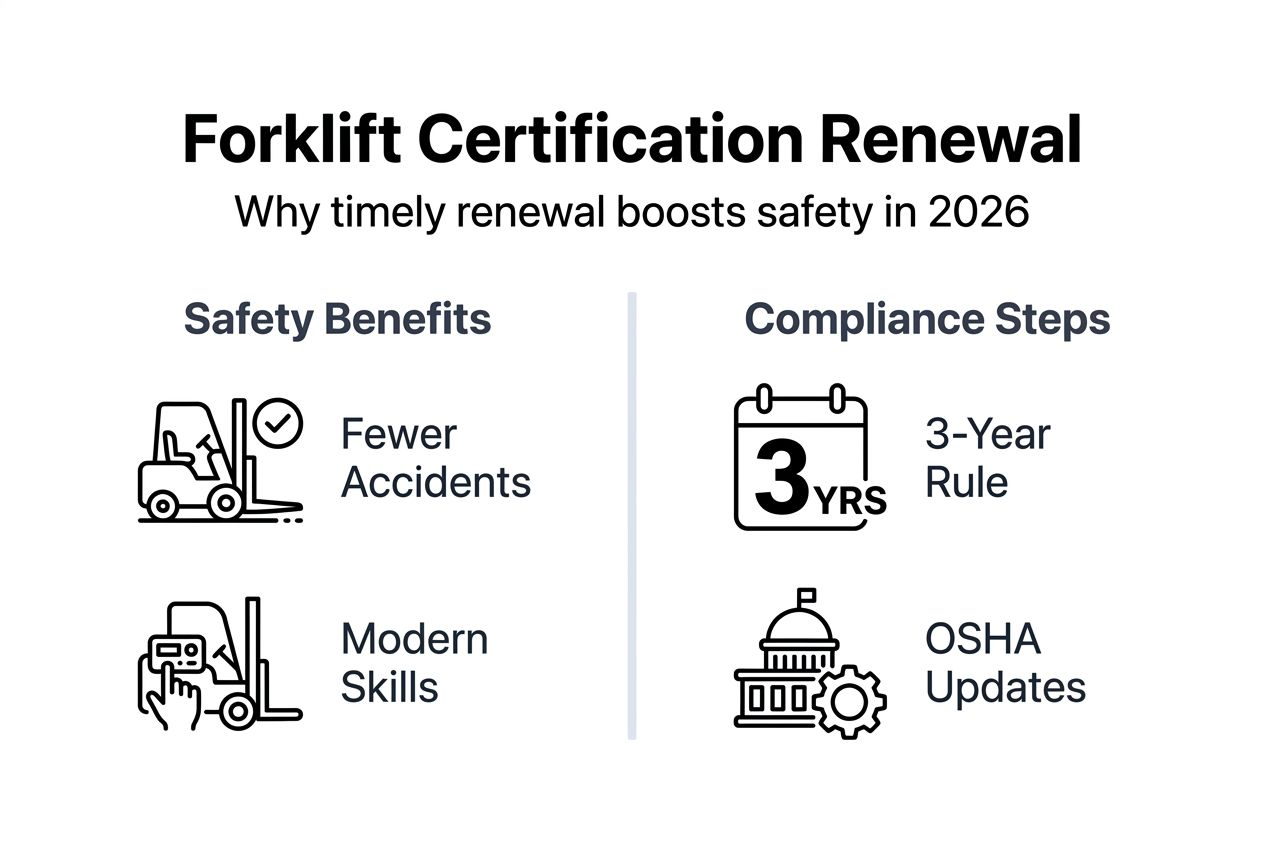
Timely renewal is both a legal obligation and a critical safety practice that protects everyone in your facility.
Renewing certification on schedule prevents costly OSHA fines and reduces liability exposure. More importantly, it ensures operators remain proficient as workplace demands evolve. New warehouse layouts, different product types, and changing traffic patterns all require adapted skills.
Companies with up-to-date certification see fewer accidents and injuries. This isn’t coincidence. Regular training reinforces safety consciousness. It reminds operators that management takes safety seriously. This cultural impact extends beyond individual competency to shape overall workplace behavior.
Proactive renewal planning supports continuous safety culture through:
“Regular recertification isn’t just about meeting requirements. It’s about building a workplace where safety is everyone’s responsibility and competency is continuously maintained.”
Don’t view renewal as a burden. See it as an investment in your workforce and your business. The cost of training is minimal. The cost of accidents is catastrophic. Choose wisely.
Staying current with forklift certification renewal doesn’t have to be complicated. Choose from flexible online or hands-on renewal training designed to meet OSHA requirements and keep your team safe.
Our programs help operators stay current, safe, and compliant with the latest standards. Whether you need individual renewals or company-wide training solutions, we provide expert instruction backed by over 20 years of industry experience. Explore train the trainer options to certify internal staff and simplify ongoing compliance. Get the support you need to avoid fines, reduce accidents, and enhance your workplace safety culture with OSHA-compliant forklift certification programs.
Operating without current certification risks OSHA fines up to $13,494 per violation and exposes your employer to serious legal liabilities. Insurance may deny claims related to accidents involving operators with expired certification. Both you and your employer face increased penalty and litigation risks that far exceed the cost of timely renewal.
OSHA requires renewal every three years at minimum, or sooner after accidents or unsafe operation. This timeline applies to all operators regardless of experience level or safety record. Renewal ensures operators meet current safety standards and maintain competency throughout their careers.
Yes, many renewal courses are available online for convenience and flexibility. However, onsite hands-on training provides better safety outcomes and stronger skill reinforcement. Evaluate your workplace needs, risk level, and operator experience to select the best option for your situation.
Initial certification covers foundational skills and comprehensive OSHA compliance from the ground up. Renewal focuses on refreshing knowledge, updating operators on new safety rules, and verifying continued competency. Renewal may include practical evaluations rather than full training because it builds on established skills.
OSHA requires renewal every three years regardless of accident history because skills naturally decay over time. Regular training prevents complacency, keeps operators sharp, and ensures they know current regulations. Workplace conditions, equipment, and safety standards change constantly, requiring updated knowledge even for experienced operators with clean records.