
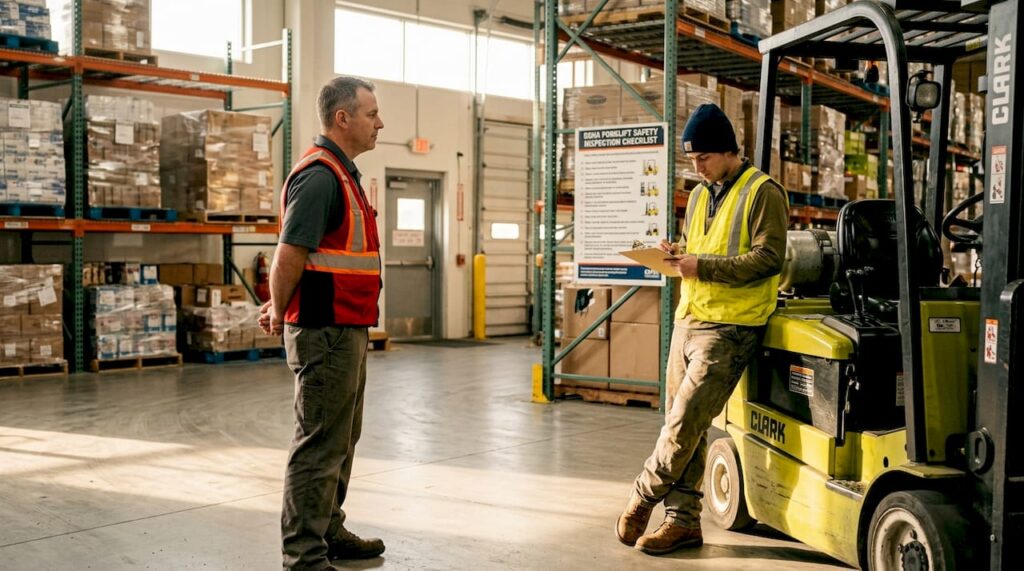

Most safety managers assume that putting an operator behind the wheel with a few hours of basic instruction is enough. It is not. OSHA-compliant training reduces workplace forklift incidents by up to 70% compared to untrained operators, a number that should stop any compliance officer in their tracks. The difference between a compliant program and a generic one is not just paperwork. It is the gap between a workforce that operates safely and one that is one near-miss away from a fatality, a fine, or a lawsuit. This guide breaks down exactly what OSHA-compliant training involves, what the data says about its impact, and how you can put it to work for your team.
| Point | Details |
|---|---|
| Major incident reduction | OSHA-compliant training can reduce forklift incidents by up to 70 percent. |
| High ROI on training | Every dollar spent on training can yield four to six dollars in cost savings for your business. |
| Legal clarity | OSHA and CSA standards differ and compliance is essential to avoiding large fines. |
| Hands-on is required | Only in-person practical evaluations meet OSHA’s forklift training rules—remote-only is not allowed. |
| Continuous improvement | Even experienced operators benefit from site-specific, ongoing, and recertified training. |
Not all forklift training is created equal, and the gap between compliant and non-compliant programs is wider than most people expect. OSHA-compliant forklift training requires three distinct components working together: formal classroom instruction, hands-on practical training, and a documented performance evaluation. Each element serves a specific purpose, and skipping any one of them puts your business out of compliance.
The recertification cycle is equally important. Refresher training is required every three years at minimum, and also after any incident, observed unsafe behavior, or when an operator is assigned to a new type of equipment. This is not optional. It is a federal requirement.
One point that surprises many managers: remote evaluations are not permitted under OSHA standards. Practical assessments must be conducted in person, on the actual equipment the operator will use. A livestream or video call does not satisfy this requirement, regardless of how sophisticated the technology is.
Here is a quick look at what separates OSHA-compliant programs from generic alternatives:
| Feature | OSHA-compliant program | Generic online-only program |
|---|---|---|
| Formal instruction | Required | Often included |
| Hands-on practical training | Required | Rarely included |
| In-person evaluation | Required | Not included |
| Recertification cycle | Every 3 years or after incident | No standard cycle |
| Site and equipment specific | Required | Rarely addressed |
| Documentation for records | Required | Inconsistent |
Key requirements at a glance:
Understanding the process helps, but what do the numbers say about OSHA-compliant training’s real-world impact?
The statistics are striking. Human error causes 87% of all forklift accidents, which means the vast majority of incidents are directly preventable through proper training. Every year in the United States, forklifts are responsible for approximately 85 fatalities and 34,900 injuries. Those are not abstract numbers. They represent real workers, real families, and real financial consequences for employers.
When you look at forklift incident reduction data, the impact of compliant training becomes undeniable. Incident rates drop from roughly 12 per 100 operators among untrained workers to about 3.6 per 100 among properly trained ones. That is a 70% reduction. Recertification pushes results even further, cutting accident rates by an additional up to 30% compared to operators who never refresh their skills.
“The data is clear: operators who receive structured, OSHA-compliant training and regular recertification are dramatically safer than those who rely on experience alone.”
Here is how the outcomes compare side by side:
| Operator category | Incidents per 100 operators | Relative risk |
|---|---|---|
| Untrained or minimally trained | ~12 | Highest |
| OSHA-compliant trained | ~3.6 | 70% lower |
| Trained and recertified | ~2.5 | Up to 79% lower |
Key takeaways from the data:
Beyond safety, there is a powerful financial case for investing in quality forklift training.

Every $1 invested in OSHA safety training returns $4 to $6 in savings from reduced injury claims, lower insurance premiums, and recovered productivity. That is a return on investment most capital expenditures cannot match. And that calculation does not even factor in the cost of OSHA fines, which can reach $13,653 per violation for serious infractions.
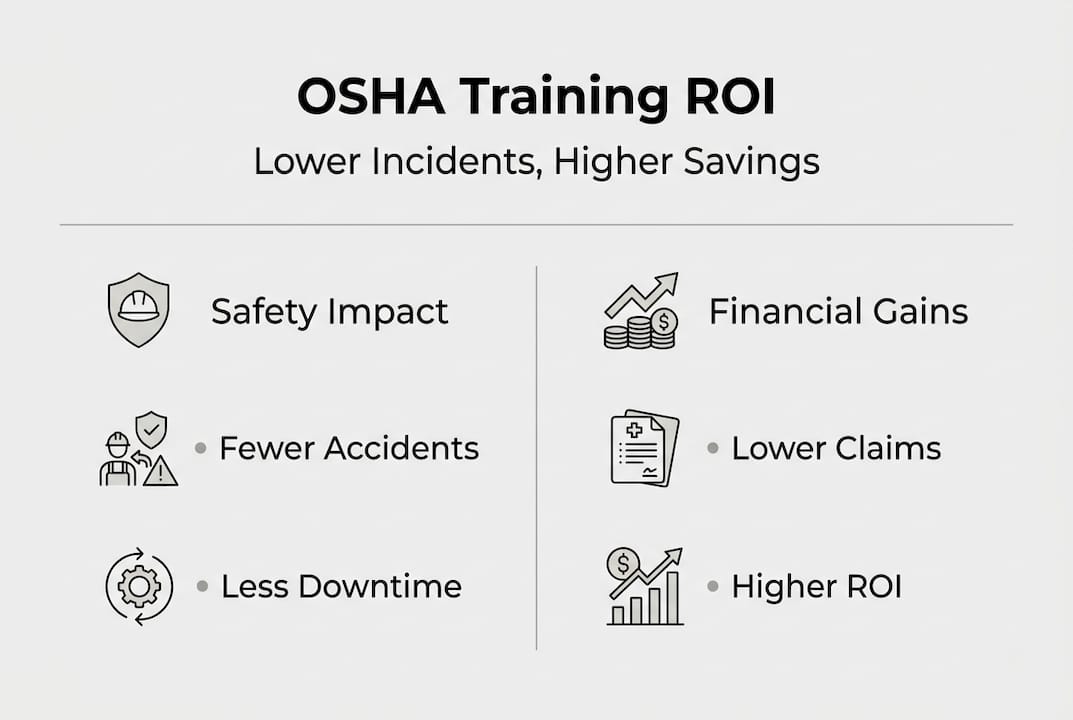
Here is a breakdown of where the savings come from:
| Cost category | Without training | With OSHA-compliant training |
|---|---|---|
| OSHA fines per violation | Up to $13,653 | Minimized or eliminated |
| Workers’ comp claims | High frequency | Reduced by up to 70% |
| Equipment damage | Frequent | Significantly reduced |
| Productivity loss from incidents | Ongoing | Minimized |
| Insurance premiums | Higher | Lower over time |
How training pays for itself over time:
Pro Tip: When building your training budget, include both direct costs like fines and claims and indirect costs like morale, turnover, and reputational damage. The full picture makes the ROI case much stronger for leadership approval. Reviewing warehouse training benefits and implementing forklift training resources can help you structure that conversation.
While safety and savings matter, legal compliance is non-negotiable, especially for North American businesses.
If your operations span both the United States and Canada, you are dealing with two distinct regulatory frameworks. In the US, OSHA standard 1910.178 is federal law, applies uniformly across all states, and sets the minimum operator age at 18. In Canada, forklift training is governed by provincial regulations and the CSA B335-15 standard, with minimum ages that vary between 16 and 18 depending on the province.
For cross-border companies, the simplest compliance strategy is to apply the strictest standard across all locations. That means using OSHA requirements as your baseline everywhere, which eliminates the risk of a Canadian site falling short of US expectations during an audit or acquisition review.
Here is a direct comparison of the two frameworks:
| Requirement | US (OSHA 1910.178) | Canada (CSA B335-15) |
|---|---|---|
| Governing body | Federal (OSHA) | Provincial + CSA standard |
| Minimum operator age | 18 | 16 to 18 (varies by province) |
| Recertification cycle | Every 3 years or after incident | Varies by province |
| In-person evaluation | Required | Required |
| Documentation | Required | Required |
Events that trigger recertification or additional training:
Reviewing a solid forklift compliance guide helps you map your current program against both frameworks and identify any gaps before an inspector does.
Looking deeper, expert perspectives reveal details most businesses overlook when choosing their training program.
One of the most common mistakes is using generic training materials that do not reflect the actual equipment, layout, or tasks at your facility. Training must be site and equipment specific to be effective. An operator trained on a counterbalance forklift in a warehouse setting is not automatically prepared to operate a reach truck in a narrow-aisle environment. Experience alone does not bridge that gap. In fact, complacency among experienced operators is one of the leading contributors to serious incidents.
Another overlooked area is training format. Microlearning and spaced repetition show strong results in empirical studies, with shorter, more frequent lessons outperforming traditional long training sessions for knowledge retention. However, these approaches must still include the OSHA-mandated hands-on evaluation component. Digital modules alone do not satisfy compliance requirements.
“Even the most experienced operator benefits from structured recertification. Familiarity breeds shortcuts, and shortcuts cause accidents.”
Common training pitfalls to avoid:
For a deeper look at building a compliant program, the employee training guide and resources on the importance of safety training offer practical frameworks you can apply immediately.
You know the why. Here is how to act on it and ensure lasting results.
Building a compliant training program does not have to be complicated, but it does require a structured approach. Formal instruction, hands-on training, and evaluation are the three pillars, and each one needs to be documented and repeatable.
Follow these steps to get your program in order:
Pro Tip: Before a surprise inspection, run a quick internal audit. Pull your training records, verify that every active operator is current on certification, and check that your documentation matches the equipment actually in use. Gaps found internally are far less costly than gaps found by an inspector. Resources on how to boost safety and efficiency and how to implement training can guide your audit process.
Your next step toward a safer, more compliant workplace starts with choosing the right training partner. At Forklift Academy, we have spent over 20 years helping safety managers and compliance officers build programs that hold up under scrutiny. Whether you need individual operator certification, onsite group training, or a train-the-trainer solution that scales across your entire organization, we have the tools to make it happen.
Our OSHA-compliant training programs cover all major forklift types and include the hands-on evaluation component that OSHA requires. We also offer forklift training certification options designed specifically for businesses managing multiple operators across multiple sites. Every program comes with documentation support so your records are inspection-ready from day one. If you are ready to close the compliance gap and protect your workforce, we are ready to help you do it.
Recertification is required every three years at minimum, and also after any incident, observed unsafe operation, or assignment to a new equipment type.
OSHA governs US training under federal standard 1910.178 with a minimum age of 18, while Canada follows the CSA B335-15 standard with minimum ages that vary by province between 16 and 18.
Practical evaluations must be in person under OSHA standards. Online modules can cover formal instruction, but the hands-on assessment component cannot be completed remotely or via livestream.
Incidents drop by up to 70% with compliant training, human error is directly addressed since it causes 87% of accidents, and costs related to injuries, claims, and fines decrease significantly.
Every $1 spent on training returns $4 to $6 in savings from reduced injury claims, lower insurance costs, and recovered productivity across your workforce.