
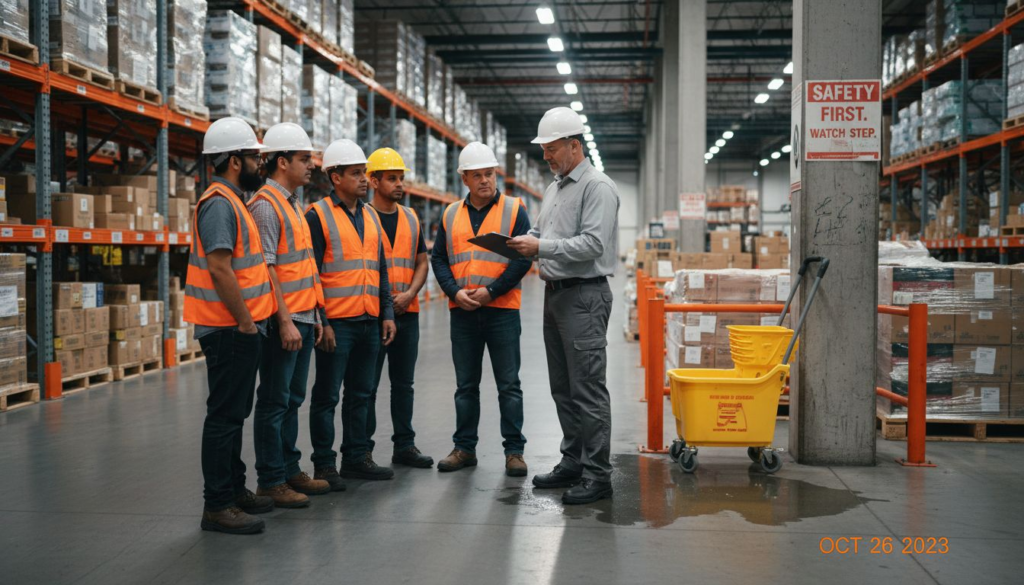

Every day, American warehouses balance busy operations with the threat of unexpected hazards. Forklifts, crowded aisles, and heavy loads all create risks that demand attention. For safety managers, building a safer workplace means focusing on hazard awareness and structured training to prevent accidents. This article gives practical guidance on key safety principles, accident types, OSHA requirements, and proven forklift certification strategies so you can improve compliance and protect your team.
| Point | Details |
|---|---|
| Worker Safety Culture | Creating a safety culture requires active participation from all employees, emphasizing continuous communication and hazard awareness. |
| Accident Prevention Strategies | Implement clear pedestrian pathways, conduct regular equipment inspections, and enforce safety training to reduce accident risks. |
| OSHA Compliance Importance | Maintaining compliance with OSHA standards not only ensures legal safety but also enhances the overall safety of the warehouse environment. |
| Proactive Safety Management | Safety managers should prioritize proactive hazard identification and training to effectively mitigate risks before accidents occur. |
Warehouse safety is the systematic approach to protecting workers, customers, and assets from harm in storage facilities. It encompasses everything from equipment operation to environmental hazards. Modern warehouses face unique challenges—from fire risks due to large fuel loads and storage configurations to moving equipment that shares space with pedestrians every day.
At its core, warehouse safety centers on two critical priorities:
Think of warehouse safety like a three-legged stool. Remove one leg, and everything collapses. The legs are people, processes, and equipment.
Pedestrian and equipment separation forms the foundation of accident prevention. Warehouses must create clear pedestrian walkways that keep foot traffic away from forklift zones. Mixing workers and powered industrial trucks in the same space invites collisions.
Equipment operation standards control how forklift operators navigate the facility. This means managing speed in congested areas, sounding horns at blind corners, and conducting pre-shift inspections. An operator who rushes creates risk; one who follows procedures stays alert.
Material handling practices prevent injuries from improperly stacked loads or items falling from heights. Correct stacking techniques protect both the product and anyone working nearby.
Shared responsibility is where safety transforms from a policy into a culture. Every employee—from operators to supervisors to visitors—must remain vigilant. Hazard awareness reduces warehouse risks when everyone participates actively.
Warehouse safety isn’t something management enforces; it’s something workers build together through constant attention and communication.
Here are the core elements every facility should establish:
Your warehouse environment directly impacts accident rates. Congested aisles, poor lighting, or inadequate training instantly increase injury risk. Conversely, well-maintained equipment, proper layout design, and competent operators reduce incidents measurably.
Pro tip: Conduct monthly safety walks through your warehouse to spot hazards before they cause accidents—look specifically for blocked aisles, worn equipment, and areas where forklift speed exceeds safe limits.
Warehouse accidents don’t happen randomly. They stem from predictable hazards that repeat across facilities every single day. Understanding these hazards is your first step toward preventing them.
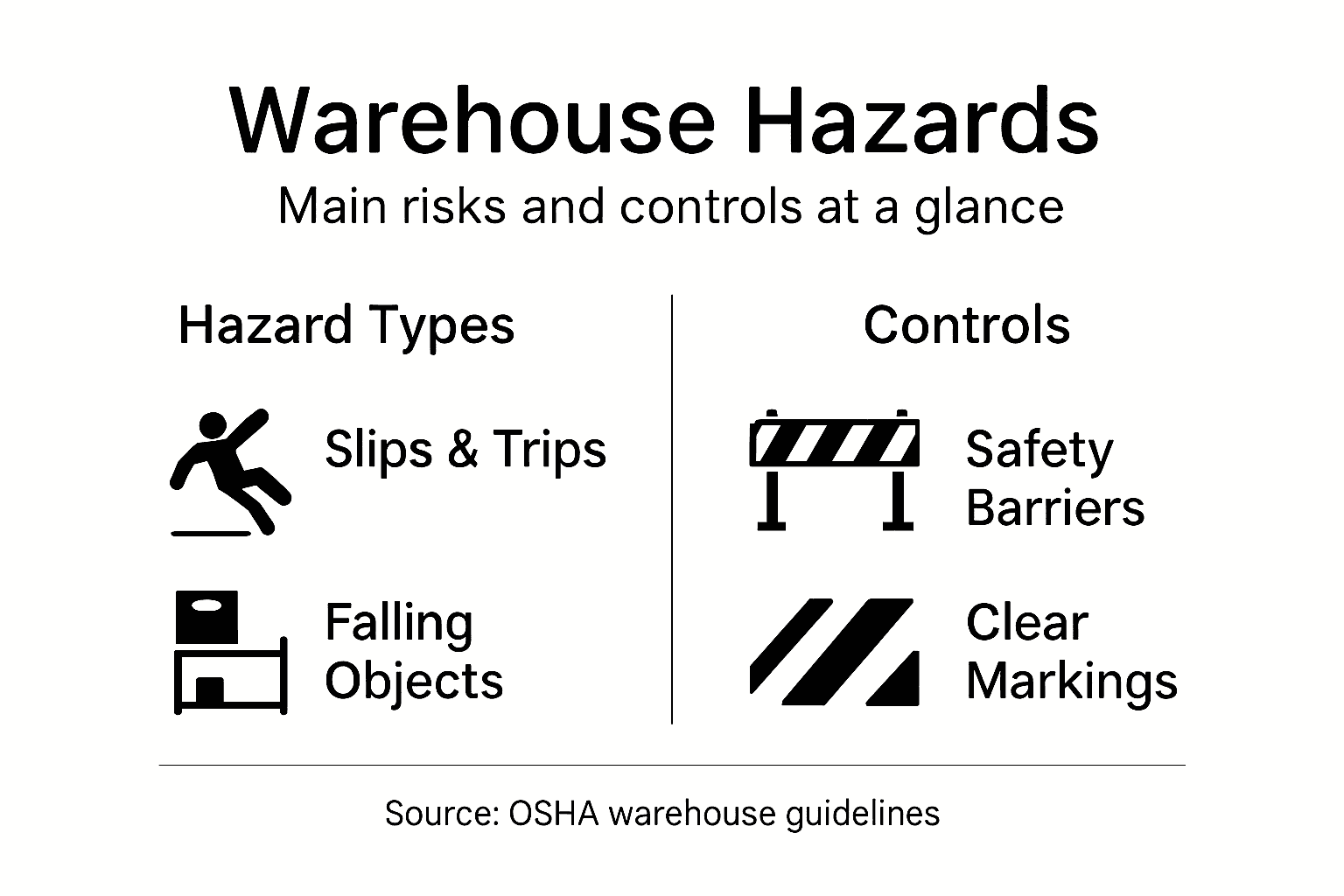
The main categories of warehouse danger include:
Physical accidents account for the majority of warehouse injuries. A wet floor near a loading dock. Pallets stacked too high. Cords running across aisles. These seem minor until someone gets hurt.
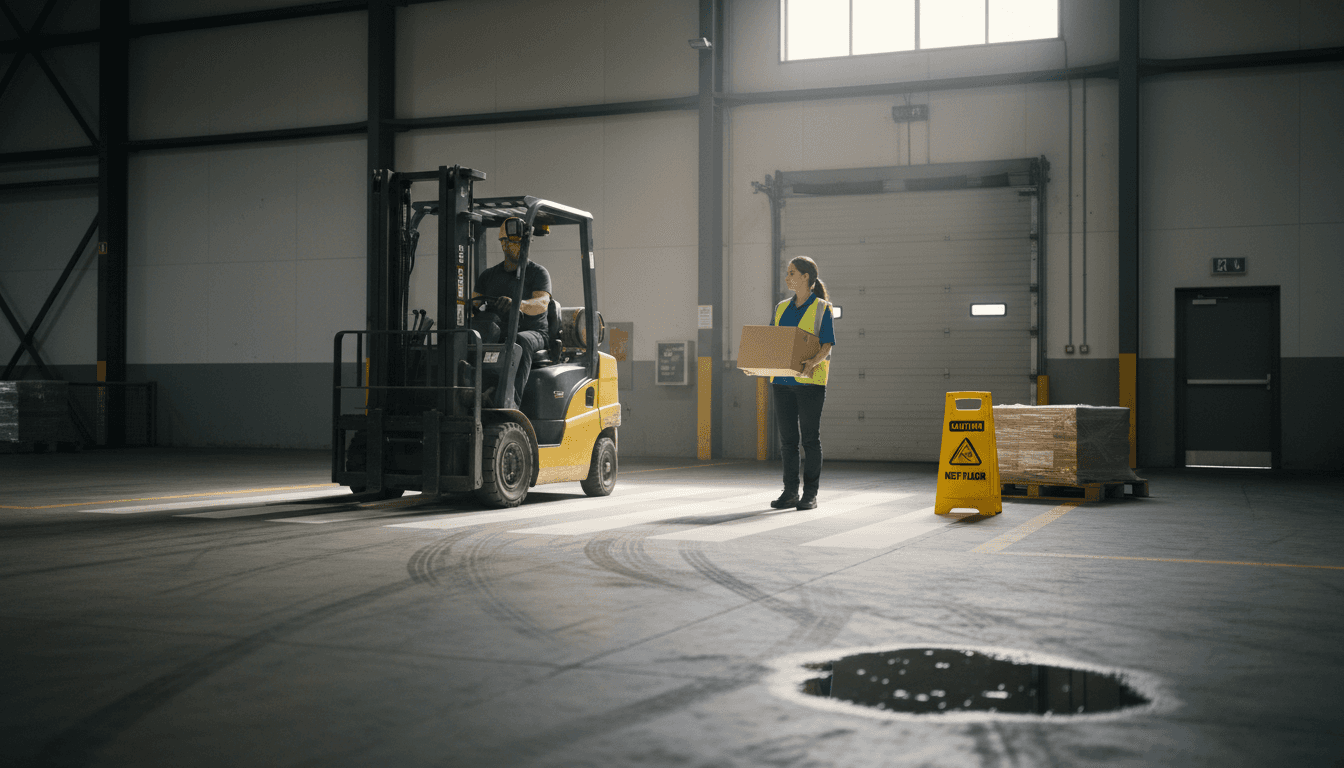
Forklift accidents remain the leading equipment hazard in American warehouses. Collisions between forklifts and pedestrians happen because operators lose visibility, misjudge distance, or operate too fast for conditions.
Common forklift accident scenarios include:
Falling objects represent another serious threat. A pallet dropped from 10 feet can cause severe injuries or death. Improperly secured loads create this constant danger.
Slips, trips, and falls occur constantly in warehouses. Physical safety hazards including falls and heavy machinery operation injure workers regularly. Wet surfaces, clutter, and poor lighting set the stage for these incidents.
Musculoskeletal injuries develop over time through repetitive lifting and improper technique. A worker might lift 300 items daily, stressing the same muscles repeatedly. This causes strains that sideline employees for weeks.
Chemical hazards emerge when warehouses store hazardous materials. Toxic fumes, spills, and improper storage create health emergencies. Cold stress affects workers in refrigerated storage areas, potentially causing dangerous medical conditions.
The difference between a safe warehouse and an accident-prone one isn’t luck—it’s attention to detail and consistent hazard management.
Each hazard category requires different control strategies. You cannot prevent a forklift accident the same way you prevent a slip. This is why comprehensive safety programs address multiple hazard types simultaneously.
Here is a comparison of common warehouse hazards and the most effective control strategies for each:
| Hazard Type | Primary Risk | Key Control Strategy |
|---|---|---|
| Forklift collisions | Worker injury or death | Pedestrian separation zones |
| Falling objects | Head and body trauma | Secure, stable stacking |
| Slips, trips, and falls | Sprains and fractures | Maintain clean, dry aisles |
| Chemical exposure | Respiratory or skin issues | Proper storage, ventilation |
| Ergonomic strain | Chronic musculoskeletal pain | Ergonomic training, job rotation |
Pro tip: Document every near-miss incident, even ones that caused no injury—these reports reveal patterns that help you eliminate hazards before they cause accidents.
OSHA compliance isn’t optional—it’s the legal foundation of warehouse safety. The Occupational Safety and Health Administration enforces federal standards that directly impact your liability, fines, and worker protection.
Understanding OSHA’s scope helps you identify what applies to your facility. OSHA regulates nearly every aspect of warehouse operations, from how you stack pallets to how you maintain emergency exits. Non-compliance brings citations, penalties, and increased accident risk.
OSHA standards covering powered industrial truck operations represent your most critical compliance area. Forklift regulations require operator certification, regular equipment inspection, and specific training protocols. Violations in this category generate frequent citations.
OSHA also enforces standards across these essential warehouse areas:
The General Duty Clause gives OSHA broad authority to cite you for any recognized serious hazard, even if a specific standard doesn’t exist. This means you cannot hide behind technicalities—you must actively identify and eliminate dangers.
OSHA compliance for forklift safety involves four critical elements: hazard identification, prevention measures, employee training, and documented proof of both.
Here’s what inspectors look for:
You cannot claim compliance without documentation. An OSHA investigator wants to see written evidence that you identified hazards, trained workers, and maintained equipment. Verbal assurances don’t hold up.
The following table summarizes essential OSHA documentation and its business importance:
| Document Type | Why It Matters for Compliance | Business Benefit |
|---|---|---|
| Written safety program | Proves policies and controls exist | Reduces liability in inspections |
| Operator training records | Verifies OSHA certification | Lowers accident risk, avoids fines |
| Equipment maintenance logs | Demonstrates regular inspections | Minimizes breakdowns and downtime |
| Incident and corrective reports | Shows hazard tracking and follow-up | Identifies trends, improves safety |
Compliance becomes easier when you treat safety documentation as ongoing business practice, not a box to check before an inspection.
Penalties for non-compliance range from $10,000 to $156,000 per violation, depending on severity. Willful violations carry criminal charges. This financial reality makes compliance investment far cheaper than fighting citations.
Your warehouse’s safety culture directly reflects your compliance posture. Facilities with strong safety programs experience fewer OSHA citations and, more importantly, fewer accidents that harm workers.
Pro tip: Schedule annual OSHA compliance audits with qualified safety professionals to identify gaps before inspectors do—this proactive approach costs far less than remedying violations after citations.
Forklift operators are not interchangeable with general warehouse workers. Operating a forklift demands specific knowledge, hands-on skill, and demonstrated competency. OSHA mandates formal training and certification before anyone touches a forklift controls.
Think of certification like a driver’s license for industrial equipment. You wouldn’t hand keys to someone without a license. The same applies to forklifts, except the stakes involve heavier loads and tighter spaces.
Formal training, practical instruction, and competency evaluation form the foundation of OSHA-compliant forklift programs. Employers must provide comprehensive instruction covering specific topics, not vague safety concepts.
OSHA mandates training content including:
Training alone doesn’t satisfy OSHA. You must evaluate operator performance before they work independently. This evaluation demonstrates the operator can actually perform tasks safely, not just understand them theoretically.
Initial certification happens after completing training and passing practical evaluation. Once certified, operators must undergo evaluation at least every three years to maintain certification status.
However, re-evaluation becomes mandatory if:
Many facilities conduct annual refresher training, which OSHA allows as best practice. This keeps skills sharp and updates operators on new facility procedures or equipment.
Employers develop forklift training programs tailored to specific truck types and hazards they use. A training program for a warehouse using three-wheel electrics differs from one using rough-terrain propane forklifts.
Effective programs combine two components:
The practical component is where real learning happens. An operator watching a video on load stability needs to practice balancing loads to truly understand weight distribution.
Certification documents are only valuable if the operator can actually perform safely when unsupervised in your real warehouse environment.
Keep detailed training records for every operator, including dates, topics covered, evaluation results, and any re-training completed. OSHA inspectors request these records immediately.
Pro tip: Create a training matrix showing each operator’s certification date and re-certification due date, then set calendar reminders 60 days before expiration—this prevents compliance gaps from overlooked deadlines.
Safety managers sit at the intersection of worker protection and business operations. Your role goes far beyond posting safety posters. You’re responsible for designing systems that prevent accidents before they happen.
The core responsibility is implementing proactive safety and health programs that identify hazards, control risks, and foster a culture where safety matters. This requires active leadership, not passive compliance.
Hazard identification demands constant vigilance. You walk the warehouse regularly, documenting slipping surfaces, equipment defects, and behavioral risks. This isn’t a once-per-year audit—it’s ongoing.
Training development and delivery falls squarely on your shoulders. Implementing training covers formal instruction, practical evaluation, and continuous improvement to ensure operators and workers understand their responsibilities.
Your essential duties include:
You also champion safety culture. Workers follow rules when they see management prioritizes safety over production speed. This starts with visible commitment from the top.
Many facilities fail because safety becomes reactive instead of proactive. You respond to accidents rather than preventing them. This approach guarantees repeated injuries.
Common pitfalls that undermine safety programs:
Poor communication creates dangerous gaps. Workers don’t know about hazard changes. Supervisors aren’t trained on new procedures. Management hears about incidents weeks late.
Another critical pitfall: insufficient worker participation. Workers operate equipment daily—they spot hazards you miss. Excluding them from safety planning wastes valuable knowledge.
The difference between safe and unsafe warehouses isn’t budget—it’s whether the safety manager sees prevention as core business strategy or administrative checkbox.
Lack of investment in training and equipment causes predictable failures. Cut training hours and you get untrained operators. Defer equipment maintenance and you get breakdowns that create emergencies.
Integrating safety into business management—not separating it—transforms results. When safety metrics matter as much as production metrics, behavior changes.
Pro tip: Create a monthly safety dashboard tracking near-misses, hazard reports from workers, and training completion rates—these leading indicators reveal problems before incidents occur.
Warehouse safety relies on a strong foundation of trained, certified operators who understand the critical relationship between hazard awareness and accident prevention. This article highlights the urgent need to manage forklift risks, enforce clear pedestrian and equipment separation, and maintain rigorous training and compliance standards. If your goal is to protect your workforce and achieve OSHA compliance while improving operational efficiency, focused forklift training is the key.
Discover comprehensive solutions in our Forklift Safety Archives – Top Osha Forklift Certification where proven strategies meet expert guidance.
Take control of your workplace safety today by choosing Forkliftacademy.com. Our OSHA-compliant forklift certification programs and hands-on training options are designed to help you meet legal requirements and reduce accident risks. Whether you need online courses, on-site training, or certification renewal support, start now to transform your safety culture and protect your most valuable asset your people.
Warehouse safety prioritizes worker protection through hazard awareness and training, along with maintaining operational efficiency without compromising safety standards.
Warehouses can prevent forklift accidents by implementing pedestrian separation zones, controlling equipment operation standards, and ensuring proper training and hazard awareness among workers.
Common types of warehouse accidents include slips, trips, falls, forklift collisions, and injuries resulting from ergonomic strain or chemical exposure.
OSHA compliance requires adherence to safety standards concerning equipment operation, hazard communication, personal protective equipment (PPE), and regular training and documentation of safety procedures.