

Finding practical, OSHA-compliant solutions for forklift safety is a real challenge for many warehouse managers. The way your team operates forklifts in an actual American warehouse—amid unique layouts, busy aisles, and varying floor conditions—makes generic training inadequate. Onsite forklift training addresses your specific hazards and ensures operators can perform their jobs safely within your facility. This introduction highlights the immediate value and long-term safety benefits that tailored workplace training delivers for logistics operations nationwide.
| Point | Details |
|---|---|
| Onsite Training Tailored to Environment | Onsite forklift training is customized to address specific hazards and equipment within your warehouse, enhancing safety and operational efficiency. |
| Regular Refresher Training | Ongoing refresher training is crucial to prevent skill fade and ensure operators maintain safe practices and knowledge of equipment changes. |
| Compliance with OSHA Requirements | Adhering to OSHA regulations requires formal instruction, practical training, and thorough documentation to avoid fines and enhance safety. |
| Cost-Effective Investment | Investing in consistent, well-structured training reduces accidents and associated costs, ultimately improving your facility’s reputation and productivity. |
Onsite forklift training is a practical, hands-on educational program delivered at your warehouse facility that teaches operators how to safely and efficiently use forklifts in your actual working environment. Unlike generic online courses, onsite training focuses specifically on your equipment, layout, floor conditions, and unique hazards. Trainers work directly with your team, identifying real obstacles and operational challenges they face daily. The goal is straightforward: ensure every operator can handle material handling tasks safely while protecting themselves, coworkers, and your facility’s assets.
At its core, this training addresses a critical gap. Your warehouse operates differently than the one down the street. Your floor slopes a certain way. Your racks have specific height limitations. Your narrow aisles present particular challenges. Forklift operator training is designed to minimize injuries and property damage by ensuring operators understand safe operation in their specific workplace conditions, hazards, and equipment types. This means trainers assess your actual environment, then teach operators how to navigate it safely. Formal instruction combines with hands-on practice tailored to your operation, not some standardized checklist.
The purpose extends beyond compliance, though OSHA certification requirements certainly matter. Regular, workplace-specific training prevents what safety experts call “skill fade”—the dangerous tendency for operators to develop unsafe habits over time or gradually forget critical safety practices. Regular refresher training and ongoing monitoring maintains safe operating practices, which directly reduces accidents, injuries, and damage to inventory, equipment, and buildings. When operators train in their actual workspace, they absorb lessons more effectively because the training feels immediately relevant and applicable.
Onsite training also communicates a clear message to your team: safety is not something management mandates from a distance—it is a priority integrated into everyday operations. Trainers present become safety advocates who understand your specific risks and constraints. This localized approach builds stronger safety culture than any generic certification program can achieve.
Here’s a summary of the main components of onsite forklift training and the business impact of each:
| Training Component | Description | Business Impact |
|---|---|---|
| Formal Instruction | Safety theory and operational rules | Ensures regulatory compliance |
| Hands-On Practice | Real equipment in actual workspace | Reduces equipment accidents |
| Site-Specific Hazards | Customize training to your facility | Minimizes workplace injuries |
| Regular Refresher | Ongoing skill checks and updates | Maintains safety culture |
Pro tip: Schedule onsite training during typically slower operational periods, and ensure all equipment to be covered is present and functioning properly so trainers can address actual equipment quirks and limitations your operators will encounter daily.
When your facility operates forklifts, OSHA doesn’t leave compliance to guesswork. The regulation 29 CFR 1910.178 is the standard that governs your entire operation, and understanding what it requires is non-negotiable. OSHA requires employers to provide training to workers exposed to workplace hazards, including formal instruction, practical training, and evaluation. Your certification documents must capture specific details: operator identity, training date, evaluation date, and trainer identity. This documentation becomes your proof that you took compliance seriously when an inspector walks through your door.
The requirements break down into three distinct components that work together. First comes formal instruction, where operators learn the theory behind safe forklift operation. Second is practical training, where they actually handle equipment under supervision. Third is the evaluation phase, where trainers assess whether operators can genuinely perform their tasks safely. All three must happen before anyone receives certification. The certification itself isn’t optional or something you can delegate casually. Your facility owns the responsibility for ensuring every single operator meets these standards before they touch a forklift key. Beyond operator training, OSHA standards require maintaining safe passageways, proper storage, and ensuring work surfaces are free from hazards, which means your warehouse layout and maintenance practices directly impact compliance.
What many warehouse managers overlook is that OSHA compliance extends far beyond initial certification. Operators need refresher training at regular intervals to maintain their skills and stay current on any equipment or procedural changes. Your facility should track certification expiration dates religiously. When an operator hasn’t trained in three years, that certification expires in the eyes of OSHA. You’ll also need to retrain operators whenever equipment changes, facility layout changes, or you discover unsafe work practices. This isn’t busywork designed by bureaucrats. These requirements exist because forklift accidents kill and injure people every year. OSHA’s framework transforms that tragic reality into concrete preventative action.
Pro tip: Create a spreadsheet or digital tracking system that displays each operator’s certification expiration date prominently, with automatic alerts three months before expiration so you never accidentally let someone operate without current certification.
Onsite forklift training programs come in different configurations depending on your warehouse’s needs, equipment types, and operational complexity. The fundamental structure remains consistent across all legitimate programs: they combine classroom instruction with hands-on practical training, followed by formal evaluation. However, how these components are delivered and emphasized varies significantly. Some facilities need basic certification for standard warehouse operations. Others operate in hazardous environments or with specialized equipment that demands deeper, more technical instruction. Understanding the different program types helps you select the right fit for your operation.
Most onsite programs begin with classroom or formal instruction covering the theory behind safe forklift operation. This includes understanding load capacity, center of gravity, stability, and the physics of why certain practices prevent accidents. Your trainers will walk operators through company-specific safety rules, facility layout hazards, and equipment-specific features. Then comes the hands-on component where operators move from theory to actual equipment. Onsite training programs must address specific site hazards and tasks, meaning trainers customize instruction to your actual warehouse conditions, not generic scenarios. An operator training for narrow-aisle warehouse operations will practice different maneuvers than someone managing outdoor construction site material handling.
Some warehouses also implement refresher or recertification programs separate from initial training. Refresher training is recommended every three years or when operational changes occur, though OSHA itself doesn’t mandate a specific frequency. Your facility might need accelerated training programs for high-turnover positions, or specialized certification for operators handling hazardous materials. Train-the-trainer programs represent another option, where you develop internal expertise so select employees become certified instructors for ongoing training. This approach builds long-term capacity and ensures your facility maintains consistent safety messaging.
The evaluation component matters just as much as instruction. Formal classroom instruction and hands-on training with workplace evaluation ensures operator competency. Trainers observe operators handling equipment, maneuvering in tight spaces, and responding to simulated hazards. They assess whether operators can demonstrate safe judgment, not just mechanical skill. An operator might handle a forklift smoothly during training but show poor decision-making under pressure. Quality evaluations catch these gaps before operators work independently.
Pro tip: Schedule your initial onsite training sessions early in the week when both trainers and operators are fresher, and limit each session to five or fewer operators so trainers can provide adequate individual attention and feedback.
Onsite forklift training delivers a dual impact that extends far beyond checking a compliance box. When trainers work with operators in your actual warehouse environment, something powerful happens. The training becomes immediately relevant, which transforms how operators absorb and retain safety information. They’re not sitting in a generic classroom trying to imagine how a concept applies to their specific work. They’re standing in the exact aisles where they’ll operate, learning to navigate the actual obstacles they face daily. This direct connection between instruction and reality dramatically improves how well operators internalize safety practices and apply them consistently.
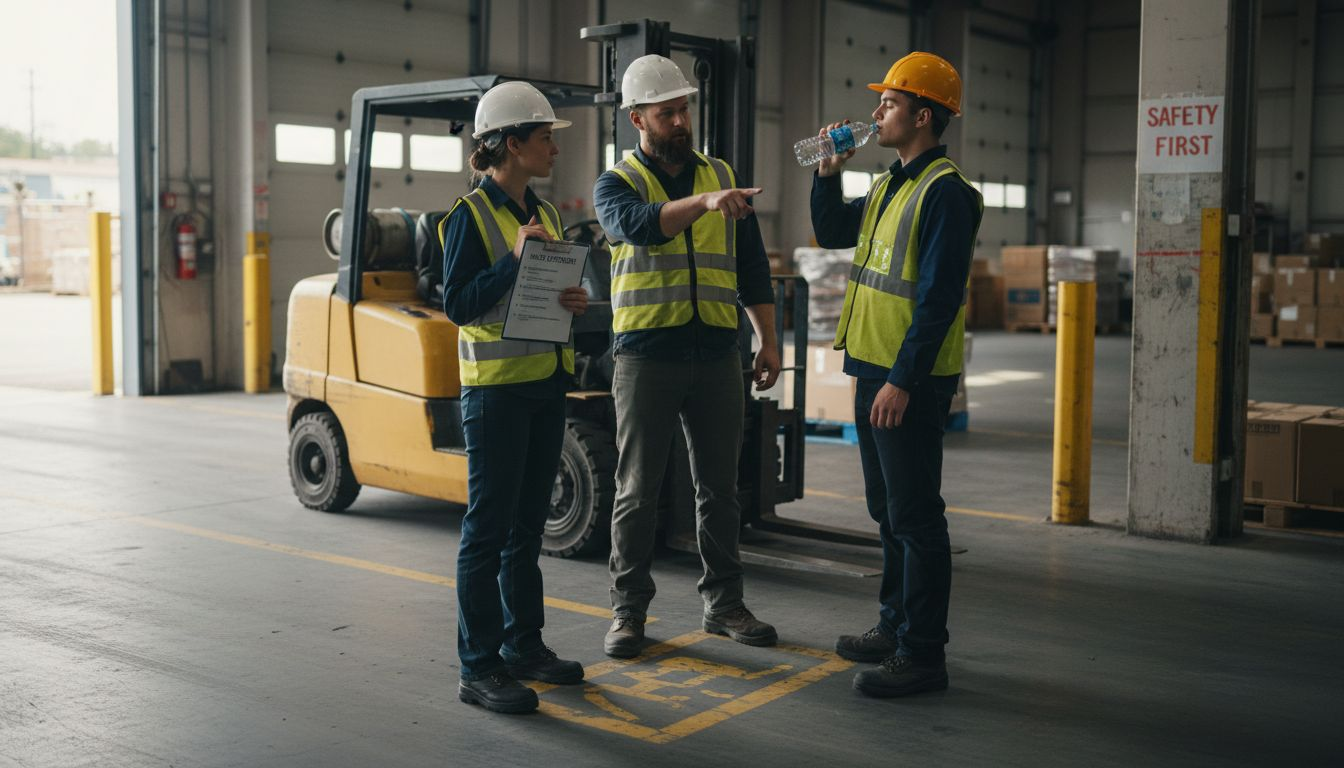
The efficiency gains are equally significant. Onsite safety training engages employees directly at their workplace and focuses on relevant, job-specific hazards, resulting in higher engagement and retention of safety practices. Your operation doesn’t grind to a halt sending operators to external training facilities miles away. Travel time, accommodation, and facility rental costs disappear. Your team stays in the warehouse where they can respond to urgent needs if something breaks down. You’re saving money on logistics while simultaneously delivering superior training because instructors observe your actual equipment quirks and procedural challenges.
But the real transformation happens at the cultural level. Effective workplace safety programs including onsite training contribute to improved operational performance by reducing injuries and associated costs while increasing worker morale and productivity. When operators see management investing in safety right there in their workspace, they internalize the message that safety matters. It’s not something corporate mandates from headquarters. It’s something your facility values enough to bring directly to the warehouse floor. This mindset shift creates what safety professionals call a “safety culture” where operators actively look out for hazards, communicate near-misses, and continuously improve how they work together. The result: fewer accidents, less downtime from injuries, better equipment maintenance, and faster material handling because operators work with confidence rather than anxiety.
Operators also become more efficient when they’re properly trained on your specific equipment and processes. They understand exactly where weight should be distributed for different load types. They know which routes through the warehouse minimize travel time. They recognize the early warning signs that equipment needs maintenance before something fails catastrophically. These details might seem minor individually, but they compound into measurable productivity improvements.
Pro tip: Involve your top-performing operators in the onsite training process by having them demonstrate proper techniques, which reinforces their own skills while building buy-in from peers who respect their expertise.
Skipping or delaying onsite forklift training isn’t cost-saving. It’s actually the most expensive shortcut a warehouse manager can take. The risks accumulate quietly until something catastrophic happens. An untrained operator misjudges load balance and tips a fully loaded pallet. Another operator doesn’t understand the specific hazards of your narrow aisles and clips a support beam. Someone doesn’t recognize the early warning signs of equipment failure and a brake system fails mid-operation. These aren’t hypothetical scenarios. They happen regularly in warehouses that cut corners on training. Risks in forklift operations often stem from insufficient training, poor maintenance, lack of risk assessments, and operator fatigue, creating a cascade of potential incidents that ripple through your entire operation.
The financial impact is staggering. A single serious forklift accident can cost your facility anywhere from ten thousand to over one hundred thousand dollars depending on severity. This includes worker compensation claims, medical treatment, equipment repair or replacement, facility damage, and lost productivity while the injured worker recovers or litigation proceeds. Beyond the direct costs, your insurance premiums rise, your OSHA violation record accumulates fines, and your facility’s safety reputation suffers. Recruiting and retaining quality operators becomes harder when word spreads that your warehouse is unsafe. One accident doesn’t just cost money. It costs your credibility. Costs of accidents include worker compensation, equipment repair, and lost productivity, emphasizing the economic benefit of consistent, well-designed training programs. The math is simple: investing in proper training costs far less than absorbing accident expenses.
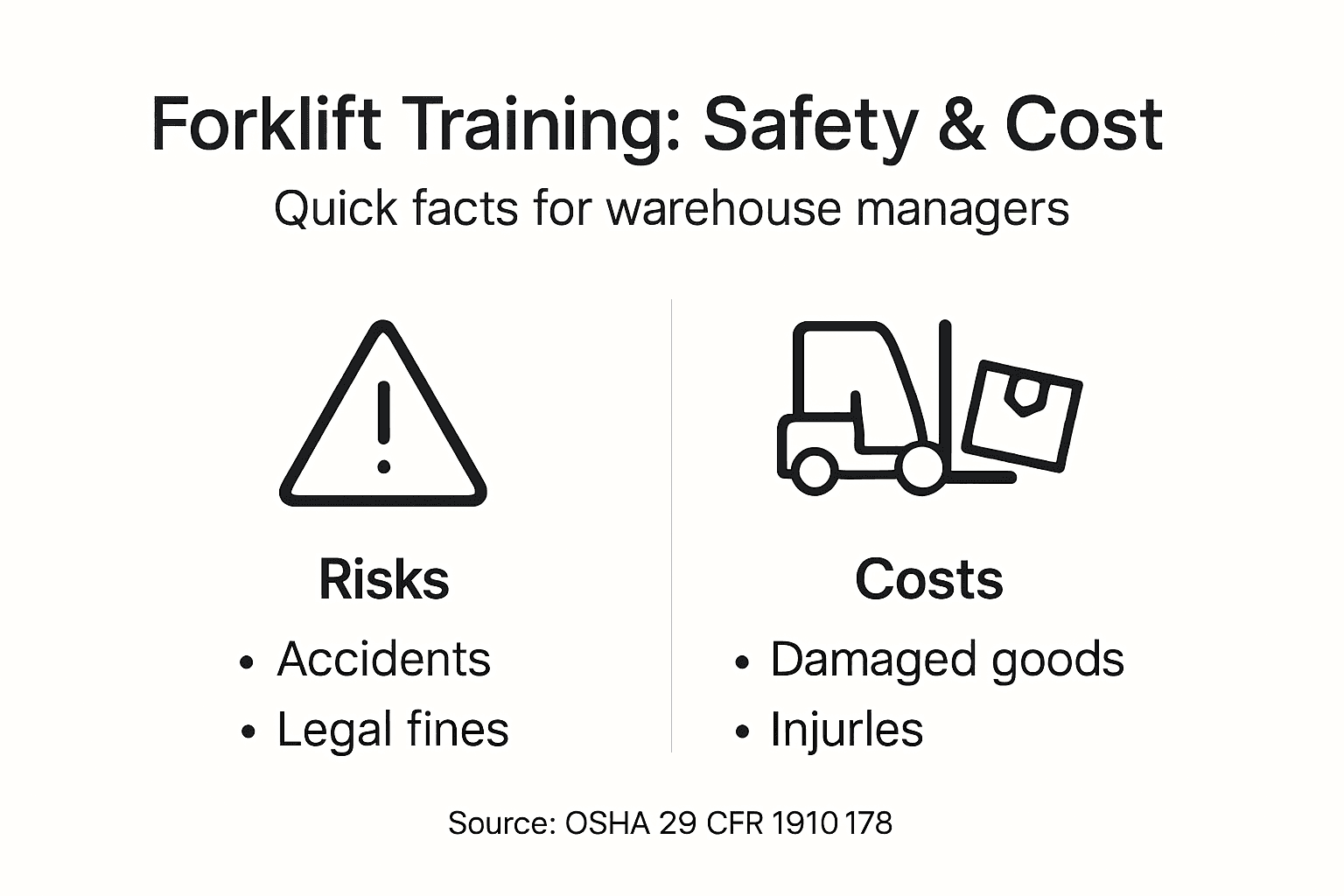
This table compares the risks and costs of delaying onsite forklift training versus investing in regular training:
| Approach | Potential Risks | Likely Costs | Long-Term Impact |
|---|---|---|---|
| Delayed/Skipped Training | Increased accidents and citations | High injury costs, fines | Damage to reputation |
| Regular Onsite Training | Skill retention and safety awareness | Lower insurance premiums | Improved productivity |
Common mistakes compound these risks. The biggest one is treating initial training as a one-time event. Managers get operators certified, then never refresh that training. Over months and years, operators drift into bad habits. They develop shortcuts that feel faster but are less safe. They forget critical procedures because they haven’t practiced them regularly. Safety professionals call this “skill fade,” and it’s devastatingly common in warehouses with high turnover or complacency. Another major mistake is generic training that ignores your facility’s specific hazards. Your warehouse has unique challenges that standard training never addresses. Operators trained on generic scenarios won’t know how to handle your specific equipment quirks, your facility layout, or your particular operational constraints. They’re technically certified but practically unprepared for your actual work.
Lack of proper evaluation represents a third critical mistake. Some facilities check off training boxes without actually assessing whether operators can safely perform their jobs. An operator might sit through training but never demonstrate competence with heavy loads, tight maneuvering, or emergency stopping. When they operate independently, gaps in their knowledge become dangerous. Additionally, failing to document training properly leaves you vulnerable if an accident occurs and regulators investigate. Your documentation becomes your defense that you took compliance seriously.
Pro tip: Create a simple spreadsheet tracking each operator’s training date, trainer name, and certification expiration, and flag any operator approaching expiration at least sixty days in advance to allow scheduling refresher training without operational disruption.
The article highlights critical challenges you face such as preventing skill fade, addressing site-specific hazards, and ensuring compliance with OSHA regulations through hands-on, workplace-focused training. These key goals require comprehensive forklift safety solutions that go beyond generic certification. Forkliftacademy.com specializes in delivering exactly that with tailored onsite training programs designed to enhance operator competency, reduce accidents, and build a lasting safety culture in your warehousing operations.
Unlock the benefits of customized forklift certification and refresher training by partnering with Forkliftacademy.com. Explore our offerings in Forklift Safety Archives – Top Osha Forklift Certification and Forklift Certification Archives – Top Osha Forklift Certification to find solutions that fit your facility’s unique needs. Visit https://forkliftacademy.com now to schedule your onsite sessions, access evaluation-only courses, or implement train-the-trainer programs. Act today to protect your people, preserve your assets, and maintain seamless compliance without disruption.
Onsite forklift training is a hands-on educational program delivered at your warehouse that teaches operators how to safely use forklifts specific to your environment, equipment, and hazards.
Onsite forklift training minimizes injuries and property damage by ensuring operators understand safe operation in their specific workplace conditions, preventing skill fade and enhancing overall safety culture.
Key OSHA requirements include formal instruction, practical training, and evaluation of operators before certification. Documentation of operator identity, training dates, and the trainer’s identity is also essential for compliance.
Refresher training is recommended every three years or whenever there are changes in equipment, facility layout, or unsafe work practices to ensure that operators maintain their skills and stay updated on safety protocols.