

Warehouse managers and HR professionals often face confusion when hiring forklift operators because minimum age requirements differ significantly across the United States and Canadian provinces. While federal OSHA standards generally mandate operators be at least 18 years old in the US, Canadian provinces set their own rules, with Quebec allowing 16-year-olds and Ontario requiring 18. Understanding these jurisdictional differences is essential for compliance, liability management, and workplace safety. This guide clarifies the regulations governing forklift operator age requirements in both countries, explains training obligations, and provides actionable steps to ensure your operation meets all legal standards while protecting your business from costly violations.
| Point | Details |
|---|---|
| US minimum age | In the United States, federal OSHA generally requires forklift operators to be at least 18, while a narrow agricultural exemption allows 16 or 17 year olds to operate with proper training and direct supervision. |
| Age verification | Before authorizing equipment use, verify the operator’s age with a government issued identification and keep copies on file. |
| Training requirements | All operators must complete OSHA compliant training covering vehicle inspection, load handling, pedestrian safety, and site hazards, with refresher training required every three years or after safety incidents. |
| Canada province rules | Canada does not have a single federal minimum and requirements vary by province from 16 in Quebec to 18 in Ontario and British Columbia. |
| Employer liability | Employers face fines and legal risks if underage operators are employed without proper certification, and may encounter insurance and reputational consequences. |
The Occupational Safety and Health Administration (OSHA) establishes clear standards for forklift operation in the United States, with age requirements forming a critical component of workplace safety regulations. Under federal law, the minimum age is generally 18 years for operating powered industrial trucks in warehouses, manufacturing facilities, and retail environments. This standard applies across all states and protects younger workers from hazardous equipment operation.
The Fair Labor Standards Act (FLSA) reinforces this requirement by classifying forklift operation as a hazardous occupation for minors. However, the law does provide a narrow exception: 16 and 17-year-old workers may operate forklifts in agricultural settings, provided they complete comprehensive training and work under direct supervision. This agricultural exemption recognizes the unique operational needs of farms while maintaining safety guardrails.
Employers who violate these age requirements face serious consequences. OSHA can impose substantial fines for each violation, and repeated offenses may result in enhanced penalties or criminal charges. Beyond financial penalties, businesses risk workers’ compensation claims, civil lawsuits, and reputational damage if underage operators cause accidents. Insurance carriers may also deny coverage for incidents involving non-compliant operators.
Before allowing anyone to operate a forklift, you must verify their age through government-issued identification and maintain copies in personnel files. This documentation proves due diligence if regulators investigate your facility. Additionally, all operators regardless of age must complete OSHA-compliant training that covers vehicle inspection, load handling, pedestrian safety, and workplace-specific hazards.
Key US requirements include:
Pro Tip: Create a standardized onboarding checklist that includes age verification, background checks, training enrollment, and competency evaluation. This systematic approach ensures no operator slips through compliance gaps and provides clear audit trails for regulatory inspections.
Understanding these federal standards helps you build compliant hiring practices, but US forklift operator age requirements extend beyond simple age verification to encompass comprehensive training and ongoing competency assessment.
Canada takes a different regulatory approach than the United States, with no single federal minimum age mandate for forklift operators. Instead, each province establishes its own occupational health and safety standards, creating a patchwork of requirements that employers with multi-provincial operations must navigate carefully. This jurisdictional variation means warehouse managers need location-specific knowledge to ensure compliance.
The Canadian provinces vary significantly, with Quebec permitting operators as young as 16 while Ontario and British Columbia require operators to be at least 18 years old. Alberta, Saskatchewan, and Manitoba generally align with the 18-year minimum, though specific exemptions may apply for supervised training situations. These provincial differences reflect local labor market conditions and safety philosophies.
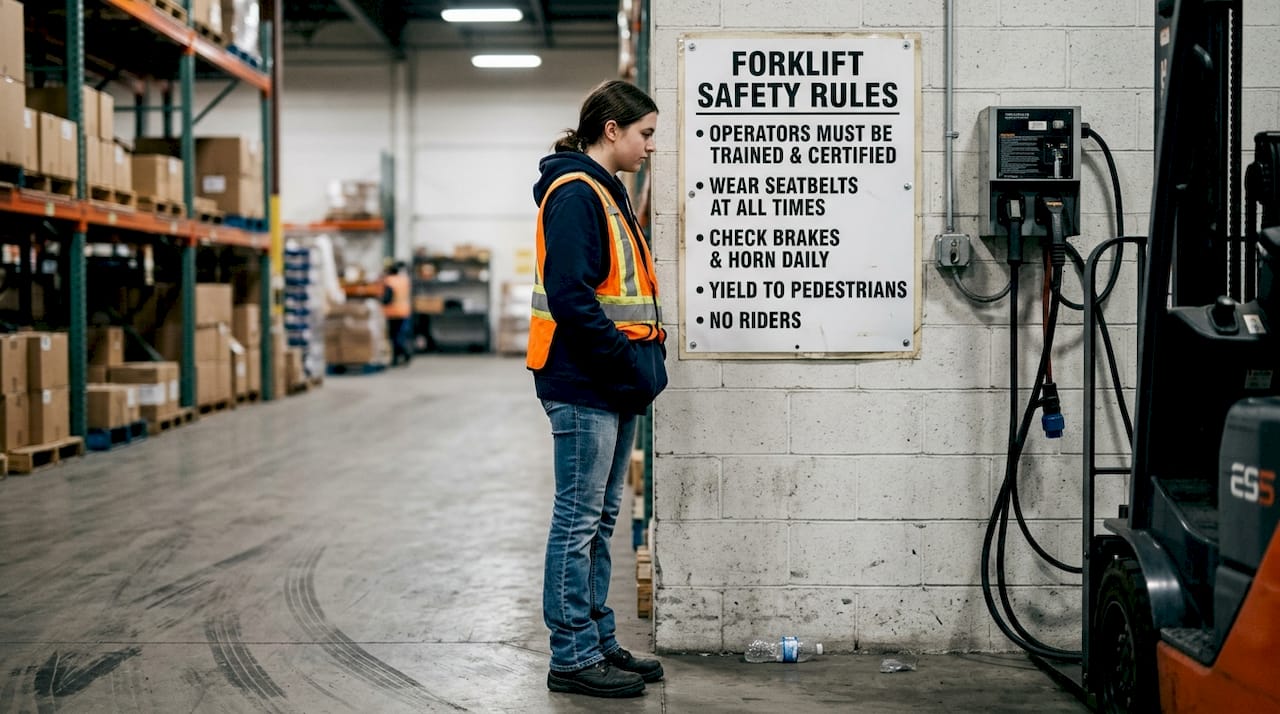
Regardless of provincial age requirements, Canadian employers must follow the CSA B335-15 standard, which establishes comprehensive training protocols for powered industrial truck operators. This standard outlines training methodology including theoretical instruction covering stability principles, load capacity, and hazard recognition. Practical evaluation must demonstrate competency in vehicle control, load handling, and safe maneuvering in realistic workplace conditions.
The CSA B335-15 framework requires equipment-specific training, meaning operators certified on counterbalance forklifts cannot automatically operate reach trucks or order pickers without additional instruction. This specificity ensures workers understand the unique characteristics and limitations of each vehicle type they encounter. Training must also address site-specific hazards like narrow aisles, dock operations, or outdoor terrain.
Refresher training represents another critical component of Canadian compliance. The standard recommends reassessment every three years or sooner if operators demonstrate unsafe practices, experience accidents, or transition to different equipment types. Employers bear responsibility for monitoring operator performance and triggering refresher training when competency concerns arise.
Provincial requirements at a glance:
| Province | Minimum Age | Key Training Standard | Refresher Interval |
|---|---|---|---|
| Quebec | 16 | CSA B335-15 | 3 years |
| Ontario | 18 | CSA B335-15 | 3 years or as needed |
| British Columbia | 18 | WorkSafeBC regulations | 3 years |
| Alberta | 18 | OHS Code Part 16 | 3 years |
Pro Tip: If your company operates warehouses in multiple Canadian provinces, standardize on the most restrictive requirements (18-year minimum, comprehensive CSA B335-15 training) to simplify compliance and reduce administrative complexity. This approach eliminates confusion about location-specific rules and demonstrates commitment to the highest safety standards.
Employers must maintain detailed training records including operator names, training dates, equipment types covered, evaluation results, and trainer qualifications. These documents prove compliance during workplace inspections and provide legal protection if accidents occur. Provincial regulators can request training records at any time, and missing documentation may result in stop-work orders or financial penalties.
For comprehensive guidance on meeting these standards, review Canadian forklift training requirements that address both provincial variations and CSA framework elements.
While both countries prioritize forklift safety, their regulatory frameworks differ in structure, enforcement, and specific requirements. Understanding these distinctions helps multinational employers develop coherent compliance strategies that satisfy both jurisdictions without creating operational inefficiencies or safety gaps.
The United States maintains a consistent federal minimum age of 18 years for forklift operation in industrial settings, with the narrow agricultural exception permitting 16-year-olds under specific conditions. This uniformity simplifies compliance for companies operating across multiple states, as the same age standard applies whether your warehouse is in California, Texas, or New York. OSHA enforcement occurs at the federal level, though state plans may impose additional requirements.
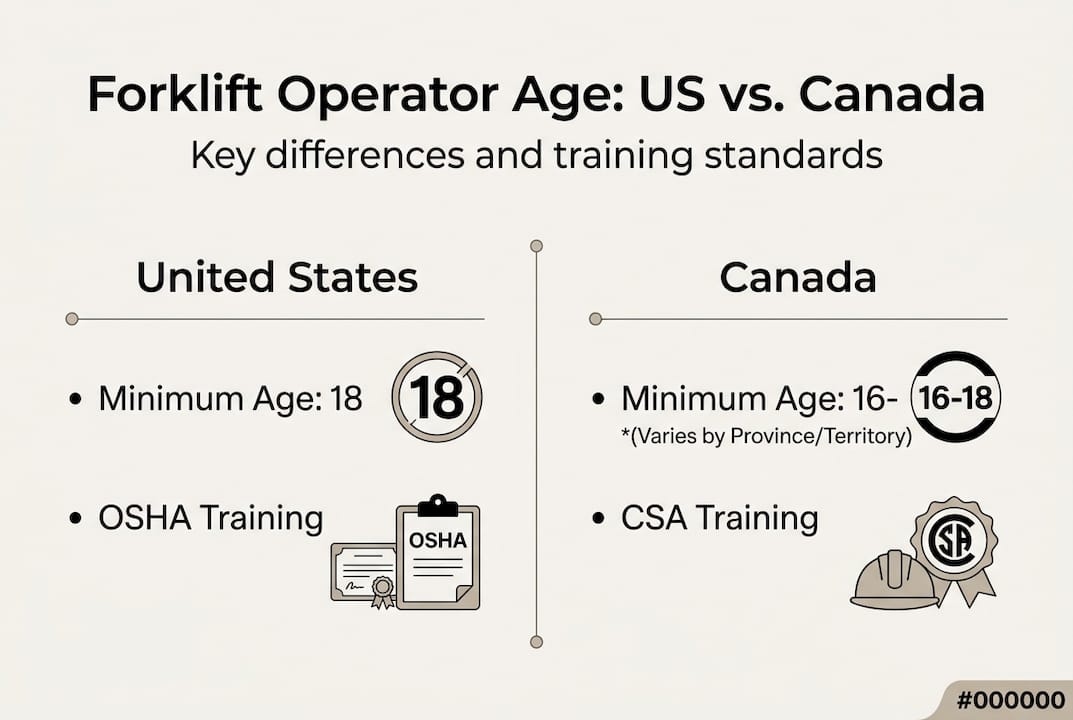
Canada’s provincial system creates more complexity. The regulatory approach varies significantly, with Quebec allowing 16-year-old operators while Ontario, British Columbia, and most other provinces require 18. This variation means employers with facilities in multiple provinces must track location-specific rules and adjust hiring practices accordingly. Provincial labor ministries handle enforcement independently, leading to different inspection frequencies and penalty structures.
Training frameworks also diverge between countries. US employers follow OSHA standards requiring formal instruction, practical training, and evaluation on specific equipment types. The regulation emphasizes employer responsibility for ensuring operator competency but provides flexibility in training delivery methods. Many companies use online courses combined with hands-on evaluation to meet OSHA requirements efficiently.
Canadian training adheres to CSA B335-15, a more prescriptive standard that details curriculum content, evaluation criteria, and documentation requirements. This framework specifies minimum training hours, mandates coverage of particular topics, and requires trainers to possess specific qualifications. While more structured than OSHA guidance, CSA B335-15 provides clearer benchmarks for compliance.
Key differences between jurisdictions:
| Aspect | United States | Canada |
|---|---|---|
| Minimum Age | 18 (16 in agriculture) | 16-18 depending on province |
| Regulatory Body | OSHA (federal) | Provincial labor ministries |
| Training Standard | OSHA 1910.178 | CSA B335-15 |
| Enforcement Level | Federal with state plans | Provincial |
| Trainer Qualifications | Knowledge and experience required | Specific qualifications detailed in CSA |
Despite these differences, both countries place ultimate responsibility on employers to verify operator age, provide comprehensive training, maintain documentation, and monitor ongoing competency. Negligent hiring or inadequate training exposes companies to regulatory penalties, civil liability, and workers’ compensation claims regardless of jurisdiction.
For businesses operating in both countries, the most practical approach involves adopting the stricter requirements as your baseline standard. Setting an 18-year minimum age universally, implementing CSA B335-15 compliant training, and maintaining detailed documentation satisfies both regulatory frameworks while simplifying administration. This strategy also demonstrates commitment to safety that resonates with employees, customers, and insurance carriers.
Review your current practices against a comprehensive forklift compliance checklist to identify gaps and prioritize improvements across all your facilities.
Compliance with age and training regulations requires systematic processes that verify operator qualifications before equipment access and maintain ongoing competency throughout employment. These practical steps help warehouse managers and HR professionals build robust programs that satisfy legal requirements while reducing accident risk.
Implement age verification during hiring. Require government-issued identification from all forklift operator candidates and photocopy documents for personnel files. This simple step proves due diligence and prevents underage operation. For positions requiring forklift skills, include age requirements in job postings to screen applicants early.
Enroll new operators in comprehensive training programs. Select training providers that cover theoretical principles, practical skills, and equipment-specific instruction aligned with OSHA or CSA B335-15 standards. Ensure training addresses your facility’s unique hazards like dock operations, narrow aisles, or outdoor conditions. Document training completion with certificates that include operator name, training date, equipment types covered, and trainer signature.
Conduct practical evaluations before authorizing independent operation. Observation of actual workplace tasks reveals competency better than written tests alone. Evaluators should assess vehicle inspection procedures, load handling techniques, pedestrian awareness, and emergency responses. Failed evaluations require additional training before reassessment.
Maintain centralized training records accessible for audits. Create a database or filing system that tracks each operator’s age verification, initial training, equipment authorizations, evaluation results, and refresher training dates. These records demonstrate compliance during OSHA inspections or legal proceedings following accidents.
Schedule refresher training every three years minimum. Calendar reminders ensure operators receive updated instruction before certifications expire. Trigger additional training when operators demonstrate unsafe practices, experience accidents, or transition to different equipment types. Refresher courses reinforce critical concepts and address new hazards.
Foster a safety culture through supervisor observation. Train supervisors to monitor operator performance during regular shifts and document concerns. Regular observation identifies skill degradation early, allowing corrective training before accidents occur. Positive reinforcement of safe practices encourages operators to maintain high standards.
Review and update training programs annually. Regulatory changes, new equipment acquisitions, and accident investigations may reveal training gaps. Annual program reviews ensure content remains current and effective. Solicit operator feedback about training quality and relevance to improve future sessions.
Pro Tip: Create a visual dashboard displaying each operator’s training status, equipment authorizations, and upcoming refresher dates. This tool helps supervisors make daily assignment decisions and flags operators approaching certification expiration. Color-coded indicators (green for current, yellow for expiring soon, red for expired) provide at-a-glance compliance status.
Employers face significant liability for allowing underage or untrained operators to use powered industrial trucks. Penalties include substantial fines and potential criminal charges if violations result in serious injuries or fatalities. Proper age verification and training documentation provide essential legal protection.
Beyond regulatory compliance, these systematic processes reduce accident rates, lower workers’ compensation costs, and improve operational efficiency. Well-trained operators handle loads more quickly, damage products less frequently, and recognize hazards before they cause incidents. The investment in comprehensive training programs delivers measurable returns through reduced downtime and insurance premiums.
For detailed guidance on building compliant operator programs, explore forklift operator compliance requirements and forklift operator responsibilities that cover evaluation criteria, documentation standards, and ongoing monitoring protocols.
Navigating the complex landscape of forklift operator age requirements and training standards across US and Canadian jurisdictions demands reliable, comprehensive training solutions. Forklift Academy delivers OSHA-compliant certification programs designed specifically for warehouse managers and HR professionals who need efficient, legally sound operator training.
Our forklift training programs cover all equipment types and skill levels, from entry-level operators to experienced drivers requiring refresher courses. Each program addresses the theoretical knowledge, practical skills, and equipment-specific competencies required by OSHA and CSA B335-15 standards. Online courses provide flexible scheduling while maintaining rigorous evaluation standards.
For businesses managing multiple operators, our forklift certification for business solutions streamline compliance across entire facilities. Bulk enrollment options, customized training schedules, and detailed reporting help you track certifications and plan refresher training efficiently. Our team works with your HR department to integrate training into onboarding processes.
Companies seeking to build internal training capacity benefit from our forklift train the trainer online programs. These courses equip your supervisors and safety managers with the knowledge and credentials to deliver compliant training in-house, reducing long-term costs while maintaining quality standards. Train-the-trainer certification includes curriculum materials, evaluation tools, and ongoing support.
The federal minimum age for forklift operation in the United States is 18 years old according to OSHA regulations and the Fair Labor Standards Act. This standard applies to all industrial, commercial, and retail settings where powered industrial trucks are used. The only exception allows 16 and 17-year-old workers to operate forklifts in agricultural environments, provided they complete required training and work under direct supervision. Employers must verify operator age through government-issued identification and maintain documentation proving compliance.
Yes, limited exceptions exist in both countries. In the United States, workers aged 16 and 17 may operate forklifts in agricultural settings if they receive comprehensive training and work under qualified supervision. This exception recognizes farming’s unique operational needs while maintaining safety standards. In Canada, Quebec permits forklift operators as young as 16 with completed training, while most other provinces require operators to be at least 18. These exceptions still mandate full compliance with training and competency requirements.
All forklift operators regardless of age must complete training that includes theoretical instruction covering stability principles, load capacity, and hazard recognition. Practical evaluation must demonstrate competency in vehicle control, load handling, and safe maneuvering in actual workplace conditions. Training must be equipment-specific, meaning certification on one forklift type does not automatically authorize operation of different vehicle classes. Employers must document training completion, conduct competency evaluations, and provide refresher training every three years or when safety concerns arise.
Employers who allow underage or untrained workers to operate forklifts face substantial financial penalties from OSHA or provincial labor authorities. Fines can reach thousands of dollars per violation, with enhanced penalties for willful or repeated offenses. Beyond regulatory fines, companies risk civil lawsuits if accidents involving non-compliant operators cause injuries or property damage. Workers’ compensation carriers may deny claims related to non-compliant operations, leaving employers fully liable for medical costs and lost wages. In cases involving serious injuries or fatalities, criminal charges including imprisonment may apply to responsible managers.