
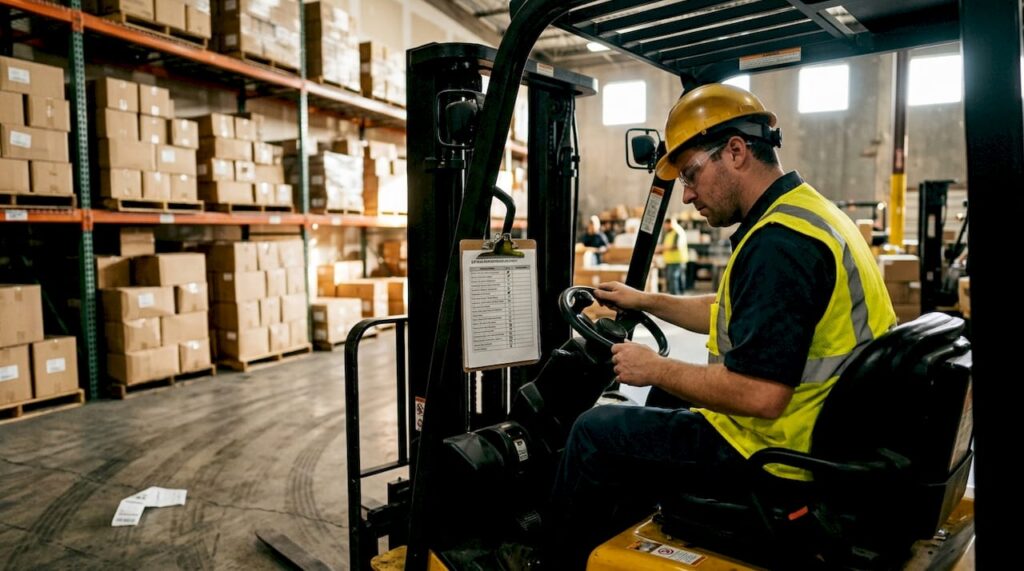

Forklift operation demands precision, awareness, and rigorous safety practices to prevent fatal accidents and costly OSHA violations. Every year, approximately 85 forklift workers die and 34,900 suffer serious injuries across North American warehouses and distribution centers. Mastering essential forklift skills protects lives, ensures regulatory compliance, and boosts operational efficiency. This guide walks you through core competencies, daily operational techniques, hazard awareness strategies, and advanced training methods to elevate your team’s performance and safety outcomes.
| Point | Details |
|---|---|
| OSHA training rules | OSHA requires formal instruction, practical training, and refresher courses every three years or after incidents. |
| Pre shift inspections | Daily inspections verify fluids, brakes, mast integrity, steering, and warning devices before work to prevent equipment failure and tip overs. |
| Load handling basics | Position forks to center the load, keep within rated capacity, and consult load charts for unusual shapes to prevent loss of control. |
| Annual refresher cadence | Schedule annual refresher training to reinforce safe habits and maintain competency. |
OSHA regulation 29 CFR 1910.178(l) mandates formal instruction, practical training, and refresher courses every three years or after incidents. This framework ensures operators understand truck-specific controls, recognize workplace hazards, and demonstrate competency through written and practical evaluations. Compliance protects your workforce and shields your organization from penalties that can reach thousands of dollars per violation.
Training must cover three critical components. Classroom instruction introduces forklift types, load capacities, stability principles, and regulatory requirements. Practical training allows operators to apply skills under supervision in real or simulated work environments. Evaluation confirms that each operator can safely perform tasks like load handling, maneuvering in tight spaces, and responding to emergencies. Refresher training is triggered by unsafe operation observations, near-miss incidents, or assignment to unfamiliar equipment types.
Managers should prioritize hands-on practice over passive learning. Operators who complete scenario-based evaluations retain skills longer and respond more effectively to unexpected hazards. Documenting each training session, evaluation result, and refresher date creates an audit trail that satisfies OSHA inspectors and supports your safety culture. Investing in OSHA forklift training regulations upfront prevents costly downtime and protects your team from preventable injuries.
Pro Tip: Schedule refresher training annually instead of waiting the full three years to keep skills sharp and reinforce safe habits.
Core training components:
Daily pre-shift inspections form the foundation of safe forklift operation. Operators must check fluid levels, brake function, mast integrity, steering responsiveness, and warning devices before starting work. Correct load centering and tilt reduce accident risks by maintaining the center of gravity within the stability triangle. Skipping inspections or rushing through load positioning invites equipment failure and tip-over incidents.
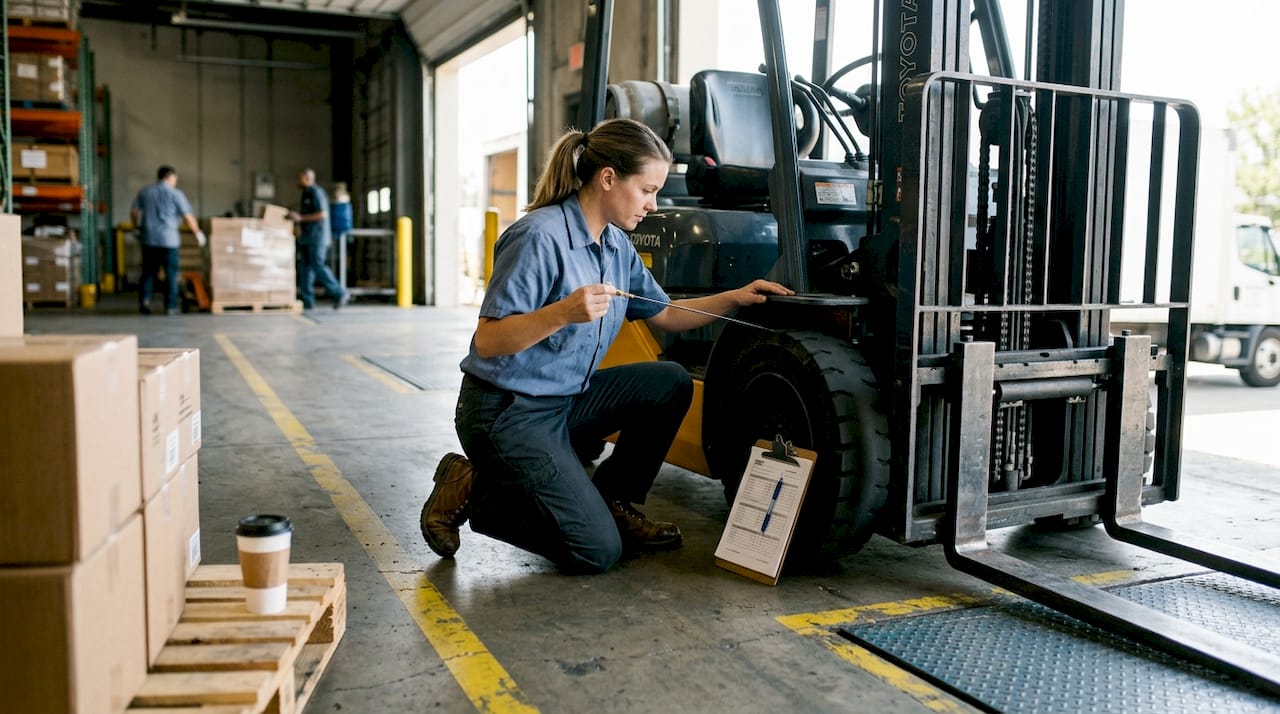
Load handling requires precision and attention to weight distribution. Position forks so the load sits centered, occupying at least two-thirds of the pallet width. Tilt the mast backward slightly during travel to secure the load against the backrest and prevent forward shifts. Never exceed the forklift’s rated capacity, and always consult the load chart when handling unusual shapes or sizes. Reducing speed when turning or navigating ramps prevents loss of control and protects nearby workers.
Maneuvering techniques directly impact safety outcomes. Travel with forks low, about four to six inches above the ground, to maintain stability and visibility. When ascending ramps, drive forward with the load in front; when descending, reverse with the load behind you to keep weight over the drive axle. Use horns at intersections and blind corners to alert pedestrians and other operators. Implementing OSHA forklift compliance safe operations practices reduces incident rates and builds operator confidence.
Pro Tip: Create laminated daily inspection checklists and mount them on each forklift to ensure consistent pre-shift reviews.
Daily inspection checklist:
| Component | Check |
|---|---|
| Fluids | Oil, coolant, hydraulic fluid at proper levels |
| Brakes | Responsive pedal, no unusual sounds or drag |
| Mast and forks | No cracks, bends, or excessive wear |
| Tires | Proper inflation, no cuts or embedded objects |
| Controls | Steering, lift, tilt operate smoothly |
| Safety devices | Horn, lights, backup alarm functional |
Tip-overs on slopes and uneven surfaces cause approximately 42% of forklift fatalities, while pedestrian strikes account for around 36%. Understanding these hazards and implementing countermeasures saves lives and prevents devastating injuries. Operators must recognize that stability decreases when turning, traveling on inclines, or lifting loads to maximum height. Maintaining 360-degree situational awareness and planning routes that separate pedestrian traffic from forklift paths are non-negotiable safety practices.
Limited visibility creates blind spots that lead to collisions with workers, racking, and other equipment. Always look in the direction of travel and use mirrors or cameras to monitor surroundings. When carrying tall loads that obstruct forward vision, travel in reverse and assign a spotter for guidance. Sound your horn before entering intersections, doorways, or areas with foot traffic. Establishing designated pedestrian walkways and installing floor markings or barriers physically separates workers from forklift operating zones.
Situational awareness extends beyond the immediate task. Scan for overhead obstructions like pipes, sprinklers, and lighting fixtures before raising loads. Watch for floor conditions such as spills, debris, or uneven surfaces that compromise stability. Communicate with coworkers using hand signals or radios when coordinating multi-operator tasks. Training your team to anticipate hazards and respond proactively transforms compliance into a daily habit that protects everyone on site. Prioritizing forklift operator compliance creates a culture where safety is everyone’s responsibility.
“Implementing route separation and 360-degree awareness protocols reduced our pedestrian strike incidents by 68% within six months.” — Safety Manager, Midwest Distribution Center
Common hazard prevention strategies:
| Hazard Type | Primary Cause | Prevention Measure |
|---|---|---|
| Tip-over | Excessive speed on slopes, overloading | Reduce speed, follow capacity charts, ascend forward |
| Pedestrian strike | Limited visibility, shared pathways | Use horns, separate routes, install barriers |
| Falling load | Improper centering, sudden stops | Center loads, tilt back, travel smoothly |
| Collision | Blind corners, distracted operation | Sound horn, use mirrors, eliminate distractions |
Scissor lifts classified as scaffolding under OSHA standards require strict pre-use inspections, PPE, and emergency procedure knowledge to prevent falls and fatalities. Operators must conduct thorough inspections covering hydraulic systems, platform integrity, guardrails, and control responsiveness before each use. Unlike forklifts, scissor lifts elevate workers who face fall hazards, making personal protective equipment and emergency readiness critical.
Wearing appropriate PPE is mandatory for scissor lift operation. Full-body harnesses with lanyards anchored to designated points prevent falls if the platform tilts or fails. Hard hats protect against overhead hazards, and non-slip footwear maintains stability on the platform. Never exceed 75% of the maximum load capacity to maintain stability and account for dynamic forces during movement. Overloading compromises the lift’s structural integrity and increases tip-over risk.
Maintaining clear zones and guardrails around the platform protects operators from entanglement and crushing hazards. Ensure all guardrails and mid-rails are in place and secure before elevating the platform. Position the lift on firm, level ground and use outriggers or stabilizers as specified by the manufacturer. Knowing emergency descent procedures and rescue protocols enables rapid response if the lift malfunctions or an operator becomes incapacitated. Regular drills and scenario training reinforce these skills and build confidence. Explore scissor lift training certification programs to ensure your team meets all regulatory requirements.
Scissor lift safety essentials:
Manual forklifts offer flexibility for varied tasks and environments, while autonomous forklifts pick orders faster in fixed, repetitive workflows. Hybrid approaches that combine human oversight with automated assistance deliver the best balance of speed, adaptability, and safety. Scenario-based practical evaluations reduce accidents by 60 to 70% compared to classroom-only instruction, proving that hands-on experience is the most effective training method.
Incorporating technology such as auto-speed reduction systems, proximity sensors, and collision avoidance alarms enhances safety on loading docks and near pedestrian zones. These systems provide real-time feedback and intervene when operators approach dangerous thresholds. However, technology cannot replace skilled judgment and situational awareness. Operators must understand the principles behind stability, load dynamics, and hazard recognition to respond effectively when automated systems fail or encounter unexpected conditions.
Daily checklists complement periodic certifications by reinforcing safe habits and catching equipment issues before they escalate. Combining digital training modules with hands-on practice allows operators to learn at their own pace while ensuring they can demonstrate competency in real-world scenarios. Managers should track training completion, evaluation scores, and incident rates to identify skill gaps and tailor refresher programs. Investing in forklift safety training implementation strategies that prioritize practical experience over passive learning delivers measurable safety improvements.
Pro Tip: Use video recordings of operator evaluations to provide personalized feedback and highlight specific areas for improvement.
| Training Method | Strengths | Limitations |
|---|---|---|
| Classroom instruction | Covers regulations, theory, and hazard recognition | Limited skill retention without hands-on practice |
| Practical evaluation | Builds real-world competency and confidence | Requires dedicated equipment and supervision time |
| Scenario-based drills | Simulates emergencies and complex situations | Resource-intensive to design and implement |
| Autonomous systems | Increases speed for repetitive tasks | Lacks adaptability for varied environments |
| Hybrid human-automation | Balances efficiency with operator judgment | Requires training on both manual and automated modes |
Steps to implement advanced training:
Mastering essential forklift skills requires more than reading guidelines. You need practical, OSHA-compliant training that builds confidence and competency in real-world scenarios. Certified forklift training programs deliver hands-on instruction, up-to-date materials, and evaluation tools that ensure every operator meets regulatory standards and performs safely under pressure.
Managers seeking to lead internal safety initiatives can benefit from train the trainer online courses that prepare you to deliver compliant instruction and evaluate operator competency. For specialized equipment, scissor lift trainer certification programs provide the knowledge and credentials to train your team on elevated work platform safety. Investing in professional training protects your workforce, reduces liability, and builds a culture where safety is the foundation of operational excellence.
OSHA requires formal instruction, practical training, and evaluation before operators work independently. Refresher training is mandatory every three years or immediately after accidents, near-misses, or unsafe operation observations.
Check fluid levels, brake function, mast integrity, steering responsiveness, tires, and safety devices like horns and lights. Document findings and report any defects before operating the forklift.
Center loads on forks occupying at least two-thirds of pallet width, tilt the mast backward during travel, and never exceed rated capacity. Travel with forks low and reduce speed when turning or navigating ramps.
Operators must wear full-body harnesses with lanyards anchored to designated points, hard hats, and non-slip footwear. Guardrails and mid-rails must be in place before elevating the platform.
Tip-overs on slopes and pedestrian strikes account for approximately 78% of forklift fatalities. Limited visibility, excessive speed, improper load handling, and inadequate training also contribute to incidents. Implementing 360-degree awareness, route separation, and daily inspections significantly reduces these risks.