

Over 6,000 workplace injuries each year in American warehouses are linked to improper forklift operation and training mistakes. For warehouse managers, mastering OSHA-compliant forklift terminology goes far beyond memorizing industry jargon. It helps build a safer work environment, improves communication with employees, and ensures every team member understands the exact standards required for operational efficiency. This guide breaks down the core language you need for legal compliance and real-world safety, making forklift training straightforward and reliable for your American workplace.
| Point | Details |
|---|---|
| Essential Terminology | Master forklift training terminology to enhance safety and compliance in warehouse operations. Regular updates to a glossary ensuring understanding of terms like Load Center and Stability Triangle are crucial. |
| Certification Importance | Forklift certifications ensure legal and safe operation; class-specific training is necessary for competence in various vehicle types. Maintain detailed training records for compliance. |
| Ongoing Training | Periodic refresher training is mandated to keep operators’ skills current and compliant with OSHA standards following significant incidents or changes. |
| Employer Responsibilities | Employers must ensure comprehensive training and documentation to mitigate negligence liability and maintain workplace safety standards. Failure to do so can result in legal and financial repercussions. |
Forklift training involves mastering a complex set of technical terms that are essential for safe and compliant warehouse operations. Understanding these foundational terms is not just about vocabulary, but about creating a comprehensive safety framework for industrial vehicle operators. OSHA standards define precise terminology that warehouse managers and operators must comprehend thoroughly.
The core terminology can be broken down into several key categories that cover equipment classification, operator requirements, and safety protocols. Powered Industrial Trucks represent the official classification for forklifts, which includes various classes of lift trucks designed for specific workplace environments. These vehicles are categorized based on their design, power source, and intended operational use. Operators must understand critical terms like load center, which determines the truck’s lifting capacity and stability, and stability triangle, which explains the geometric principles preventing tip-over accidents.
Operator certification requires mastery of specific training terminology. Formal instruction represents classroom or theoretical learning, while practical training involves hands-on skill demonstration. Operators must undergo performance evaluation to prove their competence in handling equipment safely. Additional critical terms include refresher training, which mandates periodic skill reassessment, and workplace-specific hazard identification, which requires understanding unique risks in different industrial settings.
Pro tip: Always maintain a current glossary of forklift training terminology at your workplace, updating it regularly with the latest OSHA definitions to ensure consistent safety communication among all team members.
Forklift certifications represent critical safety credentials that enable industrial workers to legally and safely operate powered industrial trucks across various workplace environments. OSHA standards mandate specific certification requirements that warehouse managers and safety professionals must comprehend and implement systematically.
Typically, forklift certifications are categorized into several distinct types based on vehicle class, operational context, and specific workplace needs. Class I Certifications cover electric motor riders, while Class II Certifications focus on electric motor narrow aisle trucks. Class III Certifications address electric motor hand trucks and center riders, each requiring specialized training tailored to unique vehicle characteristics and operational challenges. Operators must demonstrate proficiency in vehicle-specific handling, safety protocols, and workplace navigation techniques.
Here is a summary comparing key forklift certification classes and their typical workplace applications:
| Certification Class | Vehicle Type Covered | Common Workplace Uses |
|---|---|---|
| Class I | Electric motor rider trucks | Large warehouses, distribution centers |
| Class II | Electric motor narrow aisle trucks | Narrow aisles, retail storage areas |
| Class III | Electric motor hand trucks/center riders | Loading docks, small storage spaces |
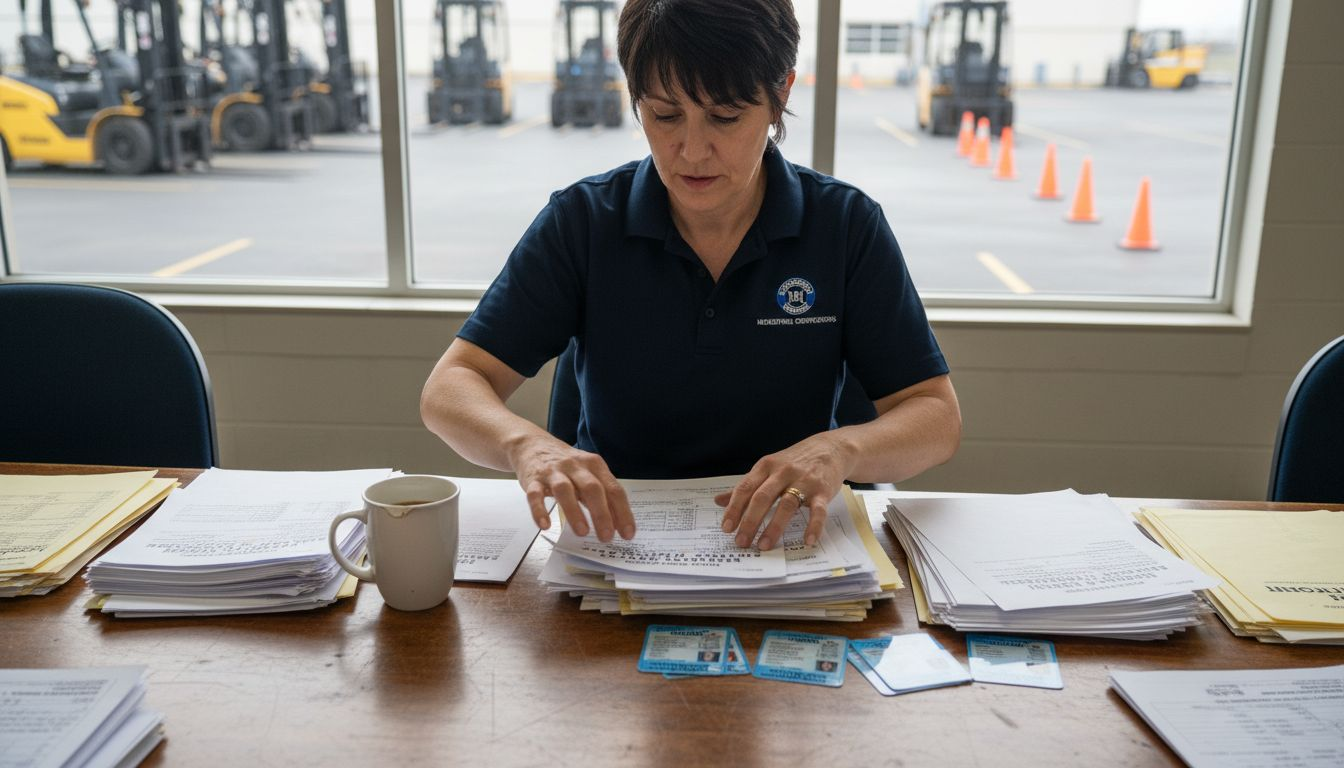
The certification process involves multiple critical components that ensure comprehensive operator competence. Formal Instruction provides theoretical knowledge through classroom training, covering equipment mechanics, safety regulations, and operational guidelines. Practical Training involves hands-on skill demonstration under supervised conditions, allowing operators to apply theoretical knowledge in realistic scenarios. Most certifications require a Performance Evaluation, where operators must prove their ability to safely maneuver equipment, understand load management, and navigate complex workplace environments. OSHA recommends recertification every three years or immediately after significant safety incidents or operational changes.
Pro tip: Maintain detailed training records for each forklift operator, documenting their specific certification type, date of initial and renewal training, and performance evaluations to ensure continuous compliance and workplace safety.
Understanding OSHA compliance terminology is crucial for maintaining workplace safety and avoiding potential regulatory penalties in industrial settings. Comprehensive safety standards detailed in 29 CFR 1910.178 provide the foundational framework for powered industrial truck operations, establishing critical definitions and requirements that warehouse managers must carefully implement.
Key compliance terms encompass several critical areas of operational safety. Approved Trucks represent vehicles that meet specific manufacturing and design standards, while Modifications refer to any alterations that could potentially compromise a vehicle’s original safety specifications. Operator Qualifications define the precise training, evaluation, and certification requirements necessary for legal equipment operation. These terms are not merely administrative labels but represent critical safety benchmarks that directly impact workplace risk management and employee protection.
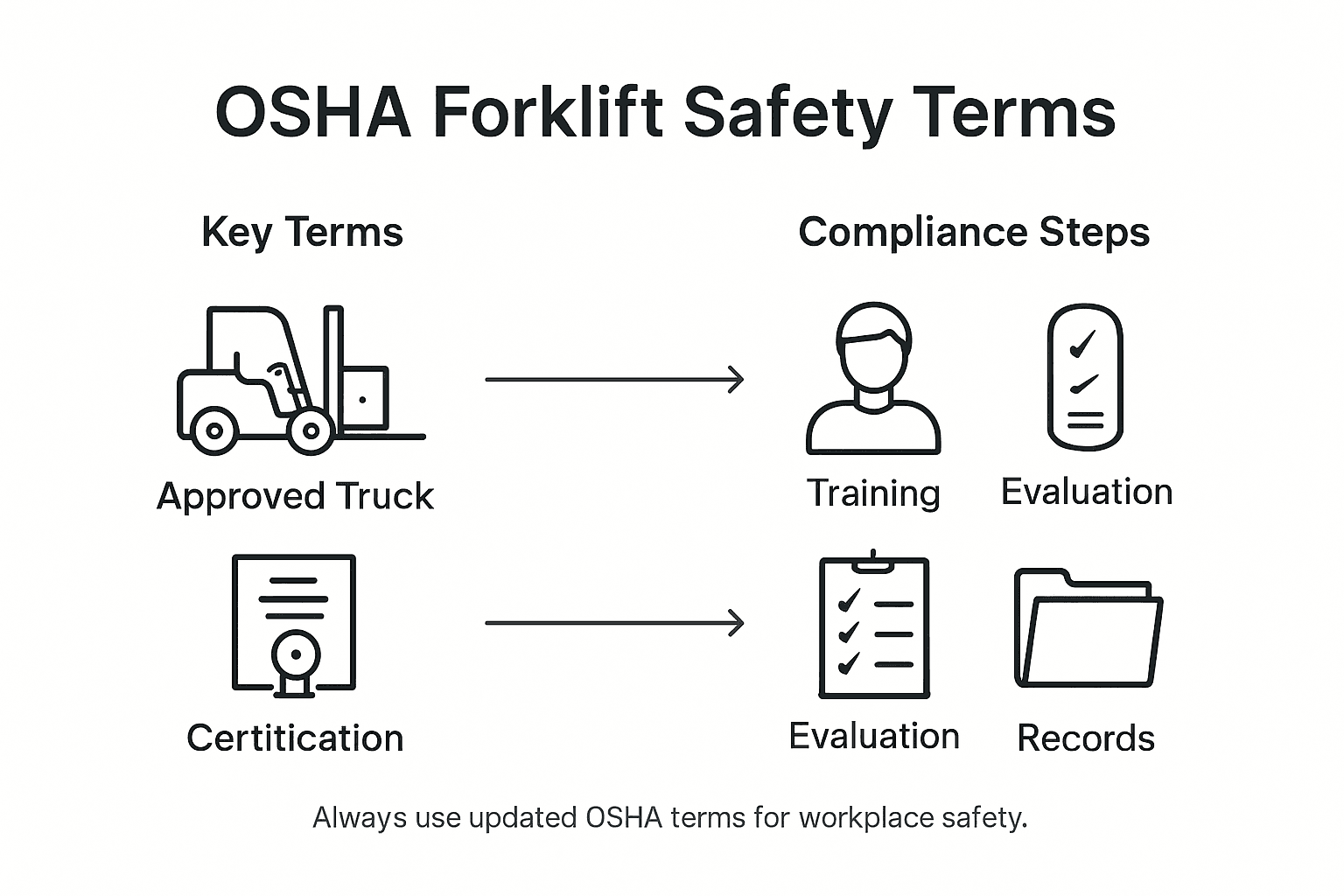
The compliance framework also includes specific Performance Evaluation standards that assess operator competence through practical demonstrations of skill and knowledge. OSHA mandates periodic Refresher Training to ensure operators maintain current safety skills, typically requiring recertification every three years or immediately following significant safety incidents, equipment changes, or observed unsafe operational practices. Compliance terminology also covers critical areas like Pedestrian Safety Protocols, Restraint Requirements, and Equipment Marking Standards, which collectively create a comprehensive safety infrastructure for powered industrial truck operations.
Pro tip: Create a comprehensive compliance terminology reference document that translates official OSHA language into practical, easy-to-understand workplace guidelines, ensuring all team members can effectively interpret and implement safety standards.
Forklift safety training is often misunderstood, with many warehouse managers and operators falling prey to dangerous misconceptions that can compromise workplace safety. OSHA’s comprehensive safety publication exposes critical training fallacies that can lead to potentially life-threatening workplace incidents.
One of the most prevalent misconceptions is the belief that Experience Equals Competence. Many operators assume that years of handling equipment automatically translates to safe operation. However, this dangerous assumption overlooks the critical need for ongoing training, understanding of current safety standards, and awareness of specific workplace hazards. Casual Operation is another significant error, where operators treat forklifts as simple machines rather than complex pieces of industrial equipment requiring precise skills and continuous attention. Operators often underestimate the importance of understanding vehicle-specific characteristics, load dynamics, and environmental limitations.
This table highlights common misconceptions in forklift training and the risks they create:
| Misconception | Potential Safety Risk | Corrective Action |
|---|---|---|
| Experience equals competence | Unsafe operation due to outdated skills | Provide ongoing refresher training |
| Casual equipment handling | Increased accident likelihood | Emphasize formal and hands-on training |
| Initial certification is enough | Fails to adapt to new hazards | Require periodic skill reassessment |
Training errors frequently stem from inadequate evaluation and oversight processes. Insufficient Practical Training remains a significant concern, where theoretical knowledge is not effectively translated into hands-on skills. Many training programs fail to tailor instruction to specific workplace environments, leaving operators unprepared for real-world challenges. Critical areas of misunderstanding include proper load capacity calculations, understanding equipment controls, navigating complex warehouse layouts, and implementing pedestrian safety protocols. Operators may also mistakenly believe that initial certification is a one-time requirement, neglecting the essential Refresher Training mandated by OSHA, which is crucial for maintaining current safety standards and adapting to evolving workplace technologies.
Pro tip: Implement a comprehensive training tracking system that documents individual operator skills, tracks recurring training requirements, and creates personalized development plans to address specific performance gaps.
Forklift operations create complex legal landscapes where employer responsibilities extend far beyond simple equipment management. OSHA’s comprehensive training guidance clarifies critical employer legal responsibilities that can potentially expose businesses to significant financial and legal risks if not carefully implemented.
Employers bear Primary Legal Responsibility for ensuring comprehensive operator training and workplace safety. This involves multiple critical components: creating documented training programs, maintaining precise certification records, and conducting thorough operator evaluations. Negligence Liability becomes a substantial risk when companies fail to meet established safety standards, potentially resulting in severe financial consequences including regulatory fines, increased insurance premiums, and potential civil litigation following workplace accidents. The legal framework demands that employers not only provide initial training but also implement ongoing assessment and skill verification processes.
The scope of legal obligations encompasses comprehensive documentation, systematic training verification, and proactive safety management. Employers must develop Workplace-Specific Training Protocols that address unique environmental hazards, equipment specifications, and operational challenges. Critical legal requirements include maintaining detailed training records, conducting periodic skill reassessments, and ensuring that operators demonstrate consistent competence. Failure to meet these standards can trigger significant penalties, with potential consequences ranging from substantial monetary fines to criminal charges in cases of severe workplace injuries or fatalities.
Pro tip: Develop a comprehensive compliance documentation system that tracks individual operator certifications, training dates, performance evaluations, and refresher course requirements to create an ironclad legal defense against potential safety claims.
Understanding the complex terminology around forklift training is crucial for safety and compliance. If mastering terms like “load center,” “performance evaluation,” and “refresher training” feels challenging, you are not alone. Many operators and managers struggle to translate OSHA’s detailed language into clear, actionable workplace practices. This can lead to gaps in training, safety risks, and costly legal liabilities.
At Forkliftacademy.com, we provide comprehensive, OSHA-compliant training solutions designed to bridge this knowledge gap. Whether you need targeted instruction for specific certification classes or want to build a culture of safety with ongoing refresher courses, our programs simplify complex concepts and make operator competence achievable. Explore our Forklift Certification Archives and Forklift Safety Archives to find courses tailored to your exact needs.
Take control of safety and compliance today by enrolling with the industry leader in forklift training. Visit Forkliftacademy.com for easy access to flexible online and onsite programs. Enhance your team’s knowledge, reduce risk, and stay OSHA compliant with proven training backed by over 20 years of experience. Act now to secure your workplace safety and legal peace of mind.
Powered Industrial Trucks is the official classification for forklifts, which includes various classes of lift trucks designed for specific workplace environments based on their design, power source, and intended operational use.
Refresher training is critical as it mandates periodic skill reassessment to ensure that operators stay updated on safety protocols and can safely navigate changing workplace conditions and hazards.
Forklift certifications are categorized primarily into distinct classes based on vehicle type, including Class I for electric motor rider trucks, Class II for electric motor narrow aisle trucks, and Class III for electric motor hand trucks and center riders, each requiring specific training.
Understanding OSHA compliance terms is essential for maintaining workplace safety and avoiding regulatory penalties, as these terms outline the necessary standards and requirements for safe forklift operation.