 Skip to content

Even the most experienced forklift operator in your facility is not immune to accidents. 70% of forklift accidents are preventable, yet many businesses still rely on years of seat time as a substitute for structured training. That assumption is costly. OSHA-compliant forklift training is not bureaucratic red tape. It is a proven system that reduces incidents, protects workers, and keeps your operation running without costly interruptions. In this article, you will learn exactly what OSHA requires, how compliance directly improves safety outcomes, which training methods work best, and how to build a program that delivers real results.
| Point | Details |
|---|---|
| OSHA training is mandatory | Every forklift operator, regardless of experience, must be formally trained, tested, and recertified. |
| Accidents are preventable | Proper forklift training cuts incident rates by 70 percent, with measurable gains in safety. |
| Training boosts efficiency | Well-trained teams reduce equipment damage, lower insurance costs, and keep operations running smoothly. |
| Blended approach works best | Combining classroom, online, and hands-on learning is the most effective way to ensure compliance and safety. |
| No one-size-fits-all certification | Programs must be tailored to site-specific hazards, equipment, and workforce needs. |
OSHA’s regulation 29 CFR 1910.178(l) sets the legal standard for forklift operator training in the United States. Every operator must complete formal instruction, hands-on practical training, and a performance evaluation before operating a powered industrial truck (a category that includes forklifts, reach trucks, and order pickers). There are no shortcuts and no grandfathering for experienced workers.
Recertification is required at least every three years. However, if an operator is involved in an accident, a near-miss, or if your facility introduces new equipment or changes operating conditions, recertification must happen sooner. OSHA also requires that training address site-specific hazards, not just general forklift operation. Language comprehension matters too. If an operator cannot fully understand the training material, the training does not count.
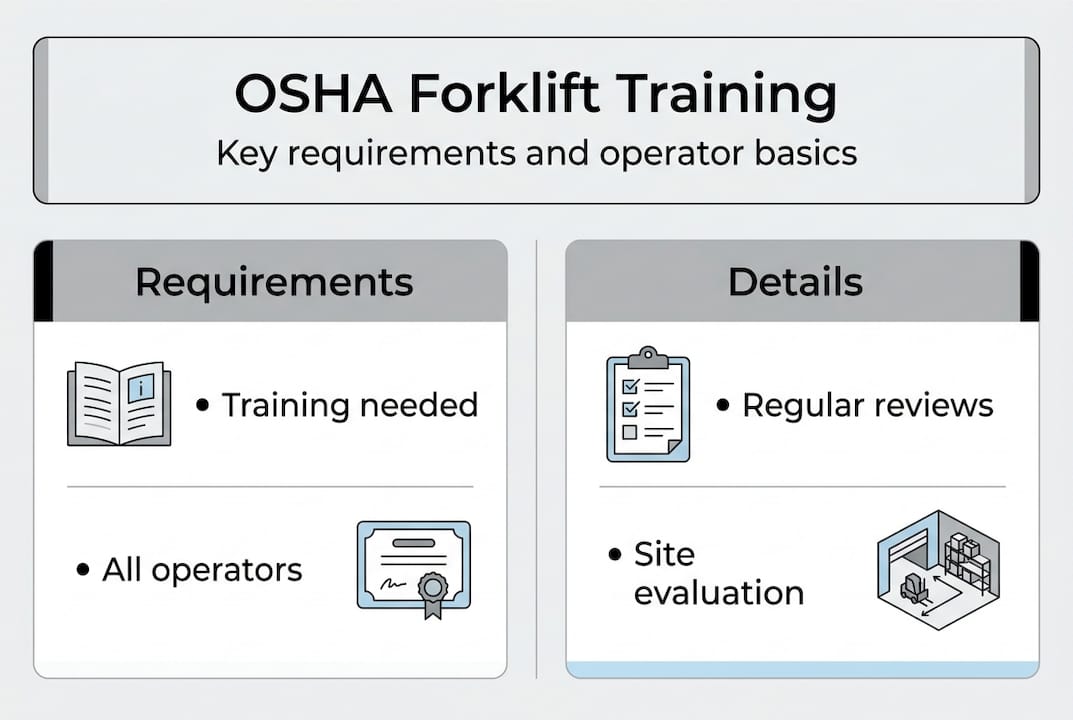
Here is a quick summary of the core OSHA requirements:
| Requirement | Details |
|---|---|
| Regulation | 29 CFR 1910.178(l) |
| Who must be trained | All operators, including part-time and temporary |
| Training components | Formal instruction, hands-on practice, evaluation |
| Recertification interval | Every 3 years minimum |
| Trigger for early recertification | Accident, near-miss, new equipment, or site changes |
| Language requirement | Training must be understood by the operator |
For a detailed breakdown of what your team needs to meet these standards, the employee forklift training guide and the business forklift training guide are practical starting points. You can also review the full list of OSHA forklift safety requirements to confirm your program covers every mandatory element.
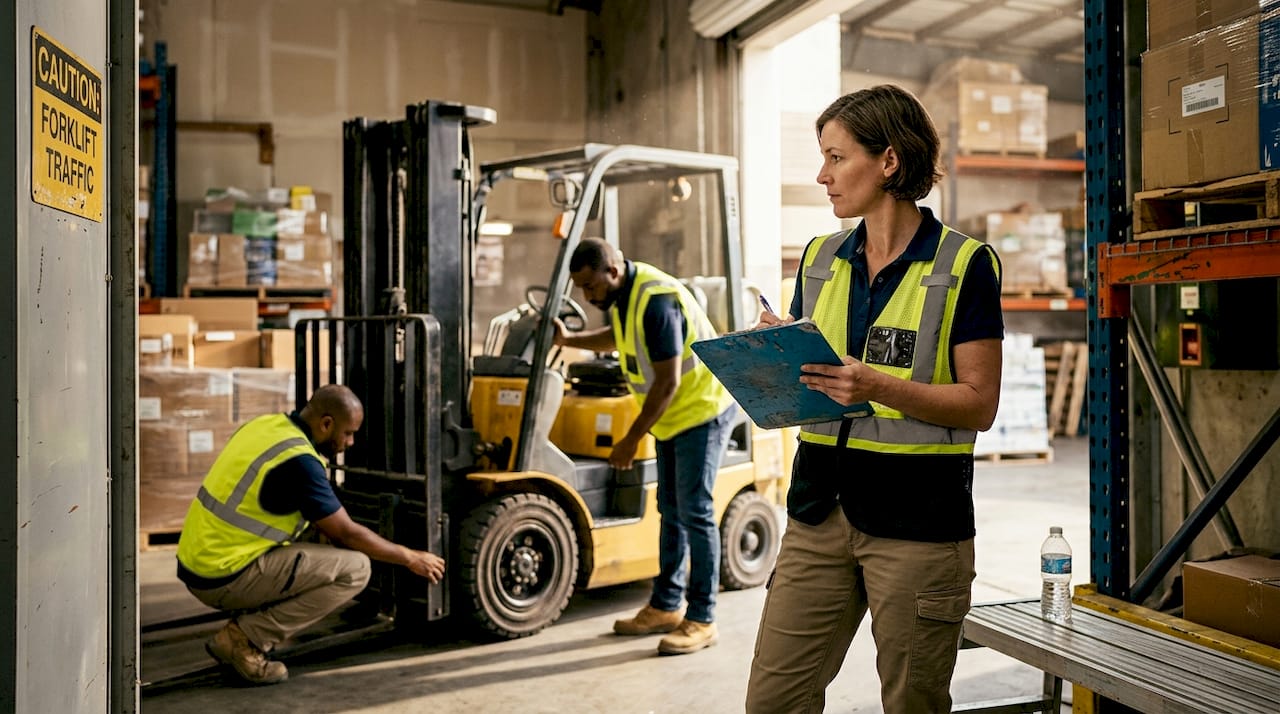
Compliance is not just about passing an audit. The numbers tell a clear story. OSHA-compliant training reduces forklift incidents by up to 70%, dropping incident rates from roughly 12 per 100 operators down to 3.6. That is a dramatic shift in risk exposure for your workforce and your business.
The financial stakes are just as significant. Powered industrial trucks ranked sixth on OSHA’s top 10 citations list in 2024, with 2,248 violations recorded and more than $8 million in penalties issued across the industry. The most common violations include unsafe operation practices, missed refresher training, and certification lapses. These are all preventable with a structured program.
“Powered industrial trucks generated over $8 million in OSHA penalties in 2024 alone, making it one of the most cited and costly compliance gaps in warehouse operations.”
Here is how the numbers compare when you look at compliant versus non-compliant operations:
| Outcome | Without compliance | With OSHA compliance |
|---|---|---|
| Incident rate (per 100 operators) | ~12 | ~3.6 |
| OSHA citation risk | High | Significantly reduced |
| Lost workdays per incident | Higher | Lower |
| Penalty exposure | $8M+ industry-wide | Minimal with documentation |
| Operator confidence | Variable | Consistently high |
For a broader look at how powered industrial trucks are regulated and what violations look like in practice, that resource breaks down the specifics clearly.
Knowing what OSHA requires is one thing. Delivering training that actually sticks is another. The most effective programs use three pillars: classroom or online instruction, hands-on operation, and regular performance evaluations. Each one serves a distinct purpose, and skipping any of them creates compliance gaps.
Training methodologies include classroom instruction covering hazards, load capacity, and stability, followed by hands-on operation and a performance evaluation conducted at least every three years. Blended training, which combines online general instruction with site-specific hands-on sessions, is increasingly the preferred model for multi-site operations because it scales without sacrificing quality.
Here is how a typical compliant training program unfolds:
Prioritizing blended training for multi-site compliance and scalability is a smart move because it lets you standardize the theory component while keeping the hands-on evaluation site-specific.
Pro Tip: If your workforce includes operators who speak different languages, build language-specific versions of your formal instruction materials. OSHA requires that operators actually understand their training, not just sit through it.
For a step-by-step walkthrough of the full process, the step-by-step forklift training resource is worth bookmarking. If you are planning an onsite session, the onsite forklift training guide covers logistics and preparation in detail.
Most managers think about forklift training as a cost center. The data says otherwise. Well-trained operators handle equipment more carefully, which translates directly into lower repair bills. Facilities that invest in structured training programs report equipment damage costs dropping from around $45,000 per year to roughly $18,000. That is real money back in your budget.
Training reduces equipment damage by approximately 60%, cuts lost-time injuries by 75%, and lowers insurance premiums by 15 to 25% for OSHA-compliant operations. Insurance carriers recognize the reduced risk profile of compliant facilities and price their policies accordingly.
Here is a snapshot of the measurable ROI improvements you can expect:
Pro Tip: Start tracking your incident counts and equipment repair costs now, before you launch or update your training program. That baseline data will let you calculate your actual ROI after training and make a compelling case to leadership for continued investment.
The forklift compliance guide walks through how to document and demonstrate these gains in a format that satisfies both OSHA auditors and internal stakeholders.
Understanding the benefits is the easy part. Building a program that holds up under an OSHA inspection and actually changes operator behavior takes deliberate planning. The most common pitfall is generic training that ignores site-specific equipment and hazards, skips evaluations, or assumes that experience equals competency. OSHA does not accept any of those assumptions.
Here is a practical checklist for launching or updating your compliant training program:
For a structured approach to keeping your operators current, the ensuring forklift operator OSHA compliance resource provides a clear framework that works for both small teams and large multi-site operations.
Forklift Academy has spent over 20 years helping warehouse and logistics teams build training programs that meet OSHA standards and deliver real operational results. Whether you need to certify a single operator or roll out a scalable solution across multiple facilities, there is a format that fits your operation.
The forklift training programs available through Forklift Academy cover everything from online certification to full onsite delivery, all built around the OSHA requirements covered in this article. If you want to build internal training capacity, the train the trainer online program gives your designated trainers the tools and credentials to run compliant evaluations in-house. For businesses managing multiple operators, the forklift certification business solutions are designed to simplify recordkeeping, scheduling, and compliance documentation at scale.
Forklift operators must be evaluated every 3 years at minimum, or sooner if they are involved in an incident, a near-miss, or if operating conditions change at your facility.
Yes, without exception. Occasional operators require the same formal instruction, hands-on practice, and evaluation as full-time employees. Employment status does not change the OSHA requirement.
No. Blended learning is essential because OSHA requires both theoretical instruction and a hands-on, site-specific performance evaluation. Online training alone does not satisfy the full standard.
Safe operation, refresher lapses, and improper operator certification are the top citations. These violations are consistently preventable with a documented, structured training program.
No. Forklift certification expires and must be renewed at least every three years, or whenever equipment, site conditions, or operator performance warrants an earlier review.




 Optimized by Seraphinite Accelerator