
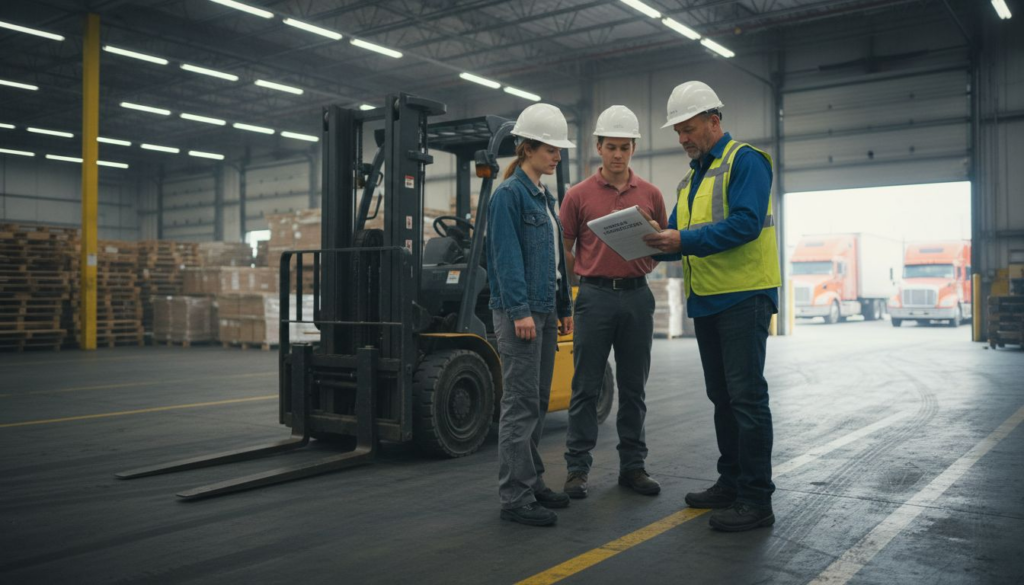

Training new forklift operators can be overwhelming, especially when workplace safety and compliance are on the line. It is not enough to provide instructions and hope for the best. Effective trainers need the right skills and methods to keep everyone safe and meet OSHA requirements.
This guide shows you how to deliver practical, OSHA-compliant forklift training that truly prepares operators for real-world challenges. Each section will reveal proven strategies for clear communication, hands-on instruction, and safety evaluation—so you can confidently support every trainee’s growth.
Get ready to uncover actionable tips and best practices that make a measurable difference in safety, operator performance, and regulatory compliance.
| Takeaway | Explanation |
|---|---|
| 1. Develop Comprehensive Training Programs | Structure programs to cover theory, hands-on practice, and performance evaluations, meeting OSHA standards. |
| 2. Communicate Safety Instructions Clearly | Use clear language and diverse teaching methods to enhance understanding and engagement among trainees. |
| 3. Assess Skills Through Realistic Scenarios | Design practical assessments that simulate workplace challenges to measure operators’ true abilities and readiness. |
| 4. Proactively Identify Safety Hazards | Instruct trainees on thorough risk assessments considering various workplace factors to prevent accidents. |
| 5. Maintain Accurate Training Documentation | Keep detailed records of training progress and evaluations to ensure compliance and track operator development. |
Forklift trainer skills begin with a comprehensive understanding of OSHA safety compliance standards for powered industrial truck operators. These standards are not just bureaucratic guidelines but critical protocols designed to protect workers and prevent workplace accidents.
OSHA regulation 1910.178(l) provides explicit requirements for forklift operator training, mandating that employers develop a structured program addressing both theoretical knowledge and practical skills. This means trainers must cover two primary domains: truck specific information and workplace specific hazards.
The training framework requires three essential components: formal classroom instruction, practical hands on training, and a performance evaluation to confirm operator competency. Trainers need to ensure that each component meets OSHA’s rigorous standards, which means developing comprehensive curriculum that goes beyond basic operational instructions.
Key elements of effective OSHA compliant training include understanding truck characteristics, workplace environment assessment, safety protocols, equipment inspection procedures, and potential hazard recognition. Trainers must be prepared to demonstrate and explain complex safety concepts in clear, actionable language that resonates with workers.
Pro tip: Regularly update your training materials to reflect the most current OSHA guidelines and incorporate real world case studies that illustrate the critical importance of safety protocols.
Forklift trainer effectiveness hinges on the ability to communicate safety instructions with absolute clarity and precision. Safety communication is a critical skill that can literally mean the difference between life and death in industrial environments.
Effective communication goes beyond simply reciting rules. Trainers must translate complex safety protocols into language that resonates with workers from diverse backgrounds and experience levels. This means breaking down technical information into digestible segments, using visual aids, real world examples, and interactive demonstration techniques that engage learners and promote genuine understanding.
The National Safety Council emphasizes that communication strategies should include multiple learning modalities. Visual learners benefit from diagrams and video demonstrations, while kinesthetic learners require hands on practice. Written instructions should be clear, concise, and free of unnecessary technical jargon that might confuse operators.
Successful safety instruction requires trainers to confirm comprehension through active questioning, practical demonstrations, and scenario based learning. This approach ensures that operators not only hear the instructions but truly understand how to apply safety principles in dynamic workplace environments.
Pro tip: Practice explaining complex safety procedures using analogies and real life scenarios that make abstract concepts immediately relatable and memorable for your trainees.
Forklift trainers must transform theoretical knowledge into practical skills through comprehensive hands on operation demonstrations. Showing trainees exactly how to operate equipment is more than a teaching technique it is a critical safety imperative.
Effective demonstration requires breaking down complex operational procedures into clear step by step processes. Trainers should showcase precise vehicle control techniques including smooth acceleration, controlled braking, accurate steering, and careful load management. This methodical approach helps trainees understand the nuanced skills required for safe forklift operation.
Practical demonstrations must cover multiple critical areas: vehicle inspection before operation, proper mounting and dismounting techniques, understanding control mechanisms, navigating different workplace environments, managing various load weights and sizes, and executing safe turning and stopping procedures. Each demonstration should simulate realistic workplace scenarios to prepare operators for actual working conditions.
Trainers need to combine verbal explanations with visual demonstrations, allowing trainees to observe correct techniques closely. This means showing correct body positioning, demonstrating smooth control inputs, and highlighting potential hazard recognition strategies that prevent workplace accidents.
Pro tip: Use video recordings of your demonstrations as supplemental training materials to reinforce learning and provide trainees with a reference they can review multiple times.
Accurate skill assessment is the cornerstone of effective forklift training, ensuring operators can safely navigate complex workplace environments. Comprehensive operator evaluation requires more than a simple checklist it demands a nuanced approach to measuring practical competence.
Trainers must design assessment protocols that go beyond theoretical knowledge and directly measure an operator ability to perform critical tasks under realistic conditions. This means creating evaluation scenarios that simulate actual workplace challenges including tight turning spaces, varying load weights, and potential hazard recognition.
Effective skill assessment includes multiple evaluation components: written knowledge tests, visual demonstration of equipment understanding, and practical performance trials. Trainers should observe operators performing specific tasks such as load pickup and placement, precise maneuvering, equipment inspection, and emergency response procedures.
Qualified evaluators must remain objective and consistent when measuring trainee performance. This requires establishing clear performance benchmarks, using standardized assessment criteria, and documenting each operators skill level with detailed observation notes. The goal is not to penalize but to ensure workplace safety through thorough and fair skills verification.
Pro tip: Create a graduated assessment framework that allows trainees multiple opportunities to demonstrate skills while providing specific feedback that supports continuous improvement.
Forklift trainer expertise demands a proactive approach to workplace safety hazard recognition. Understanding potential risks is not just about compliance it is about preventing life threatening accidents before they occur.
Effective hazard identification requires a comprehensive approach that goes beyond simple visual inspection. Trainers must teach operators to systematically assess workplace environments by examining multiple risk factors including surface conditions, pedestrian traffic patterns, load characteristics, equipment limitations, and potential environmental obstacles.
Critical hazard assessment involves breaking down risks into several key categories: physical environment hazards such as uneven surfaces or narrow corridors, equipment related risks like load instability or mechanical failures, human factors including fatigue and distraction, and site specific challenges unique to each workplace setting. Operators need to develop a keen eye for potential dangers that might not be immediately apparent.
Trainers should implement practical strategies for hazard mitigation including developing site specific safety protocols, conducting regular equipment inspections, creating clear communication systems for potential risks, and training operators to continuously scan their environment and anticipate potential problems before they escalate.
Pro tip: Create a standardized hazard assessment checklist that operators can quickly reference and use during every shift to systematically identify and address potential workplace safety risks.
Forklift trainers transform theoretical knowledge into actionable skills by creating immersive training scenarios that mirror actual workplace challenges. Simulating real world conditions bridges the critical gap between classroom learning and practical application.
Effective scenario based training goes beyond simple theoretical instruction by constructing complex situational experiences that challenge operators decision making skills. These scenarios should replicate authentic workplace environments complete with unexpected obstacles, potential hazards, and dynamic operational conditions that require quick thinking and precise control.
Trainers must design scenarios that systematically test multiple skill dimensions including spatial awareness, load management, emergency response, pedestrian interaction, and equipment handling. Each simulation should progressively increase in complexity allowing operators to build confidence and competence through structured experiential learning.
Constructing meaningful scenarios requires deep understanding of specific workplace contexts. This means customizing training environments to reflect actual warehouse layouts, manufacturing floors, construction sites, or logistics centers where forklifts operate. By integrating site specific challenges, trainers ensure that operators are genuinely prepared for their unique operational environment.
Pro tip: Record and review training scenario performances to provide targeted feedback and create a library of learning examples that can be used for continuous skill development.
Forklift trainer competence extends beyond instruction to meticulous training documentation. Comprehensive record keeping is not just an administrative task but a critical component of workplace safety and regulatory compliance.
Effective documentation involves creating a systematic approach to tracking each operators training journey. This includes maintaining detailed records of initial training dates, specific curriculum content, evaluation results, individual performance assessments, certification status, and scheduled refresher training requirements.
Trainers must develop a robust documentation system that captures multiple dimensions of operator development. This means creating standardized forms that record theoretical knowledge assessments, practical skill evaluations, equipment specific training modules, and ongoing performance monitoring. Digital tracking systems can help streamline this process and ensure no critical information falls through the cracks.
Regulatory compliance demands that these records be comprehensive, accurate, and easily accessible. Organizations should implement secure storage methods that protect individual training records while ensuring they can be quickly retrieved for internal audits or potential OSHA inspections.
Pro tip: Implement a digital tracking system with automatic renewal reminders to ensure operators never miss required recertification training and maintain continuous compliance.
Below is a comprehensive table summarizing the key elements and strategies discussed in the article regarding effective forklift operator and trainer practices according to OSHA standards.
| Topic | Overview | Key Takeaways |
|---|---|---|
| OSHA Standards | OSHA defines clear regulations for forklift training, urging a structured program of theoretical and practical components. | Ensure compliance by integrating OSHA’s guidelines into the training program. |
| Components of Training | Training involves classroom instruction, hands-on practice, and performance evaluation. | Develop a comprehensive curriculum to teach truck specifics, workplace hazards, and equipment operations. |
| Communication Strategies | Effective safety communication is crucial for trainee understanding. | Use visual aids, clear language, and engaging examples to convey safety rules effectively. |
| Practical Demonstration | Trainers must accurately and safely showcase forklift operations. | Break down complex tasks into digestible demonstrations to ensure operator comprehension and safety. |
| Training Progress Tracking | Meticulous documentation of training progress and compliance is essential. | Utilize digital systems for efficient tracking and to ensure regulatory adherence. |
This table condenses the essential content of the article into a structured format for quick understanding and practical application.
The challenge of providing effective OSHA training demands a deep understanding of safety standards, clear communication, hands-on demonstration skills, and rigorous trainee assessment. This article highlights how forklift trainers must not only grasp complex OSHA requirements but also translate them into practical, real-world training that ensures workplace safety. If you are looking to overcome hurdles like hazard identification, skill evaluation, and maintaining comprehensive documentation, focused solutions are within reach.
Elevate your forklift training program by exploring resources tailored to these critical skills. Our Forklift Safety Archives provide expert insights into safety protocols while the Forklift Certification Archives offer comprehensive program structures designed to meet OSHA regulations. 
Take action now to enhance your training effectiveness and protect your workforce. Visit ForkliftAcademy.com to access industry-leading OSHA-compliant certification courses and training products that simplify compliance and boost operational safety. Whether you need onsite training, train-the-trainer kits, or convenient online certification, your path to mastering forklift trainer skills starts here.
Forklift trainers should possess comprehensive knowledge of OSHA standards, exceptional communication skills, practical demonstration abilities, accurate skill assessment techniques, hazard identification expertise, and a knack for utilizing real-world scenarios in training. Focus on developing these key skills to enhance your training program and ensure safety compliance.
To enhance communication during forklift training, simplify complex safety protocols and use visual aids or hands-on demonstrations. Aim to create clear instructional materials that cater to various learning styles, ensuring understanding across diverse trainee backgrounds.
Begin with establishing a clear assessment protocol that includes written tests, practical evaluations, and observation during operation. Create realistic scenarios that simulate workplace conditions, allowing trainees to demonstrate their abilities under actual operating circumstances.
Perform a systematic assessment of your workplace by considering environmental factors, equipment limitations, and potential human errors. Develop a standardized hazard assessment checklist and regularly update it to ensure all risks are addressed during training.
Create a detailed documentation system that records training dates, content covered, and individual performance evaluations. Implement digital tracking methods to streamline record-keeping and ensure that training records are up-to-date and readily accessible.
Design training scenarios that replicate authentic workplace conditions, complete with challenges and hazards that trainees might face. Gradually increase the complexity of these scenarios to develop operators’ decision-making skills and confidence in their abilities.