
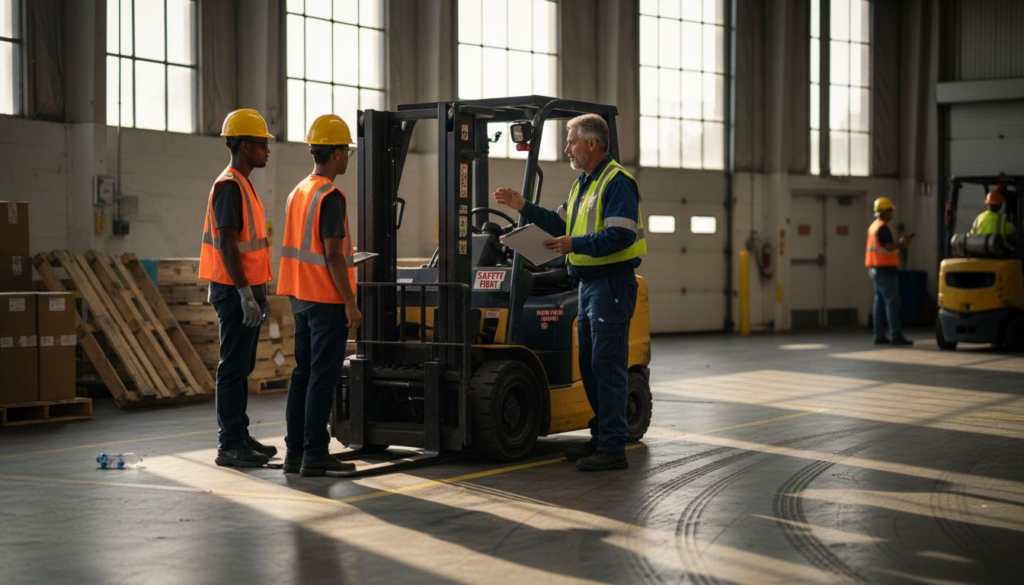

Forklift trainer responsibilities can feel overwhelming when you are expected to manage everything from safety instruction to compliance paperwork. Making sure your operators are not just trained, but truly competent and OSHA-certified, requires focused strategies and reliable systems. The good news is that there are proven approaches trusted by American safety organizations that help trainers create safer work environments and maintain compliance without guesswork.
This list reveals practical actions that will strengthen your training sessions, improve performance evaluations, and guarantee your documentation meets OSHA standards. You’ll discover real techniques for hands-on safety checks, customized lesson plans, and ongoing performance monitoring. By following these expert steps, you will gain confidence in your role and avoid costly compliance mistakes.
| Takeaway | Explanation |
|---|---|
| 1. Develop Comprehensive Training Programs | Integrate classroom instruction, hands-on training, and evaluations to ensure operator safety and comprehension. |
| 2. Conduct Hands-On Performance Evaluations | Assess operators in real-world scenarios, focusing on skills like load handling and emergency response under authentic conditions. |
| 3. Maintain Accurate Certification Records | Keep detailed documentation of training and performance to prove compliance and operator competence to meet OSHA standards. |
| 4. Customize Training Materials | Tailor training programs to address specific workplace hazards, equipment, and operator skill levels for effective learning. |
| 5. Regularly Update Training Content | Adapt programs to reflect new regulations and technologies, ensuring continuous improvement and compliance with safety standards. |
Forklift trainers play a critical role in creating safe warehouse environments through robust safety training programs. Developing comprehensive training sessions is more than a requirement – it’s a fundamental responsibility that directly impacts worker protection and operational efficiency.
The core of effective safety training involves combining multiple instructional approaches. According to the OSHA eTool for Powered Industrial Trucks, training programs must integrate:
Safety training is not a one-time event but a continuous process of education and skill refinement.
Successful training sessions should cover critical areas such as:
Trainers must ensure that operators not only understand theoretical safety concepts but can also apply them practically in real-world scenarios. This means creating training environments that simulate actual workplace conditions and challenge operators to make safe decisions.
Employers are required to provide refresher training every three years or sooner if performance issues are observed. The National Safety Council emphasizes that training should extend beyond operators to educate non-operators about forklift safety awareness.
Pro tip: Create scenario-based training modules that challenge operators to think critically about safety in dynamic warehouse environments.
Forklift trainers must move beyond classroom theory and validate operator skills through rigorous hands-on performance assessments. These practical evaluations are the critical bridge between learning and real-world safety competence.
When conducting hands-on forklift operator evaluations, trainers should comprehensively assess multiple performance domains:
A skilled evaluation reveals an operator’s true competence beyond theoretical knowledge.
Evaluation processes must simulate authentic workplace conditions. This means observing operators performing actual tasks using real equipment in their standard work environment. Practical skill demonstration becomes the ultimate test of an operator’s readiness.
Key assessment criteria should include:
Documentation is essential. Trainers must create detailed evaluation forms that objectively measure each performance category. These records serve as critical evidence of OSHA compliance and operator competency.
Pro tip: Design evaluation scenarios that progressively challenge operators with increasing complexity to truly assess their skill mastery and decision-making capabilities.
Forklift trainer responsibilities extend far beyond basic training – they include meticulous documentation and certification management. Maintaining rigorous OSHA-compliant certification processes is a critical safety imperative for workplace operations.
OSHA compliance requirements mandate comprehensive documentation that proves operator competency through structured training programs. These processes involve multiple critical components:
Certification is not a one-time event but an ongoing commitment to workplace safety.
Employers must implement systematic certification processes that include:
The certification process requires trainers to maintain detailed operator training records. These documents serve as legal proof of compliance and demonstrate that each forklift operator has received proper instruction and demonstrated competence.
Key documentation must include specific details such as operator name, training date, equipment type, and evaluation results. Retention of these records is crucial for potential OSHA inspections and workplace safety audits.
Pro tip: Develop a digital tracking system that automatically flags operators approaching recertification deadlines to ensure continuous compliance.
Forklift trainers are legally obligated to create and preserve comprehensive training documentation that serves as the backbone of workplace safety compliance. These records are not mere paperwork but critical evidence of operator readiness and regulatory adherence.
Record keeping practices require meticulous attention to detail and systematic documentation management. Trainers must capture and preserve multiple layers of critical information:
Accurate documentation transforms record keeping from an administrative task into a strategic safety tool.
Key documentation elements should include:
Regulatory requirements mandate that these records remain accessible for at least three years. Digital storage systems can provide enhanced security and easy retrieval while maintaining confidentiality and integrity of training information.
Trainers must ensure that documentation is not only comprehensive but also:
Pro tip: Implement a cloud-based digital documentation system that automatically timestamps and secures training records while providing instant access for compliance verification.
Forklift trainer effectiveness hinges on creating tailored training experiences that resonate with specific workplace environments and operator skill levels. One size never fits all when it comes to safety education.
Training program development requires strategic analysis and intentional design that goes beyond generic instructional materials. Successful customization involves understanding the unique operational context of each workplace.
Key components of effective customized training include:
Customized training transforms mandatory compliance into meaningful learning experiences.
Developing impactful training materials demands a structured approach:
Adult learning principles should guide material development. This means creating content that is:
Trainers must continuously refine materials based on performance data, emerging safety standards, and technological advancements in forklift operations.
Pro tip: Develop a modular training curriculum that allows for quick updates and personalization without rebuilding entire training programs.
Forklift trainers must transform safety oversight from a periodic obligation into a continuous improvement process. Effective performance monitoring is about preventing incidents before they occur.
Performance evaluation guidelines mandate systematic tracking of operator skills and safety adherence. This ongoing monitoring serves as a critical proactive safety strategy.
Key monitoring dimensions include:
Performance monitoring transforms potential risks into opportunities for skill enhancement.
Comprehensive monitoring requires:
Trainers should establish multiple monitoring touchpoints that capture operator performance through:
OSHA recommends conducting formal evaluations at least every three years or immediately following any safety incidents, equipment changes, or observed performance deviations.
Pro tip: Create a digital performance tracking system that provides real-time insights and automatically flags potential training needs or safety interventions.
Forklift trainers must be proactive guardians of workplace safety by continuously evolving training programs. Regulatory landscapes shift rapidly and training materials must keep pace with emerging standards and technological advancements.
Regulatory training updates are not optional but a critical compliance requirement. Successful trainers treat curriculum development as a dynamic process of continuous improvement.
Key areas for regular training updates include:
Stagnant training programs are a silent threat to workplace safety.
Strategic update processes should encompass:
Trainers must develop systematic update mechanisms that ensure:
Effective updating requires collaboration with safety experts, equipment manufacturers, and regulatory bodies to maintain training relevance and effectiveness.
Pro tip: Establish a quarterly review cycle with dedicated time for scanning regulatory updates and integrating new safety insights into your training curriculum.
Below is a comprehensive table summarizing the main strategies, insights, and recommendations from the article regarding forklift trainer responsibilities and practices.
| Key Focus Area | Description | Outcome |
|---|---|---|
| Conduct Comprehensive Safety Training | Integrate classroom lessons, practical exercises, and real-world simulations. Address critical topics, such as mechanics and hazard identification. | Enhances operator safety awareness and application of skills to prevent incidents. |
| Perform Hands-On Operator Evaluations | Assess operational proficiency through practical tests covering inspection, maneuvering, and emergency response. Document results systematically. | Validates skill mastery, ensuring operators adhere to safety protocols. |
| Ensure OSHA-Compliant Certification | Manage detailed records of operator training, evaluation, and recertification processes in adherence to OSHA standards. | Enables compliance verification and continuous skill validation. |
| Maintain Detailed Records | Keep systematically organized documentation reflecting training dates, evaluation results, and recertification status. | Ensures historical accountability and readiness for audits. |
| Develop Customized Materials | Tailor training content to align with workplace-specific hazards, equipment, and operator expertise. | Provides relevant and engaging learning experiences, fostering applicable skill development. |
| Monitor Performance Continuously | Establish ongoing evaluation processes like unscheduled observations and technology-driven tracking. | Identifies skill gaps early, enabling timely corrective actions and sustained safety compliance. |
| Update Training Regularly | Periodically revise content to incorporate OSHA updates, technological advancements, and emerging industry practices. | Keeps training programs effective and aligned with current standards, ensuring operators’ knowledge remains up-to-date. |
The article highlights vital responsibilities every forklift trainer must master to ensure workplace safety and OSHA compliance. From delivering comprehensive training sessions to maintaining detailed documentation and monitoring ongoing operator performance, these duties are key challenges for trainers striving to protect their teams and meet regulatory standards. If you are seeking to overcome these obstacles with proven, practical solutions, exploring the Forklift Safety Archives is a great first step.
Take control of your forklift training program today with expert guidance and OSHA-compliant certification options from Forkliftacademy.com. Whether you need tailored onsite training, hands-on evaluation tools, or reliable certification resources, we offer comprehensive solutions backed by over 20 years of experience. Start building safer workplaces now by visiting our Forklift Certification Archives and learn how to empower your operators and trainers effectively.
A forklift trainer is responsible for conducting comprehensive safety training sessions, performing hands-on forklift operation evaluations, ensuring OSHA-compliant certification processes, maintaining detailed training records, developing customized training materials, monitoring ongoing operator performance, and updating training to reflect new regulations and practices. Focus on creating a safe environment by integrating a mix of instructional approaches.
Forklift operators must receive refresher training every three years or sooner if performance issues are observed. Schedule these sessions proactively to maintain high safety standards and operator competency.
Include pre-operation equipment inspections, load handling techniques, safe travel and maneuvering, and emergency response readiness in evaluations. Ensure assessments simulate real workplace conditions for effective skill verification.
Documentation needs to include initial training completion dates, operator certification details, performance evaluation outcomes, and periodic skills reassessment records. Maintain these records securely and ensure they are accessible for at least three years.
Regularly monitor OSHA regulations, attend industry conferences, and analyze technological advancements to update training programs. Implement a quarterly review cycle to incorporate relevant changes swiftly.
Customize training materials by conducting detailed workplace hazard assessments and understanding the specific skill levels of your operators. Align content with operational challenges to create engaging and applicable training experiences.