 Skip to content

Forklift accidents often happen not because workers are careless, but because they misunderstand or misuse key safety terminology. For those managing warehouses across the United States and Canada, the difference between “carriage” and “mast,” or knowing why only properly trained and certified individuals over 18 can operate a forklift, is not just trivia—it is workplace safety in action. This guide clarifies critical forklift safety terms and addresses common misconceptions that lead to preventable risks.
| Point | Details |
|---|---|
| Understanding Terminology is Crucial | Comprehension of forklift-related terms is essential for safety and operational efficiency, as it helps prevent workplace accidents. |
| OSHA Regulations are Key | Familiarity with OSHA standards ensures legal compliance and promotes effective safety management practices across the workplace. |
| Training is Ongoing | Regular training, including refresher courses, is necessary to maintain operators’ skills and knowledge regarding safety protocols. |
| Precision in Communication Matters | Clear and precise language reduces the risk of misunderstandings that can lead to dangerous operational errors. |
Forklift safety terminology represents a critical foundation for preventing workplace accidents and ensuring operational efficiency. Understanding these specialized terms goes far beyond simple vocabulary—it’s about creating a comprehensive safety framework that protects workers and equipment. Powered industrial trucks are complex machines with specific operational requirements that demand precise communication and training.
Several key terms are fundamental to forklift safety knowledge:
Misconceptions about forklift operations can create dangerous workplace environments. Many operators incorrectly assume that all forklifts function identically or that prior experience automatically translates across different equipment types. OSHA regulations mandate that only properly trained individuals over 18 years old can legally operate these powerful machines, highlighting the importance of specialized knowledge.
Understanding forklift terminology isn’t just about learning words—it’s about preventing potentially fatal workplace accidents.
Workplace safety requires recognizing that different forklift types present unique hazards. Sit-down high-lift riders, for instance, have different risk profiles compared to motorized hand trucks. Operators must understand these distinctions to implement appropriate safety protocols.
Pro tip: Conduct regular terminology refresher training to ensure all team members speak the same safety language and understand critical operational definitions.
Warehouse managers play a critical role in maintaining workplace safety, and understanding key OSHA powered industrial truck standards is fundamental to protecting workers and preventing accidents. These specialized terms are not just bureaucratic language—they represent precise guidelines that directly impact operational safety and legal compliance.
Key OSHA terminology warehouse managers must master includes:
Understanding these terms goes beyond memorization—it’s about creating a comprehensive safety culture. OSHA regulations are designed to minimize workplace accidents by establishing clear communication standards and operational requirements. Warehouse managers who thoroughly comprehend these definitions can implement more effective training programs and develop proactive safety strategies.
OSHA terminology is the language of workplace safety—mastering it can literally save lives.
Comprehensive knowledge of these terms enables managers to develop robust safety protocols, conduct more effective training sessions, and ensure legal compliance. Each term represents a critical component in the broader framework of workplace safety, helping to prevent potential accidents and protect workers from unnecessary risks.
This table highlights which OSHA term is most critical for common warehouse safety objectives:
| OSHA Term | Key Purpose | Role in Safety Management |
|---|---|---|
| Operator Certification | Skill verification | Ensures operators meet legal requirements |
| Vehicle Classification | Equipment identification | Matches forklifts to task hazards |
| Safety Inspection Protocol | Risk reduction | Detects hazards before incidents occur |
| Workplace Hazard Assessment | Planning safety | Identifies site-specific dangers |
Pro tip: Conduct quarterly terminology review sessions to ensure all team members remain current with the latest OSHA definitions and safety standards.
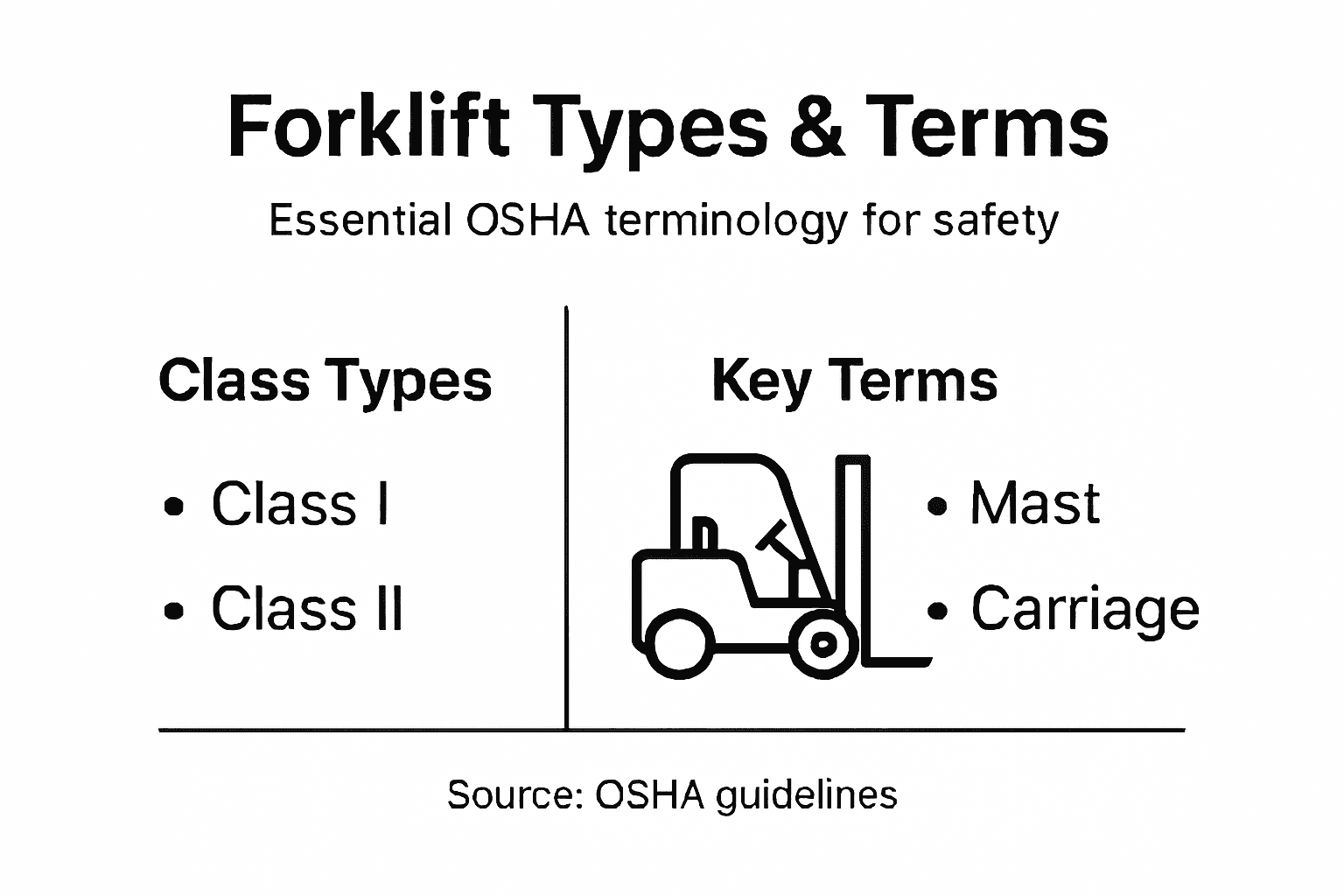
Understanding forklift classification systems is crucial for workplace safety and effective equipment management. These comprehensive categories define not just the physical characteristics of industrial trucks, but also their specific operational capabilities and potential workplace applications.
Forklift types are typically classified into several key categories:
Each classification represents a specific set of engineering design features that determine the truck’s optimal operating conditions. Tire configurations play a critical role in these distinctions, with pneumatic and cushion tires serving different surface requirements and operational environments.
Here’s a concise comparison of forklift classes to help select the right equipment for different workplace needs:
| Forklift Class | Typical Power Source | Best Use Environment | Key Advantage |
|---|---|---|---|
| Class I | Electric | Indoor warehouses | Quiet, no emissions |
| Class IV | Internal combustion | Smooth floors | Higher power output |
| Class V | Internal combustion | Rough terrain | Outdoor versatility |
| Class III | Electric | Small spaces | Maneuverable design |
Selecting the right forklift class is not just about equipment—it’s about matching precise machinery to specific workplace demands.
Beyond basic classification, equipment-specific terminology helps managers and operators understand nuanced operational characteristics. This includes detailed specifications like lift height, load capacity, power source, and specialized attachments that transform a standard forklift into a versatile workplace tool.
Pro tip: Create a visual classification chart in your warehouse to help staff quickly identify appropriate forklift types for specific tasks and environments.
Understanding OSHA forklift training requirements is crucial for maintaining workplace safety and legal compliance. The terminology surrounding forklift operator qualification involves a complex set of standards that go beyond simple documentation.
Key certification and training terminology includes:
Workplace training standards require a multifaceted approach that combines theoretical instruction with hands-on practical experience. Employers must ensure that training goes beyond simple instruction, focusing on comprehensive skill development and safety awareness.
Certification is not just a piece of paper—it’s a commitment to workplace safety and professional excellence.
The distinction between licenses and certifications can be nuanced, with certification typically representing a more comprehensive validation of an operator’s skills. While a license might be a legal requirement, true certification demonstrates a deeper understanding of operational safety, equipment characteristics, and workplace risk management.

Pro tip: Develop a comprehensive training tracking system that monitors individual operator certifications, renewal dates, and performance evaluations to ensure ongoing compliance and safety.
Misunderstanding critical forklift safety hazards and terminology can create significant workplace risks. Language precision matters immensely when communicating about industrial equipment, where a single misinterpreted term could lead to potentially dangerous operational errors.
Common terminology mistakes that compromise safety include:
Workplace communication standards demand rigorous language precision. Operators must develop a shared vocabulary that leaves no room for misinterpretation, especially when discussing equipment limitations, potential hazards, and operational protocols.
Precise terminology is the first line of defense against workplace accidents.
Risk prevention requires more than memorizing terms—it demands comprehensive understanding of how language translates into safe operational practices. Warehouse managers must create training environments that emphasize not just memorization, but deep comprehension of technical language and its real-world implications.
Pro tip: Implement quarterly terminology comprehension assessments to ensure all team members maintain a consistent and accurate understanding of critical safety language.
Understanding specialized forklift safety terms is essential to prevent costly accidents and maintain compliance. This article highlights how precise language around concepts like “load center,” “operator certification,” and “vehicle classification” builds a safer warehouse environment. If you have struggled to align your team with OSHA regulations or want to eliminate confusion surrounding forklift operation, focused training is the key.
At Forkliftacademy.com, we offer tailored solutions that bridge knowledge gaps and reinforce critical safety terminology with proven OSHA-certified programs. Our extensive Forklift Safety Archives provide deep insights to support your learning journey while our comprehensive training options ensure every operator understands the terms that protect lives and assets.
Take command of forklift safety today by exploring our expert-led certification courses and onsite training services. Don’t wait until a costly mistake happens; visit Forkliftacademy.com now to ensure your team speaks the language of safety fluently and confidently.
Understanding forklift safety terminology includes essential terms like lift cylinders, carriage, overhead guard, mast, and load center. These terms are crucial for ensuring operational safety and preventing workplace accidents.
Mastering OSHA terminology is critical for warehouse managers as it establishes clear communication standards that directly enhance safety management and legal compliance, thus minimizing the risk of accidents.
Forklifts are classified into various classes such as Class I (electric motor rider trucks), Class II (narrow aisle trucks), Class III (hand trucks), Class IV (internal combustion cushion tire trucks), Class V (pneumatic tire trucks), and more, each optimized for different operational environments and tasks.
Forklift operator training, including terminology refreshers, should be conducted regularly, with initial training followed by mandatory refresher training to maintain skills and compliance, along with quarterly reviews to keep all team members updated on the latest safety language and standards.




 Optimized by Seraphinite Accelerator