
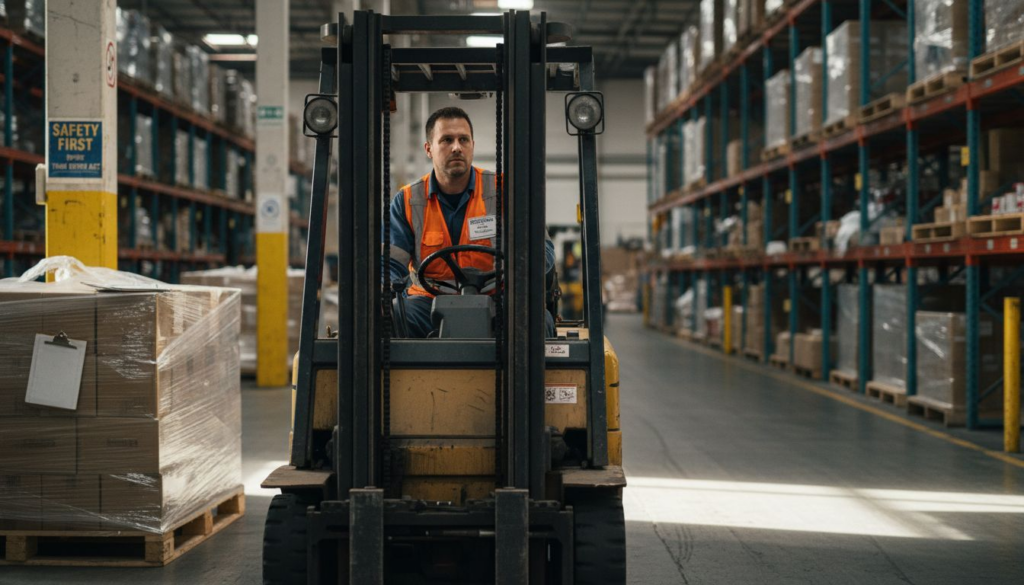

For many American warehouse managers, the terms forklift license and certification often get used interchangeably, yet they carry distinct legal and compliance implications. Mixing up these requirements can leave your facility vulnerable to audits, fines, and serious liability issues. This article unpacks the true differences between a state-issued license and OSHA-required forklift certification, equipping you to protect your team and stay fully compliant.
| Point | Details |
|---|---|
| Forklift License vs. Certification | A forklift license is state-issued for public road operation, while OSHA-required certification is employer-specific for workplace competency. |
| Compliance Responsibility | Employers are responsible for ensuring operators receive proper training, documentation, and timely refresher courses to avoid legal liabilities. |
| Certification Validity | Forklift certifications are valid for three years, requiring renewal before expiration to maintain compliance and operational legality. |
| Training Records Management | Proper recordkeeping of certifications and training completion dates is essential to prevent non-compliance and facilitate audits. |
The difference between a forklift license and certification is more than just terminology. These terms represent distinct requirements that directly affect your warehouse’s compliance status and liability exposure.
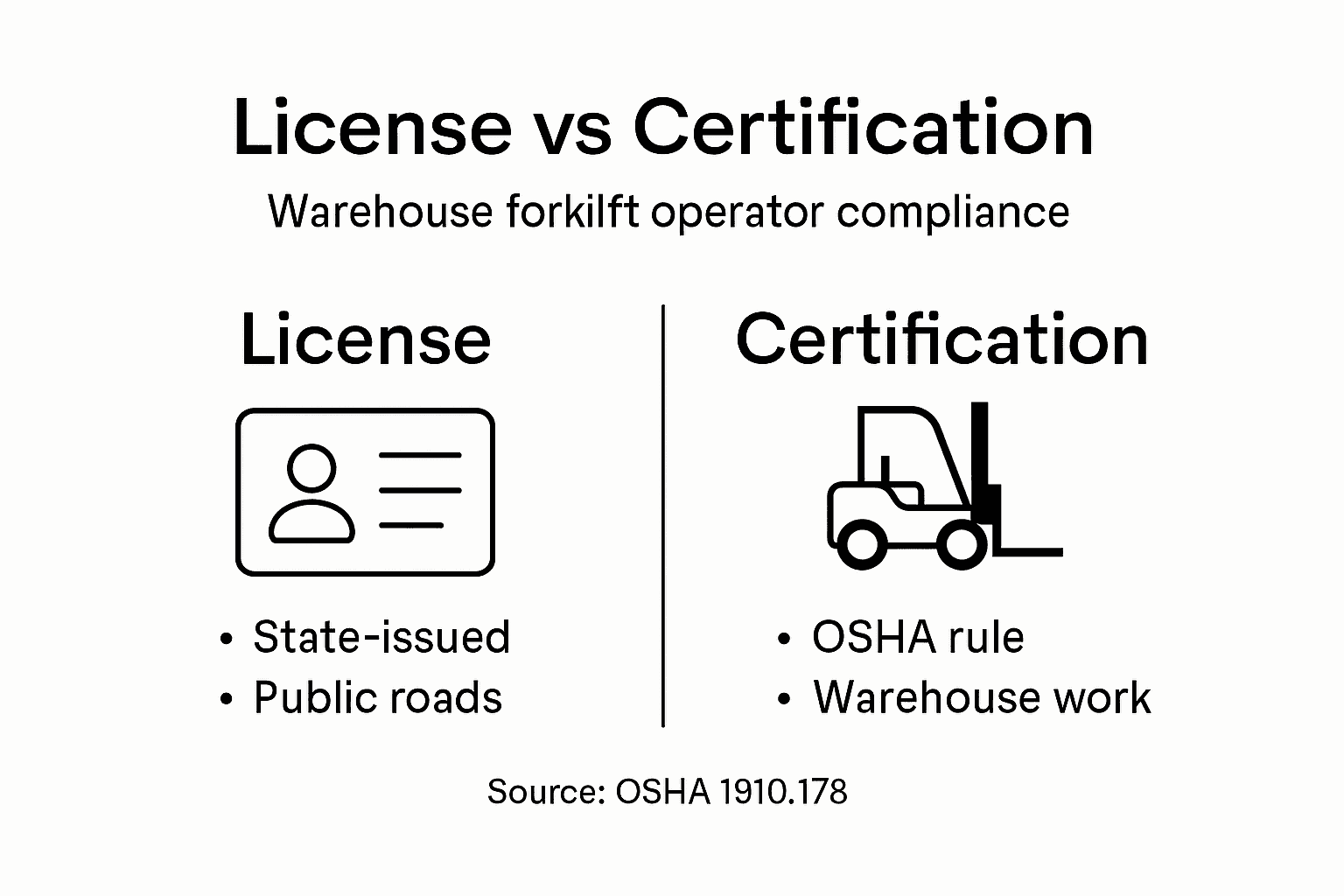
A forklift license is a state-issued credential proving legal eligibility to operate a vehicle on public roads. Think of it like a driver’s license for your vehicle—it grants permission from your state or provincial government. However, forklifts primarily operate on private property, so this distinction matters less in most warehouse settings.
A forklift certification, by contrast, is workplace-specific. OSHA requires operators to be competent, proven through training and evaluation according to strict federal standards. This certification comes from your employer or a training provider, not the state.
For most warehouse managers, OSHA certification is what matters. Your team doesn’t need state licenses to operate forklifts on your property—they need OSHA-compliant certification.
OSHA mandates that operators receive comprehensive safety training, both classroom and practical, recognizing different forklift classes and their hazards. Operating without proper training and certification is unlawful.
Here’s the practical reality: warehouse managers must ensure all forklift operators hold valid OSHA certifications. The certification documents that your operators completed classroom training, hands-on evaluation, and understand equipment hazards specific to your operation.
Understanding the distinction helps you implement the correct compliance strategy. You’ll need to focus resources on obtaining and maintaining OSHA certifications for your team rather than pursuing state licenses.
Here’s how licenses and certifications affect warehouse compliance:
| Factor | Forklift License | OSHA Certification |
|---|---|---|
| Issuer | State agency | Employer or training provider |
| Legal Scope | Public road operation | Workplace operation only |
| Compliance Impact | Minimal in warehouses | Mandatory for all operators |
| Main Business Risk | Not relevant for off-road | Fines, audits, liability |
Pro tip: Create a centralized certification tracking system listing each operator’s certification date, expiration date, and forklift classes authorized—this simplifies audits and prevents non-compliance situations.
OSHA’s forklift regulations establish mandatory training and evaluation standards that differ significantly from state licensing requirements. Understanding these distinctions protects your warehouse from citations, fines, and liability exposure.
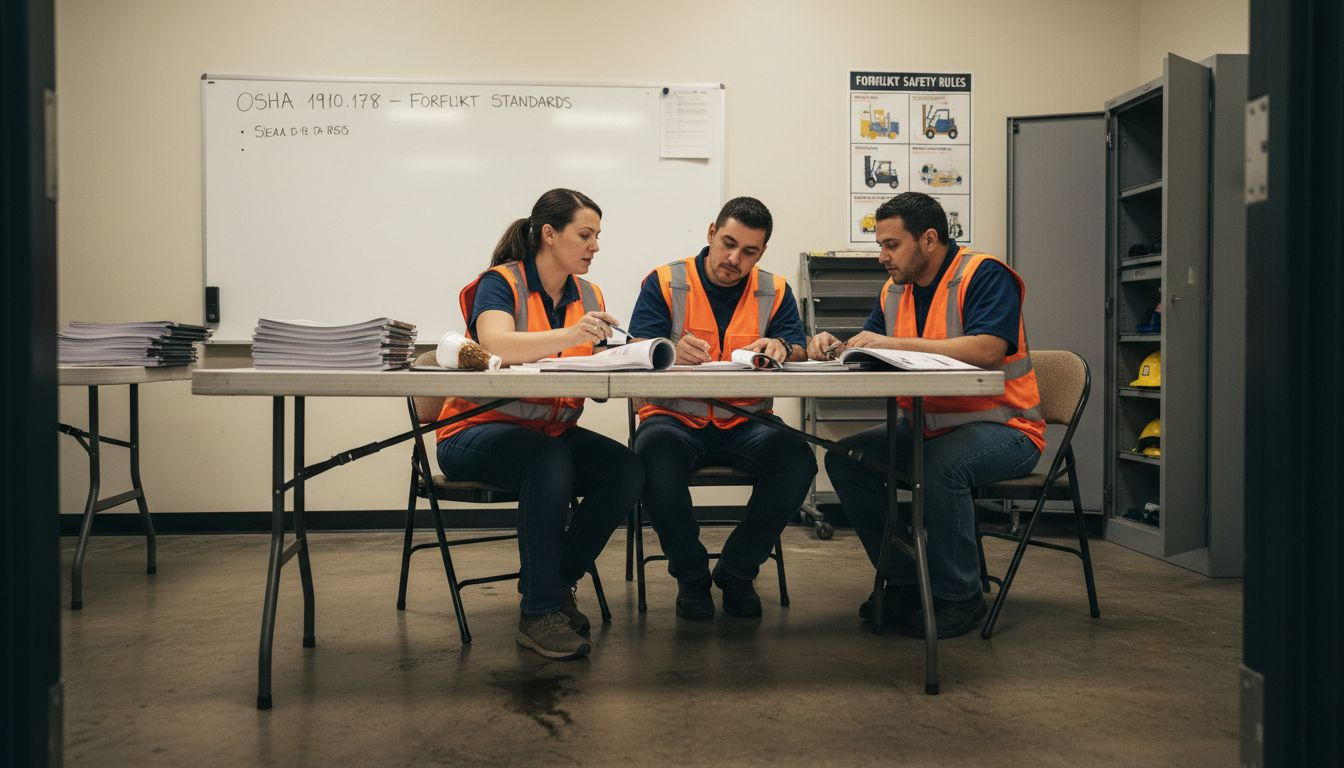
OSHA Regulation 1910.178 mandates that all forklift operators receive formal training before operating equipment. This training covers equipment-specific hazards, workplace-specific conditions, and hands-on operational skills. Your company bears the responsibility for ensuring compliance—not the operator.
The regulatory requirement centers on operator competency, documented through both classroom instruction and practical evaluation. OSHA defines competency as demonstrated knowledge and ability to operate equipment safely in your specific environment.
Unlike state licensing, OSHA certification doesn’t grant universal operating privileges. A certified operator on your premises may not be certified at another facility. Each employer must maintain training records and ensure operators understand that specific workplace’s layout, hazards, and procedures.
OSHA holds employers liable for non-compliance, not operators. Your warehouse faces potential citations up to $16,000+ per violation if operators lack proper certification.
Legal distinctions matter here. State licenses prove road-worthiness and vehicle ownership eligibility. OSHA compliance requirements address workplace safety and operational competency. These serve entirely different legal purposes.
Your liability exposure increases dramatically without proper OSHA documentation. Accidents involving uncertified operators create negligence claims, regulatory fines, and workers’ compensation complications. Insurance policies often deny coverage for injuries involving non-certified equipment operators.
The three-year refresher cycle keeps operators current on safety practices. Even certified operators require periodic retraining to maintain competency and refresh hazard recognition skills.
Pro tip: Schedule refresher training in staggered cycles so your entire team completes training gradually, preventing operational gaps and distributing training costs across multiple quarters.
The forklift certification process follows a structured three-step approach: classroom training, hands-on evaluation, and official documentation. Each component serves a specific purpose in ensuring operator competency and workplace safety.
Certification begins with classroom instruction covering forklift operations, safety principles, and hazard recognition. Trainers explain equipment limitations, load capacities, and common accident scenarios relevant to your specific workplace environment.
After classroom completion, operators proceed to hands-on practical evaluation. An authorized evaluator observes the operator performing real-world tasks: picking up loads, navigating obstacles, stacking materials at height, and parking safely. This testing phase reveals whether the operator can apply classroom knowledge to actual conditions.
Who issues these certifications? That depends on your training provider. Authorized training organizations deliver OSHA-compliant programs and issue certificates upon successful completion. Employers can also maintain internal trainers who certify operators after completing instructor-level training.
Forklift Academy and similar certified providers deliver standardized, OSHA-compliant training programs available online and onsite. Online options include classroom modules with video instruction, while onsite training provides hands-on evaluation at your facility using your equipment.
Certification validity lasts three years, after which recertification is required to maintain operator status. Don’t wait until certification expires—schedule refresher training in advance.
Some warehouses develop internal expertise through train-the-trainer programs, allowing designated staff to certify new operators. This approach reduces long-term training costs while maintaining compliance standards.
The issuer maintains records and provides documentation proving compliance during inspections. Your organization bears responsibility for keeping these records accessible and current, regardless of who conducted the training.
Pro tip: Use a certification tracking spreadsheet or software listing operator name, certification date, expiration date, and forklift types authorized—this prevents missed renewals and demonstrates due diligence during OSHA audits.
Forklift certifications expire after three years, creating a critical renewal cycle that many warehouse managers underestimate. Missing this deadline puts your operation out of compliance and exposes operators to potential incidents.
OSHA certification validity lasts three years from the date of issue. After this period, operators cannot legally operate forklifts until they complete refresher training and evaluation. This isn’t a grace period—it’s a hard stop.
Refresher training covers the same ground as initial certification: safety principles, hazard recognition, and hands-on evaluation. The refresher requirement keeps operators current on best practices and ensures they haven’t developed unsafe habits over three years.
Here’s where many managers get surprised: certifications are employer-specific and not universally transferable. An operator certified at Warehouse A cannot automatically operate forklifts at Warehouse B, even if both facilities use identical equipment.
Why? Because certifications document that an operator understands your specific workplace layout, equipment configuration, and hazards. A new facility has different dock heights, different aisle widths, different load stacking procedures, and potentially different forklift models. The operator must be retrained for those specific conditions.
If an operator transfers to a different facility or changes equipment, retraining is required before operation begins. Accidents, unsafe operation, or workplace changes also trigger mandatory retraining.
Your organization maintains liability for ensuring operators are certified for your specific conditions. A certificate from another employer doesn’t satisfy OSHA requirements—it proves they received training, but not that they’re competent in your environment.
Some regional facilities belonging to the same company can establish reciprocal agreements, but this requires formal documentation and OSHA approval. Don’t assume transferability without explicit authorization.
Track expiration dates by operator name, certification type, and expiration month. Build renewal into your annual training budget and calendar to prevent compliance gaps.
Below is a summary of OSHA’s certification and renewal essentials:
| Requirement | Details | Business Impact |
|---|---|---|
| Validity Period | 3 years | Ensures periodic re-training |
| Renewal Trigger | 30-60 days before expiration | Prevents operator downtime |
| Transferability | Not transferable across employers | Retraining required for new sites |
| Recordkeeping | All documentation must be accessible | Eases audits, reduces penalties |
Pro tip: Set automated calendar reminders 60 days before each operator’s certification expires, then schedule refresher training immediately—this buffer prevents last-minute scrambling and maintains continuous compliance across your team.
As a warehouse manager or HR professional, you bear direct responsibility for forklift operator certification. OSHA holds employers accountable—not operators—for compliance failures and the consequences that follow.
Your core responsibilities include ensuring all operators receive initial training, documenting completion, scheduling three-year refresher training, and maintaining accessible records. These aren’t suggestions. They’re legal requirements with serious financial and safety consequences.
Many employers stumble with the same preventable mistakes. The most critical error is neglecting recurring training. Operators receive initial certification, then slip into operations without refresher training on schedule. Three years passes quietly, and suddenly you have uncertified operators running equipment.
OSHA fine risks escalate when employers fail to maintain compliance. Citations for lacking operator certification routinely exceed $16,000 per violation. Multiple uncertified operators multiply that exposure exponentially.
Beyond fines, non-compliance creates liability exposure. If an uncertified operator causes an accident resulting in injury or property damage, your organization faces negligence claims. Insurance policies often deny coverage for incidents involving non-compliant operations.
Employers must implement comprehensive, OSHA-aligned training programs and maintain rigorous documentation to minimize compliance risks and prevent workplace accidents.
Your warehouse’s specific conditions require customized training. Different aisle widths, dock configurations, equipment types, and load handling procedures demand site-specific instruction beyond generic classroom content. Document this facility-specific training for each operator.
Recordkeeping is where many managers falter. Keep certification dates, evaluator names, refresher completion dates, and operator names in one searchable location. When OSHA inspectors arrive, they’ll request immediate access to these records.
Schedule retraining before expiration dates arrive. Don’t wait until certifications lapse—plan refresher training 60 days in advance and track progress.
Pro tip: Assign one staff member ownership of certification tracking and renewal scheduling, then create a monthly email reminder system that flags expiring certifications—this single accountability structure prevents the drift that causes compliance failures.
Navigating the difference between a forklift license and OSHA certification can be challenging, especially when the safety and legal compliance of your warehouse operations are at stake. This article highlights the critical need for OSHA-compliant forklift certifications that demonstrate operator competency beyond just state-issued licenses. If you want to avoid costly fines, minimize liability risks, and maintain a safe working environment, focusing on thorough operator training and certification is essential.
Take control of your forklift training program today by exploring our Forklift Certification Archives where you will find OSHA-compliant courses designed to meet all workplace-specific requirements. Whether you are seeking individual evaluation, onsite corporate training, or train-the-trainer solutions, ForkliftAcademy.com provides trusted resources backed by over 20 years of experience. Don’t wait until certification lapses jeopardize your operation. Visit our Forklift License Archives for additional insights and get started now to protect your team and your business.
A forklift license is a state-issued credential for operating vehicles on public roads, while forklift certification is workplace-specific, proving competency to operate forklifts in a specific environment as required by OSHA regulations.
No, a state-issued license is not required for operating forklifts on private property like a warehouse. However, OSHA certification is mandatory for all operators.
Forklift certifications expire after three years. Operators must complete refresher training and evaluation to maintain their certification before the expiration date.
Employers must ensure all forklift operators receive initial and refresher training, document training completion, and maintain accessible records to comply with OSHA regulations.