

Only one in four American warehouses fully comply with OSHA forklift training standards, yet the risks of non-compliance reach far beyond simple paperwork. For any warehouse manager overseeing American teams, these regulations are both a legal mandate and a powerful tool against costly accidents and downtime. This article outlines the real qualifications of certified forklift trainers and unpacks dangerous myths so you can build a truly safe, compliant operation.
| Point | Details |
|---|---|
| Certified Forklift Trainers | These professionals are highly trained safety experts, not just experienced operators, and are essential for ensuring compliance with safety protocols. |
| Credential Importance | Forklift trainer credentials vary in levels, emphasizing both operational skills and instructional capabilities, critical for effective safety training. |
| Legal Responsibilities | Certified trainers hold significant legal duties, including structured training programs and maintaining compliance with OSHA regulations to prevent workplace incidents. |
| Financial Impact | Investing in certified forklift training reduces accident rates, lowers insurance costs, and enhances overall operational efficiency, resulting in long-term financial benefits. |
Certified forklift trainers are specialized safety professionals who play a critical role in workplace equipment operations. These experts are not simply experienced operators, but highly trained individuals who understand complex safety protocols and training methodologies. Safety training requirements mandate specific qualifications that go far beyond basic operational skills.
Contrary to common misconceptions, becoming a certified forklift trainer involves much more than having years of equipment experience. These professionals must complete rigorous certification programs that teach comprehensive instructional techniques, safety assessment protocols, and detailed OSHA compliance standards. A certified trainer learns not just how to operate a forklift, but how to effectively communicate safety principles, evaluate operator competence, and design training programs that minimize workplace risks.
The key distinctions of a certified forklift trainer include their ability to:
Pro tip: Warehouse managers should always verify a trainer’s official certification credentials before allowing them to conduct safety training programs.
Forklift trainer credentials represent specialized professional qualifications that validate an individual’s ability to train and assess equipment operators safely. These credentials are not uniform but vary across different skill levels and industry requirements. Certified Forklift Technician (CFT) credentials provide a standardized pathway for professionals to demonstrate their expertise in material handling equipment training and maintenance.
The most prominent forklift trainer credentials include multiple levels of professional certification. Basic credentials typically require completion of OSHA-approved training programs, while advanced certifications like the CFT involve comprehensive online coursework, practical assessments, and in-depth knowledge of equipment maintenance and safety protocols. These credentials are crucial for ensuring that trainers possess not just operational skills, but also the instructional capabilities to effectively communicate safety standards.
Key types of forklift trainer credentials encompass:
Each credential represents a different level of expertise, with some focusing on general safety protocols while others emphasize technical maintenance and advanced instructional techniques. Warehouses and logistics companies increasingly recognize these credentials as essential markers of professional competence.
Here’s a summary of major forklift trainer credentials and their primary focus:
| Credential Type | Main Emphasis | Common Use Case |
|---|---|---|
| OSHA Compliance Trainer Certification | Regulatory safety instruction | General warehouse and logistics training |
| Certified Forklift Technician (CFT) | Equipment repair and maintenance | Technical roles or maintenance leads |
| Train-the-Trainer Certification | Peer trainer preparation | Supervisors or senior operators |
| Specialized Equipment Certification | Niche machinery or applications | Unique equipment, such as narrow aisles |
| Manufacturer Training Certification | Brand-specific operation | Facilities with specific forklift brands |
Pro tip: Always verify the specific requirements and recognition of forklift trainer credentials within your specific industry and geographical region.
Forklift trainer legal responsibilities extend far beyond simple operational guidance, encompassing comprehensive safety mandates established by federal workplace regulations. OSHA training requirements establish strict guidelines that define the precise legal obligations of certified forklift trainers in protecting workplace safety. These regulations mandate that trainers possess not just technical skills, but also the comprehensive knowledge to evaluate and certify operator competence.
Under federal workplace safety laws, forklift trainers carry significant legal responsibilities that include developing structured training programs, conducting thorough operator assessments, and maintaining detailed documentation of training processes. The regulations require employers to ensure that every forklift operator receives comprehensive training that includes:
The legal framework surrounding forklift training places substantial accountability on both trainers and employers. Failure to comply with OSHA standards can result in substantial financial penalties, potential workplace injury liability, and potential suspension of operational permits. Certified trainers must maintain meticulous records, demonstrate ongoing competence, and continuously update their knowledge of evolving safety protocols and equipment technologies.
Pro tip: Maintain comprehensive documentation of all training sessions, assessments, and operator certifications to protect your organization from potential legal challenges and ensure consistent regulatory compliance.
Certified forklift trainers serve as critical guardians of workplace safety, far beyond simple operational instruction. In-house safety training professionals play a multifaceted role in developing comprehensive safety cultures within warehouse environments. Their responsibilities extend well beyond teaching equipment operation, encompassing holistic risk management and proactive safety strategy development.
In real-world warehouse settings, trainers function as safety architects who design and implement robust risk mitigation frameworks. Their core responsibilities include:
Beyond technical instruction, certified trainers act as cultural change agents who transform workplace safety from a compliance requirement to an integrated operational philosophy. They translate complex safety regulations into practical, actionable guidance that warehouse teams can immediately implement. This approach requires deep technical knowledge, exceptional communication skills, and a strategic understanding of how human behavior intersects with equipment operation.
Successful trainers understand that safety is a continuous process, not a one-time event. They continuously adapt their training methodologies to reflect emerging technologies, changing workplace dynamics, and evolving regulatory standards. Their work directly impacts accident prevention, operational efficiency, and overall workplace risk management.
Pro tip: Implement quarterly safety refresher training sessions to maintain high awareness and reinforce critical safety protocols across your warehouse team.
Unqualified forklift trainers represent a critical safety vulnerability that can transform warehouses from productive environments into potential disaster zones. Workplace safety research reveals that inadequate training directly correlates with increased accident rates, equipment damage, and substantial legal liabilities. These unqualified instructors lack the sophisticated understanding required to effectively communicate complex operational safety protocols.
The specific risks associated with non-certified trainers encompass multiple dangerous scenarios:
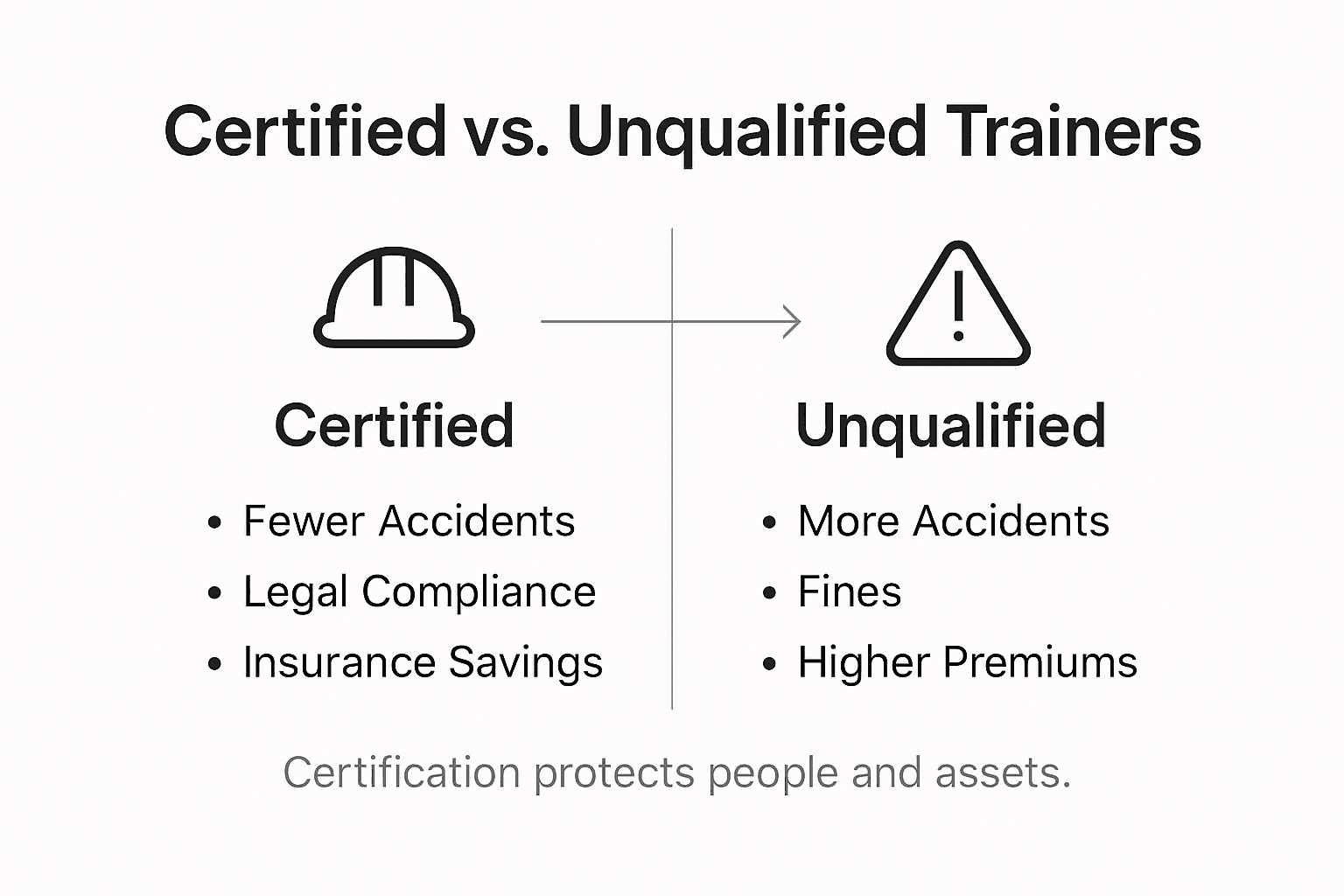
Beyond immediate physical dangers, unqualified trainers expose organizations to significant financial and legal risks. Workplace accidents triggered by improper training can result in devastating consequences, including substantial workers compensation claims, potential OSHA violations, increased insurance premiums, and potential civil litigation. The financial impact of a single serious accident can far exceed the investment required for proper certified trainer education.
Comprehensive trainer certification is not merely a bureaucratic checkbox but a critical risk management strategy. Certified trainers possess the nuanced skills to create adaptive, context-specific training programs that address the unique challenges of individual warehouse environments. Their expertise transforms safety from a theoretical concept into a practical, implementable operational standard.
Compare the organizational impact of certified versus non-certified forklift trainers:
| Factor | Certified Trainer Impact | Non-Certified Trainer Impact |
|---|---|---|
| Accident Rates | Lower due to robust safety protocols | Higher from incomplete safety coverage |
| Insurance Costs | Reduced premiums from compliance | Increased rates after incidents |
| Regulatory Compliance | Ensured with documented procedures | Exposed to OSHA penalties |
| Operational Productivity | Improved through skilled instruction | Frequent downtime from avoidable errors |
Pro tip: Conduct thorough background checks and certification verifications for all potential forklift trainers to minimize organizational risk and ensure comprehensive safety standards.
Certified forklift training represents a strategic investment that directly impacts an organization’s financial performance and operational efficiency. Labor productivity research demonstrates that targeted certification programs create measurable economic benefits by reducing workplace accidents, minimizing equipment damage, and optimizing workforce performance. These programs are not merely expense items but critical risk management strategies that generate substantial long-term financial returns.
The financial implications of certified forklift training extend across multiple critical areas:
Insurance providers recognize the tangible value of certified training, often offering significant premium reductions for warehouses that maintain rigorous certification standards. Companies with comprehensive training programs typically experience 30-50% lower insurance rates compared to those with minimal training protocols. These savings directly translate into improved bottom-line performance, making certification a financially prudent decision for forward-thinking organizations.
Beyond direct financial metrics, certified forklift training generates intangible benefits that contribute to organizational resilience. Trained professionals demonstrate higher operational confidence, more consistent performance, and a proactive approach to workplace safety. This cultural transformation yields compounding economic advantages that extend far beyond immediate cost savings.
Pro tip: Conduct a comprehensive cost-benefit analysis of your forklift training program, tracking both direct savings and indirect productivity improvements to validate your training investment.
The article highlights the critical role that certified forklift trainers play in protecting warehouses from accidents and operational inefficiencies. If you are facing challenges like ensuring OSHA compliance, reducing workplace risks, or improving operator skills, addressing these concerns starts with expert-led training programs. Key concepts such as OSHA regulations, risk management, and structured training evaluations demonstrate why uncertified trainers can endanger safety and increase costs.
Take control of your warehouse safety culture today by partnering with Forkliftacademy.com. Our comprehensive forklift certification programs deliver OSHA-compliant training both online and onsite tailored to your organizational needs. Explore real-world solutions by visiting our Forklift Certification Archives and learn how you can elevate your safety standards with certified trainers. Act now to reduce accidents, lower insurance costs, and boost productivity by securing your team’s forklift training expertise at Forkliftacademy.com.
Certified forklift trainers are specialized safety professionals who are highly trained to teach and assess forklift operators, focusing on safety protocols, training methodologies, and OSHA compliance.
Certified forklift trainers help protect warehouses by minimizing safety risks, lowering accident rates, ensuring compliance with regulations, and improving overall operational efficiency.
Unqualified forklift trainers pose significant risks, such as inadequate safety knowledge, increased accident rates, legal liabilities, and higher insurance costs due to poor training practices.
By implementing rigorous training programs, certified forklift trainers can lead to reduced accident rates and lower insurance premiums, making them a financially sound investment for warehouses.