
Finding the right forklift certification can confuse even the most experienced warehouse manager. You want compliance with OSHA standards and a team that truly knows your equipment and work environment. Onsite forklift certification ensures your operators train on your actual machines and in your facility, building real confidence and reducing daily safety risks. This article clears up common misconceptions and shows how onsite solutions directly address legal requirements while helping you avoid costly mistakes.
Table of Contents
- Defining Onsite Forklift Certification And Misconceptions
- Types Of Onsite Forklift Training Programs
- Key OSHA Compliance And Legal Requirements
- Safety, Efficiency, And Morale Benefits
- Risks, Costs, And Choosing Alternatives
Key Takeaways
| Point | Details |
|---|---|
| Onsite Forklift Certification | Tailored training at your facility improves safety by focusing on your specific equipment and operational conditions. |
| OSHA Compliance | Employers must verify training and competency, not just issue certificates, to prevent legal liabilities. |
| Benefits of Combined Training | Blending operator, pedestrian, and technician training enhances overall safety and efficiency in the workplace. |
| Cost-Benefit of Training | Investing in onsite training reduces the total cost of ownership by preventing accidents that can lead to substantial financial losses. |
Defining onsite forklift certification and misconceptions
Onsite forklift certification refers to training conducted at your actual warehouse or facility, tailored to your specific equipment, layout, and operational conditions. Unlike generic classroom training, this approach addresses the real hazards your team faces daily.
Here’s what makes it different from standard programs:
- Customized to your equipment (sit-down riders, stand-up operators, rough terrain forklifts)
- Covers your warehouse layout and unique operational challenges
- Trains operators on your actual safety protocols and procedures
- Evaluates competency in your real working environment
- Reduces time away from operations
The Big Misconception About Certification
Many warehouse managers believe OSHA requires them to issue certificates or licenses to operators. This is incorrect. OSHA requires employer certification that the operator has completed compliant training and evaluation, not that you issue an official document.
What OSHA actually mandates:
- You must ensure operators receive training from qualified instructors
- You must verify they understand your specific equipment and conditions
- You must document that they passed evaluation
- You must keep training records available for inspection
Your responsibility centers on documenting competency, not issuing laminated cards. The certification is your company’s verification that the operator is safe to operate forklifts in your unique environment.
Why This Distinction Matters
Think of it this way: an operator trained on a Toyota forklift in Florida still needs evaluation on your Yale equipment in a frozen warehouse with narrow aisles. That evaluation proves competency in your specific conditions.
When you conduct onsite forklift training, you’re not just checking a box. You’re protecting your operation from both accidents and compliance violations.
Employer certification means you’re accountable for verifying operators can safely handle your equipment in your environment—not just passing a generic test.
Many managers also assume all operators need identical training. Reality differs. A new hire needs comprehensive training. An experienced operator switching equipment needs focused evaluation on that specific machine.
The second misconception: that onsite training takes forever. Quality programs fit into your schedule without massive production disruptions. Your team learns exactly what they need, nothing more.
Pro tip: Document your training process before your first session. Record trainer credentials, equipment covered, attendee names, dates, and evaluation results—this protects you during OSHA inspections and proves compliance.
Types of onsite forklift training programs
Not all forklift training looks the same. Your warehouse may need operator training, technician training, pedestrian training, or a combination depending on your workforce and operations. Understanding which types apply to your facility helps you build a compliant, safety-focused program.
Operator Training Programs
Operator training focuses on safe equipment operation and is the most common onsite program. This covers the specific forklifts your team uses daily, from sit-down riders to stand-up operators to reach trucks.
Operator training includes:
- Pre-operation equipment inspections
- Safe lifting and load handling techniques
- Navigation through your warehouse layout
- Load capacity limits for your equipment
- Emergency procedures specific to your facility
This is where most of your resources go. When warehouse managers think “forklift certification,” they’re usually thinking operator training.
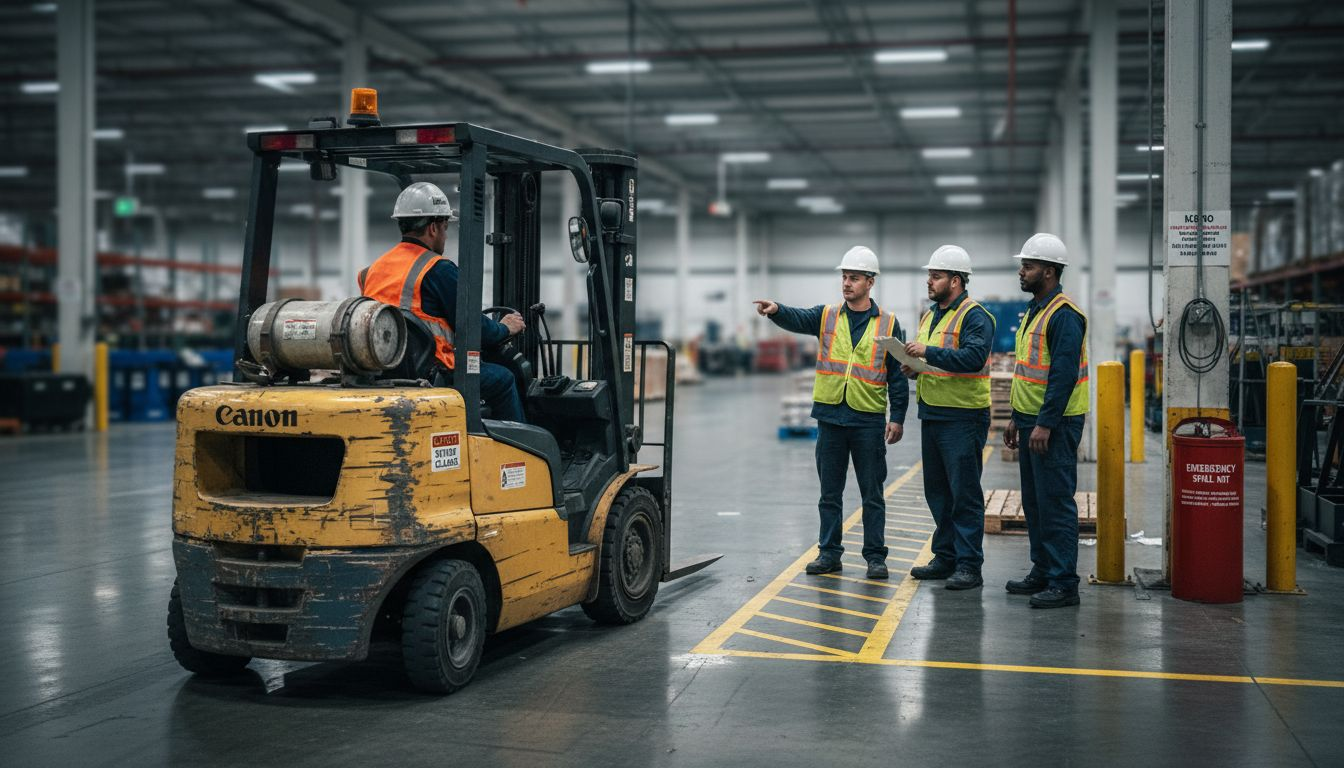
Pedestrian Safety Training
Pedestrian training targets non-operators working in forklift environments. Packing department staff, quality inspectors, maintenance workers, and receiving clerks all need this.
Pedestrian programs teach:
- Recognizing blind spots and hazardous zones
- Safe communication with forklift operators
- What to do when a forklift is operating nearby
- How to report equipment problems
Many accidents happen because ground-level workers don’t understand forklift limitations. Pedestrian training prevents these incidents by changing behavior on both sides.
Technician Training Programs
Technician training covers maintenance and repair skills. This applies if your maintenance team services forklifts onsite rather than relying on external vendors.
Technician programs address:
- Battery maintenance and charging procedures
- Hydraulic system troubleshooting
- Mechanical repairs and adjustments
- Safety lockout procedures during maintenance
Not every warehouse needs technician training, but it’s valuable if you have skilled maintenance staff.
Combining Program Types
Most facilities use different types of forklift training tailored to their specific needs. An operator may need both operator and basic technician knowledge if they perform simple maintenance. A shipping clerk needs pedestrian training only.
Effective onsite programs layer training types together—operators learn safety, pedestrians understand hazards, and technicians handle equipment care.
Your actual program depends on your operation’s structure. A small warehouse might combine operator and pedestrian training into one session. A large distribution center runs separate, specialized programs.
Pro tip: Assess your actual workforce roles before designing your program. Map which employees need operator, pedestrian, or technician training, then schedule accordingly to avoid over-training some staff while under-training others.
Here’s a comparison of major forklift training program types and their ideal audiences:
| Program Type | Primary Audience | Main Objectives | Typical Facility Need |
|---|---|---|---|
| Operator | Forklift drivers | Safe operation and hazard awareness | Always required |
| Pedestrian | Floor staff and visitors | Avoiding forklift-related accidents | Most facilities with forklifts |
| Technician | Maintenance team members | Equipment repair and preventive care | Facilities with in-house repair |
Key OSHA compliance and legal requirements
OSHA doesn’t leave forklift safety to chance. The regulations are specific, enforceable, and non-negotiable. Understanding these requirements protects your operation from violations, fines, and most importantly, workplace injuries.
The Core Requirement: 29 CFR 1910.178
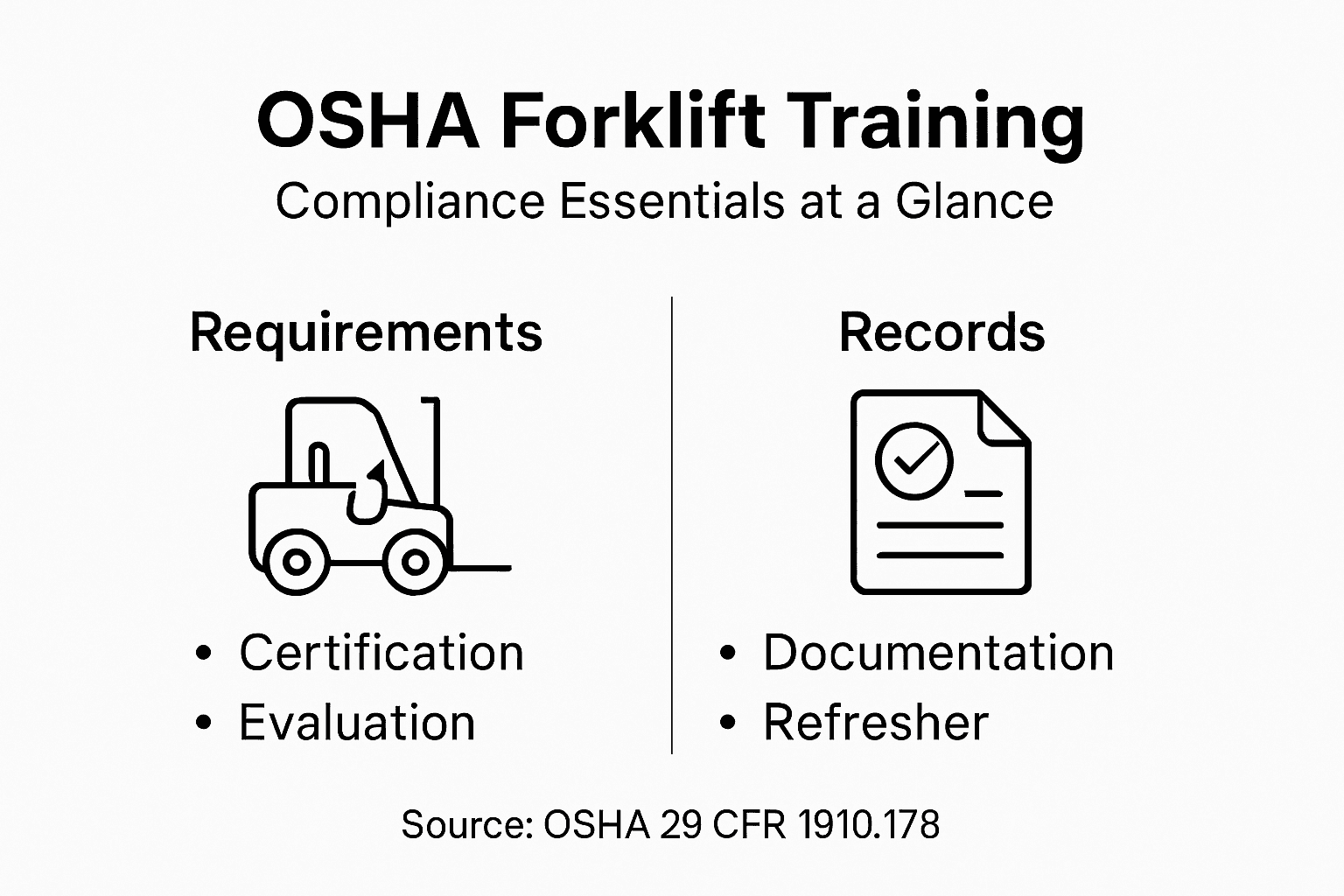
OSHA regulation 1910.178 mandates that employers ensure forklift operators are trained and evaluated for safe operation before use. This isn’t optional. You cannot let an untrained operator touch a forklift, period.
The regulation requires three specific components:
- Formal instruction covering equipment operation and hazards
- Practical training on your actual equipment and facility
- Evaluation of operator performance before authorization
Many warehouse managers think compliance means sending someone to a class. It means much more. You must document that they completed training, passed evaluation, and can safely operate your specific equipment.
Refresher Training Requirements
Training doesn’t end after the initial certification. OSHA requires refresher training every three years at minimum. If an operator has performance issues, causes an incident, or operates new equipment, you must provide additional training sooner.
Refresher training keeps skills sharp and addresses new hazards:
- Equipment changes or upgrades
- Warehouse layout modifications
- Updated safety procedures
- Performance gaps identified during observations
Skipping refresher training is a documented violation. OSHA inspectors specifically ask for three-year refresher records.
Documentation and Record-Keeping
Compliance lives in your records. You must maintain documentation proving:
- Operator names and training dates
- Trainer qualifications and credentials
- Equipment covered in training
- Evaluation results and scores
- Refresher training completion dates
Keep these records available during OSHA inspections. They’re your proof of compliance. Missing or incomplete records create liability even if your operators are actually competent.
Employer Responsibilities
You’re accountable for more than just initial training. Your ongoing responsibilities include:
- Periodic observation of operators during work
- Equipment maintenance and safety inspections
- Incident investigation and follow-up training
- Maintaining a safe warehouse environment
If an accident occurs and OSHA investigates, they’ll examine your training records, observe your current practices, and interview your team. Documented compliance protects you.
OSHA compliance isn’t just paperwork—it’s your legal shield and your safety foundation.
Pro tip: Conduct mock OSHA inspections annually. Walk through your facility, check your training records, and observe operator practices as an inspector would. This identifies gaps before regulators do.
Safety, efficiency, and morale benefits
Onsite forklift certification does more than check a compliance box. It creates measurable improvements across three critical areas: safety outcomes, operational speed, and how your team feels about their workplace.
The Safety Impact
Onsite forklift training significantly reduces accidents and injuries by ensuring operators understand your specific equipment and hazards. When someone trains on the actual forklift they’ll operate and learns your warehouse layout, mistakes drop dramatically.
Operators trained onsite avoid common errors:
- Misjudging load capacity on your equipment
- Navigating blind spots they haven’t seen before
- Operating unfamiliar controls in panic situations
- Underestimating hazards unique to your facility
Every accident prevented is a worker who goes home healthy. That matters more than any metric.
Efficiency Gains You Can Measure
Better-trained operators move faster and smarter. They handle loads more efficiently, reduce damage to inventory and racking, and waste less time troubleshooting equipment problems.
Efficiency improvements include:
- Faster load cycles from improved technique
- Fewer equipment collisions and damage incidents
- Reduced downtime from maintenance issues
- Better warehouse flow from confident operators
These gains add up. A warehouse with 15 operators who move just 5% faster through improved training sees significant output increases without hiring more staff.
Team Morale and Retention
Employees notice when you invest in their safety and skill development. Onsite forklift training fosters a positive safety culture that improves morale, engagement, and retention.
When operators feel trained and confident:
- They report hazards more openly
- They communicate better with coworkers
- They take pride in their competency
- They’re less likely to leave for other jobs
High turnover in warehouse roles is expensive. Training investment signals to your team that you value them, reducing costly replacements and knowledge loss.
The Financial Reality
Accidents cost far more than training. Medical costs, workers’ compensation claims, lost productivity, and potential OSHA fines quickly exceed the cost of quality onsite certification.
Better-trained operators mean fewer injuries, faster output, and employees who want to stay—that’s the real ROI of onsite certification.
Your bottom line improves when safety improves. Fewer incidents mean lower insurance premiums over time. Faster operations mean more revenue from the same facility.
Pro tip: Track three metrics monthly: safety incidents per operator, average load cycles per hour, and operator tenure. You’ll see improvements within 90 days of completing onsite certification, proving the investment’s value to leadership.
Risks, costs, and choosing alternatives
Skipping onsite forklift certification or choosing poorly creates real problems. Understanding the risks and costs helps you make informed decisions about your training approach.
The Risks of No Training or Poor Training
Operators working without proper certification create liability exposure across multiple areas. An untrained operator is a lawsuit waiting to happen.
Key risks include:
- Accidents causing worker injuries or fatalities
- Damage to inventory, equipment, and warehouse infrastructure
- OSHA citations and substantial fines
- Civil lawsuits from injured employees or third parties
- Workers’ compensation claims and higher insurance premiums
- Criminal liability if negligence contributes to serious injury
If an operator causes an accident and OSHA discovers they weren’t trained, your company faces penalties starting at thousands of dollars. That’s just the regulatory cost. Medical expenses and litigation often exceed regulatory fines.
Comparing Training Alternatives
Not all training is equal. You have several options, each with tradeoffs:
Generic online-only training costs less upfront but doesn’t address your specific equipment or warehouse hazards. Operators may pass a test without being competent in your environment.
Classroom training at third-party facilities removes your team from operations but doesn’t prepare them for your unique conditions. Operators train on equipment they may never use.
Onsite training costs more initially but delivers superior results. Operators train on your actual equipment in your actual facility, then return to work immediately competent.
Here’s how onsite, classroom, and online forklift training approaches compare:
| Feature | Onsite Training | Classroom Training | Online Training |
|---|---|---|---|
| Adapts to facility needs | Yes, highly customized | Limited customization | Not customized |
| Downtime required | Minimal, on-premises | More, offsite sessions | Very little |
| Compliance effectiveness | Strong, real-world focus | Moderate if customized | Often lacking |
| Initial cost per worker | Higher upfront | Moderate | Lowest |
Hidden Costs of Cheap Training
Choosing the cheapest option rarely saves money. Poor training leads to accidents, and accidents are expensive.
Hidden costs accumulate:
- Medical treatment and hospitalization
- Workers’ compensation insurance increases
- Lost productivity during incident investigations
- Equipment repair and replacement
- Potential litigation and legal fees
- Regulatory penalties and compliance costs
- Employee turnover from safety concerns
A single serious accident can cost $50,000 to $500,000+ when you add up direct and indirect expenses. Quality training paying for itself in risk reduction alone.
Why Onsite Training Wins the Cost Analysis
Understanding the importance of workplace safety shows that investing in proper training reduces your total cost of ownership significantly. Onsite training costs $800 to $2,000 per operator initially but prevents incidents that cost exponentially more.
The calculation:
- Onsite training cost: $1,500 per operator
- Average accident cost: $100,000 to $300,000
- One prevented accident pays for training 50 to 200 times over
Cheap training isn’t a bargain—it’s a calculated risk with expensive consequences.
Onsite training also improves efficiency, meaning faster output from the same operators. This additional productivity benefit often recovers training costs within months.
Pro tip: Request a cost-benefit analysis from your training provider. Compare the onsite training investment against your facility’s accident history, insurance rates, and operational output. Most managers discover onsite training pays for itself within the first year.
Elevate Your Team’s Safety and Compliance with Expert Onsite Certification
Ensuring your forklift operators are truly competent in your unique warehouse environment is a challenge many managers face. The article highlights critical pain points such as the need for customized training on your specific equipment and layout, proper OSHA-compliant documentation, and balancing effective training with minimal production downtime. With onsite forklift certification, you can avoid costly accidents, reduce OSHA compliance risks, and improve overall workforce efficiency.
At Forkliftacademy.com, we specialize in delivering OSHA-compliant onsite forklift training and certification programs designed to meet your facility’s exact needs. Our comprehensive business solutions include tailored operator training, pedestrian safety courses, and technician programs that align perfectly with the diverse roles on your warehouse floor. Backed by over 20 years of experience and trusted by companies across the United States and Canada, our training ensures your team stays safe, confident, and compliant.
Unlock the full benefits of onsite training today with expert-led programs that reduce risk and boost morale. Learn more about how we protect workplaces by visiting our Forklift Safety Archives or explore workforce development strategies on our Career Archives.
Don’t wait until an incident forces costly interventions. Visit Forkliftacademy.com now to schedule your onsite forklift certification and create safer, compliant teams that drive your operation forward.
Frequently Asked Questions
What is onsite forklift certification?
Onsite forklift certification is a tailored training program conducted at your warehouse or facility, focusing on your specific equipment and operational conditions. It ensures operators are trained on your actual safety protocols and evaluated in your real working environment.
What are OSHA’s requirements for forklift operator training?
OSHA mandates that employers ensure forklift operators receive training and evaluation for safe operation before using forklifts. This includes formal instruction, practical training on actual equipment, and documenting that operators are competent in their specific environment.
How often do forklift operators need refresher training?
Forklift operators require refresher training every three years, at minimum. Additional training is also necessary if an operator demonstrates performance issues or operates new equipment.
What types of onsite forklift training programs are available?
Onsite forklift training programs typically include operator training, pedestrian safety training, and technician training. Facilities may require a combination of these programs depending on their operational needs.
Recommended
- Onsite Forklift Course: Ensuring OSHA Compliance – Top Osha Forklift Certification
- Onsite Forklift Training: Safeguarding Warehouse Operations – Top Osha Forklift Certification
- On-site Forklift Certification – Forklift Academy
- Guide to Onsite Forklift Training: Master Safety Skills – Top Osha Forklift Certification