
Every forklift safety manager knows the pressure that comes with keeping OSHA compliance airtight on the warehouse floor. Staying up to date with forklift refresher courses is more than just a regulatory step—it is a proactive measure to protect workers and reduce liability. This guide breaks down what refresher training means, why it matters, and how choosing the right approach can support a safer, more reliable operation.
Table of Contents
- Forklift Refresher Courses: Core Definition And Goals
- OSHA Refresher Requirements And Legal Triggers
- Types Of Forklift Refresher Training Formats
- Major Benefits For Safety And Operations
- Risks And Liabilities From Skipped Training
Key Takeaways
| Point | Details |
|---|---|
| Continuous Training is Essential | Forklift refresher courses are vital for maintaining operator safety and performance beyond initial certification. |
| OSHA Compliance is Mandatory | Employers must adhere to specific OSHA retraining requirements to avoid fines and maintain safety standards. |
| Diverse Training Formats Enhance Learning | Utilizing a combination of classroom, computer-based, and hands-on training optimizes skill retention and practical application. |
| Ignoring Training Leads to Risks | Skipping refresher training can result in severe financial penalties and increased workplace accident rates. |
Forklift refresher courses: Core definition and goals
Forklift refresher courses represent structured training programs designed to maintain and enhance operator safety and performance in warehouse and industrial settings. These specialized training sessions go beyond initial certification, focusing on continuous skill development and regulatory compliance.
According to OSHA training guidelines, forklift refresher training serves critical safety objectives:
- Reinforcing proper operational techniques
- Identifying and correcting unsafe work practices
- Addressing workplace-specific operational challenges
- Ensuring ongoing operator competency
The core goals of these courses extend beyond simple repetition. Workplace safety and operator proficiency remain the primary motivations, with targeted approaches to skill maintenance and accident prevention.
Typical refresher courses typically include:
- Classroom-based theoretical instruction
- Practical hands-on equipment demonstrations
- Performance evaluations
- Workplace-specific safety protocol reviews
Operators may require refresher training under specific circumstances, such as demonstrating unsafe performance, experiencing workplace accidents, or encountering significant environmental changes. Comprehensive safety evaluation methods help ensure ongoing competence and regulatory adherence.
Pro tip: Schedule regular refresher courses proactively, not just when problems arise, to maintain a culture of continuous safety improvement.
OSHA refresher requirements and legal triggers
OSHA establishes clear and comprehensive requirements for forklift operator refresher training to ensure workplace safety and ongoing operational competency. Legal triggers for refresher training are specifically designed to address potential safety risks and maintain high operational standards.
The primary legal requirements for forklift operator refresher training include:
- Mandatory retraining every three years
- Retraining after workplace accidents or near-misses
- Evaluation following unsafe operating observations
- Reassignment to different forklift types
- Significant changes in workplace operational conditions
Compliance intervals are critically important in these regulations. OSHA’s standard 29 CFR 1910.178 mandates that operators must receive comprehensive refresher training and evaluation at least once every three years, regardless of their previous performance record.
Specific legal triggers that necessitate immediate refresher training include:
- Operator involved in an accident or near-miss incident
- Observed performing unsafe operational practices
- Failing a performance evaluation
- Assigned to operate a different type of powered industrial truck
- Workplace environments experiencing substantial operational changes
OSHA compliance standards emphasize that these requirements are not merely recommendations but legally enforceable regulations designed to protect worker safety and minimize workplace accidents.
Pro tip: Maintain detailed training records and proactively schedule refresher courses to stay ahead of OSHA compliance requirements.
Types of forklift refresher training formats
Forklift refresher training encompasses multiple dynamic learning formats designed to ensure comprehensive operator skill development and safety compliance. Training delivery methods blend theoretical instruction with practical hands-on experience to maximize learning effectiveness.
The primary forklift refresher training formats include:
- Classroom-based instruction
- Lecture presentations
- Safety video demonstrations
- Interactive group discussions
- Computer-based learning
- Online interactive modules
- Self-paced digital training programs
- Hands-on practical training
- Worksite-specific equipment demonstrations
- Direct supervised performance evaluations
- Hybrid training approaches
- Combining multiple instructional methods
- Tailored to specific workplace requirements
Performance evaluation remains a critical component across all training formats. Instructors systematically assess operator competency through written tests, practical skills demonstrations, and direct workplace observations.
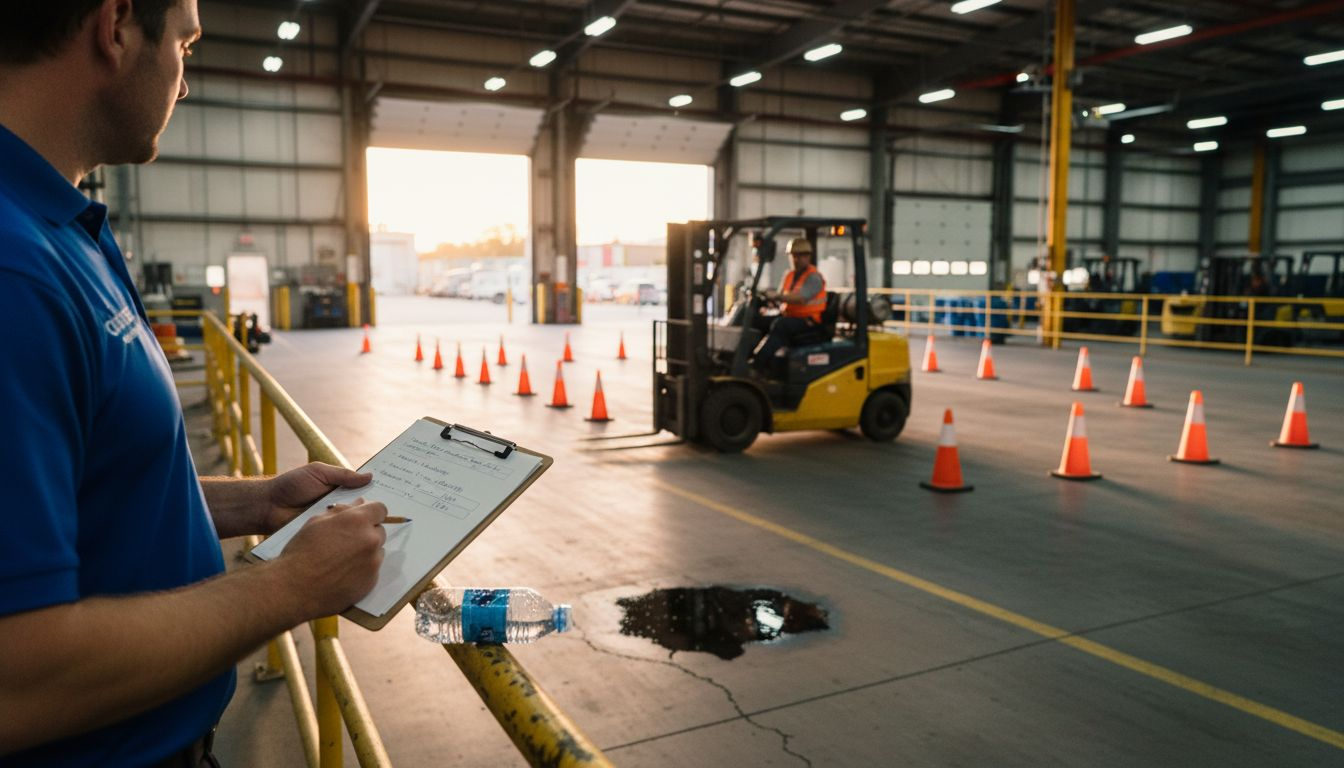
Safety training methods emphasize creating realistic training scenarios that mirror actual workplace conditions. This approach ensures operators can apply learned skills directly to their specific work environments, enhancing both safety and operational efficiency.
Training providers typically customize formats to meet individual workplace needs, considering factors such as equipment type, operational complexity, and existing operator skill levels. The goal remains consistent: creating a comprehensive learning experience that prioritizes workplace safety and regulatory compliance.
Here’s an overview of training formats and when each is most effective:
| Training Format | Best For | Delivery Method |
|---|---|---|
| Classroom-Based | New operators, compliance updates | In-person lectures, seminars |
| Computer-Based | Experienced operators, remote sites | Online modules, self-paced |
| Hands-On | Skill assessment, equipment changes | On-site practice, demonstrations |
| Hybrid | Complex workplaces, diverse needs | Combination of live and digital lessons |
Pro tip: Select a training format that offers the most interactive and hands-on experience to maximize skill retention and practical application.
Major benefits for safety and operations
Safety improvements through refresher training represent a critical investment for warehouse and industrial operations, delivering measurable benefits across multiple organizational dimensions. Continuous education for forklift operators transforms workplace safety from a compliance requirement to a strategic operational advantage.
The primary benefits of forklift refresher training include:
- Safety Risk Reduction
- Decreased workplace accident rates
- Enhanced hazard recognition skills
- Improved operator awareness
- Operational Efficiency
- Reduced equipment damage
- Minimized operational downtime
- Increased productivity
- Financial Advantages
- Lower insurance premiums
- Decreased worker compensation claims
- Reduced potential legal liabilities
Workplace safety culture fundamentally transforms when organizations prioritize continuous training. Operators develop a proactive mindset, understanding that safety is not a one-time achievement but an ongoing commitment.
Workplace safety training goes beyond preventing accidents. It creates a comprehensive ecosystem of accountability, where operators understand their role in maintaining a safe working environment and recognize the interconnected nature of their actions.
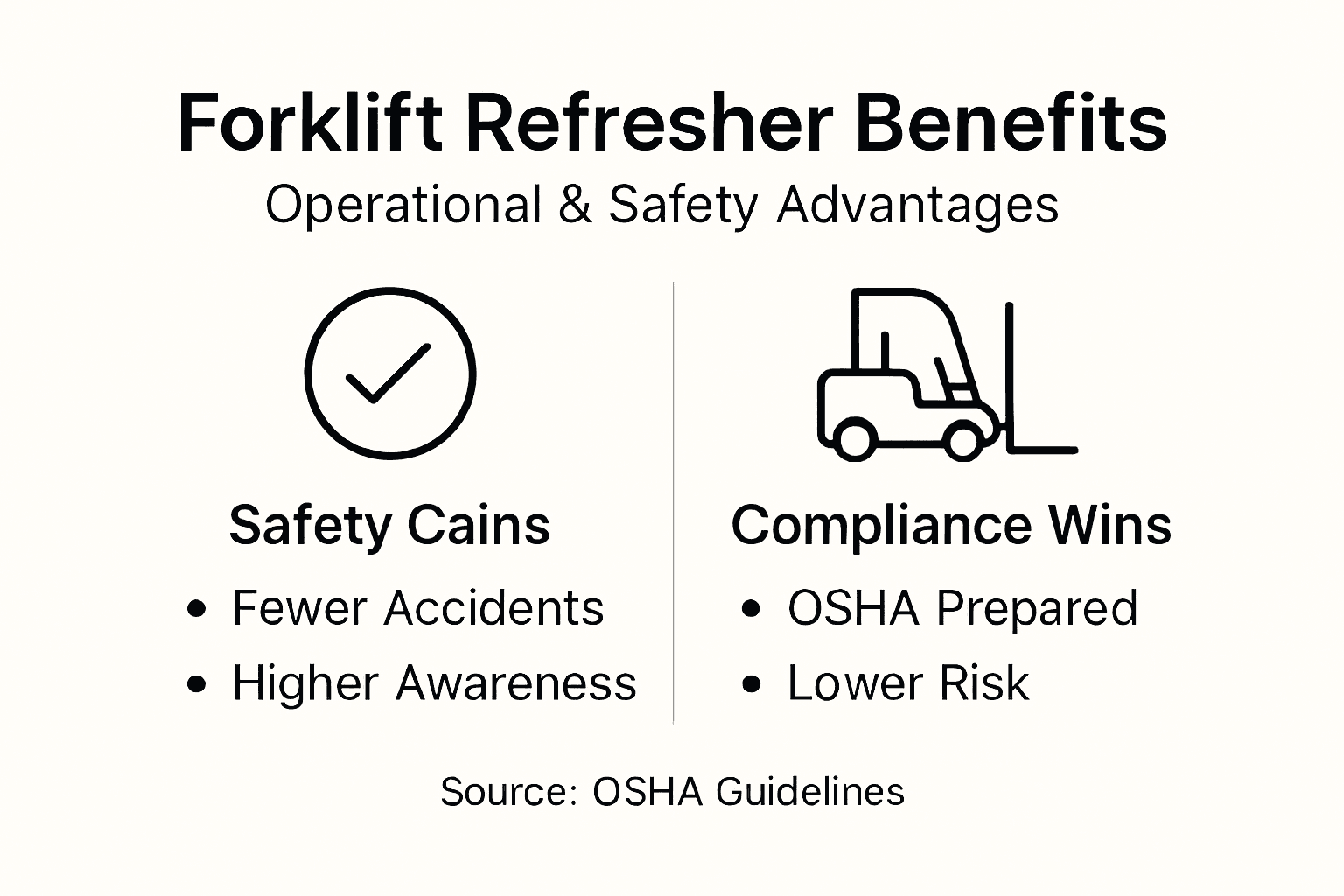
The quantifiable impacts extend far beyond immediate safety metrics. Companies implementing robust refresher training programs typically experience a significant reduction in incident rates, improved equipment longevity, and enhanced overall operational performance.
This table summarizes the major business impacts of regular forklift refresher training:
| Benefit Area | Operational Impact | Organizational Outcome |
|---|---|---|
| Safety Enhancement | Fewer injuries, improved alerts | Higher employee morale, lower turnover |
| Efficiency Gains | Less downtime, better workflow | More reliable delivery times |
| Financial Protection | Reduced penalties, fewer claims | Lower insurance costs, better reputation |
Pro tip: Track and document training outcomes to demonstrate the tangible return on investment in safety education.
Risks and liabilities from skipped training
Legal consequences of noncompliance can devastate businesses that neglect forklift operator refresher training. Skipping mandated training exposes organizations to substantial financial, legal, and operational risks that far outweigh the cost of comprehensive safety education.
The primary risks and liabilities from skipped training include:
- Financial Penalties
- Substantial OSHA citation fines
- Increased insurance premiums
- Potential worker compensation claims
- Legal Vulnerabilities
- Higher likelihood of workplace injury lawsuits
- Potential criminal negligence charges
- Compromised legal defense in accident investigations
- Operational Risks
- Increased workplace accident rates
- Reduced equipment operational efficiency
- Potential production disruptions
Regulatory compliance represents more than a bureaucratic checkbox. It is a critical mechanism for protecting both employees and organizational assets. Employers who fail to maintain current training certifications create significant exposure to multifaceted legal and financial challenges.
OSHA training requirements underscore the direct correlation between operator education and workplace safety. Neglecting refresher training transforms preventable incidents into potential catastrophic events with far-reaching consequences.
The ripple effects of skipped training extend beyond immediate financial penalties. Organizations risk long-term reputational damage, decreased employee morale, and potential permanent operational disruptions resulting from severe workplace incidents.
Pro tip: Maintain meticulous training documentation and implement proactive scheduling to demonstrate ongoing commitment to workplace safety.
Stay Ahead of OSHA Compliance with Expert Forklift Refresher Courses
The article highlights the critical challenge of maintaining OSHA compliance through regular forklift refresher courses to prevent costly penalties and ensure workplace safety. Operators must stay current with mandated training every three years and after incidents or changes in work conditions. If you want to avoid legal risks and operational disruptions caused by skipped training, a proactive approach is essential. Continuous skill reinforcement boosts safety and operational efficiency while reducing financial liabilities.
At Forkliftacademy.com, we understand these urgent needs with tailored solutions designed to keep your workforce OSHA-compliant and confident in their operation skills. Our Forklift Certification Archives offers a variety of flexible refresher training options including online, onsite, and blended formats. You can also explore our specialized Forklift Safety Archives for detailed safety resources that complement your training strategy.
Don’t wait for compliance issues or accidents to force refresher training. Take control now with our trusted certification programs to protect your team and business. Visit Forkliftacademy.com today to schedule your OSHA-approved forklift refresher courses and keep your workplace safe and efficient.
Frequently Asked Questions
What is a forklift refresher course?
Forklift refresher courses are structured training programs aimed at maintaining and enhancing operator safety and performance in industrial settings. They focus on continuous skill development and ensuring regulatory compliance beyond initial certification.
When is refresher training required for forklift operators?
Refresher training is required after specific events such as workplace accidents or near-misses, unsafe operating observations, a failed performance evaluation, reassignment to operate a different type of forklift, or significant changes in the workplace environment.
How often should forklift operators undergo refresher training?
According to OSHA regulations, forklift operators must receive refresher training at least once every three years. Immediate training is required if legal triggers such as accidents, unsafe practices, or changing operational conditions occur.
What are the benefits of forklift refresher training?
Forklift refresher training offers multiple benefits such as enhancing workplace safety, reducing accident rates, improving operational efficiency, minimizing equipment damage, lowering insurance premiums, and fostering a proactive safety culture among operators.
Recommended
- Forklift Refresher Courses: Complete Guide for 2025 – Top Osha Forklift Certification
- Forklift Certification Renewal: Ensuring OSHA Compliance – Top Osha Forklift Certification
- Forklift License Renewal Explained: OSHA Compliance Impact – Top Osha Forklift Certification
- What a Forklift Course Covers—OSHA Compliance and Safety – Top Osha Forklift Certification