
Confusing forklift and scissor lift certifications can put your team at risk and invite costly OSHA violations. American warehouses use these machines for different tasks, but each requires distinct documented training and evaluation. Understanding this separation is crucial, since OSHA holds facilities accountable for operator competency on every equipment type. This guide clarifies the specific standards and processes so you can protect your staff and maintain compliance during inspections.
Table of Contents
- Defining Forklift and Scissor Lift Certification
- OSHA Standards for Forklift and Scissor Lift Training
- Certification Requirements and Evaluation Process
- Job Roles and Operational Risks Compared
- Common Compliance Challenges and Mistakes
Key Takeaways
| Point | Details |
|---|---|
| Forklift and Scissor Lift Certifications Are Distinct | Each type requires specific training and certification due to different hazards and operational competencies. |
| OSHA Compliance Requires Meticulous Record Keeping | Maintain organized documentation of training and certification to avoid violations during inspections. |
| Refresher Training Is Essential | Regularly provide refresher courses to operators to ensure safety and compliance, especially when equipment changes occur. |
| Implementation of Safety Protocols Is Critical | Establish clear protocols and communication regarding equipment use to prevent unauthorized operation and potential accidents. |
Defining Forklift and Scissor Lift Certification
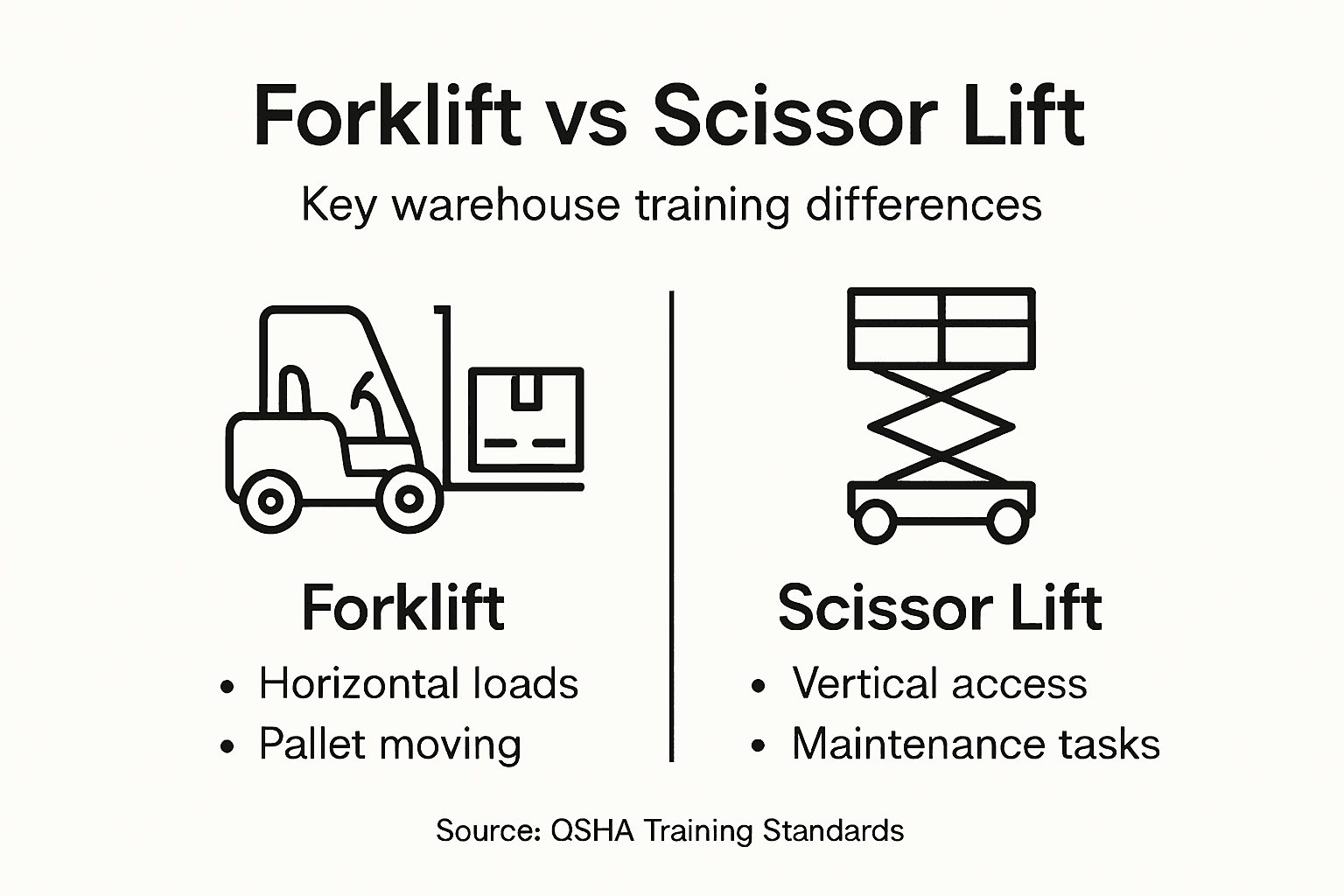
Forklift and scissor lift certifications aren’t interchangeable credentials. They represent distinct operational competencies that OSHA treats differently, and your warehouse needs to understand this distinction to stay compliant.
A forklift certification validates that an operator can safely handle powered industrial trucks with lifting mechanisms that extend forward. When your team member passes forklift training, they’ve demonstrated the ability to operate vehicles like counterbalance forklifts, reach trucks, and telehandlers. Understanding how forklift certification works helps clarify why these credentials matter for your warehouse operations. The certification covers load stability, capacity ratings, terrain hazards, and maintenance checks specific to these machines.
A scissor lift certification, by contrast, authorizes operation of vertical lifting platforms with crisscross supports that raise and lower loads directly overhead. These machines move loads straight up rather than forward, creating entirely different safety considerations. Operators certified for scissor lifts understand platform weight limits, ground stability requirements, and the unique hazards of elevated work. What scissor lift certification actually entails requires separate training because the mechanical operation and risk profiles differ significantly from forklifts.
Here’s what matters most for your warehouse: OSHA requires operator certification specifically for the equipment type being used. An employee certified only on forklifts cannot legally operate scissor lifts, and vice versa. This isn’t arbitrary bureaucracy. Each machine presents distinct hazards that demand specific skill development.
Your facility might use both types of equipment in different areas. Some warehouses operate forklifts in the main storage zone while using scissor lifts for maintenance work on elevated racks or ceiling fixtures. Each piece of equipment requires separate documented training, evaluation, and certification.
The certification process itself involves classroom instruction, practical demonstrations, and competency testing for the specific machine type. Your operators must understand that documentation. When OSHA audits your facility, they verify that every person operating a forklift or scissor lift holds current, valid certification for that particular equipment class.
Pro tip: Create a visual equipment matrix in your warehouse showing which employees hold certification for which machines, and update it whenever someone completes new training or when certification expires.
Here’s a quick comparison of forklift and scissor lift certification features and workplace impact:
| Aspect | Forklift Certification | Scissor Lift Certification |
|---|---|---|
| Primary Operation | Forward load movement | Vertical platform lifting |
| OSHA Regulation | 29 CFR 1910.178 | 29 CFR 1910.28, 1910.29, 1926.451 |
| Key Hazards | Tip overs, load shifts, collisions | Platform instability, falls, overhead strikes |
| Certification Renewal | Refresher as needed | Every three years |
| Business Impact | Faster material handling, broad warehouse use | Safe elevated work, maintenance access |
OSHA Standards for Forklift and Scissor Lift Training
OSHA doesn’t leave operator training to guesswork. The agency has established specific regulatory requirements that govern how your warehouse must train and certify both forklift and scissor lift operators. Understanding these standards keeps your facility compliant and your employees safe.
For forklifts, OSHA requires training under 29 CFR 1910.178. This regulation mandates that operators receive formal instruction covering equipment operation, load handling, hazard recognition, and workplace conditions. Your training program must include both classroom and practical components, followed by documented evaluation. Forklift safety standards explained details what these requirements actually mean for your daily operations. Every operator needs certification before operating any powered industrial truck in your warehouse.
Scissor lifts operate under a different regulatory framework. OSHA classifies scissor lifts as mobile scaffolds rather than aerial lifts, regulating them under scaffolding standards through 29 CFR 1910.28, 1910.29, and 1926.451. These standards mandate fall protection, equipment stabilization, thorough inspection protocols, and proper training for all operators. Your workers must be qualified and trained before using scissor lifts on your site.
The key difference matters here. Forklift training focuses on load handling, capacity calculations, and forward mobility hazards. Scissor lift training emphasizes vertical platform safety, ground stability, and overhead work hazards. Your employees cannot simply transfer knowledge from one certification to the other.
Both standards require documented training records. OSHA inspectors will ask to see proof that your operators completed approved training programs. The documentation must show the date of training, the trainer’s name, the equipment covered, and the competency evaluation results. If your records are missing or incomplete, you face citations regardless of actual operator skill.
OSHA also requires refresher training when an operator demonstrates unsafe practices, operates new or modified equipment, or hasn’t operated the equipment for an extended period. Your facility needs a system to track when refresher training is due.
Pro tip: Maintain a training calendar that flags refresher dates before they’re due, and conduct annual audits of your training records to catch gaps before an OSHA inspection arrives.
Certification Requirements and Evaluation Process
Certification isn’t just a checkbox item. It’s a documented proof that your operators can safely handle equipment, and OSHA expects you to maintain meticulous records showing how you got there.
The certification journey starts with formal training. Your operators must complete an OSHA-aligned program covering equipment operation, hazard identification, and regulatory compliance. This isn’t optional content either. The training must address the specific equipment they’ll operate, whether forklifts or scissor lifts. Forklift training covers load stability, capacity limits, and terrain hazards. Scissor lift training emphasizes vertical platform safety and ground stabilization.
After classroom instruction comes the practical evaluation. This is where theory meets reality. Your operators must demonstrate hands-on competency with the actual equipment they’ll use in your warehouse. They need to show they can perform pre-operation inspections, load materials safely, navigate obstacles, and respond to emergency situations. Complete guide to the forklift evaluation process breaks down exactly what evaluators look for during this critical assessment.
Scissor lift certification requires passing both written and practical evaluations, demonstrating mastery of equipment controls and hazard recognition. Your employees must show they understand the specific safety standards for mobile scaffolds, including fall protection requirements and ground stability procedures.
Once your operator passes both components, certification documentation gets created. This paperwork matters tremendously during OSHA audits. Records must include the training date, trainer credentials, equipment covered, evaluation results, and operator signatures. Store these documents where they’re easily retrievable for inspections.
Here’s a reality check. Certification isn’t permanent. Scissor lift certifications require renewal every three years to maintain compliance. Forklift certifications also need refresher training if an operator demonstrates unsafe behavior, hasn’t operated equipment for an extended period, or operates new equipment types. Your facility needs a tracking system that flags when renewals approach.
Pro tip: Implement a database or spreadsheet that tracks certification expiration dates for every operator and sends automatic reminders 30 days before renewal is due, preventing compliance gaps.
Job Roles and Operational Risks Compared
Your warehouse employs different operators for different jobs. A forklift operator and a scissor lift operator face entirely different hazard profiles, even though both handle elevated loads. Understanding these distinctions shapes your training priorities and safety protocols.
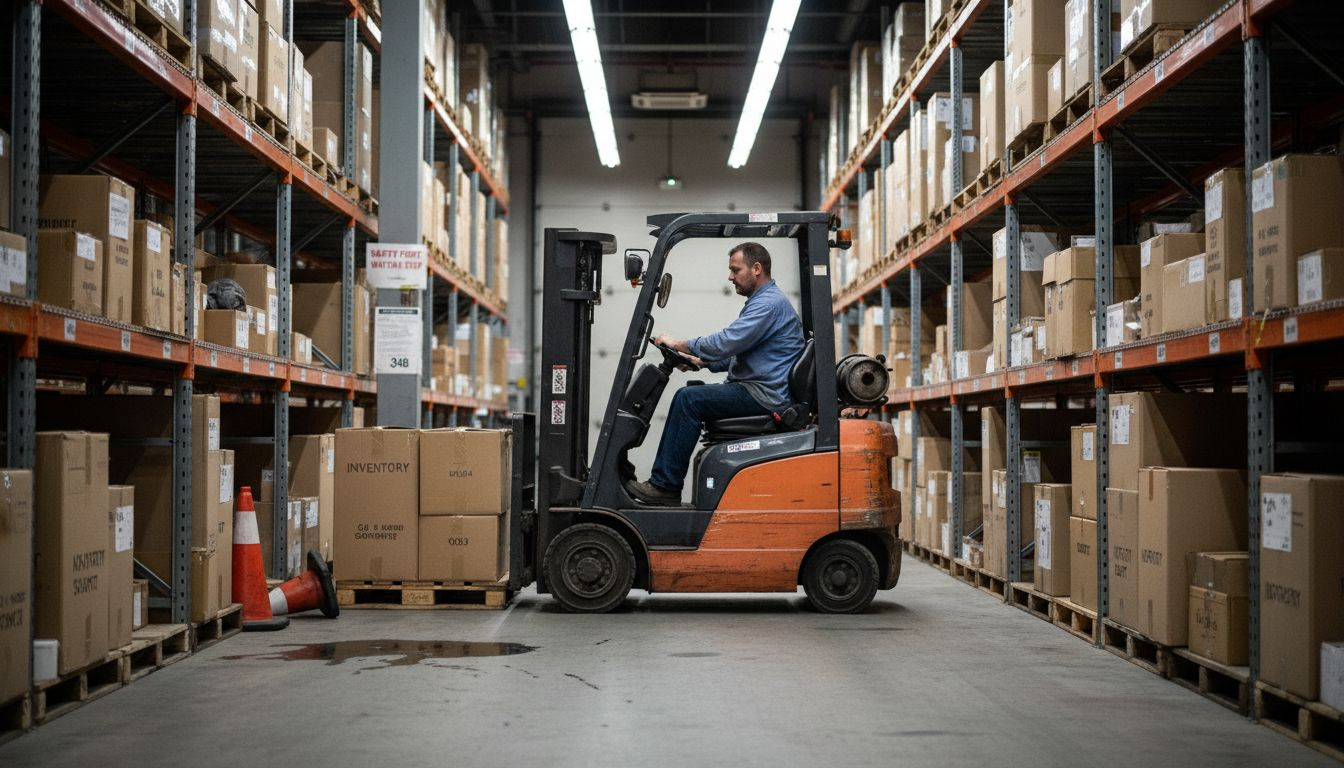
Forklift operators handle horizontal movement first. They position loads forward and backward, navigating warehouse aisles at ground level with loads elevated in front. Their primary concerns include load shifts during travel, collisions with fixed objects, and pedestrian interactions. Forklifts require constant attention to load stability. An operator might be moving pallets across a warehouse floor one moment and stacking items 20 feet high the next. The skill set emphasizes balance, speed judgment, and terrain awareness.
Scissor lift operators focus on vertical access. They raise workers or materials straight up to reach ceiling fixtures, high shelving, or maintenance points. Their environment is stationary. Once positioned, the platform lifts vertically rather than traveling to different locations. Scissor lift hazards center on platform instability, overhead obstructions, and fall protection. Operators need different risk awareness than forklift operators.
The operational contexts create specific training needs. Forklift operators must understand load capacity calculations because they’re constantly adjusting how much weight they carry at different lift heights. Scissor lift operators focus on ground stability assessment. Is the surface level? Will the platform wobble? What anchoring requirements apply?
Pedestrian safety also differs. Forklifts move through populated warehouse spaces, creating collision risks with workers and equipment. Scissor lifts typically operate in designated maintenance areas. However, both require clear communication protocols and proximity awareness.
Injury patterns reveal these differences. Forklift incidents frequently involve tip overs during turns or load drops during travel. Scissor lift incidents more often involve falls from platforms or workers struck by equipment during setup. Your safety training must address these specific scenarios rather than treating all powered equipment the same.
Consider staffing implications. Some facilities cross-train operators on both machines. However, certification requirements remain separate. An operator trained on both machines still needs distinct certifications documented for each equipment type.
Pro tip: Create role-specific safety briefings for forklift and scissor lift operators that highlight the unique hazards they’ll encounter, reinforcing that certification differences exist for concrete safety reasons, not bureaucratic ones.
Common Compliance Challenges and Mistakes
OSHA violations in your warehouse often stem from preventable mistakes. Warehouse managers frequently underestimate what compliance actually requires, and these gaps create serious liability exposure during inspections.
The most common mistake is treating certification as a one-time event. Managers get operators certified and assume the job is done. Reality works differently. Operators need refresher training regularly, and many facilities simply forget to track when certifications expire. This creates a dangerous gap where uncertified operators are running equipment on your floor. When OSHA shows up, expired certifications are immediately visible violations.
Another widespread problem involves inadequate operator training. Some facilities compress training into a few hours when comprehensive programs require significantly more time. Rushed training produces operators who understand basic controls but miss critical hazard recognition. They can start a forklift or scissor lift, but they cannot properly assess whether a load is balanced or whether ground conditions are safe. Common compliance mistakes include inadequate operator training and failure to conduct regular equipment inspections that employers often overlook.
Documentation failures plague many warehouses. You might have conducted excellent training, but if your records are incomplete or disorganized, OSHA will cite you anyway. The agency needs to see training dates, trainer qualifications, evaluation results, and operator signatures. Missing any single element creates a compliance gap. Some facilities keep records scattered across different systems or files that are difficult to retrieve during an inspection.
Overloading equipment is another critical error. Operators sometimes exceed weight limits because they believe their equipment is more capable than it actually is. Scissor lifts have specific weight capacities. Forklifts have load center ratings that change with lift height. Exceeding these limits doesn’t just violate OSHA standards. It creates immediate safety hazards that can lead to catastrophic failures.
Finally, many warehouses fail to maintain clear communication about equipment restrictions. Operators need to understand which machines they are certified to operate and which ones are off-limits. Some facilities allow uncertified operators to use equipment in emergencies, creating liability exposure.
Pro tip: Conduct an internal audit quarterly where you review every operator’s certification status, verify training records are complete, and confirm all equipment maintenance logs are current and accessible for immediate retrieval.
This table summarizes common compliance pitfalls and practical solutions for warehouse managers:
| Compliance Challenge | Typical Result | Practical Solution |
|---|---|---|
| Expired operator certifications | OSHA violations, fines | Track expiration dates with reminders |
| Rushed or shortened training | Unsafe operations | Implement robust, multi-hour programs |
| Poor record keeping | Failed inspections | Centralize and audit training files |
| Equipment overloading | Accidents, citations | Enforce strict load checks daily |
| Unclear certification policies | Unauthorized equipment use | Display operator-equipment matrix |
Ensure OSHA Compliance with Expert Forklift and Scissor Lift Certification Solutions
Understanding the critical differences between forklift and scissor lift certification is essential to maintaining safety and compliance in your warehouse. This article highlighted the challenges operators and managers face with separate OSHA standards, specific hazard profiles, and rigorous documentation requirements. If you are struggling to keep certifications updated, manage role-specific training, or need reliable solutions for comprehensive operator evaluation, you are not alone.
At Forkliftacademy.com, we specialize in OSHA-compliant forklift and scissor lift certification programs designed to address these exact pain points. Whether you need individual online courses, onsite training for your team, or tools to manage refresher schedules, our industry-leading experience delivers safety and peace of mind. Our Forklift Certification Archives provide detailed resources and courses tailored to your needs.
Take control of your warehouse safety today. Visit Forkliftacademy.com to explore certification options that align perfectly with your operational demands. Learn how you can implement effective training programs, keep records audit-ready, and empower your employees with the skills they need to operate equipment safely under OSHA standards. Don’t wait until an OSHA inspection catches a compliance gap. Act now and secure a safer, more productive workplace.
Frequently Asked Questions
What are the key differences between forklift and scissor lift certification?
Forklift certification focuses on operating powered industrial trucks that handle horizontal load movements, while scissor lift certification is for operating vertical lifting platforms. Each type of equipment has distinct safety considerations and training requirements, making separate certifications necessary.
What are the OSHA training requirements for forklift operators?
OSHA mandates that forklift operators receive comprehensive training under 29 CFR 1910.178, which includes formal instruction and practical evaluation covering equipment operation, load handling, and workplace hazards. All operators must be certified before operating forklifts in a warehouse setting.
How often do forklift and scissor lift certifications need to be renewed?
Forklift certifications require refresher training whenever an operator demonstrates unsafe practices or hasn’t operated the equipment for an extended period. Scissor lift certifications need to be renewed every three years to maintain compliance.
Why is proper documentation important for forklift and scissor lift certifications?
Accurate documentation is vital for compliance with OSHA regulations. It must include training dates, trainer qualifications, equipment covered, and evaluation results. Missing or incomplete records can lead to citations during OSHA inspections, regardless of an operator’s actual skill level.
Recommended
- Understanding OSHA Standards for Scissor Lifts – Top Osha Forklift Certification
- 7 Key OSHA Forklift Compliance Tips for Warehouse Managers – Top Osha Forklift Certification
- Complete Guide to the Role of a Scissor Lift Operator – Top Osha Forklift Certification
- What a Forklift Course Covers—OSHA Compliance and Safety – Top Osha Forklift Certification