
Every warehouse manager knows the unique challenges forklifts bring to a busy American facility, yet too often, incidents happen when hazards are missed during daily routines. Forklift hazard awareness goes beyond rulebooks—it means spotting dangers, understanding how machine design and warehouse layout influence risk, and building a culture where training creates vigilance across your team. This guide opens a practical path to OSHA-compliant hazard recognition to help you reduce accidents and strengthen safety protocols in your warehouse.
Table of Contents
- Defining Forklift Hazard Awareness In Warehousing
- Common Forklift Hazards And Real-World Impact
- OSHA Forklift Safety Rules And Warehouse Compliance
- Essential Training Methods For Hazard Recognition
- Best Practices For Ongoing Hazard Prevention
Key Takeaways
| Point | Details |
|---|---|
| Forklift Hazard Awareness | Effective training builds an understanding of why hazards occur, allowing teams to proactively identify potential risks in daily operations. |
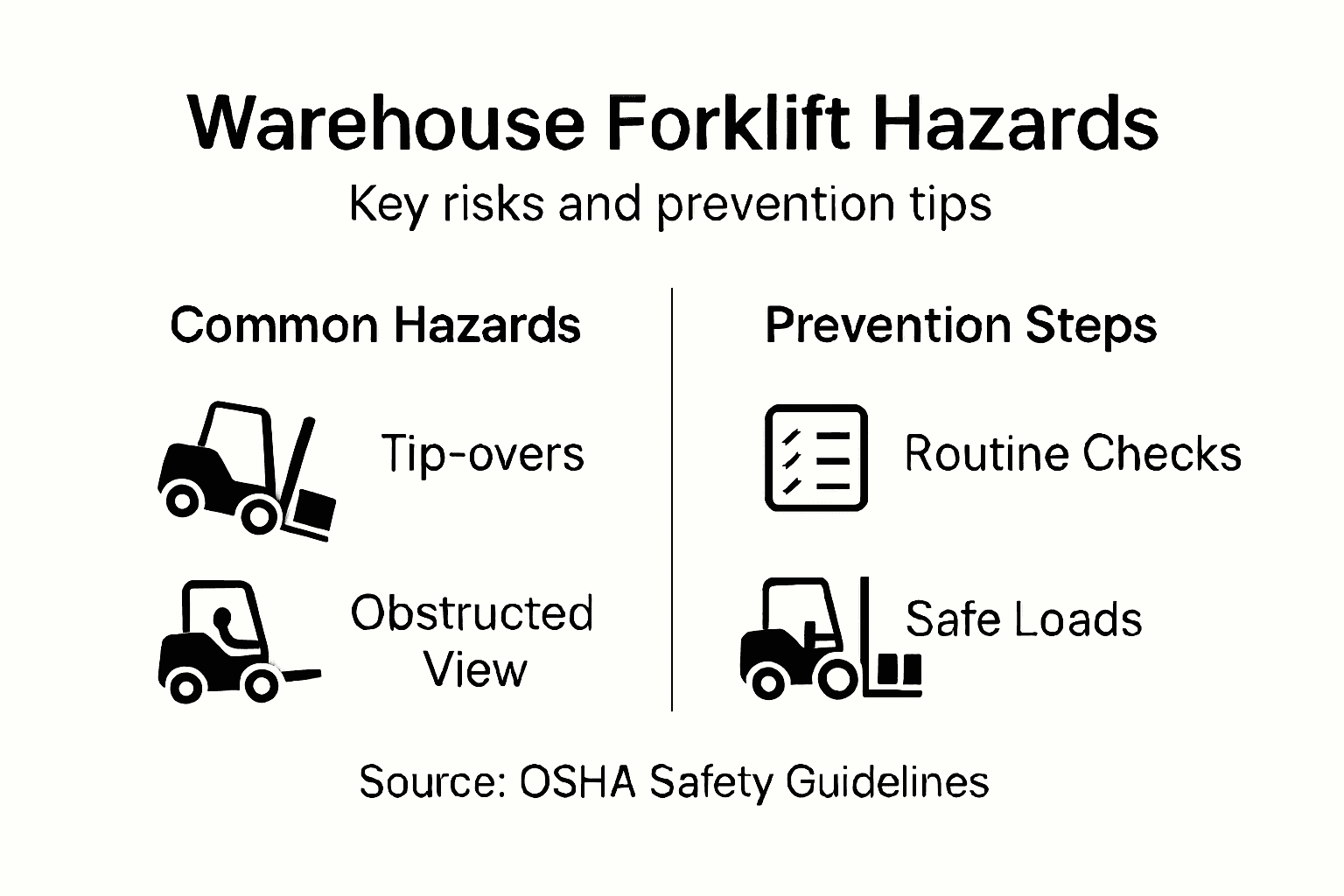
| Common Hazards | Tipping, collisions, and pedestrian accidents are predictable and can be prevented through awareness of operational conditions. |
| OSHA Compliance | Implementing OSHA regulations creates a safer work environment by addressing specific hazards and ensuring proper training and maintenance practices. |
| Continuous Improvement | Ongoing assessments and safety audits help identify gaps in training and practices, fostering a culture of safety and preventing incidents. |
Defining Forklift Hazard Awareness in Warehousing
Forklift hazard awareness in warehousing isn’t simply knowing that forklifts are dangerous. It’s the practical understanding of why they pose specific risks, how those risks emerge during daily operations, and what conditions amplify those dangers. Think of it as the difference between knowing a ladder is tall and actually understanding the physics of how a person falls from one. Real hazard awareness means your team can spot a problem before it becomes an incident.
At its core, forklift hazard awareness means recognizing that these machines operate differently than your typical vehicle. Understanding forklift stability and tipping mechanics reveals why loads can shift unexpectedly, why turning with a raised load invites disaster, and why operating speed matters more than operators typically realize. The warehouse environment compounds these challenges. Uneven floors, narrow aisles, pedestrian traffic, stacked inventory at heights, and varying load weights create a complex hazard landscape that static training alone doesn’t prepare workers for.
Warehouse managers need their teams to develop what we call “active hazard recognition.” This means your operators and staff don’t just memorize rules; they develop an instinctive ability to assess situations before they act. They notice when a load sits unevenly on the forks. They recognize how wet floors change handling dynamics. They understand that backing up with limited visibility requires different precautions than forward movement. This level of awareness comes from training that emphasizes the “why” behind safety protocols, not just the “what” to do. Comprehensive hazard recognition frameworks in warehousing address powered industrial truck operation alongside material handling challenges, ergonomics, and other warehouse-specific exposures that operators encounter daily.
The goal of developing forklift hazard awareness isn’t to create fear. It’s to build competence. When your team understands the actual physics behind why a forklift tips or how a load becomes unstable, they gain confidence in their ability to operate safely. They move faster and more efficiently because they’re operating with full understanding rather than hesitation. They also become your best defense against incidents because they can mentor newer workers and catch unsafe behaviors before someone gets hurt.
Pro tip: _Conduct quarterly “hazard walks” through your warehouse where operators point out specific hazard conditions they’ve encountered, discuss why those conditions matter, and explain how they adjusted their operation to stay safe. This transforms hazard awareness from a one-time training event into an ongoing conversation that keeps safety top-of-mind.
Common Forklift Hazards and Real-World Impact
The statistics paint a sobering picture. Over 40,000 forklift incidents result in injuries and fatalities annually across American warehouses and industrial facilities. That’s not a theoretical risk. That’s real workers experiencing serious harm because a hazard wasn’t recognized or wasn’t addressed. Understanding common forklift hazards in warehousing means looking at what actually happens when things go wrong, not just imagining worst-case scenarios.
The hazards cluster into predictable patterns. Tipping incidents occur when operators raise loads too high, turn too sharply at speed, or shift loads unevenly on the forks. Collision accidents happen because operators misjudge distances, operate with obstructed vision, or fail to account for blind spots that are inherent to forklift design. Pedestrian accidents strike when workers forget that the machine won’t stop instantly or when foot traffic crosses through areas where forklifts operate. Real-world accident case studies reveal a consistent thread: operator error, inadequate maintenance, poor visibility conditions, and unsafe working layouts combine to create incidents that could have been prevented. One operator raised a loaded pallet while turning on a sloped surface. Another backed up without a spotter in a congested aisle. A third operated equipment that hadn’t received routine maintenance inspections. These weren’t freak accidents. They were predictable failures.
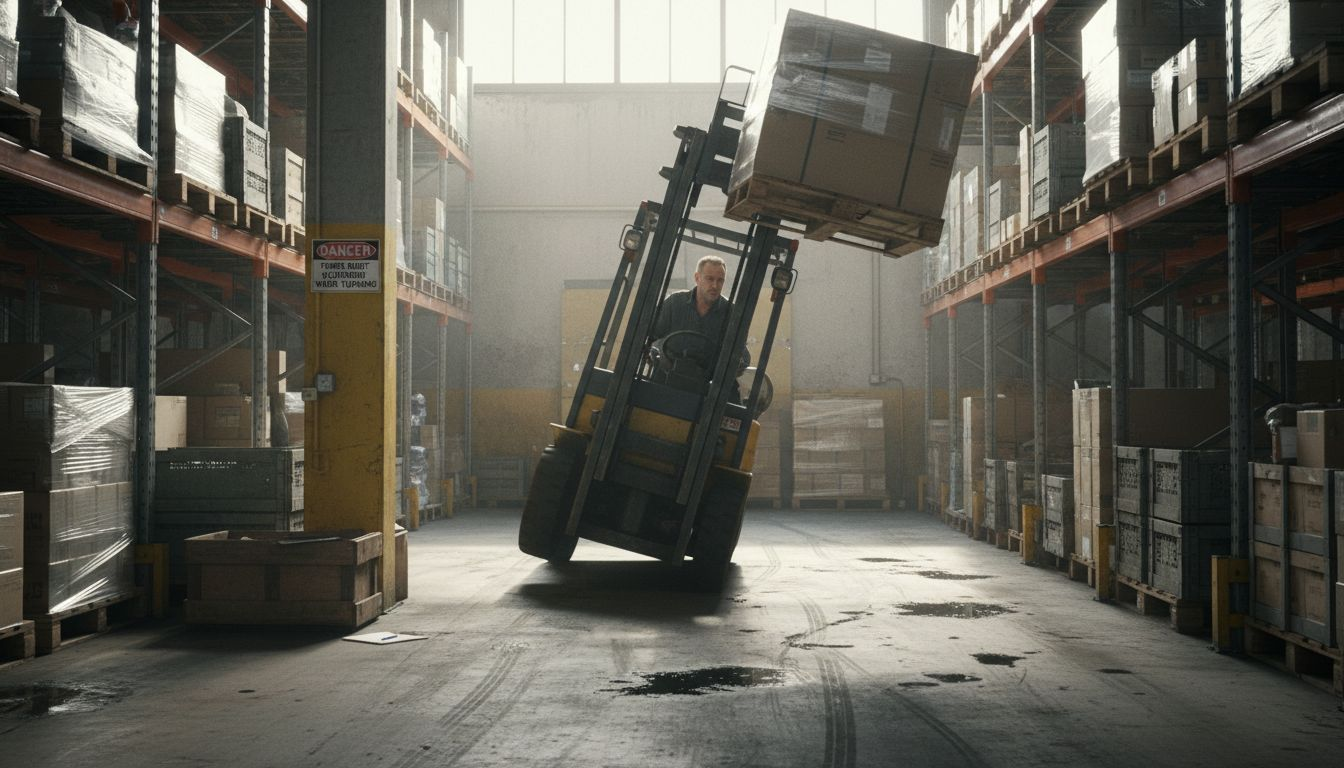
What makes these hazards dangerous is their compounding effect. A single issue like wet flooring might slow an operator slightly, but combine it with a raised load, an unfamiliar aisle layout, and poor visibility, and you’ve created conditions where disaster becomes likely rather than unlikely. Your warehouse floor might be perfectly level, but add high-velocity turns, improperly trained operators, and cluttered aisles filled with pedestrians, and you’ve multiplied the risk exponentially. The real-world impact extends beyond the injured worker. When an incident occurs, production stops, investigations consume management time, insurance rates climb, and your facility reputation suffers.
The good news is that these hazards are preventable. They’re not random. They follow patterns that can be identified, understood, and managed through systematic hazard awareness and proper safety protocols. When your team recognizes the conditions that create danger, they can adjust their behavior before something goes wrong.
Here is a summary of frequent forklift hazards and how they typically impact warehouse operations:
| Hazard Type | How It Arises | Operational Impact |
|---|---|---|
| Tipping | Raised loads, sharp turns | Causes equipment damage, injury |
| Collisions | Obstructed view, blind spots | Disrupts workflow, injures staff |
| Pedestrian Accidents | Shared traffic areas | Results in serious injuries |
| Load Shifts | Uneven stacking, unstable load | Damages products, risks tip-over |
Pro tip: _Document two or three near-miss incidents from your facility each month and review them with your entire team, walking through what conditions created the risk and what the operator did to prevent an actual accident. These real examples from your own warehouse prove that hazard awareness works and keep employees engaged with safety.
OSHA Forklift Safety Rules and Warehouse Compliance
OSHA regulations exist for one reason: to prevent exactly the kind of incidents we discussed in the previous section. The Occupational Safety and Health Administration established specific rules for powered industrial truck operation because warehouses are high-risk environments where forklift hazards cause real injuries. Your facility isn’t just following rules when you implement OSHA compliance. You’re building a system designed by professionals who have studied thousands of incidents and determined what actually works to keep people safe.
OSHA’s forklift requirements cover four major areas that directly address the hazards your team faces daily. First, operators must be certified and trained, meaning they’ve demonstrated knowledge of forklift mechanics, load limits, and safe operation procedures. Second, equipment must be inspected and maintained according to manufacturer specifications, catching problems before they cause failures. Third, your facility must establish traffic patterns and zones that separate pedestrian movement from forklift operations. Fourth, your team must maintain visibility standards, which means addressing blind spots, using spotters when necessary, and keeping aisles clear of obstructions. When you implement OSHA forklift compliance requirements, you’re not just filling out paperwork. You’re establishing the conditions where accidents become statistically unlikely rather than probable.
The challenge many warehouse managers face is that OSHA rules are performance-based, not prescriptive. The regulations don’t say “you must do X at all times.” They say “you must ensure your operation doesn’t create hazardous conditions.” This means your compliance strategy must adapt to your specific facility layout, your material handling challenges, and your workforce composition. A narrow aisle warehouse needs different traffic controls than a sprawling distribution center. A team of experienced operators requires different supervision than newly trained staff. Your compliance program succeeds when you translate OSHA requirements into specific actions that address your warehouse’s unique risks.
Implementing compliance isn’t a one-time event. It’s an ongoing process that includes initial training, regular refresher instruction, documented equipment inspections, incident investigation, and continuous improvement based on what you learn from near-misses and accidents. The facilities that maintain the best safety records don’t view OSHA as a burden. They view it as a framework that helps them protect their people while maintaining efficiency and productivity.
Pro tip: _Create a simple monthly OSHA compliance checklist that covers operator certifications, equipment maintenance records, traffic pattern effectiveness, and incident documentation. Review it with your leadership team every month so compliance becomes part of regular business operations rather than a separate compliance function.
Essential Training Methods for Hazard Recognition
Effective training isn’t about checking a box on your compliance calendar. It’s about building your team’s ability to see danger before it materializes. The difference between a warehouse where incidents happen regularly and one where they’re rare isn’t luck. It’s systematic training that teaches workers to recognize hazard patterns and respond appropriately. When your operators understand not just what to do but why they’re doing it, they become your facility’s most effective safety asset.
Structured hazard recognition training should follow a proven sequence that builds competence progressively. First, workers need to understand hazard sources specific to your operation. What conditions in your warehouse create danger? Where do the blind spots exist on your forklifts? What material handling challenges do your team face daily? This site-specific knowledge can’t come from generic training videos. It comes from walking your facility, discussing actual risks with experienced operators, and tailoring your message to your warehouse’s unique layout and challenges. Next, effective warehousing safety training methods include hands-on practice of safe operational techniques under supervision. Workers need to practice proper load positioning, safe acceleration and deceleration, appropriate turning speeds, and how to maneuver around obstacles before they’re operating independently. Third, training must include ongoing evaluation that confirms operators actually remember what they learned and can apply it correctly in their daily work.
The most successful training programs integrate multiple delivery methods because different people learn differently. Some operators grasp concepts better through visual demonstration. Others need hands-on practice. Still others benefit from peer learning where experienced operators mentor newer staff. A comprehensive approach combines initial classroom instruction covering the why and the how, practical demonstrations showing real-world application, hands-on supervised operation where new operators practice under close observation, and regular refresher training that reinforces key concepts. Many facilities make the mistake of treating training as a one-time event when new workers arrive. The best practice treats it as continuous, with refresher sessions, incident debriefing, and peer mentoring creating an ongoing culture of hazard awareness.
What separates adequate training from excellent training is the feedback loop. After your team completes formal instruction, how do you know they’re applying what they learned? How do you identify gaps in their understanding before those gaps cause incidents? Effective facilities conduct regular observation, provide corrective feedback when they observe unsafe practices, investigate near-misses to identify training gaps, and update training based on what they learn from real-world experience in their warehouse.
Below is a comparison of warehouse safety training methods and their effectiveness for hazard recognition:
| Training Method | Key Benefit | Best Used For |
|---|---|---|
| Classroom Instruction | Explains core concepts | Initial knowledge building |
| Hands-on Practice | Builds real-world competence | Safe equipment operation |
| Peer Mentoring | Provides practical feedback | New staff integration |
| Refresher Sessions | Reinforces safety behaviors | Preventing skill degradation |
Pro tip: _Pair every new operator with an experienced mentor for their first 30 days of independent operation, with the mentor observing and providing real-time feedback on hazard recognition and safe techniques specific to your facility layout. This one-on-one feedback accelerates their learning curve and prevents early mistakes from becoming ingrained habits.
Best Practices for Ongoing Hazard Prevention
Hazard prevention isn’t something you accomplish and then check off your list. It’s a continuous practice that requires consistent attention, regular evaluation, and a willingness to adjust your approach based on what you learn from your facility’s actual experience. The warehouses with the best safety records treat prevention as an ongoing operational priority, not a compliance burden that gets addressed once per year.
Effective ongoing prevention starts with systematic maintenance and equipment management. Your forklifts are machines, and like all machines, they degrade over time. Routine inspections catch problems before they cause failures that endanger operators. Check tire condition, brake responsiveness, hydraulic fluid levels, and load capacity indicators regularly. Document everything. When a piece of equipment shows wear, address it immediately rather than hoping it will last until the next scheduled maintenance window. Beyond equipment, routine stability assessments and load awareness help operators understand how balance and weight distribution affect forklift behavior in your specific warehouse conditions. Different floor surfaces, different load weights, and different stacking heights all influence stability. Your ongoing education should address how these variables interact in your actual facility, not just in theoretical scenarios.
Cultural practices matter enormously. Facilities that maintain strong safety records create environments where reporting near-misses is rewarded rather than punished. When an operator narrowly avoids an accident, that’s valuable information about your hazards and your controls. Too many warehouses treat near-miss reporting as creating extra work for management. The best practice views near-miss investigations as opportunities to identify and fix problems before they cause injuries. Similarly, implementing regular employee training, safety audits, and fostering a strong safety culture creates an environment where workers actively identify hazards rather than waiting for management to discover problems. Your team should feel empowered to stop operations when they identify unsafe conditions. That’s prevention working as designed.
Prevention also requires honest assessment. Conduct quarterly safety walks through your warehouse with a critical eye. Are aisles actually clear, or are they slowly accumulating clutter that reduces visibility and creates tripping hazards? Are traffic patterns being followed, or have operators created their own routes that skip the safer paths? Are operators actually using spotters when backing up, or has that practice drifted? Are equipment inspections being performed on schedule, or are they being skipped when production pressure mounts? When you discover gaps between your procedures and actual practice, address them immediately through retraining, process adjustments, or facility modifications.
Pro tip: _Establish a weekly safety meeting that includes your warehouse operations team where you review any near-misses or hazard observations from the previous week, discuss corrective actions, and celebrate incidents that were prevented. This keeps hazard prevention visible and reinforces that safety is a shared responsibility everyone owns.
Elevate Your Forklift Hazard Awareness with Expert Training
Forklift hazard awareness is more than just knowing the risks—it’s about developing real competence to prevent incidents before they happen. This article highlights the challenges warehouse operators face every day, from understanding forklift stability to recognizing compounded hazards in complex environments. If your goal is to build an intuitive safety culture and meet OSHA compliance seamlessly, targeted training is essential.
Unlock the full potential of your team’s hazard recognition skills by exploring our specialized Forklift Safety Archives.
Take control of warehouse risks with OSHA-compliant certification programs and innovative training solutions at Forkliftacademy.com. Whether you need individual courses or comprehensive business training, including onsite options and train-the-trainer kits, we provide the tools to transform safety understanding into confident, efficient operation. Don’t wait for accidents to happen—empower your team now and build a safer, more productive workspace.
Discover how to reduce forklift incidents by visiting our Forklift License Archives and start your path to safer warehouse operations today.
Frequently Asked Questions
What is forklift hazard awareness?
Forklift hazard awareness is the practical understanding of the specific risks associated with forklift operations in a warehouse setting, including recognizing situations that may lead to incidents before they occur.
Why is active hazard recognition important?
Active hazard recognition helps operators and staff develop an instinctive ability to assess and respond to risky situations, improving overall safety and preventing accidents in the workplace.
What are common forklift hazards in warehousing?
Common hazards include tipping due to raised loads, collisions from obstructed views, pedestrian accidents in shared traffic areas, and load shifts caused by uneven stacking.
How can training improve forklift safety?
Effective training builds operators’ understanding of hazards and safe operating procedures, facilitating real-world competence and ensuring they can recognize and react to risks appropriately.
Recommended
- Forklift Hazards Explained: Reducing Warehouse Risks – Top Osha Forklift Certification
- Forklift Accident Prevention: Protecting Workers and Compliance – Top Osha Forklift Certification
- Top 5 Forklift Hazards You Can’t Afford To Ignore On The Job Site – Top Osha Forklift Certification
- Forklift Accident Prevention: Protecting Your Workforce – Top Osha Forklift Certification